 Add to Chrome
 Add to Firefox
 Add to Edge
Progressive Prompt-Guided Cross-Modal Reasoning for Referring Image Segmentation
Mar 30, 2026
Referring image segmentation aims to localize and segment a target object in an image based on a free-form referring expression. The core challenge lies in effectively bridging linguistic descriptions with object-level visual representations, especially when referring expressions involve detailed attributes and complex inter-object relationships. Existing methods either rely on cross-modal alignment or employ Semantic Segmentation Prompts, but they often lack explicit reasoning mechanisms for grounding language descriptions to target regions in the image. To address these limitations, we propose PPCR, a Progressive Prompt-guided Cross-modal Reasoning framework for referring image segmentation. PPCR explicitly structures the reasoning process as a Semantic Understanding-Spatial Grounding-Instance Segmentation pipeline. Specifically, PPCR first employs multimodal large language models (MLLMs) to generate Semantic Segmentation Prompt that capture key semantic cues of the target object. Based on this semantic context, Spatial Segmentation Prompt are further generated to reason about object location and spatial extent, enabling a progressive transition from semantic understanding to spatial grounding. The Semantic and Spatial Segmentation prompts are then jointly integrated into the segmentation module to guide accurate target localization and segmentation. Extensive experiments on standard referring image segmentation benchmarks demonstrate that PPCR consistently outperforms existing methods. The code will be publicly released to facilitate reproducibility.

Unified Multimodal Vessel Trajectory Prediction with Explainable Navigation Intention
Nov 18, 2025Vessel trajectory prediction is fundamental to intelligent maritime systems. Within this domain, short-term prediction of rapid behavioral changes in complex maritime environments has established multimodal trajectory prediction (MTP) as a promising research area. However, existing vessel MTP methods suffer from limited scenario applicability and insufficient explainability. To address these challenges, we propose a unified MTP framework incorporating explainable navigation intentions, which we classify into sustained and transient categories. Our method constructs sustained intention trees from historical trajectories and models dynamic transient intentions using a Conditional Variational Autoencoder (CVAE), while using a non-local attention mechanism to maintain global scenario consistency. Experiments on real Automatic Identification System (AIS) datasets demonstrates our method's broad applicability across diverse scenarios, achieving significant improvements in both ADE and FDE. Furthermore, our method improves explainability by explicitly revealing the navigational intentions underlying each predicted trajectory.
Research on Foundation Model for Spatial Data Intelligence: China's 2024 White Paper on Strategic Development of Spatial Data Intelligence
May 30, 2024This report focuses on spatial data intelligent large models, delving into the principles, methods, and cutting-edge applications of these models. It provides an in-depth discussion on the definition, development history, current status, and trends of spatial data intelligent large models, as well as the challenges they face. The report systematically elucidates the key technologies of spatial data intelligent large models and their applications in urban environments, aerospace remote sensing, geography, transportation, and other scenarios. Additionally, it summarizes the latest application cases of spatial data intelligent large models in themes such as urban development, multimodal systems, remote sensing, smart transportation, and resource environments. Finally, the report concludes with an overview and outlook on the development prospects of spatial data intelligent large models.
Data-oriented Dynamic Fine-tuning Parameter Selection Strategy for FISH Mask based Efficient Fine-tuning
Mar 13, 2024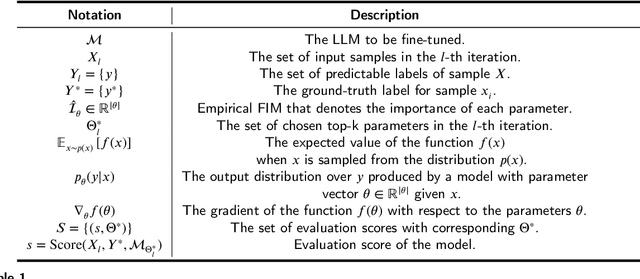
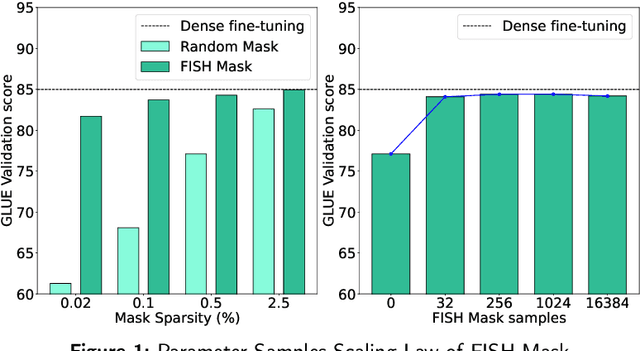
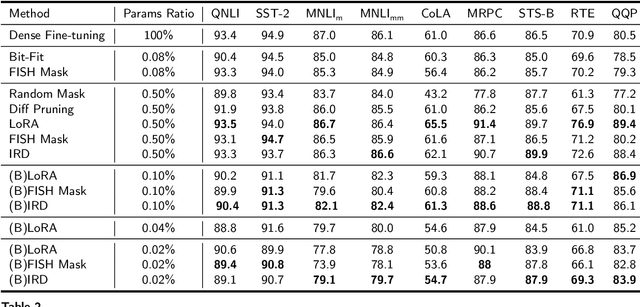
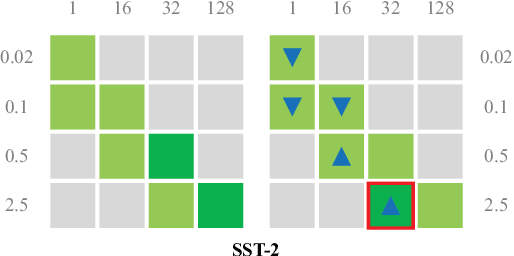
In view of the huge number of parameters of Large language models (LLMs) , tuning all parameters is very costly, and accordingly fine-tuning specific parameters is more sensible. Most of parameter efficient fine-tuning (PEFT) concentrate on parameter selection strategies, such as additive method, selective method and reparametrization-based method. However, there are few methods that consider the impact of data samples on parameter selecting, such as Fish Mask based method. Fish Mask randomly choose a part of data samples and treat them equally during parameter selection, which is unable to dynamically select optimal parameters for inconstant data distributions. In this work, we adopt a data-oriented perspective, then proposing an IRD ($\mathrm{\underline I}$terative sample-parameter $\mathrm{\underline R}$ange $\mathrm{\underline D}$ecreasing) algorithm to search the best setting of sample-parameter pair for FISH Mask. In each iteration, by searching the set of samples and parameters with larger Fish information, IRD can find better sample-parameter pair in most scale. We demonstrate the effectiveness and rationality of proposed strategy by conducting experiments on GLUE benchmark. Experimental results show our strategy optimizes the parameter selection and achieves preferable performance.