 Add to Chrome
 Add to Firefox
 Add to Edge
Implement Kubernetes Pod-Level Remote Attestation for Confidential Workloads on dstack
Jun 03, 2026
The rise of LLM-as-a-Service and other confidential cloud workloads demands cryptographic proof that user data is processed in a trusted, untampered environment. Existing solutions, notably Confidential Containers (CoCo), enforce a strict "one Pod per VM" model that attests only the Guest OS stack, leaving container-level identity unverified and incurring prohibitive per-VM resource overhead. We present dstack-capsule, a Kubernetes platform that enables Pod-level remote attestation on Intel TDX by allowing multiple Pods to share a single Confidential VM while each retains independent, hardware-backed proof of identity. Our key insight is a two-layer attestation architecture: static platform measurements are frozen in RTMR[3] via an irreversible privilege fuse, while dynamic Pod identities (pod_uid, pod_spec_hash, workload_id) are embedded in the TDX Quote's report_data field and signed by hardware on every request. dstack-capsule introduces (1) a Pod-level attestation protocol binding Pod spec digests to hardware-signed Quotes; (2) a privilege fuse mechanism that atomically transitions a node from setup mode to secure mode; (3) a multi-layer sandbox spanning storage, runtime, admission, API, and network isolation layers; and (4) a complete open-source implementation based on Kubernetes 1.32, Intel TDX, and Sysbox. We evaluate the security properties, attestation correctness, and performance characteristics of dstack-capsule, demonstrating that it achieves Pod-granularity verification without the resource overhead of per-VM isolation.

MoE-SpeQ: Speculative Quantized Decoding with Proactive Expert Prefetching and Offloading for Mixture-of-Experts
Nov 18, 2025The immense memory requirements of state-of-the-art Mixture-of-Experts (MoE) models present a significant challenge for inference, often exceeding the capacity of a single accelerator. While offloading experts to host memory is a common solution, it introduces a severe I/O bottleneck over the PCIe bus, as the data-dependent nature of expert selection places these synchronous transfers directly on the critical path of execution, crippling performance. This paper argues that the I/O bottleneck can be overcome by trading a small amount of cheap, on-device computation to hide the immense cost of data movement. We present MoE-SpeQ, a new inference system built on a novel co-design of speculative execution and expert offloading. MoE-SpeQ employs a small, on-device draft model to predict the sequence of required experts for future tokens. This foresight enables a runtime orchestrator to prefetch these experts from host memory, effectively overlapping the expensive I/O with useful computation and hiding the latency from the critical path. To maximize performance, an adaptive governor, guided by an Amortization Roofline Model, dynamically tunes the speculation strategy to the underlying hardware. Our evaluation on memory-constrained devices shows that for the Phi-MoE model, MoE-SpeQ achieves at most 2.34x speedup over the state-of-the-art offloading framework. Our work establishes a new, principled approach for managing data-dependent memory access in resource-limited environments, making MoE inference more accessible on commodity hardware.
A Survey on Inference Optimization Techniques for Mixture of Experts Models
Dec 18, 2024
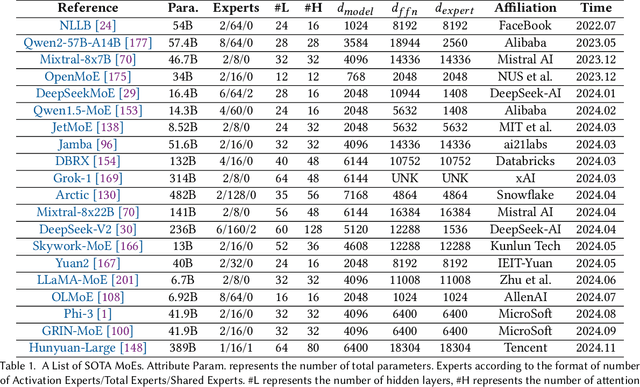
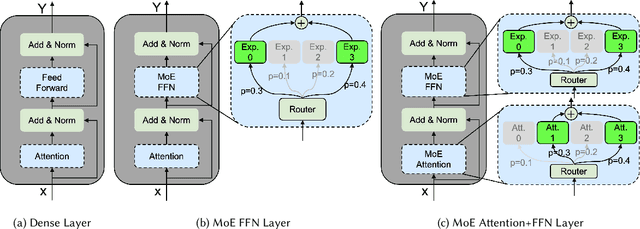
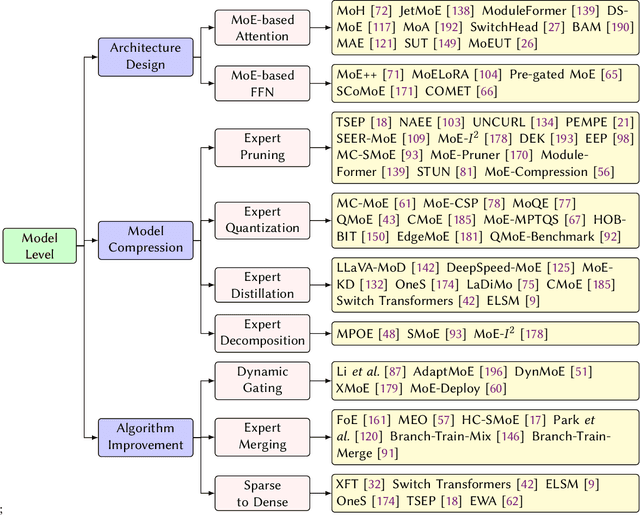
The emergence of large-scale Mixture of Experts (MoE) models has marked a significant advancement in artificial intelligence, offering enhanced model capacity and computational efficiency through conditional computation. However, the deployment and inference of these models present substantial challenges in terms of computational resources, latency, and energy efficiency. This comprehensive survey systematically analyzes the current landscape of inference optimization techniques for MoE models across the entire system stack. We first establish a taxonomical framework that categorizes optimization approaches into model-level, system-level, and hardware-level optimizations. At the model level, we examine architectural innovations including efficient expert design, attention mechanisms, various compression techniques such as pruning, quantization, and knowledge distillation, as well as algorithm improvement including dynamic routing strategies and expert merging methods. At the system level, we investigate distributed computing approaches, load balancing mechanisms, and efficient scheduling algorithms that enable scalable deployment. Furthermore, we delve into hardware-specific optimizations and co-design strategies that maximize throughput and energy efficiency. This survey not only provides a structured overview of existing solutions but also identifies key challenges and promising research directions in MoE inference optimization. Our comprehensive analysis serves as a valuable resource for researchers and practitioners working on large-scale deployment of MoE models in resource-constrained environments. To facilitate ongoing updates and the sharing of cutting-edge advances in MoE inference optimization research, we have established a repository accessible at \url{https://github.com/MoE-Inf/awesome-moe-inference/}.