 Add to Chrome
 Add to Firefox
 Add to Edge
Character-Adapter: Prompt-Guided Region Control for High-Fidelity Character Customization
Jun 24, 2024

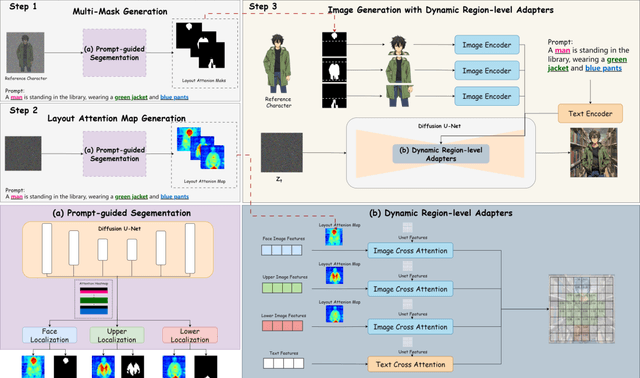


Customized image generation, which seeks to synthesize images with consistent characters, holds significant relevance for applications such as storytelling, portrait generation, and character design. However, previous approaches have encountered challenges in preserving characters with high-fidelity consistency due to inadequate feature extraction and concept confusion of reference characters. Therefore, we propose Character-Adapter, a plug-and-play framework designed to generate images that preserve the details of reference characters, ensuring high-fidelity consistency. Character-Adapter employs prompt-guided segmentation to ensure fine-grained regional features of reference characters and dynamic region-level adapters to mitigate concept confusion. Extensive experiments are conducted to validate the effectiveness of Character-Adapter. Both quantitative and qualitative results demonstrate that Character-Adapter achieves the state-of-the-art performance of consistent character generation, with an improvement of 24.8% compared with other methods

Bayesian Design Principles for Offline-to-Online Reinforcement Learning
May 31, 2024Offline reinforcement learning (RL) is crucial for real-world applications where exploration can be costly or unsafe. However, offline learned policies are often suboptimal, and further online fine-tuning is required. In this paper, we tackle the fundamental dilemma of offline-to-online fine-tuning: if the agent remains pessimistic, it may fail to learn a better policy, while if it becomes optimistic directly, performance may suffer from a sudden drop. We show that Bayesian design principles are crucial in solving such a dilemma. Instead of adopting optimistic or pessimistic policies, the agent should act in a way that matches its belief in optimal policies. Such a probability-matching agent can avoid a sudden performance drop while still being guaranteed to find the optimal policy. Based on our theoretical findings, we introduce a novel algorithm that outperforms existing methods on various benchmarks, demonstrating the efficacy of our approach. Overall, the proposed approach provides a new perspective on offline-to-online RL that has the potential to enable more effective learning from offline data.
vMFER: Von Mises-Fisher Experience Resampling Based on Uncertainty of Gradient Directions for Policy Improvement
May 14, 2024


Reinforcement Learning (RL) is a widely employed technique in decision-making problems, encompassing two fundamental operations -- policy evaluation and policy improvement. Enhancing learning efficiency remains a key challenge in RL, with many efforts focused on using ensemble critics to boost policy evaluation efficiency. However, when using multiple critics, the actor in the policy improvement process can obtain different gradients. Previous studies have combined these gradients without considering their disagreements. Therefore, optimizing the policy improvement process is crucial to enhance learning efficiency. This study focuses on investigating the impact of gradient disagreements caused by ensemble critics on policy improvement. We introduce the concept of uncertainty of gradient directions as a means to measure the disagreement among gradients utilized in the policy improvement process. Through measuring the disagreement among gradients, we find that transitions with lower uncertainty of gradient directions are more reliable in the policy improvement process. Building on this analysis, we propose a method called von Mises-Fisher Experience Resampling (vMFER), which optimizes the policy improvement process by resampling transitions and assigning higher confidence to transitions with lower uncertainty of gradient directions. Our experiments demonstrate that vMFER significantly outperforms the benchmark and is particularly well-suited for ensemble structures in RL.
A Dataset for the Validation of Truth Inference Algorithms Suitable for Online Deployment
Mar 10, 2024
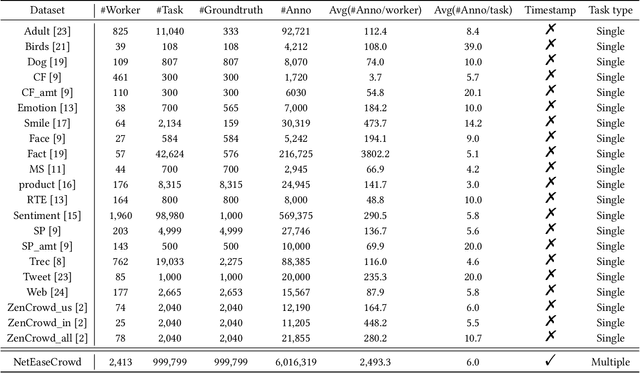
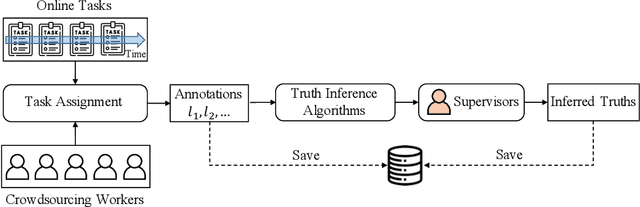
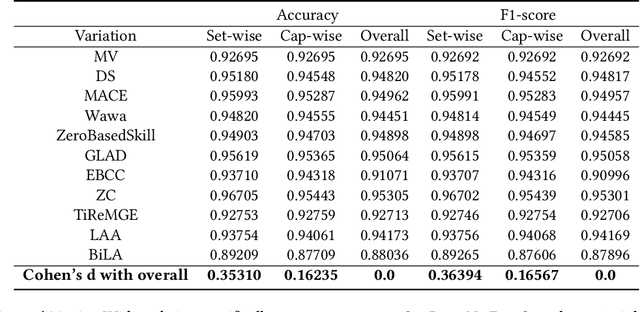
For the purpose of efficient and cost-effective large-scale data labeling, crowdsourcing is increasingly being utilized. To guarantee the quality of data labeling, multiple annotations need to be collected for each data sample, and truth inference algorithms have been developed to accurately infer the true labels. Despite previous studies having released public datasets to evaluate the efficacy of truth inference algorithms, these have typically focused on a single type of crowdsourcing task and neglected the temporal information associated with workers' annotation activities. These limitations significantly restrict the practical applicability of these algorithms, particularly in the context of long-term and online truth inference. In this paper, we introduce a substantial crowdsourcing annotation dataset collected from a real-world crowdsourcing platform. This dataset comprises approximately two thousand workers, one million tasks, and six million annotations. The data was gathered over a period of approximately six months from various types of tasks, and the timestamps of each annotation were preserved. We analyze the characteristics of the dataset from multiple perspectives and evaluate the effectiveness of several representative truth inference algorithms on this dataset. We anticipate that this dataset will stimulate future research on tracking workers' abilities over time in relation to different types of tasks, as well as enhancing online truth inference.
XRL-Bench: A Benchmark for Evaluating and Comparing Explainable Reinforcement Learning Techniques
Feb 20, 2024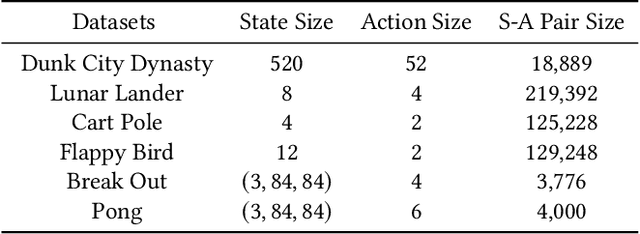
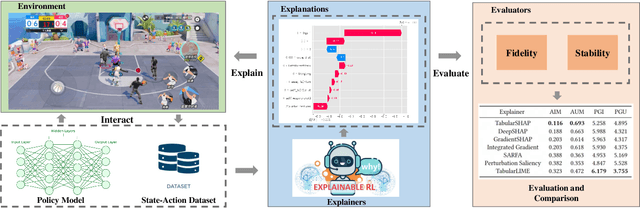
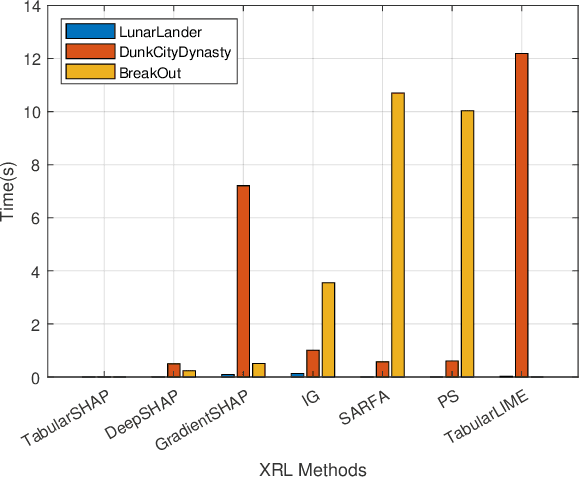

Reinforcement Learning (RL) has demonstrated substantial potential across diverse fields, yet understanding its decision-making process, especially in real-world scenarios where rationality and safety are paramount, is an ongoing challenge. This paper delves in to Explainable RL (XRL), a subfield of Explainable AI (XAI) aimed at unravelling the complexities of RL models. Our focus rests on state-explaining techniques, a crucial subset within XRL methods, as they reveal the underlying factors influencing an agent's actions at any given time. Despite their significant role, the lack of a unified evaluation framework hinders assessment of their accuracy and effectiveness. To address this, we introduce XRL-Bench, a unified standardized benchmark tailored for the evaluation and comparison of XRL methods, encompassing three main modules: standard RL environments, explainers based on state importance, and standard evaluators. XRL-Bench supports both tabular and image data for state explanation. We also propose TabularSHAP, an innovative and competitive XRL method. We demonstrate the practical utility of TabularSHAP in real-world online gaming services and offer an open-source benchmark platform for the straightforward implementation and evaluation of XRL methods. Our contributions facilitate the continued progression of XRL technology.
Towards a Simultaneous and Granular Identity-Expression Control in Personalized Face Generation
Jan 02, 2024



In human-centric content generation, the pre-trained text-to-image models struggle to produce user-wanted portrait images, which retain the identity of individuals while exhibiting diverse expressions. This paper introduces our efforts towards personalized face generation. To this end, we propose a novel multi-modal face generation framework, capable of simultaneous identity-expression control and more fine-grained expression synthesis. Our expression control is so sophisticated that it can be specialized by the fine-grained emotional vocabulary. We devise a novel diffusion model that can undertake the task of simultaneously face swapping and reenactment. Due to the entanglement of identity and expression, it's nontrivial to separately and precisely control them in one framework, thus has not been explored yet. To overcome this, we propose several innovative designs in the conditional diffusion model, including balancing identity and expression encoder, improved midpoint sampling, and explicitly background conditioning. Extensive experiments have demonstrated the controllability and scalability of the proposed framework, in comparison with state-of-the-art text-to-image, face swapping, and face reenactment methods.
Towards Long-term Annotators: A Supervised Label Aggregation Baseline
Nov 15, 2023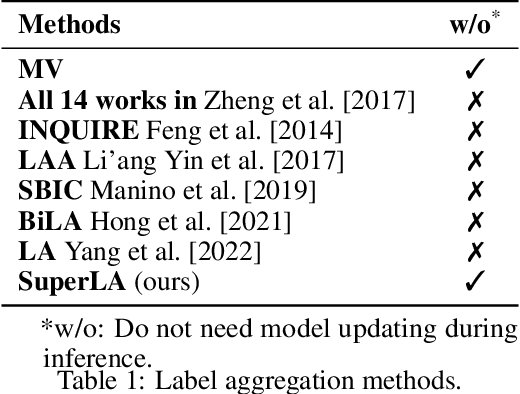
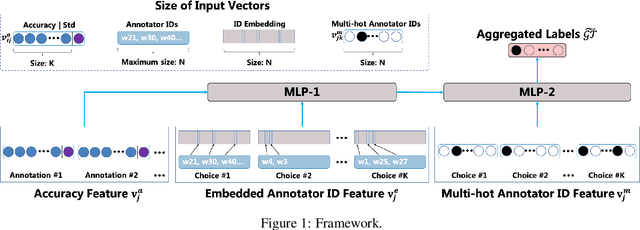
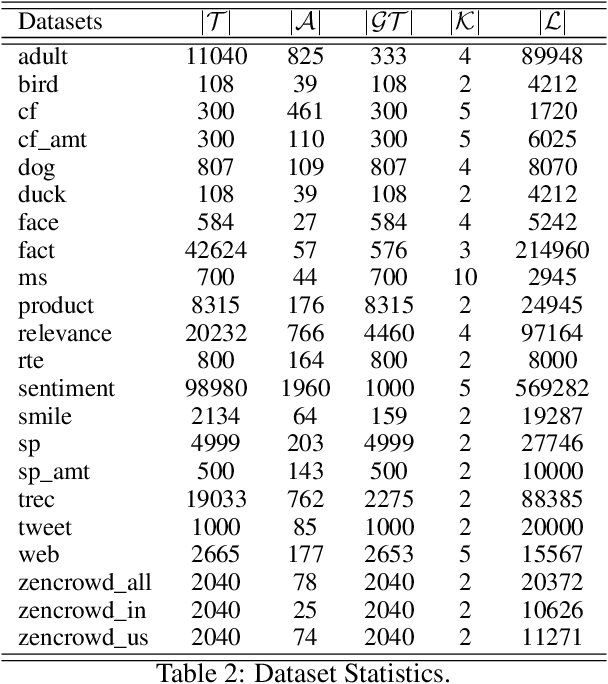
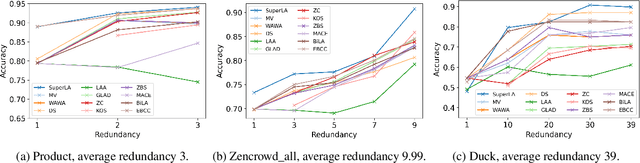
Relying on crowdsourced workers, data crowdsourcing platforms are able to efficiently provide vast amounts of labeled data. Due to the variability in the annotation quality of crowd workers, modern techniques resort to redundant annotations and subsequent label aggregation to infer true labels. However, these methods require model updating during the inference, posing challenges in real-world implementation. Meanwhile, in recent years, many data labeling tasks have begun to require skilled and experienced annotators, leading to an increasing demand for long-term annotators. These annotators could leave substantial historical annotation records on the crowdsourcing platforms, which can benefit label aggregation, but are ignored by previous works. Hereby, in this paper, we propose a novel label aggregation technique, which does not need any model updating during inference and can extensively explore the historical annotation records. We call it SuperLA, a Supervised Label Aggregation method. Inside this model, we design three types of input features and a straightforward neural network structure to merge all the information together and subsequently produce aggregated labels. Based on comparison experiments conducted on 22 public datasets and 11 baseline methods, we find that SuperLA not only outperforms all those baselines in inference performance but also offers significant advantages in terms of efficiency.
Rethink Baseline of Integrated Gradients from the Perspective of Shapley Value
Oct 10, 2023Numerous approaches have attempted to interpret deep neural networks (DNNs) by attributing the prediction of DNN to its input features. One of the well-studied attribution methods is Integrated Gradients (IG). Specifically, the choice of baselines for IG is a critical consideration for generating meaningful and unbiased explanations for model predictions in different scenarios. However, current practice of exploiting a single baseline fails to fulfill this ambition, thus demanding multiple baselines. Fortunately, the inherent connection between IG and Aumann-Shapley Value forms a unique perspective to rethink the design of baselines. Under certain hypothesis, we theoretically analyse that a set of baseline aligns with the coalitions in Shapley Value. Thus, we propose a novel baseline construction method called Shapley Integrated Gradients (SIG) that searches for a set of baselines by proportional sampling to partly simulate the computation path of Shapley Value. Simulations on GridWorld show that SIG approximates the proportion of Shapley Values. Furthermore, experiments conducted on various image tasks demonstrate that compared to IG using other baseline methods, SIG exhibits an improved estimation of feature's contribution, offers more consistent explanations across diverse applications, and is generic to distinct data types or instances with insignificant computational overhead.
AlignDiff: Aligning Diverse Human Preferences via Behavior-Customisable Diffusion Model
Oct 03, 2023Aligning agent behaviors with diverse human preferences remains a challenging problem in reinforcement learning (RL), owing to the inherent abstractness and mutability of human preferences. To address these issues, we propose AlignDiff, a novel framework that leverages RL from Human Feedback (RLHF) to quantify human preferences, covering abstractness, and utilizes them to guide diffusion planning for zero-shot behavior customizing, covering mutability. AlignDiff can accurately match user-customized behaviors and efficiently switch from one to another. To build the framework, we first establish the multi-perspective human feedback datasets, which contain comparisons for the attributes of diverse behaviors, and then train an attribute strength model to predict quantified relative strengths. After relabeling behavioral datasets with relative strengths, we proceed to train an attribute-conditioned diffusion model, which serves as a planner with the attribute strength model as a director for preference aligning at the inference phase. We evaluate AlignDiff on various locomotion tasks and demonstrate its superior performance on preference matching, switching, and covering compared to other baselines. Its capability of completing unseen downstream tasks under human instructions also showcases the promising potential for human-AI collaboration. More visualization videos are released on https://aligndiff.github.io/.
EfficientDreamer: High-Fidelity and Robust 3D Creation via Orthogonal-view Diffusion Prior
Aug 25, 2023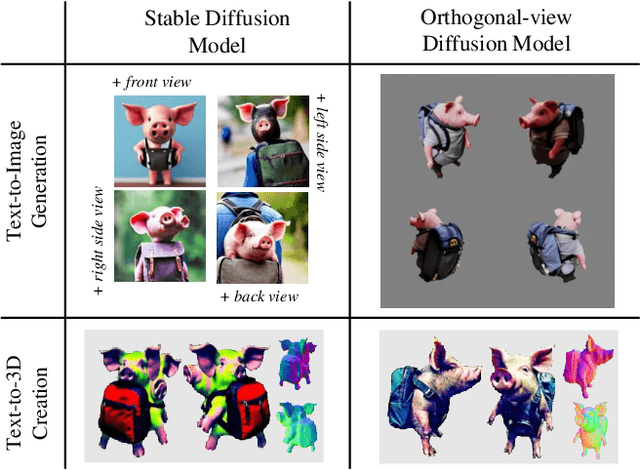
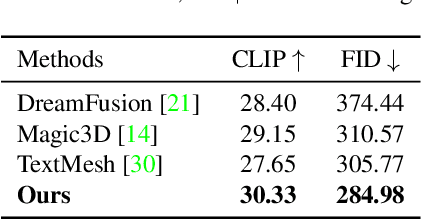


While the image diffusion model has made significant strides in text-driven 3D content creation, it often falls short in accurately capturing the intended meaning of the text prompt, particularly with respect to direction information. This shortcoming gives rise to the Janus problem, where multi-faced 3D models are produced with the guidance of such diffusion models. In this paper, we present a robust pipeline for generating high-fidelity 3D content with orthogonal-view image guidance. Specifically, we introduce a novel 2D diffusion model that generates an image consisting of four orthogonal-view sub-images for the given text prompt. The 3D content is then created with this diffusion model, which enhances 3D consistency and provides strong structured semantic priors. This addresses the infamous Janus problem and significantly promotes generation efficiency. Additionally, we employ a progressive 3D synthesis strategy that results in substantial improvement in the quality of the created 3D contents. Both quantitative and qualitative evaluations show that our method demonstrates a significant improvement over previous text-to-3D techniques.