 Add to Chrome
 Add to Firefox
 Add to Edge
Graphectory Viewer: A Tool for Process-Centric Analysis of Agentic Software Trajectories
Aug 17, 2026
We present Graphectory Viewer, a web-based tool for interactive, process-centric analysis of software-agent trajectories. Building on the Graphectory representation introduced in our previous work, Graphectory Viewer transforms heterogeneous raw trajectories into phase-aware graphs that connect low-level execution details with higher-level behavioral structures. The tool supports trajectories from multiple agent frameworks and provides interactive graph construction; node-level inspection of thoughts, actions, and observations; search and filtering over large trajectory collections; and Sankey-style summaries of problem-solving phase transitions. These capabilities enable researchers and practitioners to inspect individual executions, identify recurring behavioral patterns, compare successful and failed runs, and analyze large trajectory corpora beyond final task outcomes. To support reproducibility and further research, we release Graphectory Viewer as an open-source artifact together with documentation, precomputed graphs, and the large-scale trajectory corpus.

Online Monitoring and Corrective Steering of Programming Agents
Aug 07, 2026Fixing GitHub issues in large-scale projects is a long-horizon task, especially when a fix requires changes across multiple locations or the issue description lacks the information needed to localize and repair it. As a result, agents traverse long trajectories that are prone to inefficiency and error: they drift away from their intended plan, repeat failed actions, or terminate without a working patch. This paper proposes LivePlan to monitor, detect, and correct such behavioral inefficiencies and drifts in real time. LivePlan decouples judging from advising: a deterministic, rule-based monitor examines general signals over the trajectory to detect issues without invoking an LLM, and only when an issue is detected does it consult an advisor LLM for a high-level, next-step correction. This design avoids the misleading re-planning and costly interventions of prior approaches. We implement LivePlan on top of SWE-agent and evaluate it using five LLMs (three as executor agents and two as advisors) across SWE-bench Verified and SWE-bench Pro. Compared to vanilla SWE-agent, LivePlan notably improves issue resolution rates, achieving consistent gains of up to 15.2% (average: 9.9%), while incurring only an additional cost of $0.08 per instance. The additional solutions concentrate on medium and hard instances. LivePlan consistently outperforms alternative approaches in resolution rate, with minimal regression on already successful runs and new successes on problems that no baseline solves.
BeyondFusion: Self-Aligned Latent Diffusion for Calibration-Free Infrared Super-Resolution and Infrared-Visible Fusion
Jul 27, 2026Mobile infrared-visible imaging typically pairs a compact infrared sensor with a high-resolution visible camera for complementary perception. While cross-sensor misalignment caused by different optics, viewpoints, fields of view, and exposure timings hinders practical deployment. In this paper, we propose BeyondFusion, a unified latent diffusion framework for calibration-free visible-guided infrared super-resolution and infrared-visible fusion tasks. The proposed framework supports both task-specific training and joint training where two tasks are optimized and executed as two readouts of the same generative process. Instead of relying on explicit registration or geometric warping, BeyondFusion introduces a cross-modal self-aligning (CMSA) module into the denoising U-Net. CMSA reorganizes infrared and visible latent tokens into a shared attention space to learn content-adaptive cross-modal correspondence during the denoising process. Together with misalignment augmentation module, the model is facilitated to exploit visible structural and semantic cues while preserving thermal consistency, enabling high-frequency infrared reconstruction and informative fused-image generation under uncalibrated conditions. Extensive experiments on public benchmarks and a mobile infrared-visible imaging system show strong performance across aligned inputs, low-resolution infrared observations, synthetic misalignments, and real mobile captures with unsynchronized sensors. Ablation studies, unified training analysis, and downstream pedestrian detection further validate the effectiveness of BeyondFusion for calibration-free multimodal imaging.
MTSSL: Meta-Thresholding Semi-Supervised Learning
Jul 17, 2026A large body of Semi-supervised Learning~(SSL) algorithms encounter the threshold $τ$ to select pseudo-labels. The value of $τ$ across different SSL algorithms can vary depending on the learning perspective, yet they may achieve similar performance. It motivates us to establish a unified theoretical framework to explain the role of $τ$ in SSL. We statistically explained that the unsupervised loss is affected independently by correct and incorrect pseudo-labels, while $τ$ adjusts their numbers to balance the corresponding error term. This inherent trade-off indicates that SSL can reach the same loss with varying $τ$, precise optimal values of $τ$ during training may be unnecessary. With this, we treat $τ$ as an updatable parameter and optimize it via differentiation; the new policy is named \textbf{Meta-Thresholding Semi-Supervised Learning (MTSSL)}. Extensive experiments demonstrate the superior performance of MTSSL. We observe that the accuracy curves of SSL algorithms can overlap completely even when the values of $τ$ differ significantly, which supports our theoretical framework and indicates that the selection of $τ$ can be relaxed in the future design of SSL algorithms.
From Plan to Action: How Well Do Agents Follow the Plan?
Apr 13, 2026Agents aspire to eliminate the need for task-specific prompt crafting through autonomous reason-act-observe loops. Still, they are commonly instructed to follow a task-specific plan for guidance, e.g., to resolve software issues following phases for navigation, reproduction, patch, and validation. Unfortunately, it is unknown to what extent agents actually follow such instructed plans. Without such an analysis, determining the extent agents comply with a given plan, it is impossible to assess whether a solution was reached through correct strategic reasoning or through other means, e.g., data contamination or overfitting to a benchmark. This paper presents the first extensive, systematic analysis of plan compliance in programming agents, examining 16,991 trajectories from SWE-agent across four LLMs on SWE-bench Verified and SWE-bench Pro under eight plan variations. Without an explicit plan, agents fall back on workflows internalized during training, which are often incomplete, overfit, or inconsistently applied. Providing the standard plan improves issue resolution, and we observe that periodic plan reminders can mitigate plan violations and improve task success. A subpar plan hurts performance even more than no plan at all. Surprisingly, augmenting a plan with additional task-relevant phases in the early stage can degrade performance, particularly when these phases do not align with the model's internal problem-solving strategy. These findings highlight a research gap: fine-tuning paradigms that teach models to follow instructed plans, rather than encoding task-specific plans in them. This requires teaching models to reason and act adaptively, rather than memorizing workflows.
Probability-density-aware Semi-supervised Learning
Dec 23, 2024Semi-supervised learning (SSL) assumes that neighbor points lie in the same category (neighbor assumption), and points in different clusters belong to various categories (cluster assumption). Existing methods usually rely on similarity measures to retrieve the similar neighbor points, ignoring cluster assumption, which may not utilize unlabeled information sufficiently and effectively. This paper first provides a systematical investigation into the significant role of probability density in SSL and lays a solid theoretical foundation for cluster assumption. To this end, we introduce a Probability-Density-Aware Measure (PM) to discern the similarity between neighbor points. To further improve Label Propagation, we also design a Probability-Density-Aware Measure Label Propagation (PMLP) algorithm to fully consider the cluster assumption in label propagation. Last but not least, we prove that traditional pseudo-labeling could be viewed as a particular case of PMLP, which provides a comprehensive theoretical understanding of PMLP's superior performance. Extensive experiments demonstrate that PMLP achieves outstanding performance compared with other recent methods.
Open-Set Video-based Facial Expression Recognition with Human Expression-sensitive Prompting
Apr 26, 2024In Video-based Facial Expression Recognition (V-FER), models are typically trained on closed-set datasets with a fixed number of known classes. However, these V-FER models cannot deal with unknown classes that are prevalent in real-world scenarios. In this paper, we introduce a challenging Open-set Video-based Facial Expression Recognition (OV-FER) task, aiming at identifying not only known classes but also new, unknown human facial expressions not encountered during training. While existing approaches address open-set recognition by leveraging large-scale vision-language models like CLIP to identify unseen classes, we argue that these methods may not adequately capture the nuanced and subtle human expression patterns required by the OV-FER task. To address this limitation, we propose a novel Human Expression-Sensitive Prompting (HESP) mechanism to significantly enhance CLIP's ability to model video-based facial expression details effectively, thereby presenting a new CLIP-based OV-FER approach. Our proposed HESP comprises three components: 1) a textual prompting module with learnable prompt representations to complement the original CLIP textual prompts and enhance the textual representations of both known and unknown emotions, 2) a visual prompting module that encodes temporal emotional information from video frames using expression-sensitive attention, equipping CLIP with a new visual modeling ability to extract emotion-rich information, 3) a delicately designed open-set multi-task learning scheme that facilitates prompt learning and encourages interactions between the textual and visual prompting modules. Extensive experiments conducted on four OV-FER task settings demonstrate that HESP can significantly boost CLIP's performance (a relative improvement of 17.93% on AUROC and 106.18% on OSCR) and outperform other state-of-the-art open-set video understanding methods by a large margin.
Rethink Baseline of Integrated Gradients from the Perspective of Shapley Value
Oct 10, 2023Numerous approaches have attempted to interpret deep neural networks (DNNs) by attributing the prediction of DNN to its input features. One of the well-studied attribution methods is Integrated Gradients (IG). Specifically, the choice of baselines for IG is a critical consideration for generating meaningful and unbiased explanations for model predictions in different scenarios. However, current practice of exploiting a single baseline fails to fulfill this ambition, thus demanding multiple baselines. Fortunately, the inherent connection between IG and Aumann-Shapley Value forms a unique perspective to rethink the design of baselines. Under certain hypothesis, we theoretically analyse that a set of baseline aligns with the coalitions in Shapley Value. Thus, we propose a novel baseline construction method called Shapley Integrated Gradients (SIG) that searches for a set of baselines by proportional sampling to partly simulate the computation path of Shapley Value. Simulations on GridWorld show that SIG approximates the proportion of Shapley Values. Furthermore, experiments conducted on various image tasks demonstrate that compared to IG using other baseline methods, SIG exhibits an improved estimation of feature's contribution, offers more consistent explanations across diverse applications, and is generic to distinct data types or instances with insignificant computational overhead.
CasIL: Cognizing and Imitating Skills via a Dual Cognition-Action Architecture
Sep 28, 2023Enabling robots to effectively imitate expert skills in longhorizon tasks such as locomotion, manipulation, and more, poses a long-standing challenge. Existing imitation learning (IL) approaches for robots still grapple with sub-optimal performance in complex tasks. In this paper, we consider how this challenge can be addressed within the human cognitive priors. Heuristically, we extend the usual notion of action to a dual Cognition (high-level)-Action (low-level) architecture by introducing intuitive human cognitive priors, and propose a novel skill IL framework through human-robot interaction, called Cognition-Action-based Skill Imitation Learning (CasIL), for the robotic agent to effectively cognize and imitate the critical skills from raw visual demonstrations. CasIL enables both cognition and action imitation, while high-level skill cognition explicitly guides low-level primitive actions, providing robustness and reliability to the entire skill IL process. We evaluated our method on MuJoCo and RLBench benchmarks, as well as on the obstacle avoidance and point-goal navigation tasks for quadrupedal robot locomotion. Experimental results show that our CasIL consistently achieves competitive and robust skill imitation capability compared to other counterparts in a variety of long-horizon robotic tasks.
Symmetry-Preserving Program Representations for Learning Code Semantics
Aug 07, 2023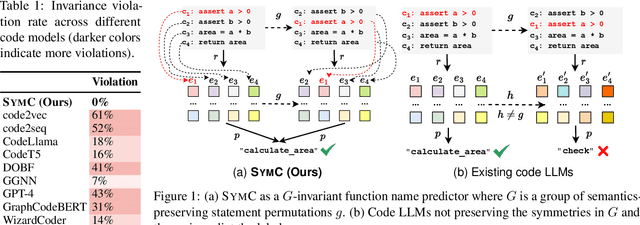
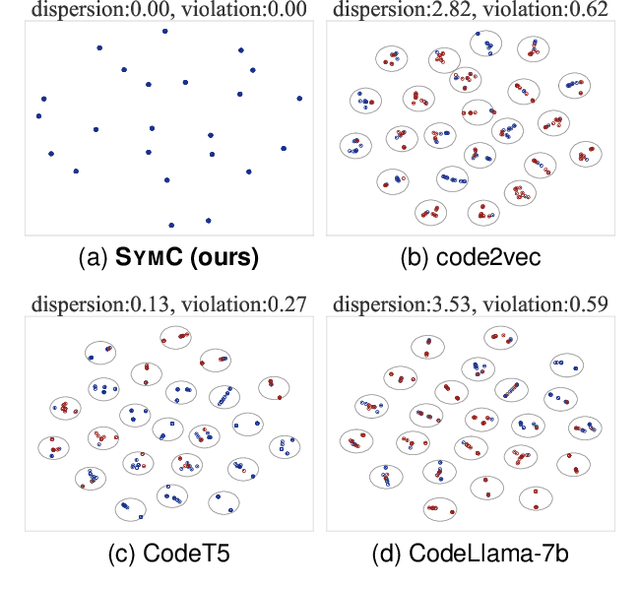
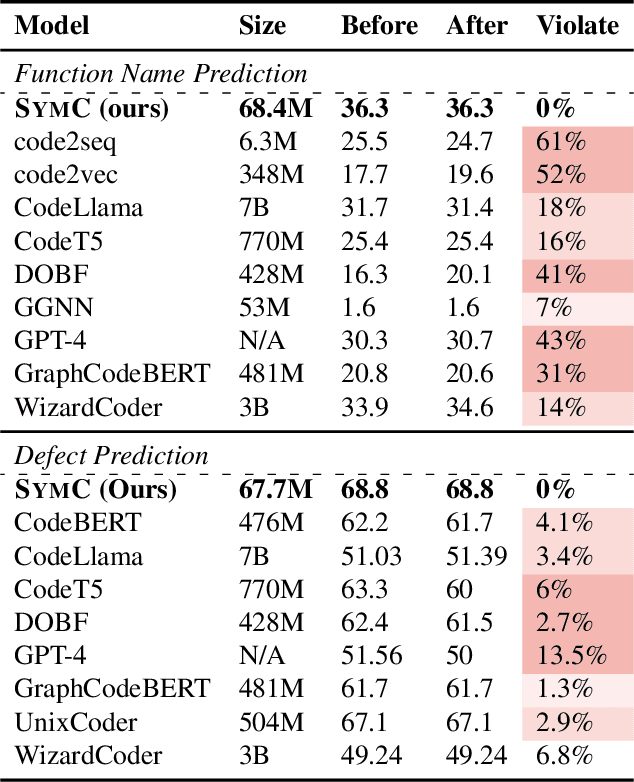
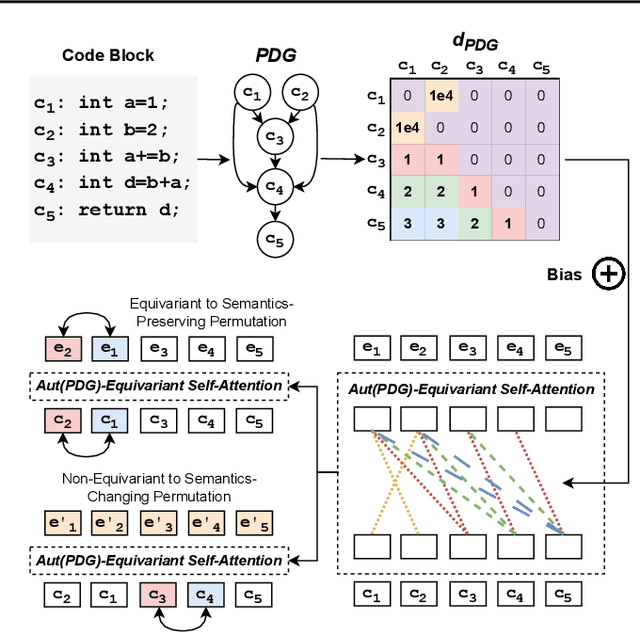
Large Language Models (LLMs) have shown promise in automated program reasoning, a crucial aspect of many security tasks. However, existing LLM architectures for code are often borrowed from other domains like natural language processing, raising concerns about their generalization and robustness to unseen code. A key generalization challenge is to incorporate the knowledge of code semantics, including control and data flow, into the LLM architectures. Drawing inspiration from examples of convolution layers exploiting translation symmetry, we explore how code symmetries can enhance LLM architectures for program analysis and modeling. We present a rigorous group-theoretic framework that formally defines code symmetries as semantics-preserving transformations and provides techniques for precisely reasoning about symmetry preservation within LLM architectures. Using this framework, we introduce a novel variant of self-attention that preserves program symmetries, demonstrating its effectiveness in generalization and robustness through detailed experimental evaluations across different binary and source code analysis tasks. Overall, our code symmetry framework offers rigorous and powerful reasoning techniques that can guide the future development of specialized LLMs for code and advance LLM-guided program reasoning tasks.