 Add to Chrome
 Add to Firefox
 Add to Edge
LAVENDER: Unifying Video-Language Understanding as Masked Language Modeling
Jun 14, 2022
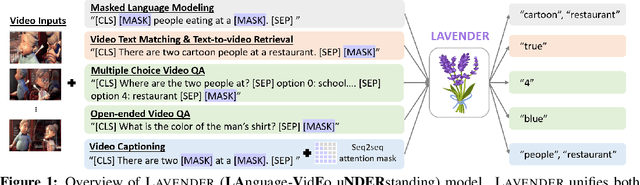
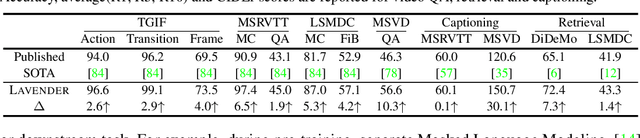
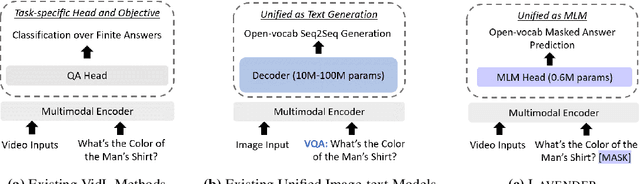
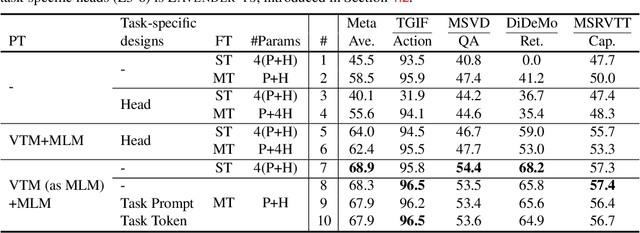
Unified vision-language frameworks have greatly advanced in recent years, most of which adopt an encoder-decoder architecture to unify image-text tasks as sequence-to-sequence generation. However, existing video-language (VidL) models still require task-specific designs in model architecture and training objectives for each task. In this work, we explore a unified VidL framework LAVENDER, where Masked Language Modeling (MLM) is used as the common interface for all pre-training and downstream tasks. Such unification leads to a simplified model architecture, where only a lightweight MLM head, instead of a decoder with much more parameters, is needed on top of the multimodal encoder. Surprisingly, experimental results show that this unified framework achieves competitive performance on 14 VidL benchmarks, covering video question answering, text-to-video retrieval and video captioning. Extensive analyses further demonstrate the advantage of LAVENDER over existing VidL methods in: (i) supporting all downstream tasks with just a single set of parameter values when multi-task finetuned; (ii) few-shot generalization on various downstream tasks; and (iii) enabling zero-shot evaluation on video question answering tasks. Code is available at https://github.com/microsoft/LAVENDER.

Visual Clues: Bridging Vision and Language Foundations for Image Paragraph Captioning
Jun 03, 2022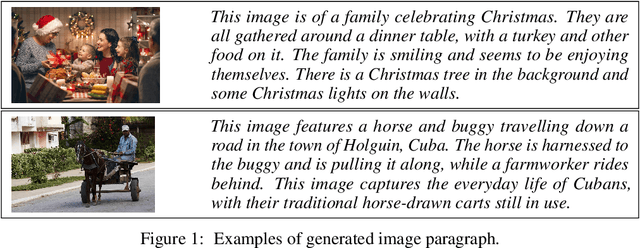
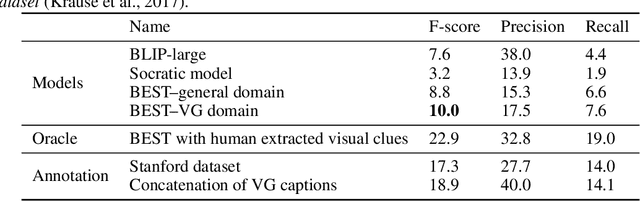
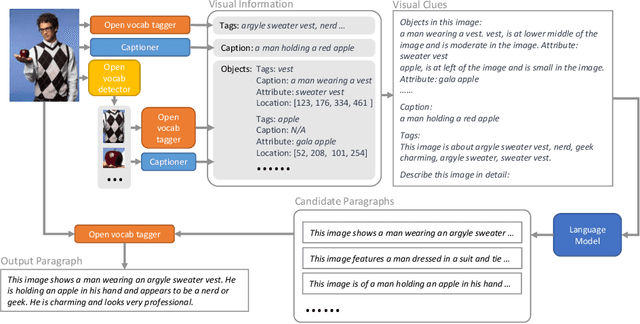
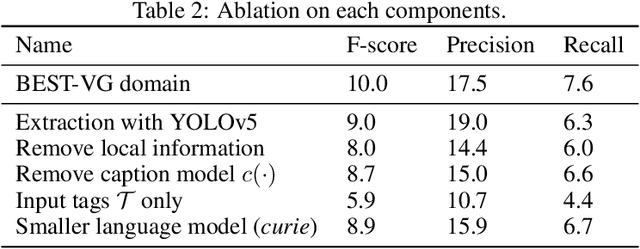
People say, "A picture is worth a thousand words". Then how can we get the rich information out of the image? We argue that by using visual clues to bridge large pretrained vision foundation models and language models, we can do so without any extra cross-modal training. Thanks to the strong zero-shot capability of foundation models, we start by constructing a rich semantic representation of the image (e.g., image tags, object attributes / locations, captions) as a structured textual prompt, called visual clues, using a vision foundation model. Based on visual clues, we use large language model to produce a series of comprehensive descriptions for the visual content, which is then verified by the vision model again to select the candidate that aligns best with the image. We evaluate the quality of generated descriptions by quantitative and qualitative measurement. The results demonstrate the effectiveness of such a structured semantic representation.
GIT: A Generative Image-to-text Transformer for Vision and Language
May 31, 2022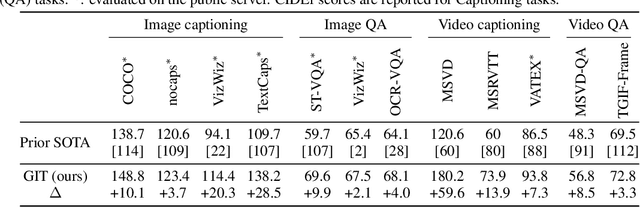
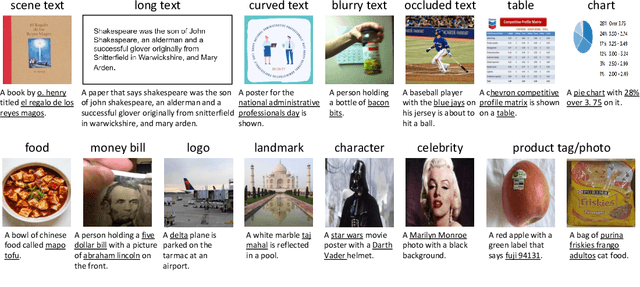
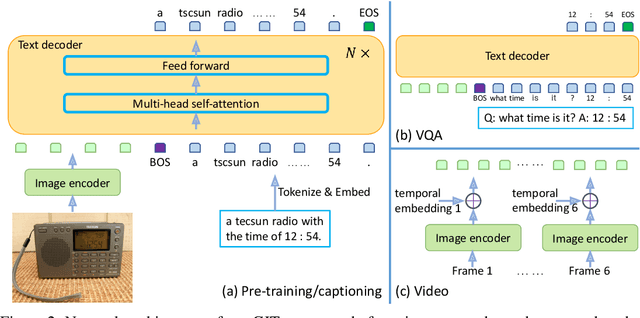
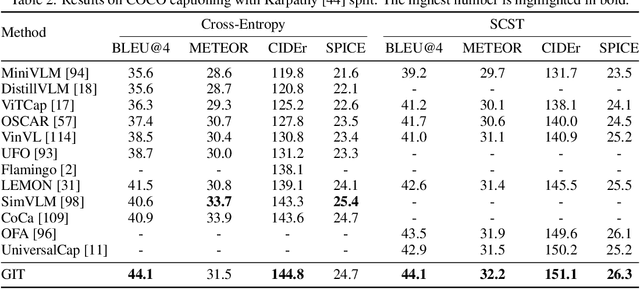
In this paper, we design and train a Generative Image-to-text Transformer, GIT, to unify vision-language tasks such as image/video captioning and question answering. While generative models provide a consistent network architecture between pre-training and fine-tuning, existing work typically contains complex structures (uni/multi-modal encoder/decoder) and depends on external modules such as object detectors/taggers and optical character recognition (OCR). In GIT, we simplify the architecture as one image encoder and one text decoder under a single language modeling task. We also scale up the pre-training data and the model size to boost the model performance. Without bells and whistles, our GIT establishes new state of the arts on 12 challenging benchmarks with a large margin. For instance, our model surpasses the human performance for the first time on TextCaps (138.2 vs. 125.5 in CIDEr). Furthermore, we present a new scheme of generation-based image classification and scene text recognition, achieving decent performance on standard benchmarks.
K-LITE: Learning Transferable Visual Models with External Knowledge
Apr 20, 2022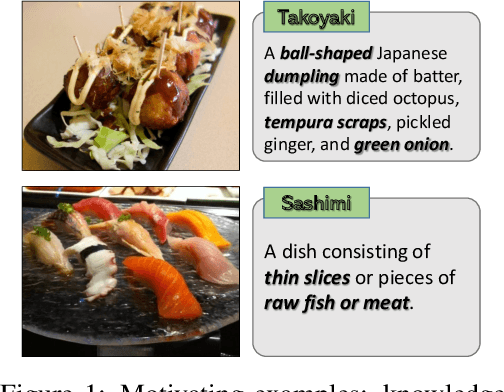
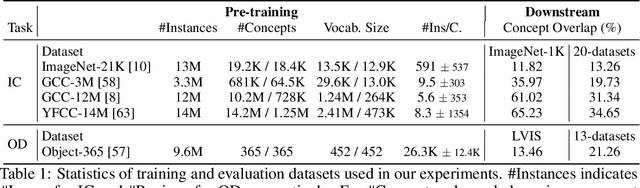
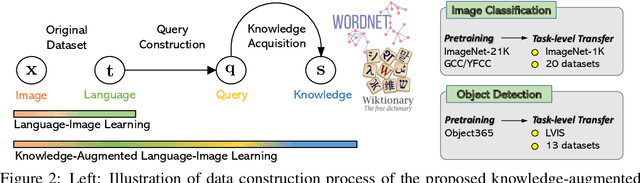
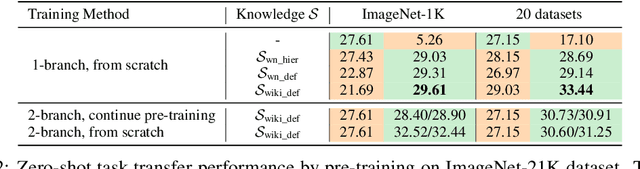
Recent state-of-the-art computer vision systems are trained from natural language supervision, ranging from simple object category names to descriptive captions. This free form of supervision ensures high generality and usability of the learned visual models, based on extensive heuristics on data collection to cover as many visual concepts as possible. Alternatively, learning with external knowledge about images is a promising way which leverages a much more structured source of supervision. In this paper, we propose K-LITE (Knowledge-augmented Language-Image Training and Evaluation), a simple strategy to leverage external knowledge to build transferable visual systems: In training, it enriches entities in natural language with WordNet and Wiktionary knowledge, leading to an efficient and scalable approach to learning image representations that can understand both visual concepts and their knowledge; In evaluation, the natural language is also augmented with external knowledge and then used to reference learned visual concepts (or describe new ones) to enable zero-shot and few-shot transfer of the pre-trained models. We study the performance of K-LITE on two important computer vision problems, image classification and object detection, benchmarking on 20 and 13 different existing datasets, respectively. The proposed knowledge-augmented models show significant improvement in transfer learning performance over existing methods.
Unified Contrastive Learning in Image-Text-Label Space
Apr 07, 2022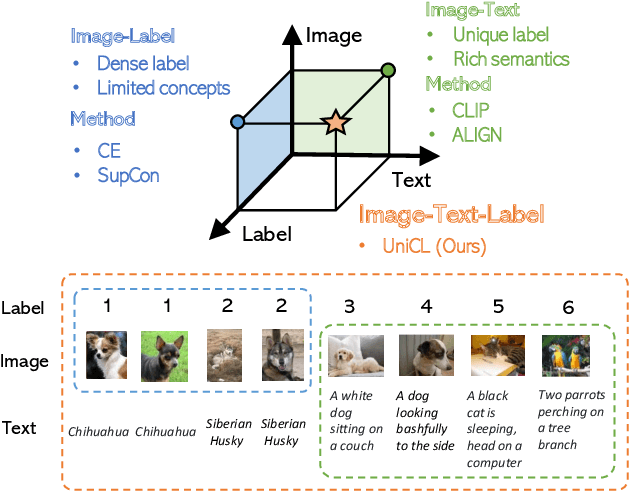
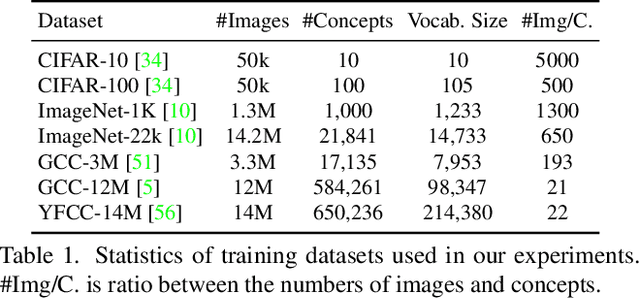
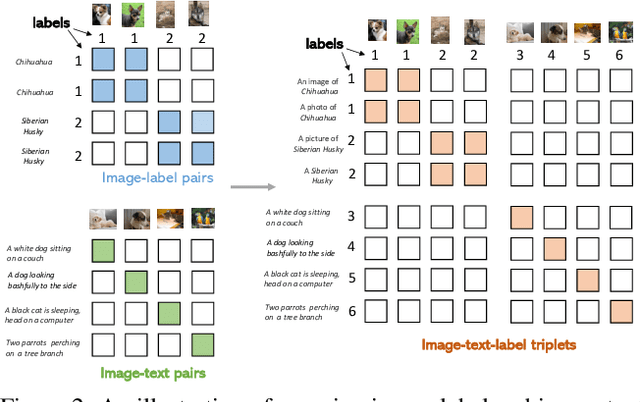

Visual recognition is recently learned via either supervised learning on human-annotated image-label data or language-image contrastive learning with webly-crawled image-text pairs. While supervised learning may result in a more discriminative representation, language-image pretraining shows unprecedented zero-shot recognition capability, largely due to the different properties of data sources and learning objectives. In this work, we introduce a new formulation by combining the two data sources into a common image-text-label space. In this space, we propose a new learning paradigm, called Unified Contrastive Learning (UniCL) with a single learning objective to seamlessly prompt the synergy of two data types. Extensive experiments show that our UniCL is an effective way of learning semantically rich yet discriminative representations, universally for image recognition in zero-shot, linear-probe, fully finetuning and transfer learning scenarios. Particularly, it attains gains up to 9.2% and 14.5% in average on zero-shot recognition benchmarks over the language-image contrastive learning and supervised learning methods, respectively. In linear probe setting, it also boosts the performance over the two methods by 7.3% and 3.4%, respectively. Our study also indicates that UniCL stand-alone is a good learner on pure image-label data, rivaling the supervised learning methods across three image classification datasets and two types of vision backbones, ResNet and Swin Transformer. Code is available at https://github.com/microsoft/UniCL.
MaskGIT: Masked Generative Image Transformer
Feb 08, 2022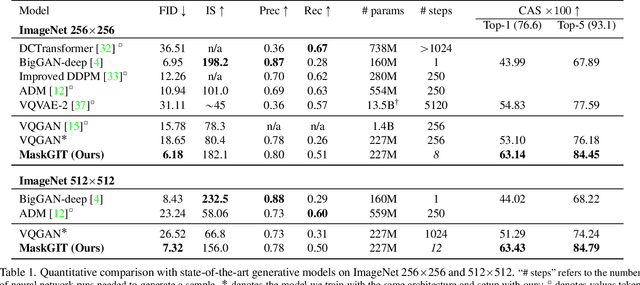
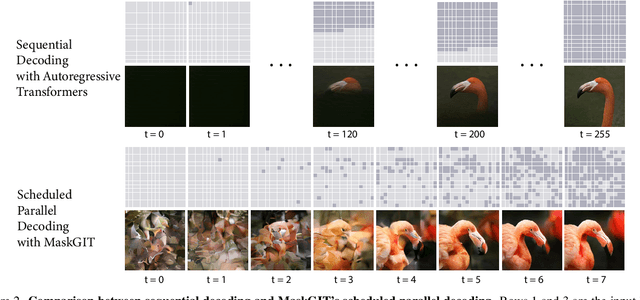
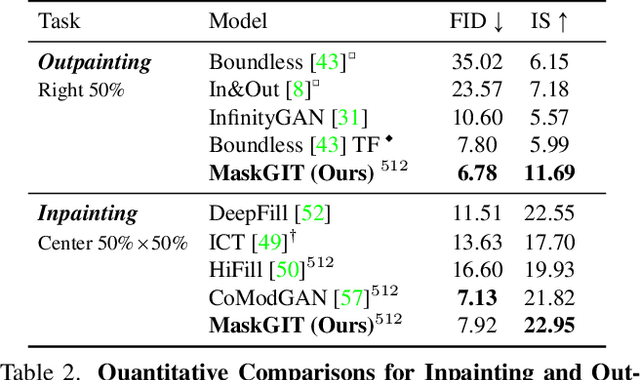
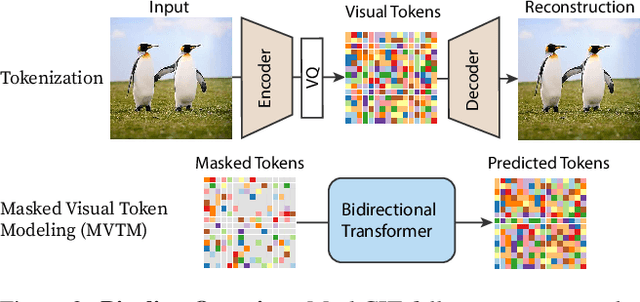
Generative transformers have experienced rapid popularity growth in the computer vision community in synthesizing high-fidelity and high-resolution images. The best generative transformer models so far, however, still treat an image naively as a sequence of tokens, and decode an image sequentially following the raster scan ordering (i.e. line-by-line). We find this strategy neither optimal nor efficient. This paper proposes a novel image synthesis paradigm using a bidirectional transformer decoder, which we term MaskGIT. During training, MaskGIT learns to predict randomly masked tokens by attending to tokens in all directions. At inference time, the model begins with generating all tokens of an image simultaneously, and then refines the image iteratively conditioned on the previous generation. Our experiments demonstrate that MaskGIT significantly outperforms the state-of-the-art transformer model on the ImageNet dataset, and accelerates autoregressive decoding by up to 64x. Besides, we illustrate that MaskGIT can be easily extended to various image editing tasks, such as inpainting, extrapolation, and image manipulation.
Pyramid Adversarial Training Improves ViT Performance
Nov 30, 2021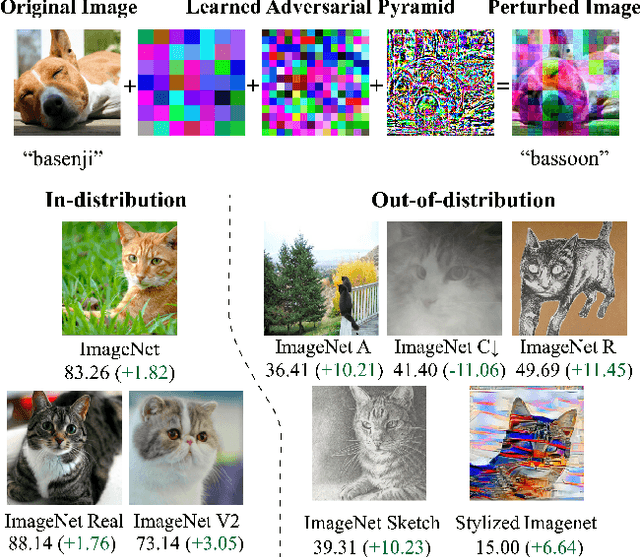
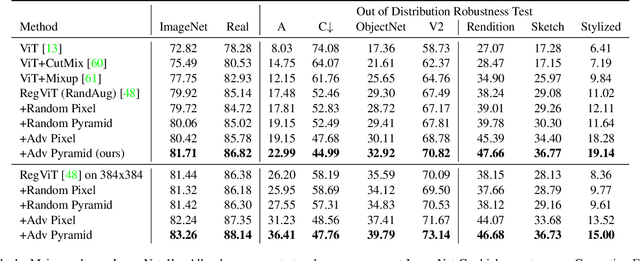
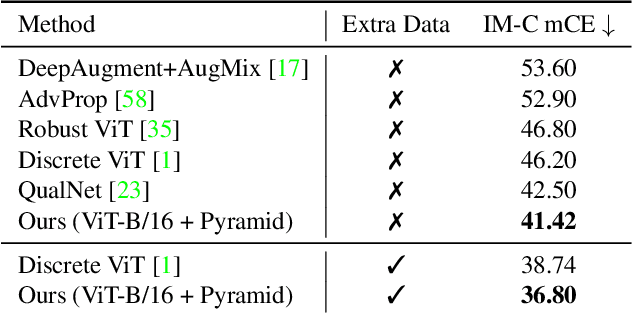
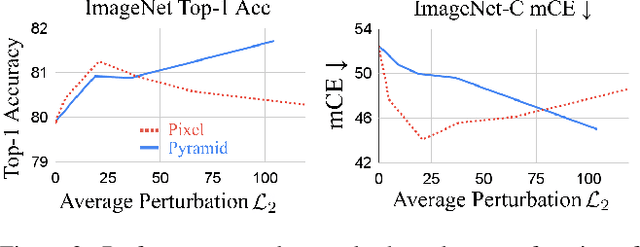
Aggressive data augmentation is a key component of the strong generalization capabilities of Vision Transformer (ViT). One such data augmentation technique is adversarial training; however, many prior works have shown that this often results in poor clean accuracy. In this work, we present Pyramid Adversarial Training, a simple and effective technique to improve ViT's overall performance. We pair it with a "matched" Dropout and stochastic depth regularization, which adopts the same Dropout and stochastic depth configuration for the clean and adversarial samples. Similar to the improvements on CNNs by AdvProp (not directly applicable to ViT), our Pyramid Adversarial Training breaks the trade-off between in-distribution accuracy and out-of-distribution robustness for ViT and related architectures. It leads to $1.82\%$ absolute improvement on ImageNet clean accuracy for the ViT-B model when trained only on ImageNet-1K data, while simultaneously boosting performance on $7$ ImageNet robustness metrics, by absolute numbers ranging from $1.76\%$ to $11.45\%$. We set a new state-of-the-art for ImageNet-C (41.4 mCE), ImageNet-R ($53.92\%$), and ImageNet-Sketch ($41.04\%$) without extra data, using only the ViT-B/16 backbone and our Pyramid Adversarial Training. Our code will be publicly available upon acceptance.
Florence: A New Foundation Model for Computer Vision
Nov 22, 2021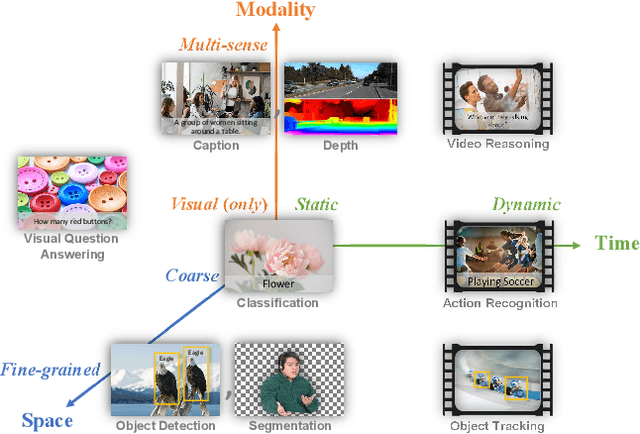
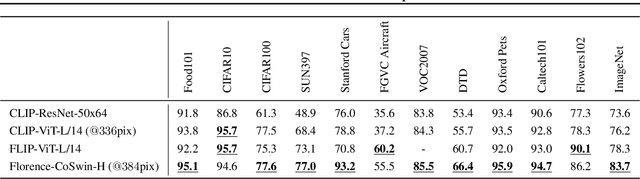
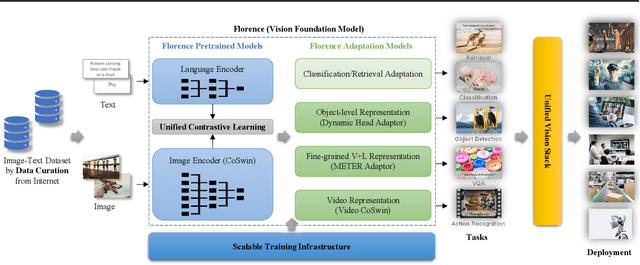
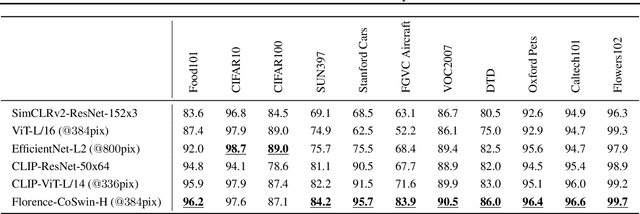
Automated visual understanding of our diverse and open world demands computer vision models to generalize well with minimal customization for specific tasks, similar to human vision. Computer vision foundation models, which are trained on diverse, large-scale dataset and can be adapted to a wide range of downstream tasks, are critical for this mission to solve real-world computer vision applications. While existing vision foundation models such as CLIP, ALIGN, and Wu Dao 2.0 focus mainly on mapping images and textual representations to a cross-modal shared representation, we introduce a new computer vision foundation model, Florence, to expand the representations from coarse (scene) to fine (object), from static (images) to dynamic (videos), and from RGB to multiple modalities (caption, depth). By incorporating universal visual-language representations from Web-scale image-text data, our Florence model can be easily adapted for various computer vision tasks, such as classification, retrieval, object detection, VQA, image caption, video retrieval and action recognition. Moreover, Florence demonstrates outstanding performance in many types of transfer learning: fully sampled fine-tuning, linear probing, few-shot transfer and zero-shot transfer for novel images and objects. All of these properties are critical for our vision foundation model to serve general purpose vision tasks. Florence achieves new state-of-the-art results in majority of 44 representative benchmarks, e.g., ImageNet-1K zero-shot classification with top-1 accuracy of 83.74 and the top-5 accuracy of 97.18, 62.4 mAP on COCO fine tuning, 80.36 on VQA, and 87.8 on Kinetics-600.
Neural-PIL: Neural Pre-Integrated Lighting for Reflectance Decomposition
Oct 27, 2021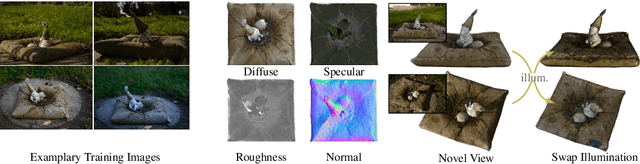
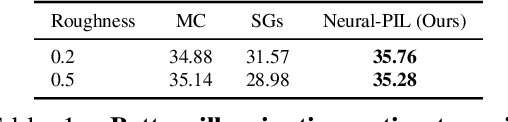

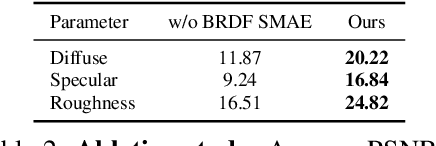
Decomposing a scene into its shape, reflectance and illumination is a fundamental problem in computer vision and graphics. Neural approaches such as NeRF have achieved remarkable success in view synthesis, but do not explicitly perform decomposition and instead operate exclusively on radiance (the product of reflectance and illumination). Extensions to NeRF, such as NeRD, can perform decomposition but struggle to accurately recover detailed illumination, thereby significantly limiting realism. We propose a novel reflectance decomposition network that can estimate shape, BRDF, and per-image illumination given a set of object images captured under varying illumination. Our key technique is a novel illumination integration network called Neural-PIL that replaces a costly illumination integral operation in the rendering with a simple network query. In addition, we also learn deep low-dimensional priors on BRDF and illumination representations using novel smooth manifold auto-encoders. Our decompositions can result in considerably better BRDF and light estimates enabling more accurate novel view-synthesis and relighting compared to prior art. Project page: https://markboss.me/publication/2021-neural-pil/
SLIDE: Single Image 3D Photography with Soft Layering and Depth-aware Inpainting
Sep 02, 2021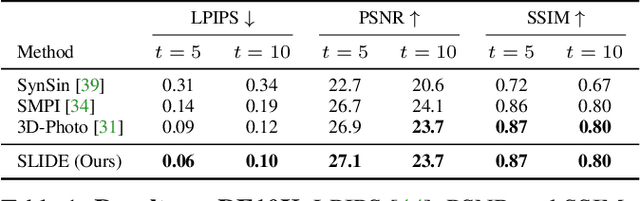
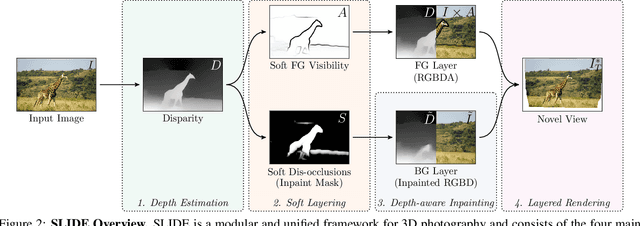
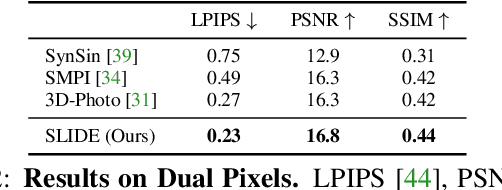
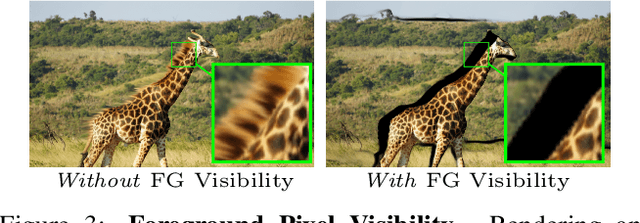
Single image 3D photography enables viewers to view a still image from novel viewpoints. Recent approaches combine monocular depth networks with inpainting networks to achieve compelling results. A drawback of these techniques is the use of hard depth layering, making them unable to model intricate appearance details such as thin hair-like structures. We present SLIDE, a modular and unified system for single image 3D photography that uses a simple yet effective soft layering strategy to better preserve appearance details in novel views. In addition, we propose a novel depth-aware training strategy for our inpainting module, better suited for the 3D photography task. The resulting SLIDE approach is modular, enabling the use of other components such as segmentation and matting for improved layering. At the same time, SLIDE uses an efficient layered depth formulation that only requires a single forward pass through the component networks to produce high quality 3D photos. Extensive experimental analysis on three view-synthesis datasets, in combination with user studies on in-the-wild image collections, demonstrate superior performance of our technique in comparison to existing strong baselines while being conceptually much simpler. Project page: https://varunjampani.github.io/slide