 Add to Chrome
 Add to Firefox
 Add to Edge
From Hypothesis to Publication: A Comprehensive Survey of AI-Driven Research Support Systems
Mar 03, 2025
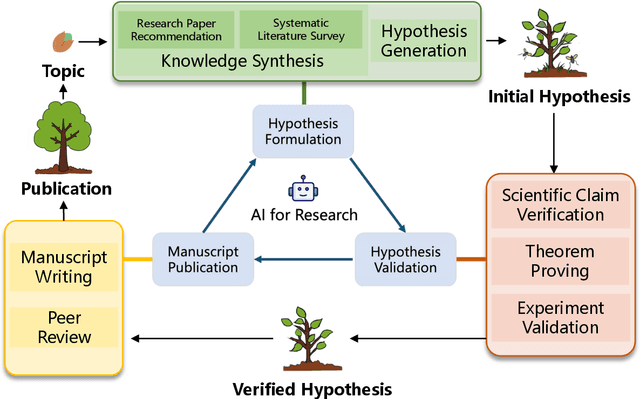
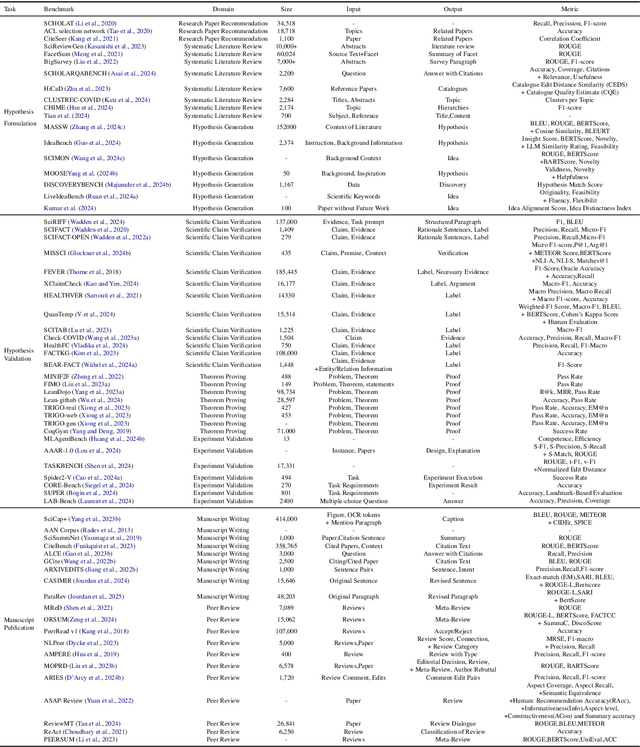
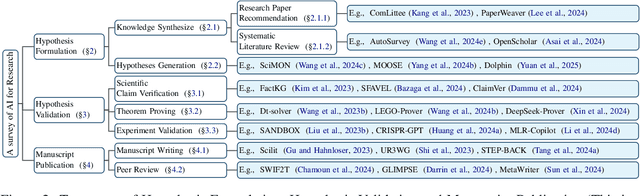
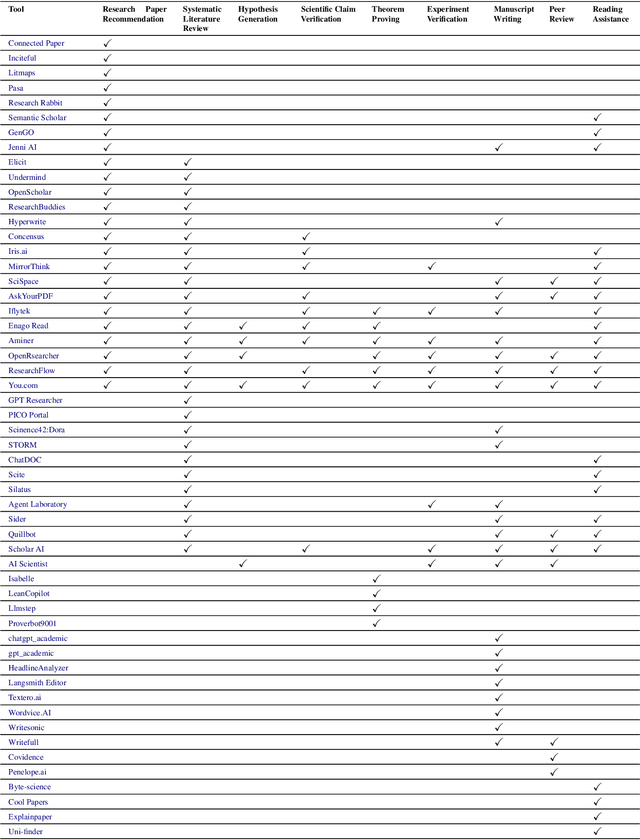
Research is a fundamental process driving the advancement of human civilization, yet it demands substantial time and effort from researchers. In recent years, the rapid development of artificial intelligence (AI) technologies has inspired researchers to explore how AI can accelerate and enhance research. To monitor relevant advancements, this paper presents a systematic review of the progress in this domain. Specifically, we organize the relevant studies into three main categories: hypothesis formulation, hypothesis validation, and manuscript publication. Hypothesis formulation involves knowledge synthesis and hypothesis generation. Hypothesis validation includes the verification of scientific claims, theorem proving, and experiment validation. Manuscript publication encompasses manuscript writing and the peer review process. Furthermore, we identify and discuss the current challenges faced in these areas, as well as potential future directions for research. Finally, we also offer a comprehensive overview of existing benchmarks and tools across various domains that support the integration of AI into the research process. We hope this paper serves as an introduction for beginners and fosters future research. Resources have been made publicly available at https://github.com/zkzhou126/AI-for-Research.

Beware of Your Po! Measuring and Mitigating AI Safety Risks in Role-Play Fine-Tuning of LLMs
Feb 28, 2025Role-playing enables large language models (LLMs) to engage users in immersive and personalized interactions, but it also introduces significant safety risks. Existing role-play fine-tuning techniques improve role adaptability but may degrade safety performance, particularly for villainous characters. In this work, we conduct the first comprehensive assessment of role-play fine-tuning risks by training 95 role-specific LLMs using RoleBench. Our experiments reveal that role-play fine-tuning leads to a noticeable decline in safety performance, with safety risks varying based on character traits. To tackle this challenge, we propose Safety-Aware Role-Play Fine-Tuning (SaRFT), a novel method designed to balance role-playing capabilities and safety. Extensive experiments on LLaMA-3-8B-Instruct, Gemma-2-9B-it, and Qwen2.5-7B-Instruct demonstrate that SaRFT consistently outperforms state-of-the-art baselines under both LoRA and full-parameter fine-tuning settings. Our findings highlight the necessity of role-adaptive safety measures and provide insights into mitigating role-specific safety risks in role-playing LLMs.
MA-GTS: A Multi-Agent Framework for Solving Complex Graph Problems in Real-World Applications
Feb 25, 2025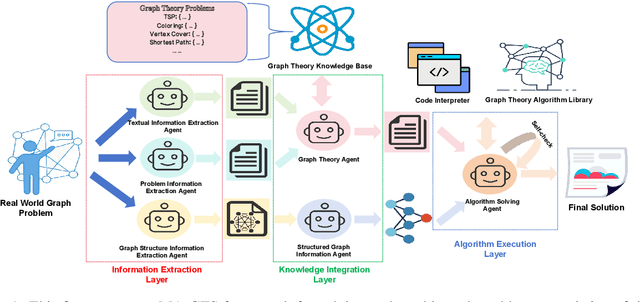
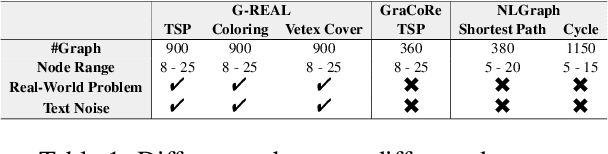
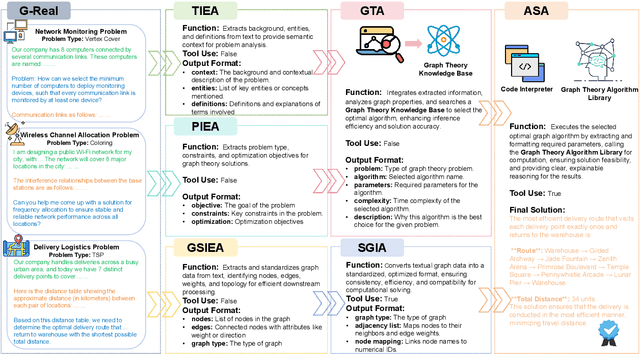
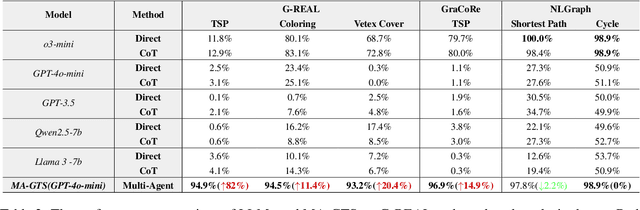
Graph-theoretic problems arise in real-world applications like logistics, communication networks, and traffic optimization. These problems are often complex, noisy, and irregular, posing challenges for traditional algorithms. Large language models (LLMs) offer potential solutions but face challenges, including limited accuracy and input length constraints. To address these challenges, we propose MA-GTS (Multi-Agent Graph Theory Solver), a multi-agent framework that decomposes these complex problems through agent collaboration. MA-GTS maps the implicitly expressed text-based graph data into clear, structured graph representations and dynamically selects the most suitable algorithm based on problem constraints and graph structure scale. This approach ensures that the solution process remains efficient and the resulting reasoning path is interpretable. We validate MA-GTS using the G-REAL dataset, a real-world-inspired graph theory dataset we created. Experimental results show that MA-GTS outperforms state-of-the-art approaches in terms of efficiency, accuracy, and scalability, with strong results across multiple benchmarks (G-REAL 94.2%, GraCoRe 96.9%, NLGraph 98.4%).MA-GTS is open-sourced at https://github.com/ZIKEYUAN/MA-GTS.git.
Improved Diffusion-based Generative Model with Better Adversarial Robustness
Feb 24, 2025Diffusion Probabilistic Models (DPMs) have achieved significant success in generative tasks. However, their training and sampling processes suffer from the issue of distribution mismatch. During the denoising process, the input data distributions differ between the training and inference stages, potentially leading to inaccurate data generation. To obviate this, we analyze the training objective of DPMs and theoretically demonstrate that this mismatch can be alleviated through Distributionally Robust Optimization (DRO), which is equivalent to performing robustness-driven Adversarial Training (AT) on DPMs. Furthermore, for the recently proposed Consistency Model (CM), which distills the inference process of the DPM, we prove that its training objective also encounters the mismatch issue. Fortunately, this issue can be mitigated by AT as well. Based on these insights, we propose to conduct efficient AT on both DPM and CM. Finally, extensive empirical studies validate the effectiveness of AT in diffusion-based models. The code is available at https://github.com/kugwzk/AT_Diff.
NLP-AKG: Few-Shot Construction of NLP Academic Knowledge Graph Based on LLM
Feb 20, 2025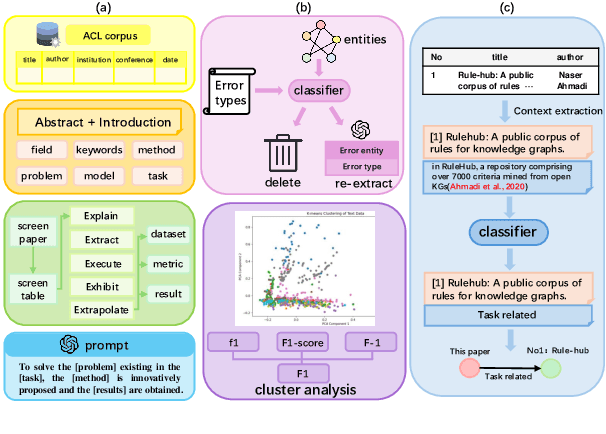
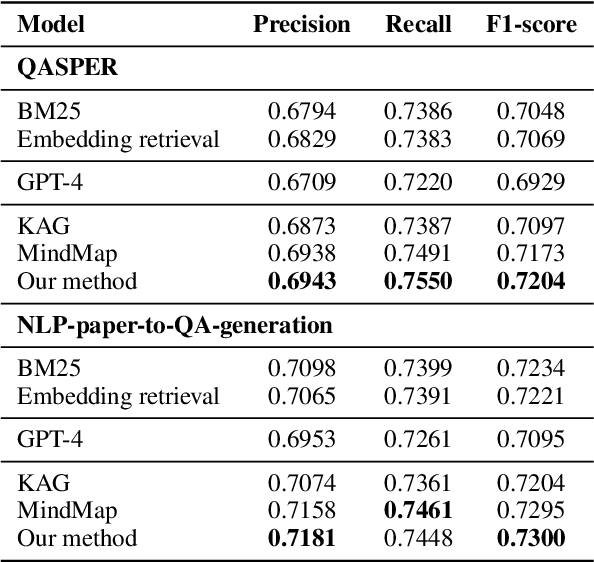
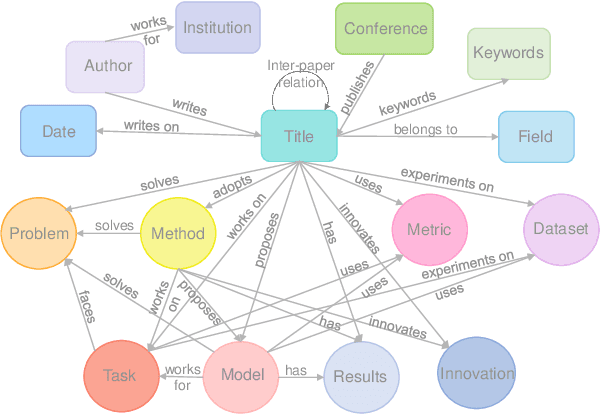
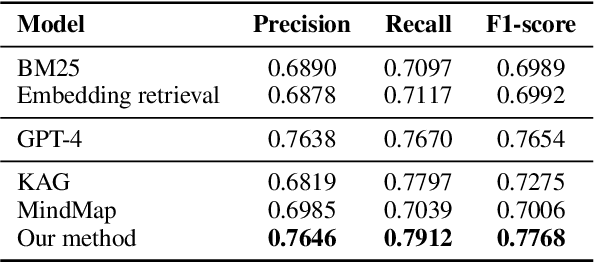
Large language models (LLMs) have been widely applied in question answering over scientific research papers. To enhance the professionalism and accuracy of responses, many studies employ external knowledge augmentation. However, existing structures of external knowledge in scientific literature often focus solely on either paper entities or domain concepts, neglecting the intrinsic connections between papers through shared domain concepts. This results in less comprehensive and specific answers when addressing questions that combine papers and concepts. To address this, we propose a novel knowledge graph framework that captures deep conceptual relations between academic papers, constructing a relational network via intra-paper semantic elements and inter-paper citation relations. Using a few-shot knowledge graph construction method based on LLM, we develop NLP-AKG, an academic knowledge graph for the NLP domain, by extracting 620,353 entities and 2,271,584 relations from 60,826 papers in ACL Anthology. Based on this, we propose a 'sub-graph community summary' method and validate its effectiveness on three NLP scientific literature question answering datasets.
Ontology-Guided Reverse Thinking Makes Large Language Models Stronger on Knowledge Graph Question Answering
Feb 17, 2025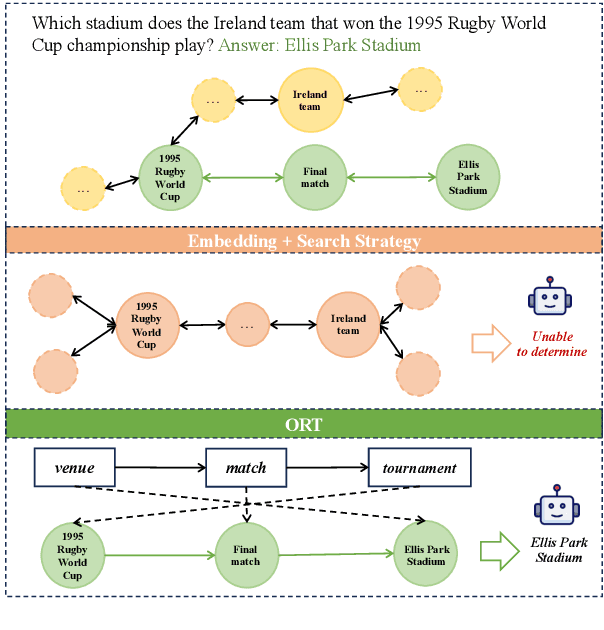
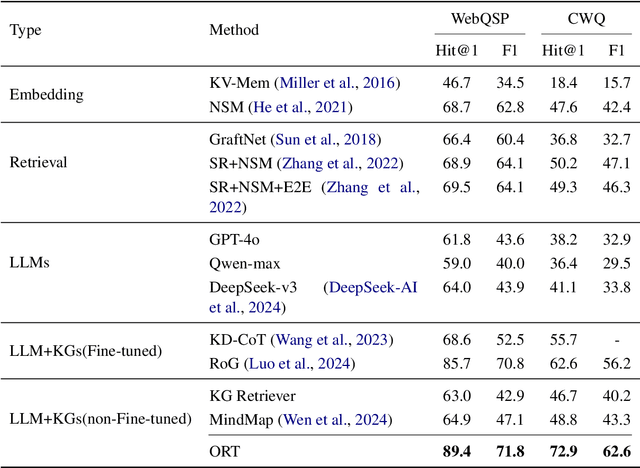
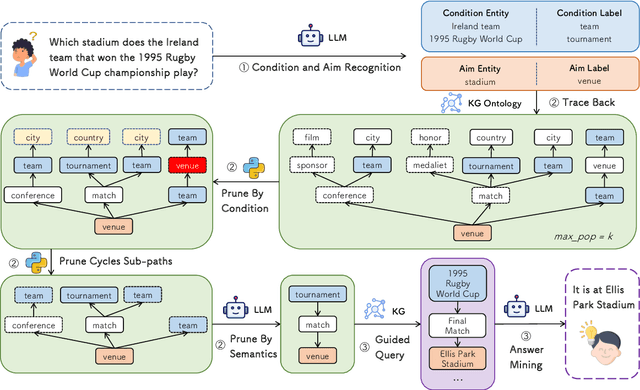
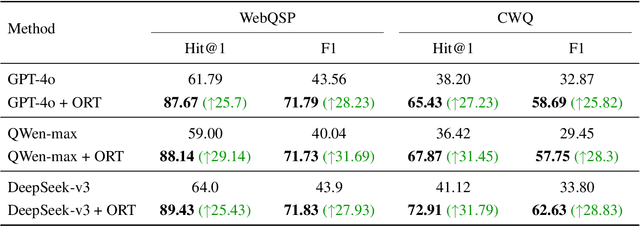
Large language models (LLMs) have shown remarkable capabilities in natural language processing. However, in knowledge graph question answering tasks (KGQA), there remains the issue of answering questions that require multi-hop reasoning. Existing methods rely on entity vector matching, but the purpose of the question is abstract and difficult to match with specific entities. As a result, it is difficult to establish reasoning paths to the purpose, which leads to information loss and redundancy. To address this issue, inspired by human reverse thinking, we propose Ontology-Guided Reverse Thinking (ORT), a novel framework that constructs reasoning paths from purposes back to conditions. ORT operates in three key phases: (1) using LLM to extract purpose labels and condition labels, (2) constructing label reasoning paths based on the KG ontology, and (3) using the label reasoning paths to guide knowledge retrieval. Experiments on the WebQSP and CWQ datasets show that ORT achieves state-of-the-art performance and significantly enhances the capability of LLMs for KGQA.
Boosting Tool Use of Large Language Models via Iterative Reinforced Fine-Tuning
Jan 15, 2025


Augmenting large language models (LLMs) with external tools is a promising approach to enhance their capabilities. Effectively leveraging this potential for complex tasks hinges crucially on improving their ability to use tools. Synthesizing tool use data by simulating the real world is an effective approach. Nevertheless, our investigation reveals that training gains significantly decay as the scale of these data increases. The primary factor is the model's poor performance (a.k.a deficiency) in complex scenarios, which hinders learning from data using SFT. Driven by this objective, we propose an iterative reinforced fine-tuning strategy to continually guide the model to alleviate it. Specifically, we first identify deficiency-related data based on feedback from the policy model, then perform a Monte Carlo Tree Search to collect fine-grained preference pairs to pinpoint deficiencies. Subsequently, we update the policy model using preference optimization to align with ground truth and misalign with deficiencies. This process can be iterated. Moreover, before the iteration, we propose an easy-to-hard warm-up SFT strategy to facilitate learning from challenging data. The experiments demonstrate our models go beyond the same parametric models, outperforming many larger open-source and closed-source models. Additionally, it has achieved notable training gains in complex tool use scenarios.
Ensuring Consistency for In-Image Translation
Dec 24, 2024The in-image machine translation task involves translating text embedded within images, with the translated results presented in image format. While this task has numerous applications in various scenarios such as film poster translation and everyday scene image translation, existing methods frequently neglect the aspect of consistency throughout this process. We propose the need to uphold two types of consistency in this task: translation consistency and image generation consistency. The former entails incorporating image information during translation, while the latter involves maintaining consistency between the style of the text-image and the original image, ensuring background integrity. To address these consistency requirements, we introduce a novel two-stage framework named HCIIT (High-Consistency In-Image Translation) which involves text-image translation using a multimodal multilingual large language model in the first stage and image backfilling with a diffusion model in the second stage. Chain of thought learning is utilized in the first stage to enhance the model's ability to leverage image information during translation. Subsequently, a diffusion model trained for style-consistent text-image generation ensures uniformity in text style within images and preserves background details. A dataset comprising 400,000 style-consistent pseudo text-image pairs is curated for model training. Results obtained on both curated test sets and authentic image test sets validate the effectiveness of our framework in ensuring consistency and producing high-quality translated images.
Cross-Lingual Text-Rich Visual Comprehension: An Information Theory Perspective
Dec 23, 2024


Recent Large Vision-Language Models (LVLMs) have shown promising reasoning capabilities on text-rich images from charts, tables, and documents. However, the abundant text within such images may increase the model's sensitivity to language. This raises the need to evaluate LVLM performance on cross-lingual text-rich visual inputs, where the language in the image differs from the language of the instructions. To address this, we introduce XT-VQA (Cross-Lingual Text-Rich Visual Question Answering), a benchmark designed to assess how LVLMs handle language inconsistency between image text and questions. XT-VQA integrates five existing text-rich VQA datasets and a newly collected dataset, XPaperQA, covering diverse scenarios that require faithful recognition and comprehension of visual information despite language inconsistency. Our evaluation of prominent LVLMs on XT-VQA reveals a significant drop in performance for cross-lingual scenarios, even for models with multilingual capabilities. A mutual information analysis suggests that this performance gap stems from cross-lingual questions failing to adequately activate relevant visual information. To mitigate this issue, we propose MVCL-MI (Maximization of Vision-Language Cross-Lingual Mutual Information), where a visual-text cross-lingual alignment is built by maximizing mutual information between the model's outputs and visual information. This is achieved by distilling knowledge from monolingual to cross-lingual settings through KL divergence minimization, where monolingual output logits serve as a teacher. Experimental results on the XT-VQA demonstrate that MVCL-MI effectively reduces the visual-text cross-lingual performance disparity while preserving the inherent capabilities of LVLMs, shedding new light on the potential practice for improving LVLMs. Codes are available at: https://github.com/Stardust-y/XTVQA.git
Simulation-Free Hierarchical Latent Policy Planning for Proactive Dialogues
Dec 19, 2024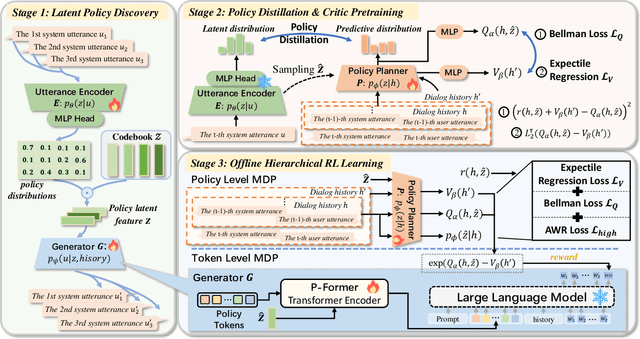


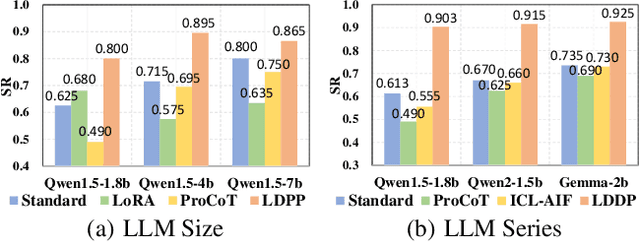
Recent advancements in proactive dialogues have garnered significant attention, particularly for more complex objectives (e.g. emotion support and persuasion). Unlike traditional task-oriented dialogues, proactive dialogues demand advanced policy planning and adaptability, requiring rich scenarios and comprehensive policy repositories to develop such systems. However, existing approaches tend to rely on Large Language Models (LLMs) for user simulation and online learning, leading to biases that diverge from realistic scenarios and result in suboptimal efficiency. Moreover, these methods depend on manually defined, context-independent, coarse-grained policies, which not only incur high expert costs but also raise concerns regarding their completeness. In our work, we highlight the potential for automatically discovering policies directly from raw, real-world dialogue records. To this end, we introduce a novel dialogue policy planning framework, LDPP. It fully automates the process from mining policies in dialogue records to learning policy planning. Specifically, we employ a variant of the Variational Autoencoder to discover fine-grained policies represented as latent vectors. After automatically annotating the data with these latent policy labels, we propose an Offline Hierarchical Reinforcement Learning (RL) algorithm in the latent space to develop effective policy planning capabilities. Our experiments demonstrate that LDPP outperforms existing methods on two proactive scenarios, even surpassing ChatGPT with only a 1.8-billion-parameter LLM.