 Add to Chrome
 Add to Firefox
 Add to Edge
Robot Home Dataset
Papers and Code
Articulated 3D Scene Graphs for Open-World Mobile Manipulation
Feb 18, 2026
Semantics has enabled 3D scene understanding and affordance-driven object interaction. However, robots operating in real-world environments face a critical limitation: they cannot anticipate how objects move. Long-horizon mobile manipulation requires closing the gap between semantics, geometry, and kinematics. In this work, we present MoMa-SG, a novel framework for building semantic-kinematic 3D scene graphs of articulated scenes containing a myriad of interactable objects. Given RGB-D sequences containing multiple object articulations, we temporally segment object interactions and infer object motion using occlusion-robust point tracking. We then lift point trajectories into 3D and estimate articulation models using a novel unified twist estimation formulation that robustly estimates revolute and prismatic joint parameters in a single optimization pass. Next, we associate objects with estimated articulations and detect contained objects by reasoning over parent-child relations at identified opening states. We also introduce the novel Arti4D-Semantic dataset, which uniquely combines hierarchical object semantics including parent-child relation labels with object axis annotations across 62 in-the-wild RGB-D sequences containing 600 object interactions and three distinct observation paradigms. We extensively evaluate the performance of MoMa-SG on two datasets and ablate key design choices of our approach. In addition, real-world experiments on both a quadruped and a mobile manipulator demonstrate that our semantic-kinematic scene graphs enable robust manipulation of articulated objects in everyday home environments. We provide code and data at: https://momasg.cs.uni-freiburg.de.

SceneSmith: Agentic Generation of Simulation-Ready Indoor Scenes
Feb 09, 2026Simulation has become a key tool for training and evaluating home robots at scale, yet existing environments fail to capture the diversity and physical complexity of real indoor spaces. Current scene synthesis methods produce sparsely furnished rooms that lack the dense clutter, articulated furniture, and physical properties essential for robotic manipulation. We introduce SceneSmith, a hierarchical agentic framework that generates simulation-ready indoor environments from natural language prompts. SceneSmith constructs scenes through successive stages$\unicode{x2013}$from architectural layout to furniture placement to small object population$\unicode{x2013}$each implemented as an interaction among VLM agents: designer, critic, and orchestrator. The framework tightly integrates asset generation through text-to-3D synthesis for static objects, dataset retrieval for articulated objects, and physical property estimation. SceneSmith generates 3-6x more objects than prior methods, with <2% inter-object collisions and 96% of objects remaining stable under physics simulation. In a user study with 205 participants, it achieves 92% average realism and 91% average prompt faithfulness win rates against baselines. We further demonstrate that these environments can be used in an end-to-end pipeline for automatic robot policy evaluation.
HARMONI: Multimodal Personalization of Multi-User Human-Robot Interactions with LLMs
Jan 27, 2026Existing human-robot interaction systems often lack mechanisms for sustained personalization and dynamic adaptation in multi-user environments, limiting their effectiveness in real-world deployments. We present HARMONI, a multimodal personalization framework that leverages large language models to enable socially assistive robots to manage long-term multi-user interactions. The framework integrates four key modules: (i) a perception module that identifies active speakers and extracts multimodal input; (ii) a world modeling module that maintains representations of the environment and short-term conversational context; (iii) a user modeling module that updates long-term speaker-specific profiles; and (iv) a generation module that produces contextually grounded and ethically informed responses. Through extensive evaluation and ablation studies on four datasets, as well as a real-world scenario-driven user-study in a nursing home environment, we demonstrate that HARMONI supports robust speaker identification, online memory updating, and ethically aligned personalization, outperforming baseline LLM-driven approaches in user modeling accuracy, personalization quality, and user satisfaction.
See-Control: A Multimodal Agent Framework for Smartphone Interaction with a Robotic Arm
Dec 09, 2025Recent advances in Multimodal Large Language Models (MLLMs) have enabled their use as intelligent agents for smartphone operation. However, existing methods depend on the Android Debug Bridge (ADB) for data transmission and action execution, limiting their applicability to Android devices. In this work, we introduce the novel Embodied Smartphone Operation (ESO) task and present See-Control, a framework that enables smartphone operation via direct physical interaction with a low-DoF robotic arm, offering a platform-agnostic solution. See-Control comprises three key components: (1) an ESO benchmark with 155 tasks and corresponding evaluation metrics; (2) an MLLM-based embodied agent that generates robotic control commands without requiring ADB or system back-end access; and (3) a richly annotated dataset of operation episodes, offering valuable resources for future research. By bridging the gap between digital agents and the physical world, See-Control provides a concrete step toward enabling home robots to perform smartphone-dependent tasks in realistic environments.
AgentWorld: An Interactive Simulation Platform for Scene Construction and Mobile Robotic Manipulation
Aug 13, 2025We introduce AgentWorld, an interactive simulation platform for developing household mobile manipulation capabilities. Our platform combines automated scene construction that encompasses layout generation, semantic asset placement, visual material configuration, and physics simulation, with a dual-mode teleoperation system supporting both wheeled bases and humanoid locomotion policies for data collection. The resulting AgentWorld Dataset captures diverse tasks ranging from primitive actions (pick-and-place, push-pull, etc.) to multistage activities (serve drinks, heat up food, etc.) across living rooms, bedrooms, and kitchens. Through extensive benchmarking of imitation learning methods including behavior cloning, action chunking transformers, diffusion policies, and vision-language-action models, we demonstrate the dataset's effectiveness for sim-to-real transfer. The integrated system provides a comprehensive solution for scalable robotic skill acquisition in complex home environments, bridging the gap between simulation-based training and real-world deployment. The code, datasets will be available at https://yizhengzhang1.github.io/agent_world/
Context-Aware Risk Estimation in Home Environments: A Probabilistic Framework for Service Robots
Aug 27, 2025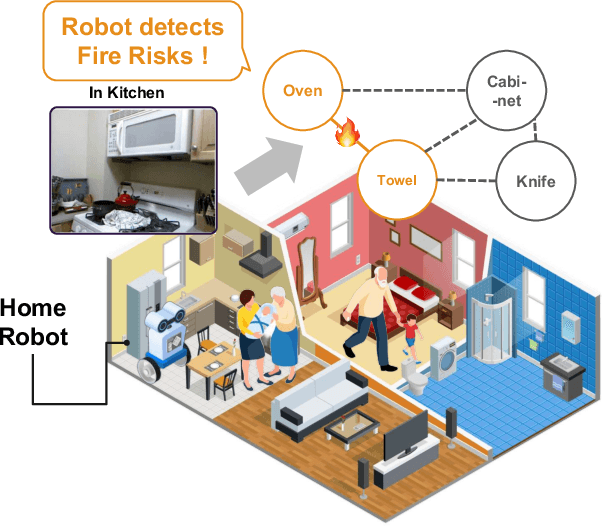
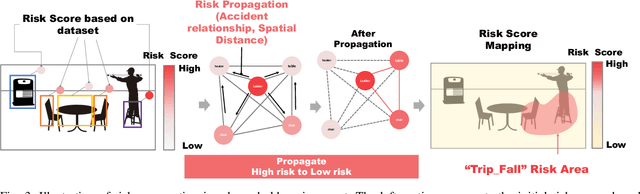
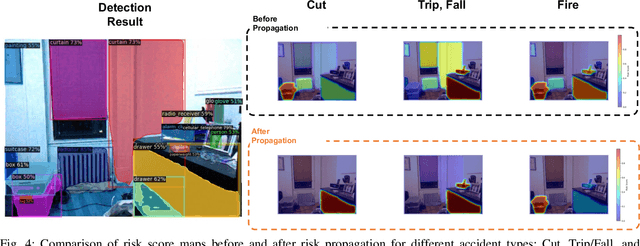
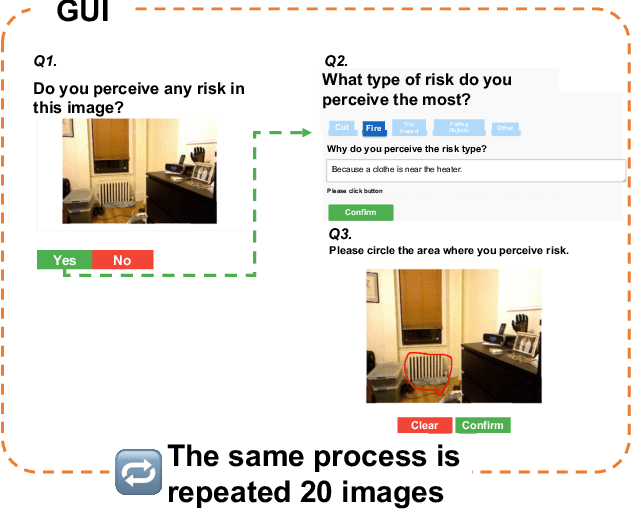
We present a novel framework for estimating accident-prone regions in everyday indoor scenes, aimed at improving real-time risk awareness in service robots operating in human-centric environments. As robots become integrated into daily life, particularly in homes, the ability to anticipate and respond to environmental hazards is crucial for ensuring user safety, trust, and effective human-robot interaction. Our approach models object-level risk and context through a semantic graph-based propagation algorithm. Each object is represented as a node with an associated risk score, and risk propagates asymmetrically from high-risk to low-risk objects based on spatial proximity and accident relationship. This enables the robot to infer potential hazards even when they are not explicitly visible or labeled. Designed for interpretability and lightweight onboard deployment, our method is validated on a dataset with human-annotated risk regions, achieving a binary risk detection accuracy of 75%. The system demonstrates strong alignment with human perception, particularly in scenes involving sharp or unstable objects. These results underline the potential of context-aware risk reasoning to enhance robotic scene understanding and proactive safety behaviors in shared human-robot spaces. This framework could serve as a foundation for future systems that make context-driven safety decisions, provide real-time alerts, or autonomously assist users in avoiding or mitigating hazards within home environments.
DiG-Net: Enhancing Quality of Life through Hyper-Range Dynamic Gesture Recognition in Assistive Robotics
May 30, 2025Dynamic hand gestures play a pivotal role in assistive human-robot interaction (HRI), facilitating intuitive, non-verbal communication, particularly for individuals with mobility constraints or those operating robots remotely. Current gesture recognition methods are mostly limited to short-range interactions, reducing their utility in scenarios demanding robust assistive communication from afar. In this paper, we introduce a novel approach designed specifically for assistive robotics, enabling dynamic gesture recognition at extended distances of up to 30 meters, thereby significantly improving accessibility and quality of life. Our proposed Distance-aware Gesture Network (DiG-Net) effectively combines Depth-Conditioned Deformable Alignment (DADA) blocks with Spatio-Temporal Graph modules, enabling robust processing and classification of gesture sequences captured under challenging conditions, including significant physical attenuation, reduced resolution, and dynamic gesture variations commonly experienced in real-world assistive environments. We further introduce the Radiometric Spatio-Temporal Depth Attenuation Loss (RSTDAL), shown to enhance learning and strengthen model robustness across varying distances. Our model demonstrates significant performance improvement over state-of-the-art gesture recognition frameworks, achieving a recognition accuracy of 97.3% on a diverse dataset with challenging hyper-range gestures. By effectively interpreting gestures from considerable distances, DiG-Net significantly enhances the usability of assistive robots in home healthcare, industrial safety, and remote assistance scenarios, enabling seamless and intuitive interactions for users regardless of physical limitations
Two by Two: Learning Multi-Task Pairwise Objects Assembly for Generalizable Robot Manipulation
Apr 09, 2025
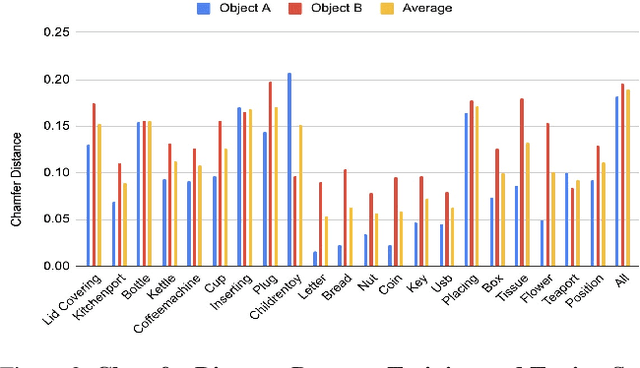

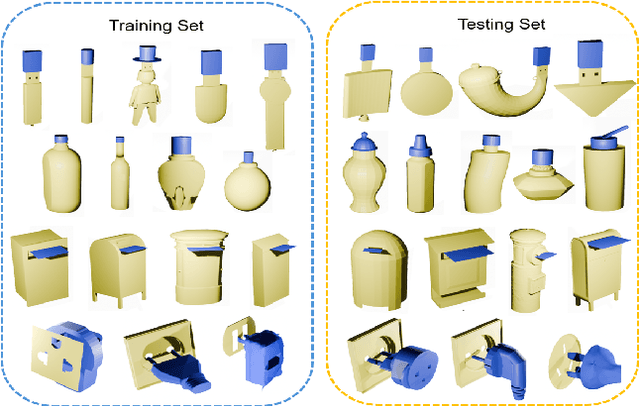
3D assembly tasks, such as furniture assembly and component fitting, play a crucial role in daily life and represent essential capabilities for future home robots. Existing benchmarks and datasets predominantly focus on assembling geometric fragments or factory parts, which fall short in addressing the complexities of everyday object interactions and assemblies. To bridge this gap, we present 2BY2, a large-scale annotated dataset for daily pairwise objects assembly, covering 18 fine-grained tasks that reflect real-life scenarios, such as plugging into sockets, arranging flowers in vases, and inserting bread into toasters. 2BY2 dataset includes 1,034 instances and 517 pairwise objects with pose and symmetry annotations, requiring approaches that align geometric shapes while accounting for functional and spatial relationships between objects. Leveraging the 2BY2 dataset, we propose a two-step SE(3) pose estimation method with equivariant features for assembly constraints. Compared to previous shape assembly methods, our approach achieves state-of-the-art performance across all 18 tasks in the 2BY2 dataset. Additionally, robot experiments further validate the reliability and generalization ability of our method for complex 3D assembly tasks.
HomeEmergency -- Using Audio to Find and Respond to Emergencies in the Home
Apr 01, 2025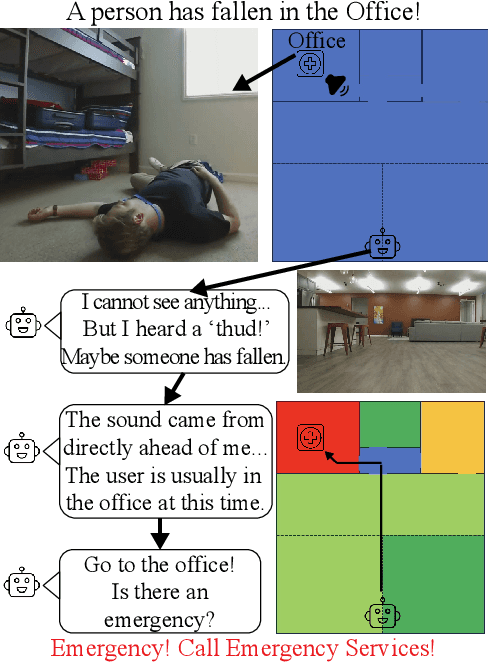
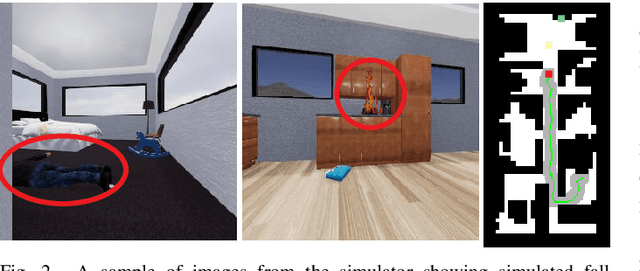
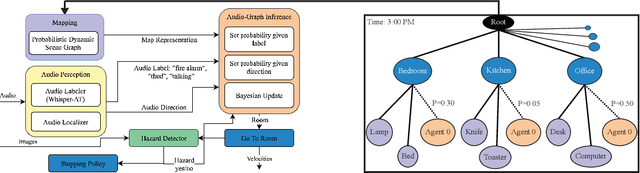
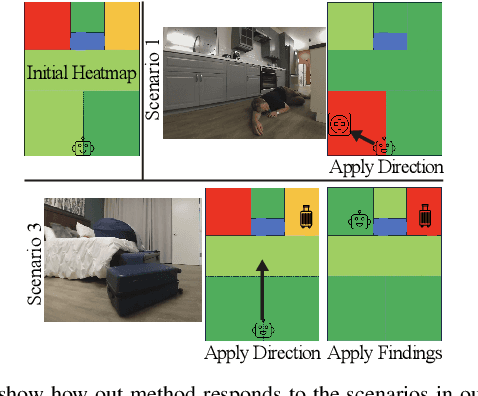
In the United States alone accidental home deaths exceed 128,000 per year. Our work aims to enable home robots who respond to emergency scenarios in the home, preventing injuries and deaths. We introduce a new dataset of household emergencies based in the ThreeDWorld simulator. Each scenario in our dataset begins with an instantaneous or periodic sound which may or may not be an emergency. The agent must navigate the multi-room home scene using prior observations, alongside audio signals and images from the simulator, to determine if there is an emergency or not. In addition to our new dataset, we present a modular approach for localizing and identifying potential home emergencies. Underpinning our approach is a novel probabilistic dynamic scene graph (P-DSG), where our key insight is that graph nodes corresponding to agents can be represented with a probabilistic edge. This edge, when refined using Bayesian inference, enables efficient and effective localization of agents in the scene. We also utilize multi-modal vision-language models (VLMs) as a component in our approach, determining object traits (e.g. flammability) and identifying emergencies. We present a demonstration of our method completing a real-world version of our task on a consumer robot, showing the transferability of both our task and our method. Our dataset will be released to the public upon this papers publication.
LM-MCVT: A Lightweight Multi-modal Multi-view Convolutional-Vision Transformer Approach for 3D Object Recognition
Apr 27, 2025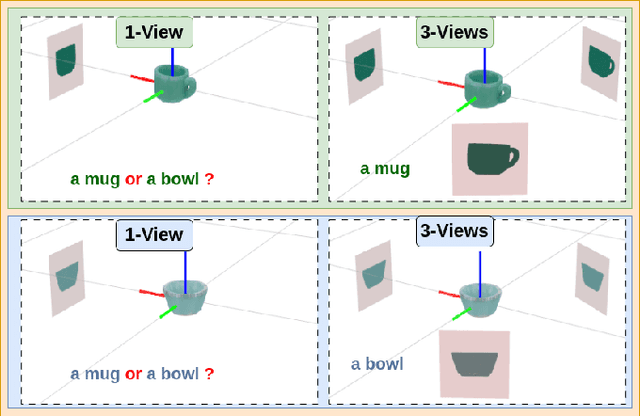
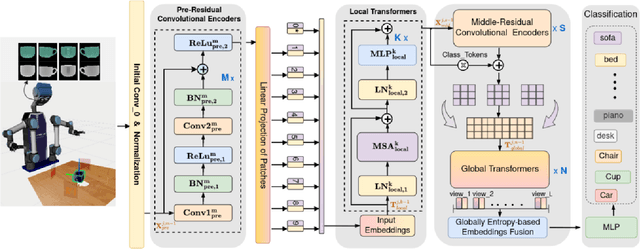
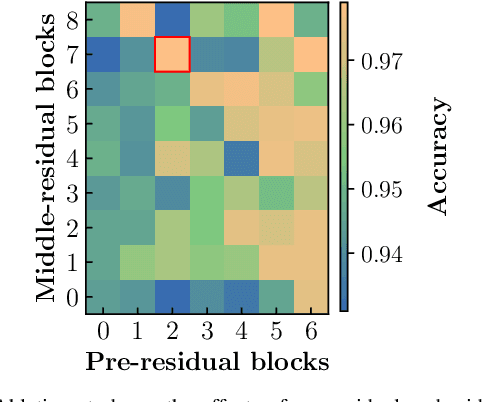
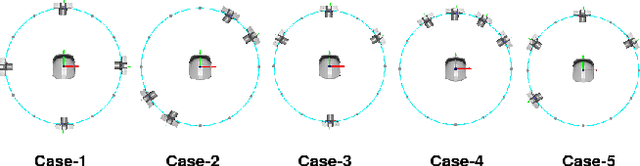
In human-centered environments such as restaurants, homes, and warehouses, robots often face challenges in accurately recognizing 3D objects. These challenges stem from the complexity and variability of these environments, including diverse object shapes. In this paper, we propose a novel Lightweight Multi-modal Multi-view Convolutional-Vision Transformer network (LM-MCVT) to enhance 3D object recognition in robotic applications. Our approach leverages the Globally Entropy-based Embeddings Fusion (GEEF) method to integrate multi-views efficiently. The LM-MCVT architecture incorporates pre- and mid-level convolutional encoders and local and global transformers to enhance feature extraction and recognition accuracy. We evaluate our method on the synthetic ModelNet40 dataset and achieve a recognition accuracy of 95.6% using a four-view setup, surpassing existing state-of-the-art methods. To further validate its effectiveness, we conduct 5-fold cross-validation on the real-world OmniObject3D dataset using the same configuration. Results consistently show superior performance, demonstrating the method's robustness in 3D object recognition across synthetic and real-world 3D data.