 Add to Chrome
 Add to Firefox
 Add to Edge
LIME: Learning Intent-aware Camera Motion from Egocentric Video
Jul 02, 2026
Autonomous robots often need to move their camera before they can act: to inspect an object, reveal an occluded region, or obtain a view that responds to a user's intent. While vision-language navigation translates instructions to base motion and vision-language-action policies map instructions to manipulation actions, language-conditioned camera motion remains comparatively underexplored as a first-class action. We formulate language-conditioned camera motion generation: given a current RGB observation and a free-form natural-language intent, predict a relative target camera pose for the next observation. This task is inherently non-trivial: viewpoint changes are driven by latent perceptual intentions, and a valid motion may operate at different semantic granularity, from entering a room to looking around a corner, inspecting a visible object, or revealing an occluded detail. To model this structure, we mine multi-intention camera-motion supervision from egocentric video, pairing plausible intents and observation-gain descriptions with relative SE(3) target poses. We propose LIME, a vision-language camera-motion generator that combines an auto-regressive observation-gain output with a continuous flow-matching pose head. This design lets the model jointly predict what the next view should reveal while representing multi-hypothesis target views. Across experiments and downstream robotic tasks, we show that LIME can learn to actively choose camera poses from passive human video, turning ordinary egocentric recordings into supervision for intent-aware active perception.

Articulated 3D Scene Graphs for Open-World Mobile Manipulation
Feb 18, 2026Semantics has enabled 3D scene understanding and affordance-driven object interaction. However, robots operating in real-world environments face a critical limitation: they cannot anticipate how objects move. Long-horizon mobile manipulation requires closing the gap between semantics, geometry, and kinematics. In this work, we present MoMa-SG, a novel framework for building semantic-kinematic 3D scene graphs of articulated scenes containing a myriad of interactable objects. Given RGB-D sequences containing multiple object articulations, we temporally segment object interactions and infer object motion using occlusion-robust point tracking. We then lift point trajectories into 3D and estimate articulation models using a novel unified twist estimation formulation that robustly estimates revolute and prismatic joint parameters in a single optimization pass. Next, we associate objects with estimated articulations and detect contained objects by reasoning over parent-child relations at identified opening states. We also introduce the novel Arti4D-Semantic dataset, which uniquely combines hierarchical object semantics including parent-child relation labels with object axis annotations across 62 in-the-wild RGB-D sequences containing 600 object interactions and three distinct observation paradigms. We extensively evaluate the performance of MoMa-SG on two datasets and ablate key design choices of our approach. In addition, real-world experiments on both a quadruped and a mobile manipulator demonstrate that our semantic-kinematic scene graphs enable robust manipulation of articulated objects in everyday home environments. We provide code and data at: https://momasg.cs.uni-freiburg.de.
Spot-On: A Mixed Reality Interface for Multi-Robot Cooperation
May 28, 2025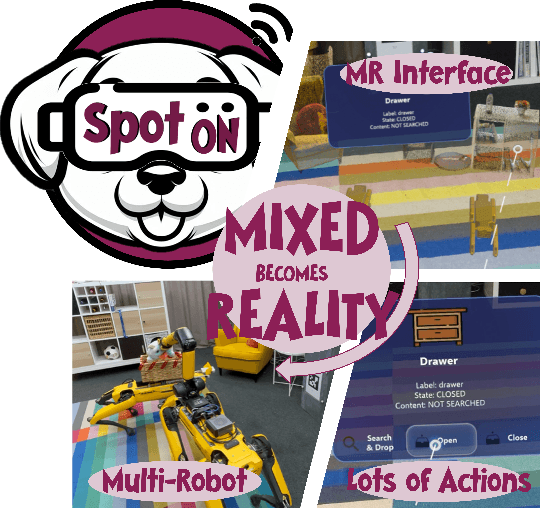
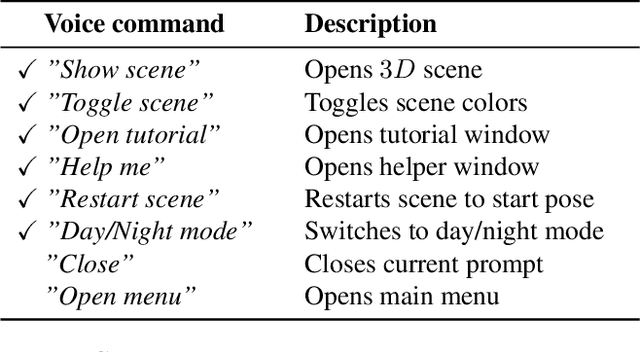
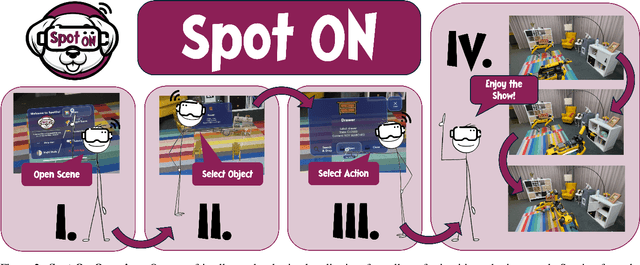
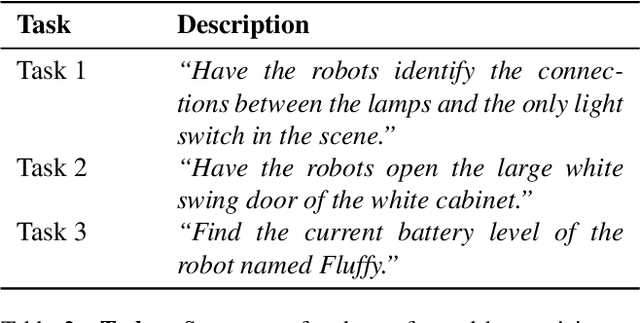
Recent progress in mixed reality (MR) and robotics is enabling increasingly sophisticated forms of human-robot collaboration. Building on these developments, we introduce a novel MR framework that allows multiple quadruped robots to operate in semantically diverse environments via a MR interface. Our system supports collaborative tasks involving drawers, swing doors, and higher-level infrastructure such as light switches. A comprehensive user study verifies both the design and usability of our app, with participants giving a "good" or "very good" rating in almost all cases. Overall, our approach provides an effective and intuitive framework for MR-based multi-robot collaboration in complex, real-world scenarios.
SpotLight: Robotic Scene Understanding through Interaction and Affordance Detection
Sep 18, 2024Despite increasing research efforts on household robotics, robots intended for deployment in domestic settings still struggle with more complex tasks such as interacting with functional elements like drawers or light switches, largely due to limited task-specific understanding and interaction capabilities. These tasks require not only detection and pose estimation but also an understanding of the affordances these elements provide. To address these challenges and enhance robotic scene understanding, we introduce SpotLight: A comprehensive framework for robotic interaction with functional elements, specifically light switches. Furthermore, this framework enables robots to improve their environmental understanding through interaction. Leveraging VLM-based affordance prediction to estimate motion primitives for light switch interaction, we achieve up to 84% operation success in real world experiments. We further introduce a specialized dataset containing 715 images as well as a custom detection model for light switch detection. We demonstrate how the framework can facilitate robot learning through physical interaction by having the robot explore the environment and discover previously unknown relationships in a scene graph representation. Lastly, we propose an extension to the framework to accommodate other functional interactions such as swing doors, showcasing its flexibility. Videos and Code: timengelbracht.github.io/SpotLight/