 Add to Chrome
 Add to Firefox
 Add to Edge
Think When It Matters: Conditional VLM Reasoning for Social Navigation with RL Policies
Jul 13, 2026
As mobile robots become more integrated into everyday human environments, social robot navigation is becoming essential for ensuring human comfort, safety, and trust. While reinforcement learning (RL) navigation policies provide the fast inference and reactive behavior necessary for real-time deployment, they still lack flexible semantic reasoning capabilities and often fail to generalize to complex social scenarios. Recent approaches have increasingly turned to vision-language models (VLMs) in place of RL policies to improve semantic and social reasoning in robot navigation. Nevertheless, their high computational cost and slow inference remain major barriers to real-time deployment. To overcome these limitations, we introduce HUMA (Hybrid Understanding for Multi-modal social Navigation), a hybrid architecture that dynamically balances the computational efficiency of RL policies with the deep semantic understanding of VLMs. Our approach uses a reactive RL policy to handle low-density, routine navigation tasks, while conditioning it on a post-trained high-level VLM when a human enters sensitive situations, such as the robot's proximity zone. We evaluate HUMA on the Social-MP3D and Social-HM3D benchmarks, where it achieves task success improvements of 20% and 3%, respectively, while significantly reducing personal space violations and human collisions against state-of-the-art baselines. Extensive ablation studies validate each architectural component, and real-world deployment on the Mirokaï mobile robot further demonstrates the practical viability of our approach.

HARMONI: Multimodal Personalization of Multi-User Human-Robot Interactions with LLMs
Jan 27, 2026Existing human-robot interaction systems often lack mechanisms for sustained personalization and dynamic adaptation in multi-user environments, limiting their effectiveness in real-world deployments. We present HARMONI, a multimodal personalization framework that leverages large language models to enable socially assistive robots to manage long-term multi-user interactions. The framework integrates four key modules: (i) a perception module that identifies active speakers and extracts multimodal input; (ii) a world modeling module that maintains representations of the environment and short-term conversational context; (iii) a user modeling module that updates long-term speaker-specific profiles; and (iv) a generation module that produces contextually grounded and ethically informed responses. Through extensive evaluation and ablation studies on four datasets, as well as a real-world scenario-driven user-study in a nursing home environment, we demonstrate that HARMONI supports robust speaker identification, online memory updating, and ethically aligned personalization, outperforming baseline LLM-driven approaches in user modeling accuracy, personalization quality, and user satisfaction.
Scalable, Training-Free Visual Language Robotics: A Modular Multi-Model Framework for Consumer-Grade GPUs
Feb 03, 2025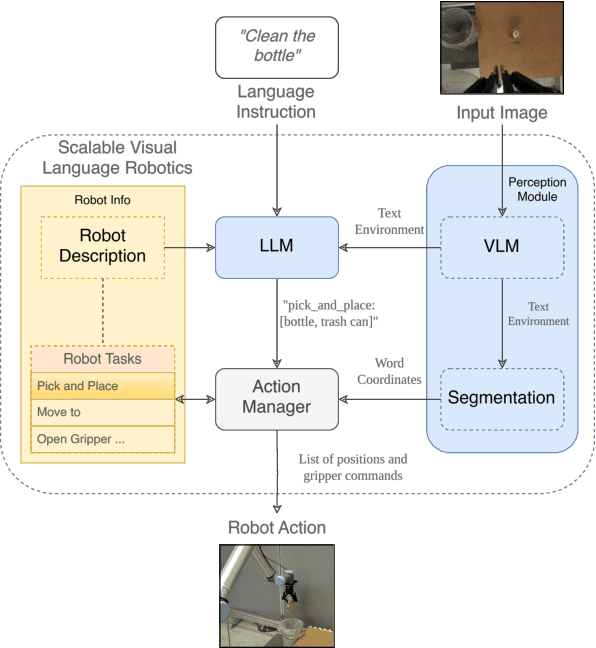
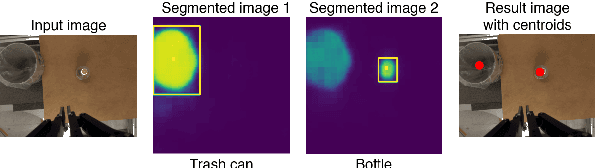
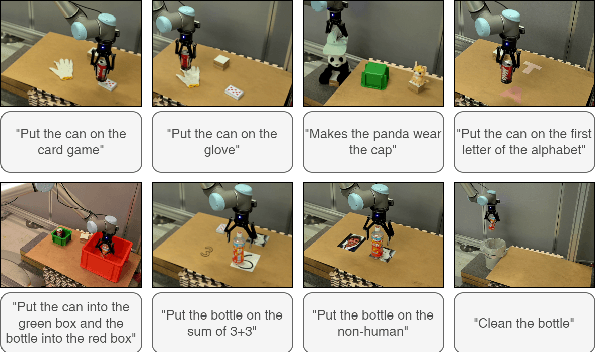
The integration of language instructions with robotic control, particularly through Vision Language Action (VLA) models, has shown significant potential. However, these systems are often hindered by high computational costs, the need for extensive retraining, and limited scalability, making them less accessible for widespread use. In this paper, we introduce SVLR (Scalable Visual Language Robotics), an open-source, modular framework that operates without the need for retraining, providing a scalable solution for robotic control. SVLR leverages a combination of lightweight, open-source AI models including the Vision-Language Model (VLM) Mini-InternVL, zero-shot image segmentation model CLIPSeg, Large Language Model Phi-3, and sentence similarity model all-MiniLM to process visual and language inputs. These models work together to identify objects in an unknown environment, use them as parameters for task execution, and generate a sequence of actions in response to natural language instructions. A key strength of SVLR is its scalability. The framework allows for easy integration of new robotic tasks and robots by simply adding text descriptions and task definitions, without the need for retraining. This modularity ensures that SVLR can continuously adapt to the latest advancements in AI technologies and support a wide range of robots and tasks. SVLR operates effectively on an NVIDIA RTX 2070 (mobile) GPU, demonstrating promising performance in executing pick-and-place tasks. While these initial results are encouraging, further evaluation across a broader set of tasks and comparisons with existing VLA models are needed to assess SVLR's generalization capabilities and performance in more complex scenarios.