 Add to Chrome
 Add to Firefox
 Add to Edge
Efficient Diffusion Personalization
Papers and Code
HINT: Hierarchical Interaction Modeling for Autoregressive Multi-Human Motion Generation
Jan 28, 2026
Text-driven multi-human motion generation with complex interactions remains a challenging problem. Despite progress in performance, existing offline methods that generate fixed-length motions with a fixed number of agents, are inherently limited in handling long or variable text, and varying agent counts. These limitations naturally encourage autoregressive formulations, which predict future motions step by step conditioned on all past trajectories and current text guidance. In this work, we introduce HINT, the first autoregressive framework for multi-human motion generation with Hierarchical INTeraction modeling in diffusion. First, HINT leverages a disentangled motion representation within a canonicalized latent space, decoupling local motion semantics from inter-person interactions. This design facilitates direct adaptation to varying numbers of human participants without requiring additional refinement. Second, HINT adopts a sliding-window strategy for efficient online generation, and aggregates local within-window and global cross-window conditions to capture past human history, inter-person dependencies, and align with text guidance. This strategy not only enables fine-grained interaction modeling within each window but also preserves long-horizon coherence across all the long sequence. Extensive experiments on public benchmarks demonstrate that HINT matches the performance of strong offline models and surpasses autoregressive baselines. Notably, on InterHuman, HINT achieves an FID of 3.100, significantly improving over the previous state-of-the-art score of 5.154.

Learning Language-Driven Sequence-Level Modal-Invariant Representations for Video-Based Visible-Infrared Person Re-Identification
Jan 17, 2026The core of video-based visible-infrared person re-identification (VVI-ReID) lies in learning sequence-level modal-invariant representations across different modalities. Recent research tends to use modality-shared language prompts generated by CLIP to guide the learning of modal-invariant representations. Despite achieving optimal performance, such methods still face limitations in efficient spatial-temporal modeling, sufficient cross-modal interaction, and explicit modality-level loss guidance. To address these issues, we propose the language-driven sequence-level modal-invariant representation learning (LSMRL) method, which includes spatial-temporal feature learning (STFL) module, semantic diffusion (SD) module and cross-modal interaction (CMI) module. To enable parameter- and computation-efficient spatial-temporal modeling, the STFL module is built upon CLIP with minimal modifications. To achieve sufficient cross-modal interaction and enhance the learning of modal-invariant features, the SD module is proposed to diffuse modality-shared language prompts into visible and infrared features to establish preliminary modal consistency. The CMI module is further developed to leverage bidirectional cross-modal self-attention to eliminate residual modality gaps and refine modal-invariant representations. To explicitly enhance the learning of modal-invariant representations, two modality-level losses are introduced to improve the features' discriminative ability and their generalization to unseen categories. Extensive experiments on large-scale VVI-ReID datasets demonstrate the superiority of LSMRL over AOTA methods.
Forget Less by Learning Together through Concept Consolidation
Jan 05, 2026Custom Diffusion Models (CDMs) have gained significant attention due to their remarkable ability to personalize generative processes. However, existing CDMs suffer from catastrophic forgetting when continuously learning new concepts. Most prior works attempt to mitigate this issue under the sequential learning setting with a fixed order of concept inflow and neglect inter-concept interactions. In this paper, we propose a novel framework - Forget Less by Learning Together (FL2T) - that enables concurrent and order-agnostic concept learning while addressing catastrophic forgetting. Specifically, we introduce a set-invariant inter-concept learning module where proxies guide feature selection across concepts, facilitating improved knowledge retention and transfer. By leveraging inter-concept guidance, our approach preserves old concepts while efficiently incorporating new ones. Extensive experiments, across three datasets, demonstrates that our method significantly improves concept retention and mitigates catastrophic forgetting, highlighting the effectiveness of inter-concept catalytic behavior in incremental concept learning of ten tasks with at least 2% gain on average CLIP Image Alignment scores.
Interact2Ar: Full-Body Human-Human Interaction Generation via Autoregressive Diffusion Models
Dec 22, 2025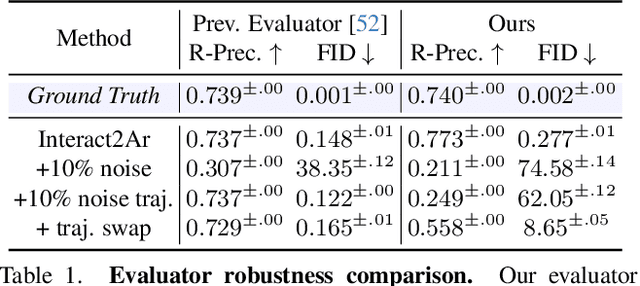
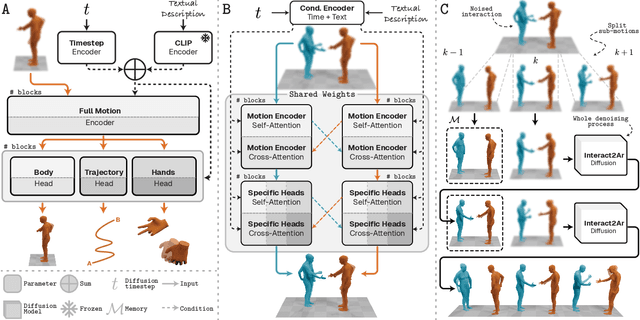
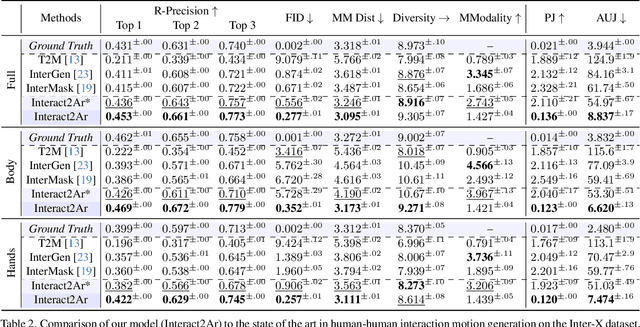
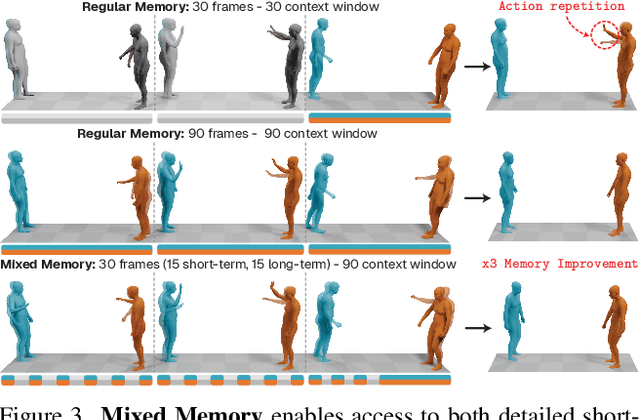
Generating realistic human-human interactions is a challenging task that requires not only high-quality individual body and hand motions, but also coherent coordination among all interactants. Due to limitations in available data and increased learning complexity, previous methods tend to ignore hand motions, limiting the realism and expressivity of the interactions. Additionally, current diffusion-based approaches generate entire motion sequences simultaneously, limiting their ability to capture the reactive and adaptive nature of human interactions. To address these limitations, we introduce Interact2Ar, the first end-to-end text-conditioned autoregressive diffusion model for generating full-body, human-human interactions. Interact2Ar incorporates detailed hand kinematics through dedicated parallel branches, enabling high-fidelity full-body generation. Furthermore, we introduce an autoregressive pipeline coupled with a novel memory technique that facilitates adaptation to the inherent variability of human interactions using efficient large context windows. The adaptability of our model enables a series of downstream applications, including temporal motion composition, real-time adaptation to disturbances, and extension beyond dyadic to multi-person scenarios. To validate the generated motions, we introduce a set of robust evaluators and extended metrics designed specifically for assessing full-body interactions. Through quantitative and qualitative experiments, we demonstrate the state-of-the-art performance of Interact2Ar.
Hand-Aware Egocentric Motion Reconstruction with Sequence-Level Context
Dec 22, 2025Egocentric vision systems are becoming widely available, creating new opportunities for human-computer interaction. A core challenge is estimating the wearer's full-body motion from first-person videos, which is crucial for understanding human behavior. However, this task is difficult since most body parts are invisible from the egocentric view. Prior approaches mainly rely on head trajectories, leading to ambiguity, or assume continuously tracked hands, which is unrealistic for lightweight egocentric devices. In this work, we present HaMoS, the first hand-aware, sequence-level diffusion framework that directly conditions on both head trajectory and intermittently visible hand cues caused by field-of-view limitations and occlusions, as in real-world egocentric devices. To overcome the lack of datasets pairing diverse camera views with human motion, we introduce a novel augmentation method that models such real-world conditions. We also demonstrate that sequence-level contexts such as body shape and field-of-view are crucial for accurate motion reconstruction, and thus employ local attention to infer long sequences efficiently. Experiments on public benchmarks show that our method achieves state-of-the-art accuracy and temporal smoothness, demonstrating a practical step toward reliable in-the-wild egocentric 3D motion understanding.
DeContext as Defense: Safe Image Editing in Diffusion Transformers
Dec 19, 2025In-context diffusion models allow users to modify images with remarkable ease and realism. However, the same power raises serious privacy concerns: personal images can be easily manipulated for identity impersonation, misinformation, or other malicious uses, all without the owner's consent. While prior work has explored input perturbations to protect against misuse in personalized text-to-image generation, the robustness of modern, large-scale in-context DiT-based models remains largely unexamined. In this paper, we propose DeContext, a new method to safeguard input images from unauthorized in-context editing. Our key insight is that contextual information from the source image propagates to the output primarily through multimodal attention layers. By injecting small, targeted perturbations that weaken these cross-attention pathways, DeContext breaks this flow, effectively decouples the link between input and output. This simple defense is both efficient and robust. We further show that early denoising steps and specific transformer blocks dominate context propagation, which allows us to concentrate perturbations where they matter most. Experiments on Flux Kontext and Step1X-Edit show that DeContext consistently blocks unwanted image edits while preserving visual quality. These results highlight the effectiveness of attention-based perturbations as a powerful defense against image manipulation. Code is available at https://github.com/LinghuiiShen/DeContext.
V-Warper: Appearance-Consistent Video Diffusion Personalization via Value Warping
Dec 13, 2025Video personalization aims to generate videos that faithfully reflect a user-provided subject while following a text prompt. However, existing approaches often rely on heavy video-based finetuning or large-scale video datasets, which impose substantial computational cost and are difficult to scale. Furthermore, they still struggle to maintain fine-grained appearance consistency across frames. To address these limitations, we introduce V-Warper, a training-free coarse-to-fine personalization framework for transformer-based video diffusion models. The framework enhances fine-grained identity fidelity without requiring any additional video training. (1) A lightweight coarse appearance adaptation stage leverages only a small set of reference images, which are already required for the task. This step encodes global subject identity through image-only LoRA and subject-embedding adaptation. (2) A inference-time fine appearance injection stage refines visual fidelity by computing semantic correspondences from RoPE-free mid-layer query--key features. These correspondences guide the warping of appearance-rich value representations into semantically aligned regions of the generation process, with masking ensuring spatial reliability. V-Warper significantly improves appearance fidelity while preserving prompt alignment and motion dynamics, and it achieves these gains efficiently without large-scale video finetuning.
Continuous-time Discrete-space Diffusion Model for Recommendation
Nov 15, 2025In the era of information explosion, Recommender Systems (RS) are essential for alleviating information overload and providing personalized user experiences. Recent advances in diffusion-based generative recommenders have shown promise in capturing the dynamic nature of user preferences. These approaches explore a broader range of user interests by progressively perturbing the distribution of user-item interactions and recovering potential preferences from noise, enabling nuanced behavioral understanding. However, existing diffusion-based approaches predominantly operate in continuous space through encoded graph-based historical interactions, which may compromise potential information loss and suffer from computational inefficiency. As such, we propose CDRec, a novel Continuous-time Discrete-space Diffusion Recommendation framework, which models user behavior patterns through discrete diffusion on historical interactions over continuous time. The discrete diffusion algorithm operates via discrete element operations (e.g., masking) while incorporating domain knowledge through transition matrices, producing more meaningful diffusion trajectories. Furthermore, the continuous-time formulation enables flexible adaptive sampling. To better adapt discrete diffusion models to recommendations, CDRec introduces: (1) a novel popularity-aware noise schedule that generates semantically meaningful diffusion trajectories, and (2) an efficient training framework combining consistency parameterization for fast sampling and a contrastive learning objective guided by multi-hop collaborative signals for personalized recommendation. Extensive experiments on real-world datasets demonstrate CDRec's superior performance in both recommendation accuracy and computational efficiency.
MusRec: Zero-Shot Text-to-Music Editing via Rectified Flow and Diffusion Transformers
Nov 06, 2025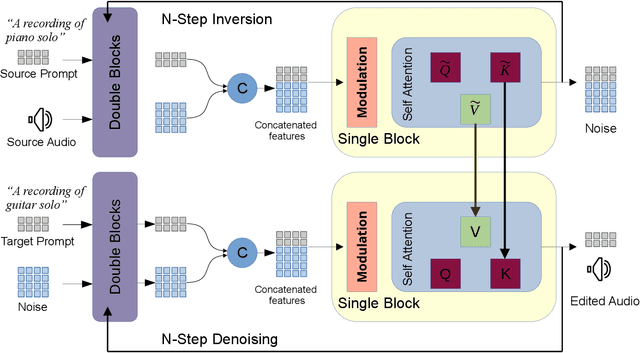
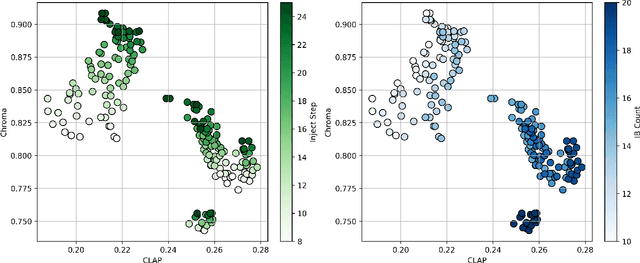
Music editing has emerged as an important and practical area of artificial intelligence, with applications ranging from video game and film music production to personalizing existing tracks according to user preferences. However, existing models face significant limitations, such as being restricted to editing synthesized music generated by their own models, requiring highly precise prompts, or necessitating task-specific retraining, thus lacking true zero-shot capability. Leveraging recent advances in rectified flow and diffusion transformers, we introduce MusRec, the first zero-shot text-to-music editing model capable of performing diverse editing tasks on real-world music efficiently and effectively. Experimental results demonstrate that our approach outperforms existing methods in preserving musical content, structural consistency, and editing fidelity, establishing a strong foundation for controllable music editing in real-world scenarios.
A Survey on Generative Recommendation: Data, Model, and Tasks
Oct 31, 2025Recommender systems serve as foundational infrastructure in modern information ecosystems, helping users navigate digital content and discover items aligned with their preferences. At their core, recommender systems address a fundamental problem: matching users with items. Over the past decades, the field has experienced successive paradigm shifts, from collaborative filtering and matrix factorization in the machine learning era to neural architectures in the deep learning era. Recently, the emergence of generative models, especially large language models (LLMs) and diffusion models, have sparked a new paradigm: generative recommendation, which reconceptualizes recommendation as a generation task rather than discriminative scoring. This survey provides a comprehensive examination through a unified tripartite framework spanning data, model, and task dimensions. Rather than simply categorizing works, we systematically decompose approaches into operational stages-data augmentation and unification, model alignment and training, task formulation and execution. At the data level, generative models enable knowledge-infused augmentation and agent-based simulation while unifying heterogeneous signals. At the model level, we taxonomize LLM-based methods, large recommendation models, and diffusion approaches, analyzing their alignment mechanisms and innovations. At the task level, we illuminate new capabilities including conversational interaction, explainable reasoning, and personalized content generation. We identify five key advantages: world knowledge integration, natural language understanding, reasoning capabilities, scaling laws, and creative generation. We critically examine challenges in benchmark design, model robustness, and deployment efficiency, while charting a roadmap toward intelligent recommendation assistants that fundamentally reshape human-information interaction.