 Add to Chrome
 Add to Firefox
 Add to Edge
TETO: Tracking Events with Teacher Observation for Motion Estimation and Frame Interpolation
Mar 24, 2026
Event cameras capture per-pixel brightness changes with microsecond resolution, offering continuous motion information lost between RGB frames. However, existing event-based motion estimators depend on large-scale synthetic data that often suffers from a significant sim-to-real gap. We propose TETO (Tracking Events with Teacher Observation), a teacher-student framework that learns event motion estimation from only $\sim$25 minutes of unannotated real-world recordings through knowledge distillation from a pretrained RGB tracker. Our motion-aware data curation and query sampling strategy maximizes learning from limited data by disentangling object motion from dominant ego-motion. The resulting estimator jointly predicts point trajectories and dense optical flow, which we leverage as explicit motion priors to condition a pretrained video diffusion transformer for frame interpolation. We achieve state-of-the-art point tracking on EVIMO2 and optical flow on DSEC using orders of magnitude less training data, and demonstrate that accurate motion estimation translates directly to superior frame interpolation quality on BS-ERGB and HQ-EVFI.

V-Warper: Appearance-Consistent Video Diffusion Personalization via Value Warping
Dec 13, 2025Video personalization aims to generate videos that faithfully reflect a user-provided subject while following a text prompt. However, existing approaches often rely on heavy video-based finetuning or large-scale video datasets, which impose substantial computational cost and are difficult to scale. Furthermore, they still struggle to maintain fine-grained appearance consistency across frames. To address these limitations, we introduce V-Warper, a training-free coarse-to-fine personalization framework for transformer-based video diffusion models. The framework enhances fine-grained identity fidelity without requiring any additional video training. (1) A lightweight coarse appearance adaptation stage leverages only a small set of reference images, which are already required for the task. This step encodes global subject identity through image-only LoRA and subject-embedding adaptation. (2) A inference-time fine appearance injection stage refines visual fidelity by computing semantic correspondences from RoPE-free mid-layer query--key features. These correspondences guide the warping of appearance-rich value representations into semantically aligned regions of the generation process, with masking ensuring spatial reliability. V-Warper significantly improves appearance fidelity while preserving prompt alignment and motion dynamics, and it achieves these gains efficiently without large-scale video finetuning.
Augmentation-Driven Metric for Balancing Preservation and Modification in Text-Guided Image Editing
Oct 15, 2024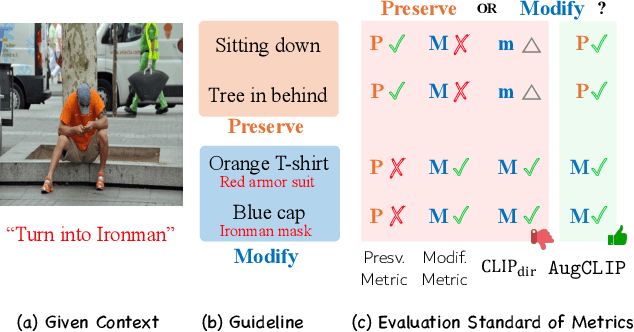

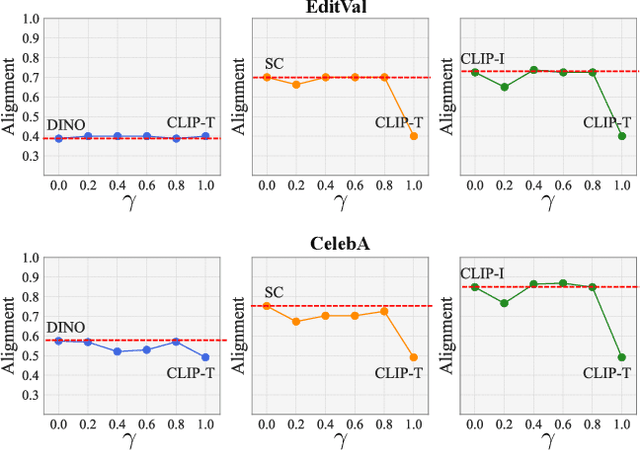
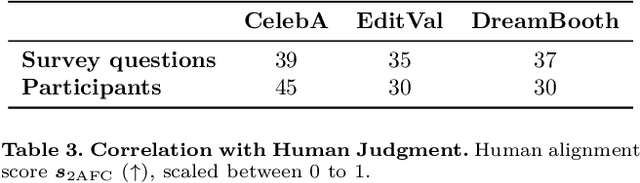
The development of vision-language and generative models has significantly advanced text-guided image editing, which seeks \textit{preservation} of core elements in the source image while implementing \textit{modifications} based on the target text. However, in the absence of evaluation metrics specifically tailored for text-guided image editing, existing metrics are limited in balancing the consideration of preservation and modification. Especially, our analysis reveals that CLIPScore, the most commonly used metric, tends to favor modification and ignore core attributes to be preserved, resulting in inaccurate evaluations. To address this problem, we propose \texttt{AugCLIP}, \black{which balances preservation and modification by estimating the representation of an ideal edited image that aligns with the target text with minimum alteration on the source image. We augment detailed textual descriptions on the source image and the target text using a multi-modal large language model, to model a hyperplane that separates CLIP space into source or target. The representation of the ideal edited image is an orthogonal projection of the source image into the hyperplane, which encapsulates the relative importance of each attribute considering the interdependent relationships.} Our extensive experiments on five benchmark datasets, encompassing a diverse range of editing scenarios, demonstrate that \texttt{AugCLIP} aligns remarkably well with human evaluation standards compared to existing metrics. The code for evaluation will be open-sourced to contribute to the community.