 Add to Chrome
 Add to Firefox
 Add to Edge
FirstDiff: One-Step Diffusion-Based Anomaly Detection for Multivariate Time Series via Initial Noise Prediction
Aug 16, 2026
Diffusion models have recently shown strong potential for multivariate time-series anomaly detection by learning the distribution of normal data through iterative denoising. Existing diffusion-based approaches, however, typically perform anomaly detection after completing the reverse diffusion process, relying primarily on the final reconstructed signal and overlooking informative representations produced during denoising. This design incurs substantial computational cost and limits the use of intermediate diffusion information for anomaly detection. In this paper, we propose FirstDiff, a diffusion-based anomaly detection framework based on the observation that the predicted diffusion noise at the initial reverse-diffusion evaluation already contains sufficient information for accurate anomaly detection. FirstDiff models the statistical distribution of predicted diffusion noise under normal behavior using validation data, enabling anomaly inference from a single denoising-network evaluation rather than completing the reverse diffusion trajectory. To model complex temporal and inter-sensor dependencies, FirstDiff employs a Diffusion Transformer as the denoising backbone. Extensive experiments on five public benchmark datasets demonstrate that FirstDiff achieves state-of-the-art performance while reducing diffusion inference from the full reverse trajectory to a single denoising-network evaluation.

FlowSonic: Stable Zero-Shot Music Editing via High-Order Trajectory Integration
Jul 20, 2026Zero-shot text-guided editing of real-world music recordings requires balancing semantic modification with faithful preservation of the original musical structure. Although recent diffusion transformers trained with rectified flow have achieved remarkable success in text-to-music generation, extending them to edit existing recordings remains challenging because editing requires accurate deterministic inversion, reliable structural preservation, and numerically stable integration throughout the inversion and generation processes. We present FlowSonic, a zero-shot music editing framework built upon a pretrained diffusion transformer trained with rectified flow. FlowSonic first deterministically inverts a real-world recording into the latent space and preserves its musical structure during editing by reusing cross-attention representations extracted during inversion. To improve the numerical reliability of inversion-based editing, we introduce a high-order ODE solver and systematically investigate how different numerical integration schemes influence trajectory stability, structural preservation, and semantic controllability. Comprehensive experiments on timbre-transfer and genre-modification tasks demonstrate that FlowSonic consistently outperforms existing music editing methods across semantic alignment, harmonic preservation, structural consistency, and perceptual audio quality. We further provide geometric and empirical analyses showing how the proposed numerical integration strategy improves latent trajectory stability and leads to more reliable music editing.
MusRec: Zero-Shot Text-to-Music Editing via Rectified Flow and Diffusion Transformers
Nov 06, 2025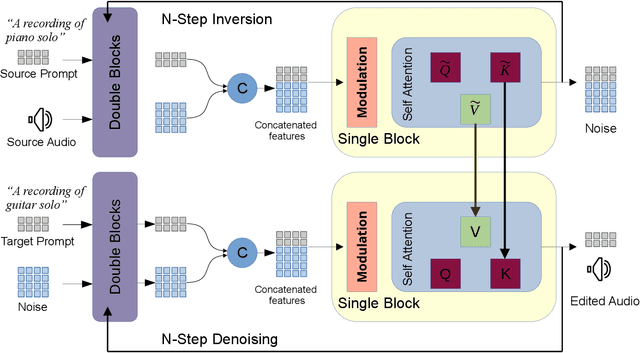
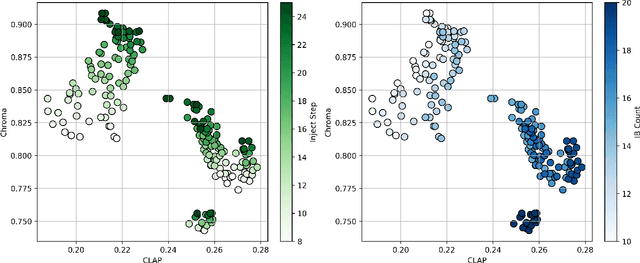
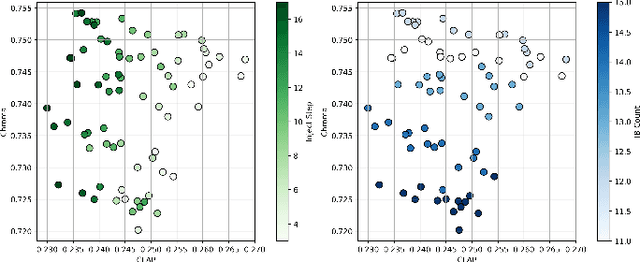
Music editing has emerged as an important and practical area of artificial intelligence, with applications ranging from video game and film music production to personalizing existing tracks according to user preferences. However, existing models face significant limitations, such as being restricted to editing synthesized music generated by their own models, requiring highly precise prompts, or necessitating task-specific retraining, thus lacking true zero-shot capability. Leveraging recent advances in rectified flow and diffusion transformers, we introduce MusRec, the first zero-shot text-to-music editing model capable of performing diverse editing tasks on real-world music efficiently and effectively. Experimental results demonstrate that our approach outperforms existing methods in preserving musical content, structural consistency, and editing fidelity, establishing a strong foundation for controllable music editing in real-world scenarios.