 Add to Chrome
 Add to Firefox
 Add to Edge
FirstDiff: One-Step Diffusion-Based Anomaly Detection for Multivariate Time Series via Initial Noise Prediction
Aug 16, 2026
Diffusion models have recently shown strong potential for multivariate time-series anomaly detection by learning the distribution of normal data through iterative denoising. Existing diffusion-based approaches, however, typically perform anomaly detection after completing the reverse diffusion process, relying primarily on the final reconstructed signal and overlooking informative representations produced during denoising. This design incurs substantial computational cost and limits the use of intermediate diffusion information for anomaly detection. In this paper, we propose FirstDiff, a diffusion-based anomaly detection framework based on the observation that the predicted diffusion noise at the initial reverse-diffusion evaluation already contains sufficient information for accurate anomaly detection. FirstDiff models the statistical distribution of predicted diffusion noise under normal behavior using validation data, enabling anomaly inference from a single denoising-network evaluation rather than completing the reverse diffusion trajectory. To model complex temporal and inter-sensor dependencies, FirstDiff employs a Diffusion Transformer as the denoising backbone. Extensive experiments on five public benchmark datasets demonstrate that FirstDiff achieves state-of-the-art performance while reducing diffusion inference from the full reverse trajectory to a single denoising-network evaluation.

FlowSonic: Stable Zero-Shot Music Editing via High-Order Trajectory Integration
Jul 20, 2026Zero-shot text-guided editing of real-world music recordings requires balancing semantic modification with faithful preservation of the original musical structure. Although recent diffusion transformers trained with rectified flow have achieved remarkable success in text-to-music generation, extending them to edit existing recordings remains challenging because editing requires accurate deterministic inversion, reliable structural preservation, and numerically stable integration throughout the inversion and generation processes. We present FlowSonic, a zero-shot music editing framework built upon a pretrained diffusion transformer trained with rectified flow. FlowSonic first deterministically inverts a real-world recording into the latent space and preserves its musical structure during editing by reusing cross-attention representations extracted during inversion. To improve the numerical reliability of inversion-based editing, we introduce a high-order ODE solver and systematically investigate how different numerical integration schemes influence trajectory stability, structural preservation, and semantic controllability. Comprehensive experiments on timbre-transfer and genre-modification tasks demonstrate that FlowSonic consistently outperforms existing music editing methods across semantic alignment, harmonic preservation, structural consistency, and perceptual audio quality. We further provide geometric and empirical analyses showing how the proposed numerical integration strategy improves latent trajectory stability and leads to more reliable music editing.
MusRec: Zero-Shot Text-to-Music Editing via Rectified Flow and Diffusion Transformers
Nov 06, 2025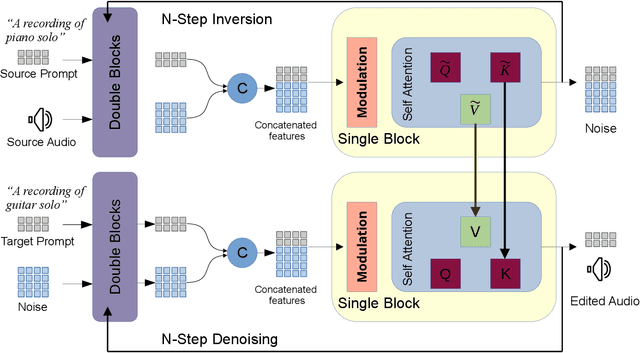
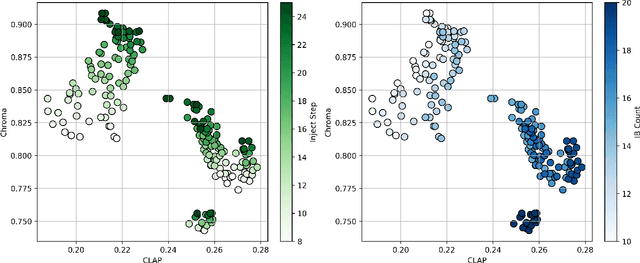
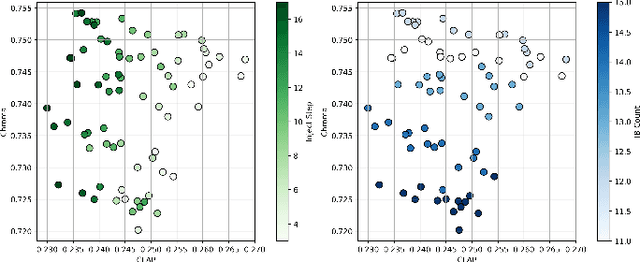
Music editing has emerged as an important and practical area of artificial intelligence, with applications ranging from video game and film music production to personalizing existing tracks according to user preferences. However, existing models face significant limitations, such as being restricted to editing synthesized music generated by their own models, requiring highly precise prompts, or necessitating task-specific retraining, thus lacking true zero-shot capability. Leveraging recent advances in rectified flow and diffusion transformers, we introduce MusRec, the first zero-shot text-to-music editing model capable of performing diverse editing tasks on real-world music efficiently and effectively. Experimental results demonstrate that our approach outperforms existing methods in preserving musical content, structural consistency, and editing fidelity, establishing a strong foundation for controllable music editing in real-world scenarios.
DCOR: Anomaly Detection in Attributed Networks via Dual Contrastive Learning Reconstruction
Dec 21, 2024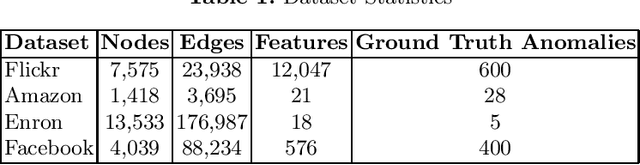
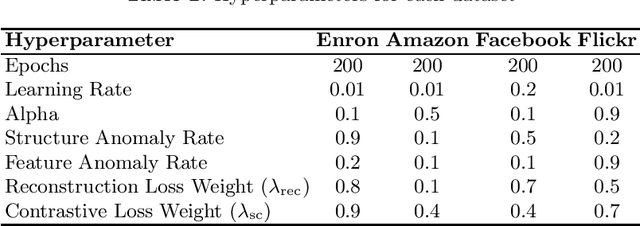

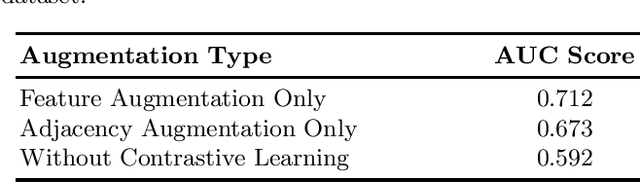
Anomaly detection using a network-based approach is one of the most efficient ways to identify abnormal events such as fraud, security breaches, and system faults in a variety of applied domains. While most of the earlier works address the complex nature of graph-structured data and predefined anomalies, the impact of data attributes and emerging anomalies are often neglected. This paper introduces DCOR, a novel approach on attributed networks that integrates reconstruction-based anomaly detection with Contrastive Learning. Utilizing a Graph Neural Network (GNN) framework, DCOR contrasts the reconstructed adjacency and feature matrices from both the original and augmented graphs to detect subtle anomalies. We employed comprehensive experimental studies on benchmark datasets through standard evaluation measures. The results show that DCOR significantly outperforms state-of-the-art methods. Obtained results demonstrate the efficacy of proposed approach in attributed networks with the potential of uncovering new patterns of anomalies.
Neural Graph Collaborative Filtering Using Variational Inference
Dec 02, 2023The customization of recommended content to users holds significant importance in enhancing user experiences across a wide spectrum of applications such as e-commerce, music, and shopping. Graph-based methods have achieved considerable performance by capturing user-item interactions. However, these methods tend to utilize randomly constructed embeddings in the dataset used for training the recommender, which lacks any user preferences. Here, we propose the concept of variational embeddings as a means of pre-training the recommender system to improve the feature propagation through the layers of graph convolutional networks (GCNs). The graph variational embedding collaborative filtering (GVECF) is introduced as a novel framework to incorporate representations learned through a variational graph auto-encoder which are embedded into a GCN-based collaborative filtering. This approach effectively transforms latent high-order user-item interactions into more trainable vectors, ultimately resulting in better performance in terms of recall and normalized discounted cumulative gain(NDCG) metrics. The experiments conducted on benchmark datasets demonstrate that our proposed method achieves up to 13.78% improvement in the recall over the test data.
Low-rank Dictionary Learning for Unsupervised Feature Selection
Jun 21, 2021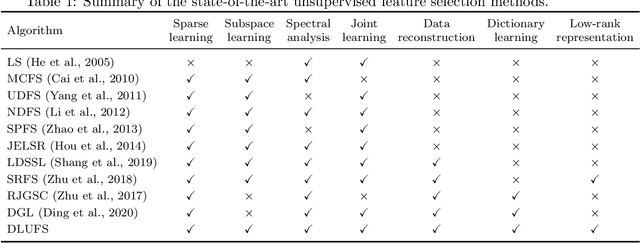
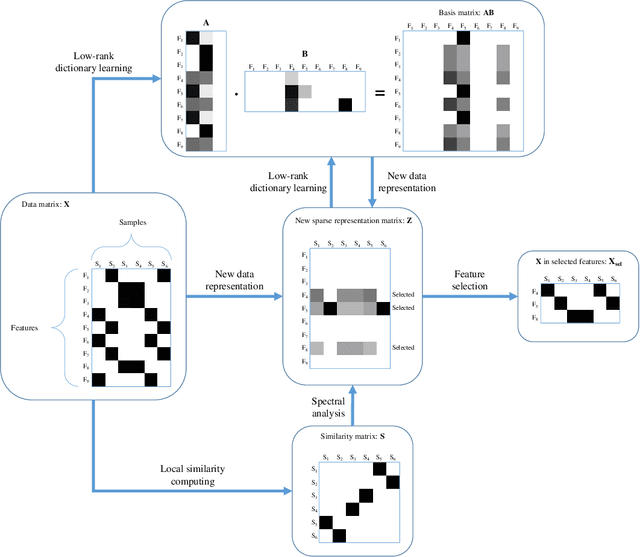
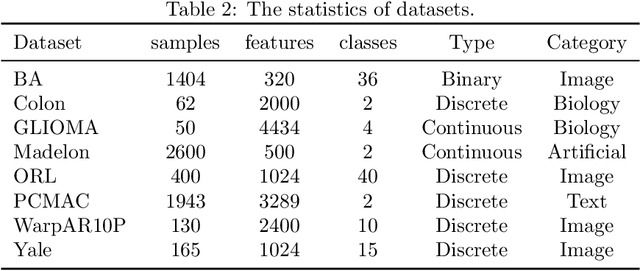
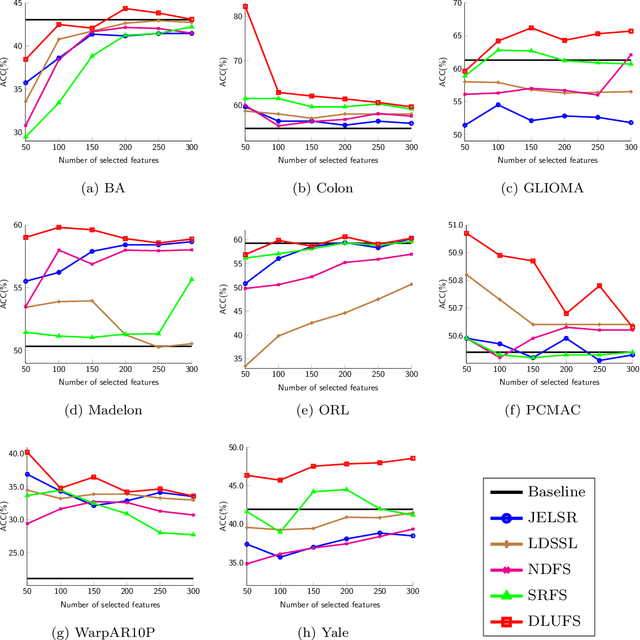
There exist many high-dimensional data in real-world applications such as biology, computer vision, and social networks. Feature selection approaches are devised to confront with high-dimensional data challenges with the aim of efficient learning technologies as well as reduction of models complexity. Due to the hardship of labeling on these datasets, there are a variety of approaches on feature selection process in an unsupervised setting by considering some important characteristics of data. In this paper, we introduce a novel unsupervised feature selection approach by applying dictionary learning ideas in a low-rank representation. Dictionary learning in a low-rank representation not only enables us to provide a new representation, but it also maintains feature correlation. Then, spectral analysis is employed to preserve sample similarities. Finally, a unified objective function for unsupervised feature selection is proposed in a sparse way by an $\ell_{2,1}$-norm regularization. Furthermore, an efficient numerical algorithm is designed to solve the corresponding optimization problem. We demonstrate the performance of the proposed method based on a variety of standard datasets from different applied domains. Our experimental findings reveal that the proposed method outperforms the state-of-the-art algorithm.
Detection of Community Structures in Networks with Nodal Features based on Generative Probabilistic Approach
Dec 24, 2019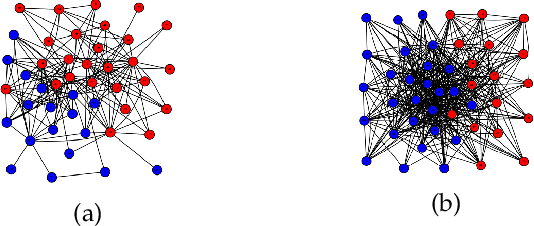
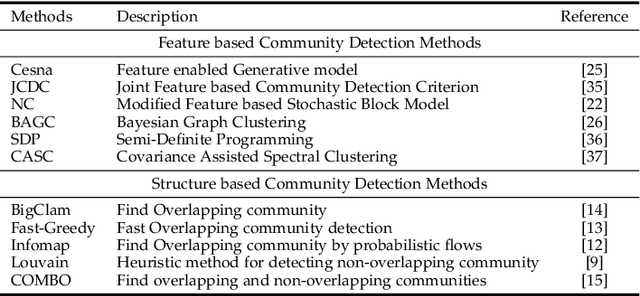
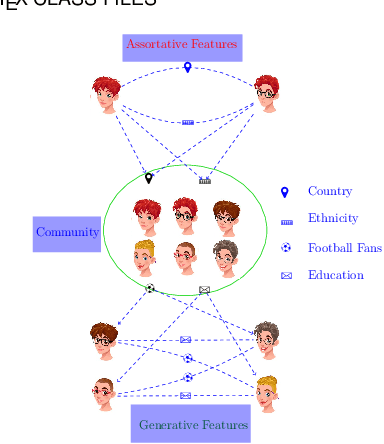
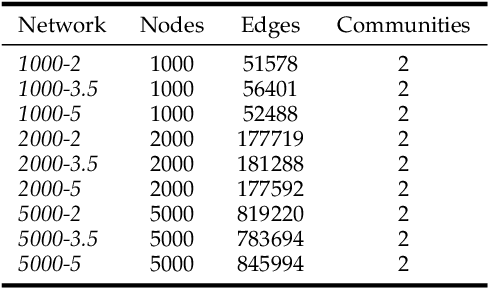
Community detection is considered as a fundamental task in analyzing social networks. Even though many techniques have been proposed for community detection, most of them are based exclusively on the connectivity structures. However, there are node features in real networks, such as gender types in social networks, feeding behavior in ecological networks, and location on e-trading networks, that can be further leveraged with the network structure to attain more accurate community detection methods. We propose a novel probabilistic graphical model to detect communities by taking into account both network structure and nodes' features. The proposed approach learns the relevant features of communities through a generative probabilistic model without any prior assumption on the communities. Furthermore, the model is capable of determining the strength of node features and structural elements of the networks on shaping the communities. The effectiveness of the proposed approach over the state-of-the-art algorithms is revealed on synthetic and benchmark networks.
* 12 pages, 13 figures, 6 tables
Unsupervised Feature Selection based on Adaptive Similarity Learning and Subspace Clustering
Dec 10, 2019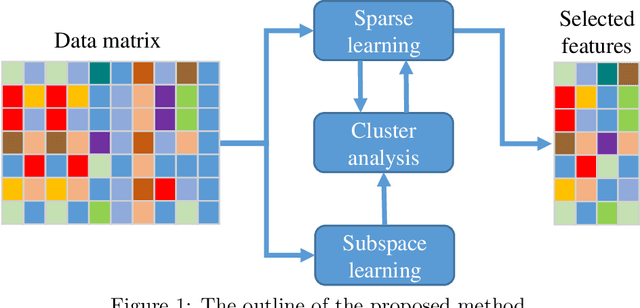
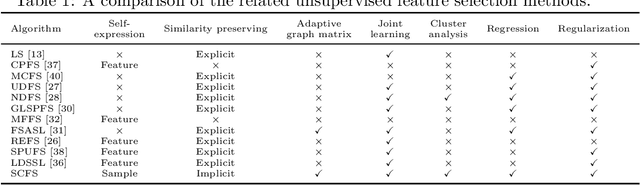
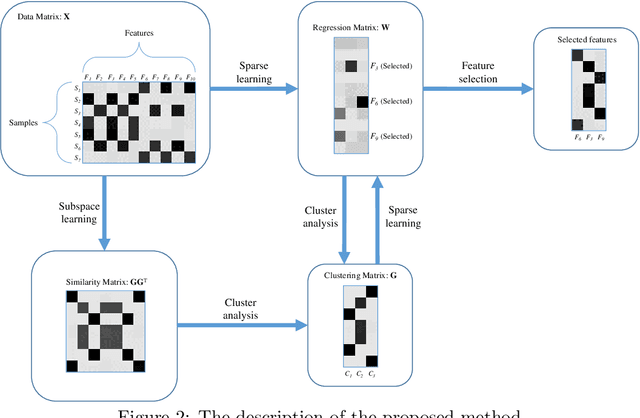
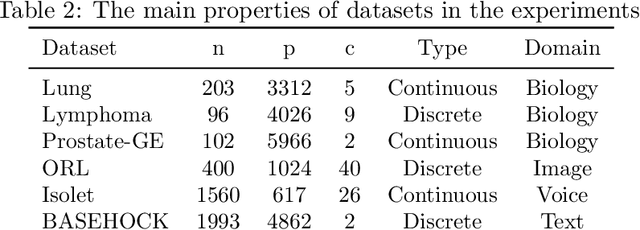
Feature selection methods have an important role on the readability of data and the reduction of complexity of learning algorithms. In recent years, a variety of efforts are investigated on feature selection problems based on unsupervised viewpoint due to the laborious labeling task on large datasets. In this paper, we propose a novel approach on unsupervised feature selection initiated from the subspace clustering to preserve the similarities by representation learning of low dimensional subspaces among the samples. A self-expressive model is employed to implicitly learn the cluster similarities in an adaptive manner. The proposed method not only maintains the sample similarities through subspace clustering, but it also captures the discriminative information based on a regularized regression model. In line with the convergence analysis of the proposed method, the experimental results on benchmark datasets demonstrate the effectiveness of our approach as compared with the state of the art methods.
Deep Sentiment Analysis using a Graph-based Text Representation
Feb 23, 2019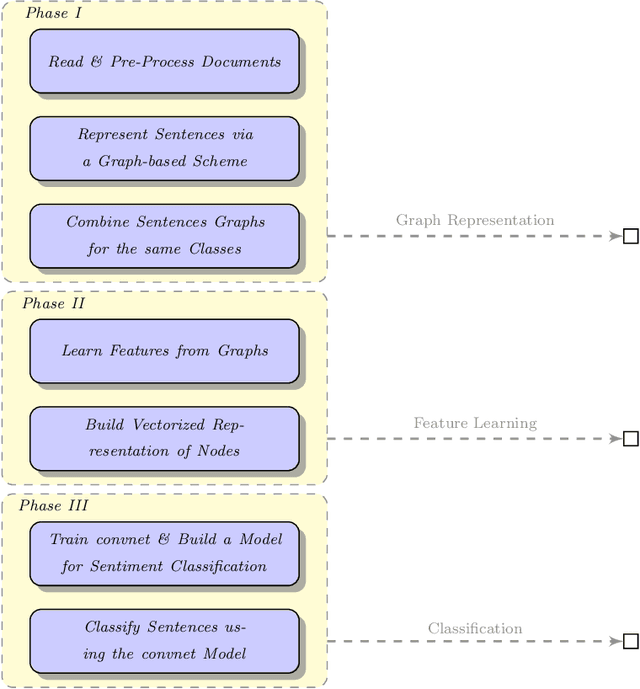
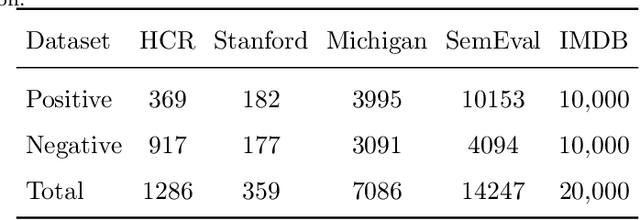
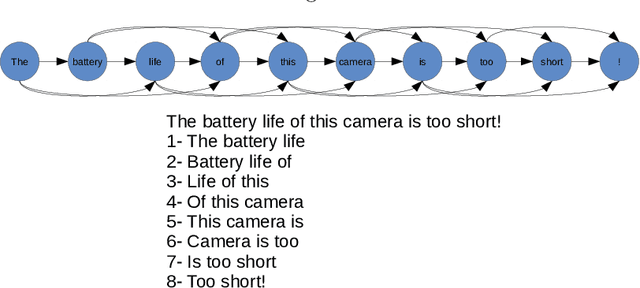
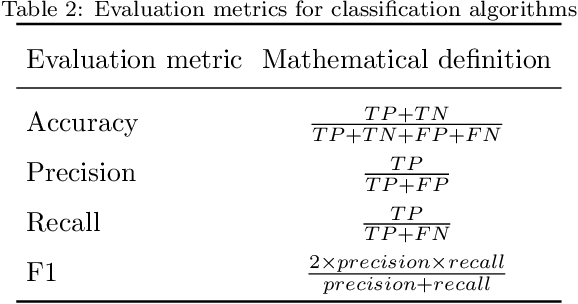
Social media brings about new ways of communication among people and is influencing trading strategies in the market. The popularity of social networks produces a large collection of unstructured data such as text and image in a variety of disciplines like business and health. The main element of social media arises as text which provokes a set of challenges for traditional information retrieval and natural language processing tools. Informal language, spelling errors, abbreviations, and special characters are typical in social media posts. These features lead to a prohibitively large vocabulary size for text mining methods. Another problem with traditional social text mining techniques is that they fail to take semantic relations into account, which is essential in a domain of applications such as event detection, opinion mining, and news recommendation. This paper set out to employ a network-based viewpoint on text documents and investigate the usefulness of graph representation to exploit word relations and semantics of the textual data. Moreover, the proposed approach makes use of a random walker to extract deep features of a graph to facilitate the task of document classification. The experimental results indicate that the proposed approach defeats the earlier sentiment analysis methods based on several benchmark datasets, and it generalizes well on different datasets without dependency for pre-trained word embeddings.
Deep Learning Approach on Information Diffusion in Heterogeneous Networks
Feb 23, 2019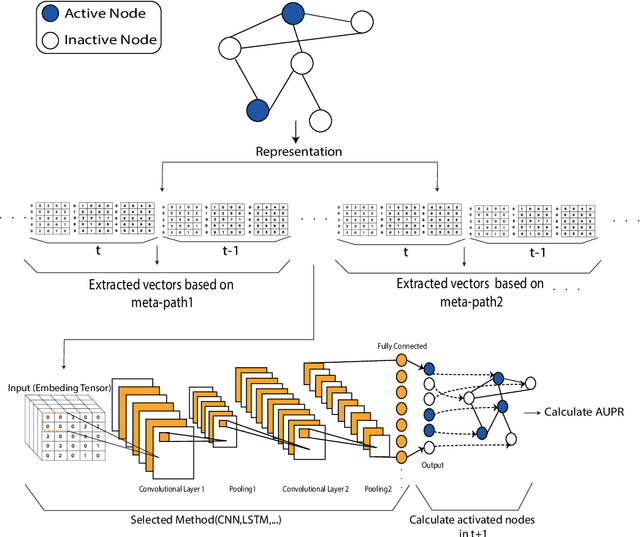
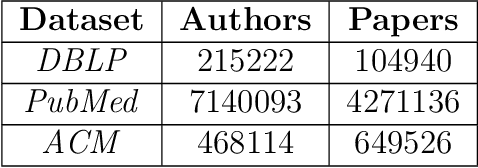
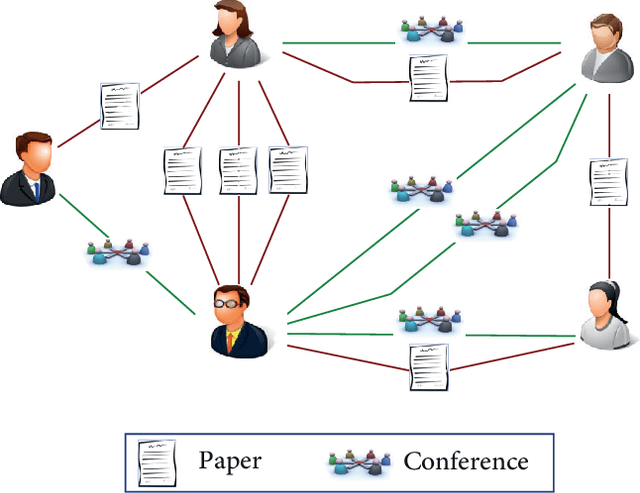
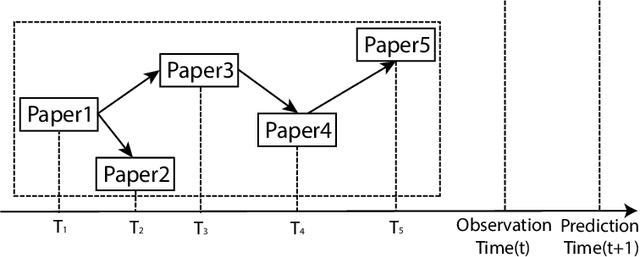
There are many real-world knowledge based networked systems with multi-type interacting entities that can be regarded as heterogeneous networks including human connections and biological evolutions. One of the main issues in such networks is to predict information diffusion such as shape, growth and size of social events and evolutions in the future. While there exist a variety of works on this topic mainly using a threshold-based approach, they suffer from the local viewpoint on the network and sensitivity to the threshold parameters. In this paper, information diffusion is considered through a latent representation learning of the heterogeneous networks to encode in a deep learning model. To this end, we propose a novel meta-path representation learning approach, Heterogeneous Deep Diffusion(HDD), to exploit meta-paths as main entities in networks. At first, the functional heterogeneous structures of the network are learned by a continuous latent representation through traversing meta-paths with the aim of global end-to-end viewpoint. Then, the well-known deep learning architectures are employed on our generated features to predict diffusion processes in the network. The proposed approach enables us to apply it on different information diffusion tasks such as topic diffusion and cascade prediction. We demonstrate the proposed approach on benchmark network datasets through the well-known evaluation measures. The experimental results show that our approach outperforms the earlier state-of-the-art methods.