 Add to Chrome
 Add to Firefox
 Add to Edge
TheBioCollection: Unified Pre-Training Scale LLM Corpus for Biology
Jul 09, 2026
The push toward large language models for biology (BioLM) has created a need for training corpora that can endow models with a genuine understanding of biology. However, existing biological resources, such as molecular databases, protein repositories, genomic annotations, single-cell atlases, and pathway databases, are scattered across heterogeneous formats and remain unorganized into a cohesive corpus for language model training. We present TheBioCollection, a 52.6B-token pre-training-scale corpus that converts these disparate resources into a unified, training-ready form spanning small molecules, proteins, genomic sequences, cells, and pathways. Beyond consolidating existing data, TheBioCollection enriches each record with tool-computed biological properties and introduces new instruction tasks for capabilities that current corpora barely cover. We pair the corpus with TheBioCollection-Eval, a matched suite probing recognition, generation, and prediction across molecular, protein, genomic, cellular, and cross-domain settings. Holding the base Gravity-16B-A3B architecture fixed, training on TheBioCollection more than doubles its overall score on TheBioCollection-Eval with gains in every domain, while leaving general linguistic ability nearly intact.

Do Counterfactually Fair Image Classifiers Satisfy Group Fairness? -- A Theoretical and Empirical Study
Jul 07, 2026The notion of algorithmic fairness has been actively explored from various aspects of fairness, such as counterfactual fairness (CF) and group fairness (GF). However, the exact relationship between CF and GF remains to be unclear, especially in image classification tasks; the reason is because we often cannot collect counterfactual samples regarding a sensitive attribute, essential for evaluating CF, from the existing images (\eg, a photo of the same person but with different secondary sex characteristics). In this paper, we construct new image datasets for evaluating CF by using a high-quality image editing method and carefully labeling with human annotators. Our datasets, \oursceleb and \ourslfw, build upon the popular image GF benchmarks; hence, we can evaluate CF and GF simultaneously. We empirically observe that CF does not imply GF in image classification, whereas previous studies on tabular datasets observed the opposite. We theoretically show that it could be due to the existence of a latent attribute $G$ that is correlated with, but not caused by, the sensitive attribute (\eg, secondary sex characteristics are highly correlated with hair length). From this observation, we propose a simple baseline, Counterfactual Knowledge Distillation (CKD), to mitigate such correlation with the sensitive attributes. Extensive experimental results on \oursceleb and \ourslfw demonstrate that CF-achieving models satisfy GF if we successfully reduce the reliance on $G$ (\eg, using CKD).
Transferability Between Understanding and Generation in Unified Multimodal Models
Jul 05, 2026Unified Multimodal Models (UMMs) integrate image understanding and generation within a single architecture, yet how the two tasks interact remains understudied. We investigate $\boldsymbol{\mathsf{transferability}}$ in UMMs: whether training a capability on one task improves the same capability on the other without explicit supervision. Through controlled experiments, we empirically find that transferability depends on architecture-models with fully shared transformer backbone and a unified visual encoder exhibit consistent cross-task transfer, while loosely coupled designs show little or none. Leveraging this transferability, we propose a practical training strategy. The most straightforward way to improve a target generative capability (e.g., counting) is to fine-tune generation directly, but this can degrade visual quality due to distribution shift. Instead, we train the corresponding understanding task and let it transfer into generation, which improves capability-specific generative performance while minimizing distribution shift. We validate this across three capabilities-counting, spatial relation, and text recognition/generation-showing that cross-task transferability can be systematically exploited in UMMs.
Advancing DialNav through Automatic Embodied Dialog Augmentation
Jun 18, 2026For embodied agents capable of physical interaction, the capability to create and understand dialog is crucial to ensure both safety and effectiveness. While DialNav~\cite{han2025dialnav} provides a framework for holistic evaluation of the dialog--execution loop in photorealistic indoor navigation, its performance remains limited by a critical scarcity of training data (2K episodes). To address this, we propose an automatic generation pipeline, and construct the \textbf{RAINbow} dataset, a large-scale training dataset with 238K episodes for DialNav. Our pipeline converts existing VLN datasets into multi-turn dialog and creates cost-efficient and high-quality dataset. Then, we introduce two additional complementary advances to unlock the data's full potential: (1) Dual-Strategy Training, a navigation training scheme to align the navigation training with the dynamic dialog-navigation loop, and (2) a localization model that leverages VLN knowledge. By combining these complementary solutions, our model substantially outperforms the baseline in success rate on both \textbf{Val Seen} (58.24, \textbf{+89\%}) and \textbf{Val Unseen} (29.05, \textbf{+100\%}) splits, establishing a new state of the art.
Extreme-MIMO Field Trials in 7 GHz Band: Unlocking the Potential of New Spectrum for 6G
Mar 23, 2026The frequency range around 7 GHz has emerged as a promising upper mid-band spectrum for 6th generation (6G), offering a practical balance between coverage and capacity. To fully exploit this band, however, future systems require substantially stronger beamforming and spatial multiplexing capability than today's 5G 64-port commercial deployments. This article investigates extreme multiple-input multiple-output (X-MIMO) with 256 digital ports as a practical 6G architecture for 7 GHz operation. First, through system-level simulations, we examine the throughput benefits and design trade-offs of increasing the number of base station (BS) and user equipment (UE) digital antenna ports, including comparisons between 128-port and 256-port configurations. We then present a 256-port 7 GHz BS and UE prototype and report field-trial results obtained in urban outdoor environments. The measurements demonstrate the feasibility of 8-layer downlink single-user MIMO over a 100 MHz bandwidth, achieving more than 3 Gbps for a single user under urban outdoor propagation conditions. Channel analysis based on measured data further suggests how the large digital aperture of X-MIMO supports high-order spatial multiplexing even with limited dominant angular clusters. Finally, we identify key challenges and outline research directions toward practical deployment of 7 GHz X-MIMO systems for 6G.
V-Warper: Appearance-Consistent Video Diffusion Personalization via Value Warping
Dec 13, 2025Video personalization aims to generate videos that faithfully reflect a user-provided subject while following a text prompt. However, existing approaches often rely on heavy video-based finetuning or large-scale video datasets, which impose substantial computational cost and are difficult to scale. Furthermore, they still struggle to maintain fine-grained appearance consistency across frames. To address these limitations, we introduce V-Warper, a training-free coarse-to-fine personalization framework for transformer-based video diffusion models. The framework enhances fine-grained identity fidelity without requiring any additional video training. (1) A lightweight coarse appearance adaptation stage leverages only a small set of reference images, which are already required for the task. This step encodes global subject identity through image-only LoRA and subject-embedding adaptation. (2) A inference-time fine appearance injection stage refines visual fidelity by computing semantic correspondences from RoPE-free mid-layer query--key features. These correspondences guide the warping of appearance-rich value representations into semantically aligned regions of the generation process, with masking ensuring spatial reliability. V-Warper significantly improves appearance fidelity while preserving prompt alignment and motion dynamics, and it achieves these gains efficiently without large-scale video finetuning.
Multi-Group Proportional Representation for Text-to-Image Models
May 29, 2025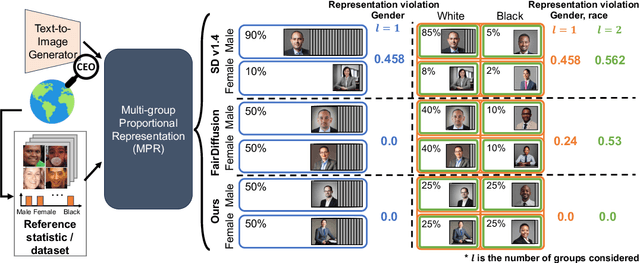
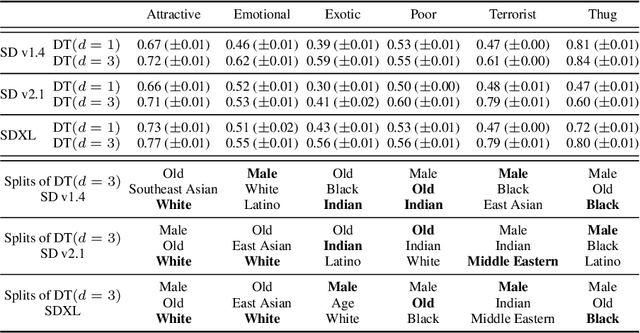
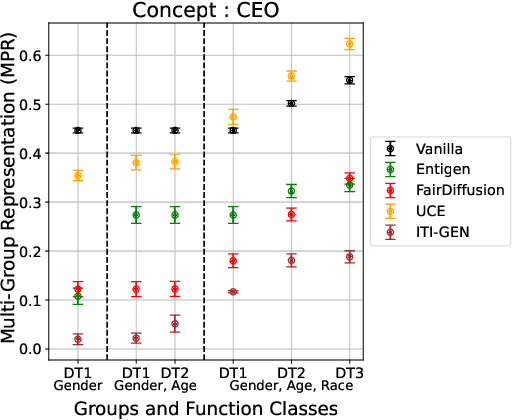
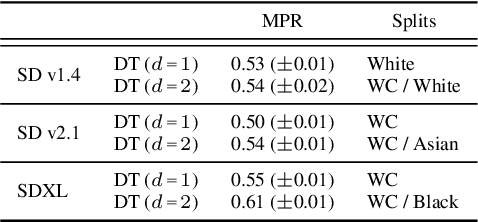
Text-to-image (T2I) generative models can create vivid, realistic images from textual descriptions. As these models proliferate, they expose new concerns about their ability to represent diverse demographic groups, propagate stereotypes, and efface minority populations. Despite growing attention to the "safe" and "responsible" design of artificial intelligence (AI), there is no established methodology to systematically measure and control representational harms in image generation. This paper introduces a novel framework to measure the representation of intersectional groups in images generated by T2I models by applying the Multi-Group Proportional Representation (MPR) metric. MPR evaluates the worst-case deviation of representation statistics across given population groups in images produced by a generative model, allowing for flexible and context-specific measurements based on user requirements. We also develop an algorithm to optimize T2I models for this metric. Through experiments, we demonstrate that MPR can effectively measure representation statistics across multiple intersectional groups and, when used as a training objective, can guide models toward a more balanced generation across demographic groups while maintaining generation quality.
Listwise Reward Estimation for Offline Preference-based Reinforcement Learning
Aug 08, 2024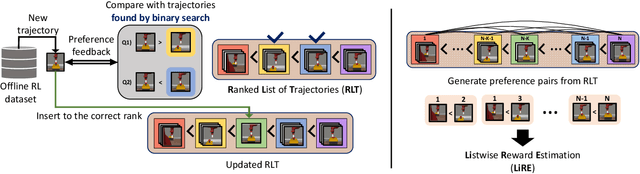
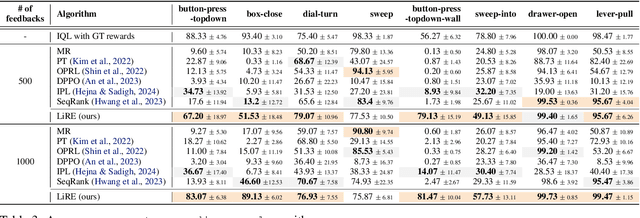
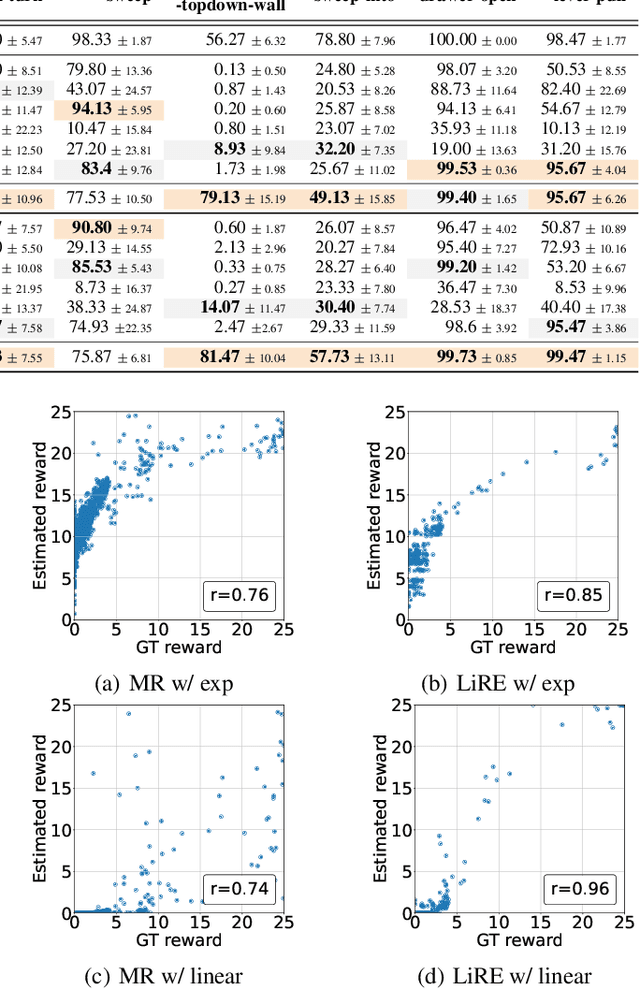
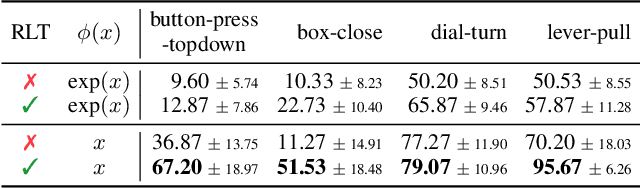
In Reinforcement Learning (RL), designing precise reward functions remains to be a challenge, particularly when aligning with human intent. Preference-based RL (PbRL) was introduced to address this problem by learning reward models from human feedback. However, existing PbRL methods have limitations as they often overlook the second-order preference that indicates the relative strength of preference. In this paper, we propose Listwise Reward Estimation (LiRE), a novel approach for offline PbRL that leverages second-order preference information by constructing a Ranked List of Trajectories (RLT), which can be efficiently built by using the same ternary feedback type as traditional methods. To validate the effectiveness of LiRE, we propose a new offline PbRL dataset that objectively reflects the effect of the estimated rewards. Our extensive experiments on the dataset demonstrate the superiority of LiRE, i.e., outperforming state-of-the-art baselines even with modest feedback budgets and enjoying robustness with respect to the number of feedbacks and feedback noise. Our code is available at https://github.com/chwoong/LiRE
Continual Learning in the Presence of Spurious Correlation
Mar 21, 2023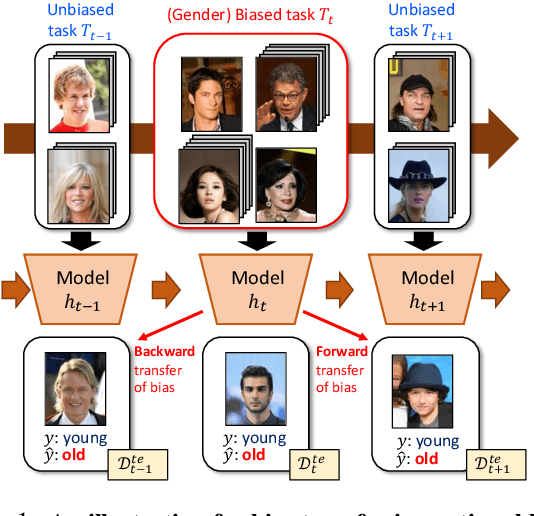

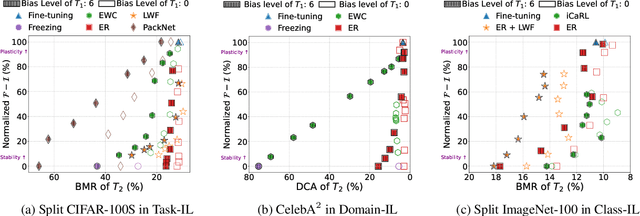
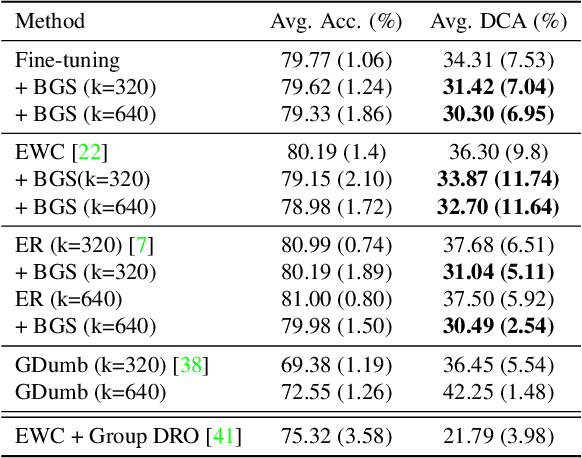
Most continual learning (CL) algorithms have focused on tackling the stability-plasticity dilemma, that is, the challenge of preventing the forgetting of previous tasks while learning new ones. However, they have overlooked the impact of the knowledge transfer when the dataset in a certain task is biased - namely, when some unintended spurious correlations of the tasks are learned from the biased dataset. In that case, how would they affect learning future tasks or the knowledge already learned from the past tasks? In this work, we carefully design systematic experiments using one synthetic and two real-world datasets to answer the question from our empirical findings. Specifically, we first show through two-task CL experiments that standard CL methods, which are unaware of dataset bias, can transfer biases from one task to another, both forward and backward, and this transfer is exacerbated depending on whether the CL methods focus on the stability or the plasticity. We then present that the bias transfer also exists and even accumulate in longer sequences of tasks. Finally, we propose a simple, yet strong plug-in method for debiasing-aware continual learning, dubbed as Group-class Balanced Greedy Sampling (BGS). As a result, we show that our BGS can always reduce the bias of a CL model, with a slight loss of CL performance at most.
Re-weighting Based Group Fairness Regularization via Classwise Robust Optimization
Mar 01, 2023Many existing group fairness-aware training methods aim to achieve the group fairness by either re-weighting underrepresented groups based on certain rules or using weakly approximated surrogates for the fairness metrics in the objective as regularization terms. Although each of the learning schemes has its own strength in terms of applicability or performance, respectively, it is difficult for any method in the either category to be considered as a gold standard since their successful performances are typically limited to specific cases. To that end, we propose a principled method, dubbed as \ours, which unifies the two learning schemes by incorporating a well-justified group fairness metric into the training objective using a class wise distributionally robust optimization (DRO) framework. We then develop an iterative optimization algorithm that minimizes the resulting objective by automatically producing the correct re-weights for each group. Our experiments show that FairDRO is scalable and easily adaptable to diverse applications, and consistently achieves the state-of-the-art performance on several benchmark datasets in terms of the accuracy-fairness trade-off, compared to recent strong baselines.