 Add to Chrome
 Add to Firefox
 Add to Edge
Coded Hankel Polynomial Chaos: Spectral Identification of Dominant Polynomial-Chaos Modes
Aug 17, 2026
Identification of dominant polynomial-chaos modes is usually formulated as a sparse-regression problem on a sampled multivariate polynomial dictionary. We develop coded Hankel polynomial chaos (CH-PC), a complementary spectral formulation for dominant-mode identification. A finite generating transform converts PCE coefficients into a coefficient-generating polynomial, and evaluation along a geometric phase orbit produces a finite exponential sum. Its model order and spectral nodes are encoded by low-rank Hankel matrices, while coordinate phase shifts attach root-of-unity labels from which the full polynomial multi-indices are recovered. Coordinate-shifted probes are combined as common-node snapshots, and independent phase encodings provide redundant representations when a single spectral encoding is poorly conditioned. For finite observations, population, finite-data, and observed probes are kept distinct: sampling or quadrature error and observation error enter as separate Hankel perturbations, which are then connected to spectral stability, discrete decoding, and phase voting. For tensor-product candidate sets, the generating kernel factorizes into one-dimensional sums and can be evaluated without assembling the full multivariate PCE design matrix. Numerical experiments on sparse Legendre benchmarks and a stochastic Darcy problem illustrate exact recovery, noise stabilization, unknown-order identification by phase persistence, and dominant-mode recovery for a PDE-generated quantity of interest.

Learning Language-Driven Sequence-Level Modal-Invariant Representations for Video-Based Visible-Infrared Person Re-Identification
Jan 17, 2026The core of video-based visible-infrared person re-identification (VVI-ReID) lies in learning sequence-level modal-invariant representations across different modalities. Recent research tends to use modality-shared language prompts generated by CLIP to guide the learning of modal-invariant representations. Despite achieving optimal performance, such methods still face limitations in efficient spatial-temporal modeling, sufficient cross-modal interaction, and explicit modality-level loss guidance. To address these issues, we propose the language-driven sequence-level modal-invariant representation learning (LSMRL) method, which includes spatial-temporal feature learning (STFL) module, semantic diffusion (SD) module and cross-modal interaction (CMI) module. To enable parameter- and computation-efficient spatial-temporal modeling, the STFL module is built upon CLIP with minimal modifications. To achieve sufficient cross-modal interaction and enhance the learning of modal-invariant features, the SD module is proposed to diffuse modality-shared language prompts into visible and infrared features to establish preliminary modal consistency. The CMI module is further developed to leverage bidirectional cross-modal self-attention to eliminate residual modality gaps and refine modal-invariant representations. To explicitly enhance the learning of modal-invariant representations, two modality-level losses are introduced to improve the features' discriminative ability and their generalization to unseen categories. Extensive experiments on large-scale VVI-ReID datasets demonstrate the superiority of LSMRL over AOTA methods.
CLIP4VI-ReID: Learning Modality-shared Representations via CLIP Semantic Bridge for Visible-Infrared Person Re-identification
Nov 13, 2025This paper proposes a novel CLIP-driven modality-shared representation learning network named CLIP4VI-ReID for VI-ReID task, which consists of Text Semantic Generation (TSG), Infrared Feature Embedding (IFE), and High-level Semantic Alignment (HSA). Specifically, considering the huge gap in the physical characteristics between natural images and infrared images, the TSG is designed to generate text semantics only for visible images, thereby enabling preliminary visible-text modality alignment. Then, the IFE is proposed to rectify the feature embeddings of infrared images using the generated text semantics. This process injects id-related semantics into the shared image encoder, enhancing its adaptability to the infrared modality. Besides, with text serving as a bridge, it enables indirect visible-infrared modality alignment. Finally, the HSA is established to refine the high-level semantic alignment. This process ensures that the fine-tuned text semantics only contain id-related information, thereby achieving more accurate cross-modal alignment and enhancing the discriminability of the learned modal-shared representations. Extensive experimental results demonstrate that the proposed CLIP4VI-ReID achieves superior performance than other state-of-the-art methods on some widely used VI-ReID datasets.
Multi-layer Attention Mechanism for Speech Keyword Recognition
Jul 10, 2019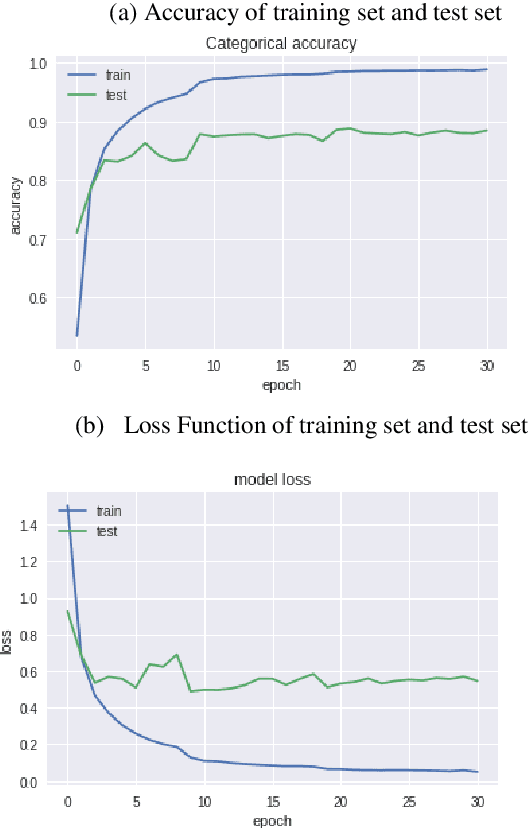
As an important part of speech recognition technology, automatic speech keyword recognition has been intensively studied in recent years. Such technology becomes especially pivotal under situations with limited infrastructures and computational resources, such as voice command recognition in vehicles and robot interaction. At present, the mainstream methods in automatic speech keyword recognition are based on long short-term memory (LSTM) networks with attention mechanism. However, due to inevitable information losses for the LSTM layer caused during feature extraction, the calculated attention weights are biased. In this paper, a novel approach, namely Multi-layer Attention Mechanism, is proposed to handle the inaccurate attention weights problem. The key idea is that, in addition to the conventional attention mechanism, information of layers prior to feature extraction and LSTM are introduced into attention weights calculations. Therefore, the attention weights are more accurate because the overall model can have more precise and focused areas. We conduct a comprehensive comparison and analysis on the keyword spotting performances on convolution neural network, bi-directional LSTM cyclic neural network, and cyclic neural network with the proposed attention mechanism on Google Speech Command datasets V2 datasets. Experimental results indicate favorable results for the proposed method and demonstrate the validity of the proposed method. The proposed multi-layer attention methods can be useful for other researches related to object spotting.