 Add to Chrome
 Add to Firefox
 Add to Edge
Car Datasets In Multiple Scenes
Papers and Code
GrabS: Generative Embodied Agent for 3D Object Segmentation without Scene Supervision
Apr 16, 2025
We study the hard problem of 3D object segmentation in complex point clouds without requiring human labels of 3D scenes for supervision. By relying on the similarity of pretrained 2D features or external signals such as motion to group 3D points as objects, existing unsupervised methods are usually limited to identifying simple objects like cars or their segmented objects are often inferior due to the lack of objectness in pretrained features. In this paper, we propose a new two-stage pipeline called GrabS. The core concept of our method is to learn generative and discriminative object-centric priors as a foundation from object datasets in the first stage, and then design an embodied agent to learn to discover multiple objects by querying against the pretrained generative priors in the second stage. We extensively evaluate our method on two real-world datasets and a newly created synthetic dataset, demonstrating remarkable segmentation performance, clearly surpassing all existing unsupervised methods.

Transfer Your Perspective: Controllable 3D Generation from Any Viewpoint in a Driving Scene
Feb 10, 2025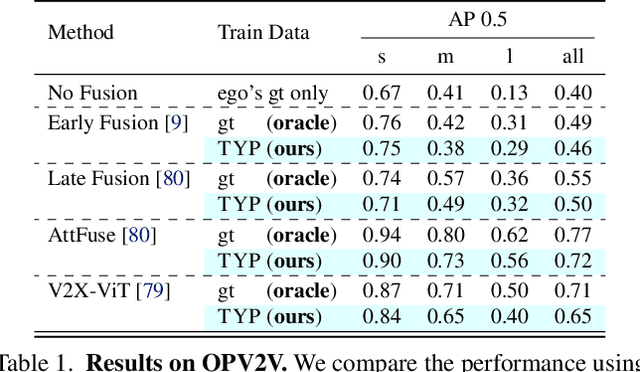
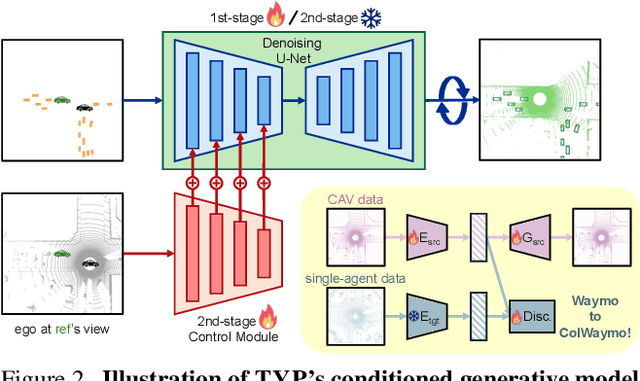
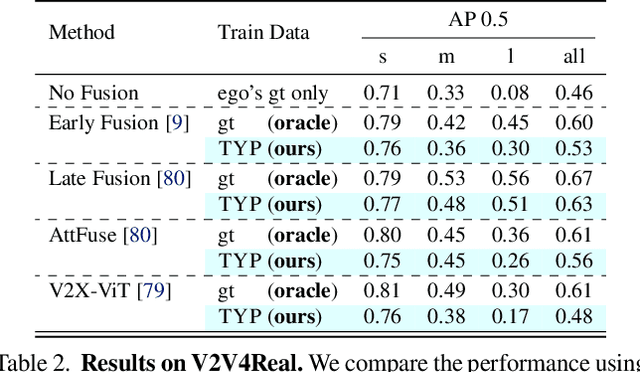
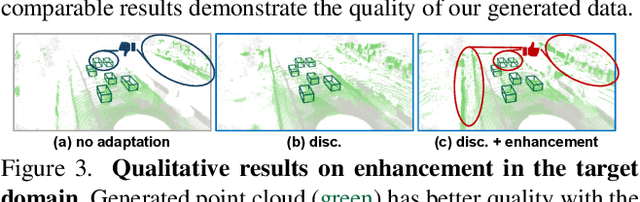
Self-driving cars relying solely on ego-centric perception face limitations in sensing, often failing to detect occluded, faraway objects. Collaborative autonomous driving (CAV) seems like a promising direction, but collecting data for development is non-trivial. It requires placing multiple sensor-equipped agents in a real-world driving scene, simultaneously! As such, existing datasets are limited in locations and agents. We introduce a novel surrogate to the rescue, which is to generate realistic perception from different viewpoints in a driving scene, conditioned on a real-world sample - the ego-car's sensory data. This surrogate has huge potential: it could potentially turn any ego-car dataset into a collaborative driving one to scale up the development of CAV. We present the very first solution, using a combination of simulated collaborative data and real ego-car data. Our method, Transfer Your Perspective (TYP), learns a conditioned diffusion model whose output samples are not only realistic but also consistent in both semantics and layouts with the given ego-car data. Empirical results demonstrate TYP's effectiveness in aiding in a CAV setting. In particular, TYP enables us to (pre-)train collaborative perception algorithms like early and late fusion with little or no real-world collaborative data, greatly facilitating downstream CAV applications.
GMS-VINS:Multi-category Dynamic Objects Semantic Segmentation for Enhanced Visual-Inertial Odometry Using a Promptable Foundation Model
Nov 28, 2024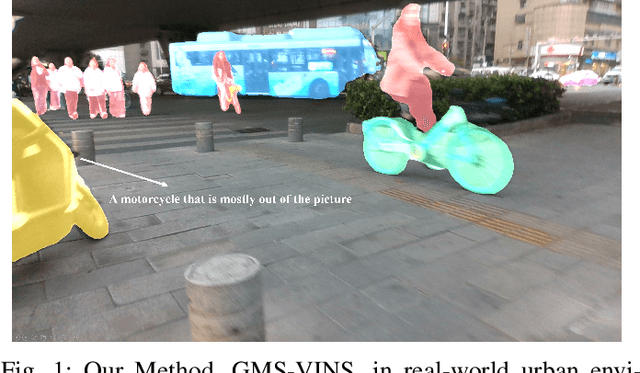

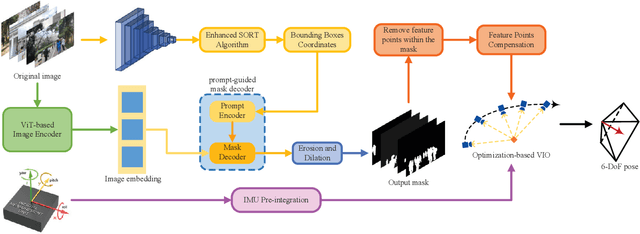
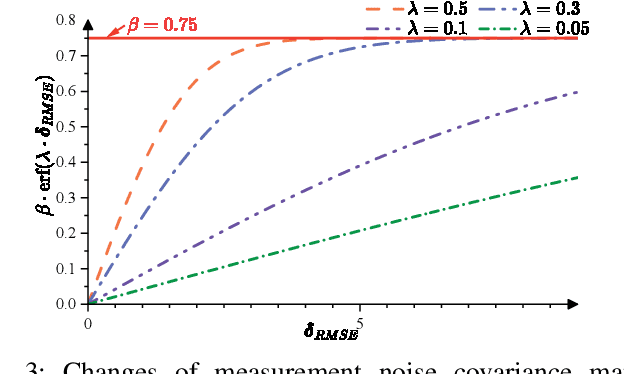
Visual-inertial odometry (VIO) is widely used in various fields, such as robots, drones, and autonomous vehicles, due to its low cost and complementary sensors. Most VIO methods presuppose that observed objects are static and time-invariant. However, real-world scenes often feature dynamic objects, compromising the accuracy of pose estimation. These moving entities include cars, trucks, buses, motorcycles, and pedestrians. The diversity and partial occlusion of these objects present a tough challenge for existing dynamic object removal techniques. To tackle this challenge, we introduce GMS-VINS, which integrates an enhanced SORT algorithm along with a robust multi-category segmentation framework into VIO, thereby improving pose estimation accuracy in environments with diverse dynamic objects and frequent occlusions. Leveraging the promptable foundation model, our solution efficiently tracks and segments a wide range of object categories. The enhanced SORT algorithm significantly improves the reliability of tracking multiple dynamic objects, especially in urban settings with partial occlusions or swift movements. We evaluated our proposed method using multiple public datasets representing various scenes, as well as in a real-world scenario involving diverse dynamic objects. The experimental results demonstrate that our proposed method performs impressively in multiple scenarios, outperforming other state-of-the-art methods. This highlights its remarkable generalization and adaptability in diverse dynamic environments, showcasing its potential to handle various dynamic objects in practical applications.
V-CAS: A Realtime Vehicle Anti Collision System Using Vision Transformer on Multi-Camera Streams
Nov 04, 2024This paper introduces a real-time Vehicle Collision Avoidance System (V-CAS) designed to enhance vehicle safety through adaptive braking based on environmental perception. V-CAS leverages the advanced vision-based transformer model RT-DETR, DeepSORT tracking, speed estimation, brake light detection, and an adaptive braking mechanism. It computes a composite collision risk score based on vehicles' relative accelerations, distances, and detected braking actions, using brake light signals and trajectory data from multiple camera streams to improve scene perception. Implemented on the Jetson Orin Nano, V-CAS enables real-time collision risk assessment and proactive mitigation through adaptive braking. A comprehensive training process was conducted on various datasets for comparative analysis, followed by fine-tuning the selected object detection model using transfer learning. The system's effectiveness was rigorously evaluated on the Car Crash Dataset (CCD) from YouTube and through real-time experiments, achieving over 98% accuracy with an average proactive alert time of 1.13 seconds. Results indicate significant improvements in object detection and tracking, enhancing collision avoidance compared to traditional single-camera methods. This research demonstrates the potential of low-cost, multi-camera embedded vision transformer systems to advance automotive safety through enhanced environmental perception and proactive collision avoidance mechanisms.
RSA: Resolving Scale Ambiguities in Monocular Depth Estimators through Language Descriptions
Oct 03, 2024
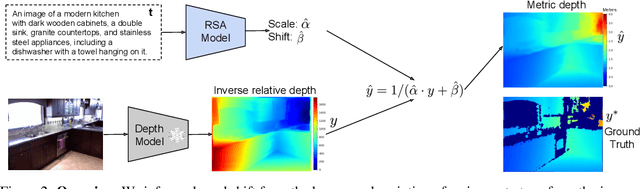
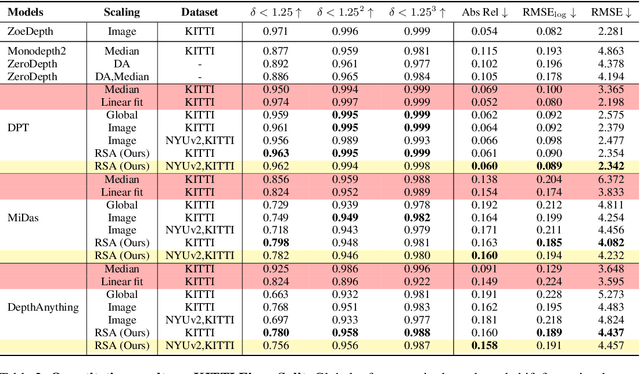
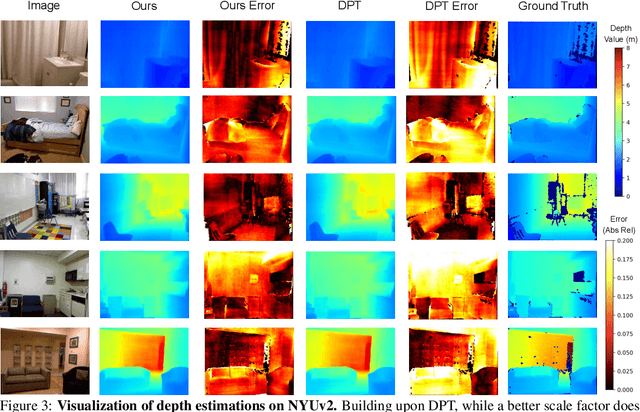
We propose a method for metric-scale monocular depth estimation. Inferring depth from a single image is an ill-posed problem due to the loss of scale from perspective projection during the image formation process. Any scale chosen is a bias, typically stemming from training on a dataset; hence, existing works have instead opted to use relative (normalized, inverse) depth. Our goal is to recover metric-scaled depth maps through a linear transformation. The crux of our method lies in the observation that certain objects (e.g., cars, trees, street signs) are typically found or associated with certain types of scenes (e.g., outdoor). We explore whether language descriptions can be used to transform relative depth predictions to those in metric scale. Our method, RSA, takes as input a text caption describing objects present in an image and outputs the parameters of a linear transformation which can be applied globally to a relative depth map to yield metric-scaled depth predictions. We demonstrate our method on recent general-purpose monocular depth models on indoors (NYUv2) and outdoors (KITTI). When trained on multiple datasets, RSA can serve as a general alignment module in zero-shot settings. Our method improves over common practices in aligning relative to metric depth and results in predictions that are comparable to an upper bound of fitting relative depth to ground truth via a linear transformation.
Robo-Platform: A Robotic System for Recording Sensors and Controlling Robots
Sep 25, 2024Mobile smartphones compactly provide sensors such as cameras, IMUs, GNSS measurement units, and wireless and wired communication channels required for robotics projects. They are affordable, portable, and programmable, which makes them ideal for testing, data acquisition, controlling mobile robots, and many other robotic applications. A robotic system is proposed in this paper, consisting of an Android phone, a microcontroller board attached to the phone via USB, and a remote wireless controller station. In the data acquisition mode, the Android device can record a dataset of a diverse configuration of multiple cameras, IMUs, GNSS units, and external USB ADC channels in the rawest format used for, but not limited to, pose estimation and scene reconstruction applications. In robot control mode, the Android phone, a microcontroller board, and other peripherals constitute the mobile or stationary robotic system. This system is controlled using a remote server connected over Wi-Fi or Bluetooth. Experiments show that although the SLAM and AR applications can utilize the acquired data, the proposed system can pave the way for more advanced algorithms for processing these noisy and sporadic measurements. Moreover, the characteristics of the communication media are studied, and two example robotic projects, which involve controlling a toy car and a quadcopter, are included.
BOX3D: Lightweight Camera-LiDAR Fusion for 3D Object Detection and Localization
Aug 27, 2024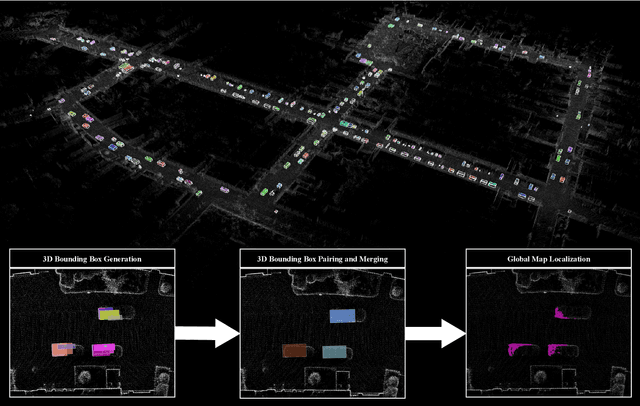
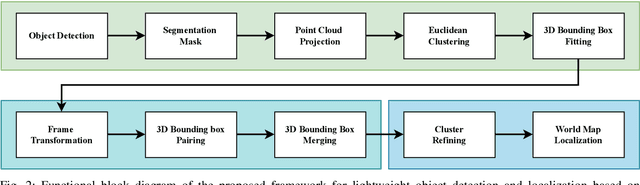

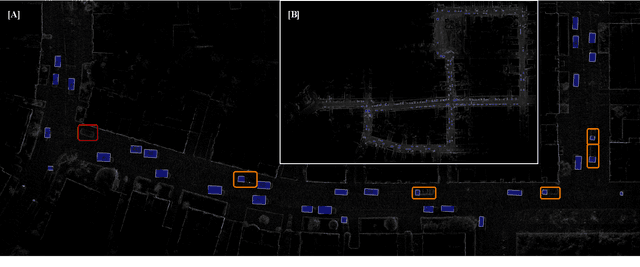
Object detection and global localization play a crucial role in robotics, spanning across a great spectrum of applications from autonomous cars to multi-layered 3D Scene Graphs for semantic scene understanding. This article proposes BOX3D, a novel multi-modal and lightweight scheme for localizing objects of interest by fusing the information from RGB camera and 3D LiDAR. BOX3D is structured around a three-layered architecture, building up from the local perception of the incoming sequential sensor data to the global perception refinement that covers for outliers and the general consistency of each object's observation. More specifically, the first layer handles the low-level fusion of camera and LiDAR data for initial 3D bounding box extraction. The second layer converts each LiDAR's scan 3D bounding boxes to the world coordinate frame and applies a spatial pairing and merging mechanism to maintain the uniqueness of objects observed from different viewpoints. Finally, BOX3D integrates the third layer that supervises the consistency of the results on the global map iteratively, using a point-to-voxel comparison for identifying all points in the global map that belong to the object. Benchmarking results of the proposed novel architecture are showcased in multiple experimental trials on public state-of-the-art large-scale dataset of urban environments.
SEVD: Synthetic Event-based Vision Dataset for Ego and Fixed Traffic Perception
Apr 12, 2024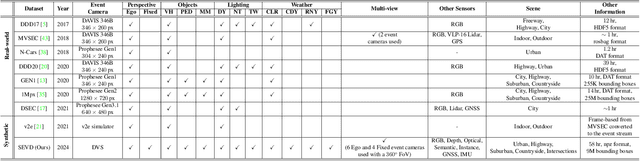
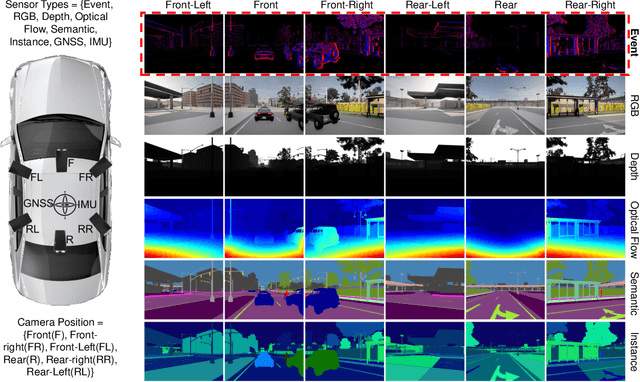
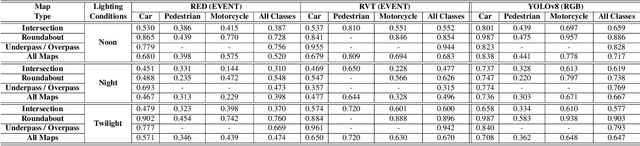
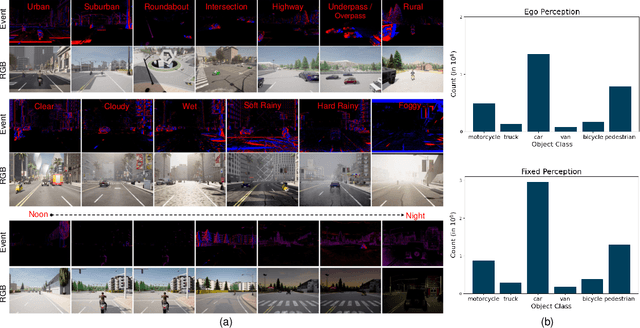
Recently, event-based vision sensors have gained attention for autonomous driving applications, as conventional RGB cameras face limitations in handling challenging dynamic conditions. However, the availability of real-world and synthetic event-based vision datasets remains limited. In response to this gap, we present SEVD, a first-of-its-kind multi-view ego, and fixed perception synthetic event-based dataset using multiple dynamic vision sensors within the CARLA simulator. Data sequences are recorded across diverse lighting (noon, nighttime, twilight) and weather conditions (clear, cloudy, wet, rainy, foggy) with domain shifts (discrete and continuous). SEVD spans urban, suburban, rural, and highway scenes featuring various classes of objects (car, truck, van, bicycle, motorcycle, and pedestrian). Alongside event data, SEVD includes RGB imagery, depth maps, optical flow, semantic, and instance segmentation, facilitating a comprehensive understanding of the scene. Furthermore, we evaluate the dataset using state-of-the-art event-based (RED, RVT) and frame-based (YOLOv8) methods for traffic participant detection tasks and provide baseline benchmarks for assessment. Additionally, we conduct experiments to assess the synthetic event-based dataset's generalization capabilities. The dataset is available at https://eventbasedvision.github.io/SEVD
Aerial Lifting: Neural Urban Semantic and Building Instance Lifting from Aerial Imagery
Mar 18, 2024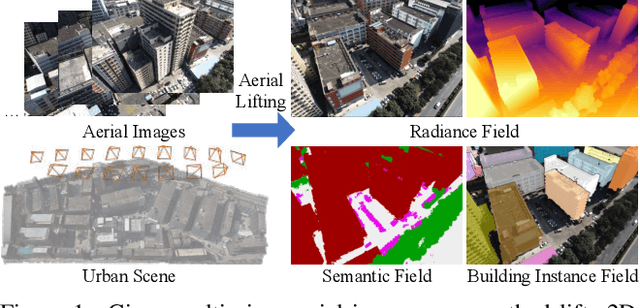
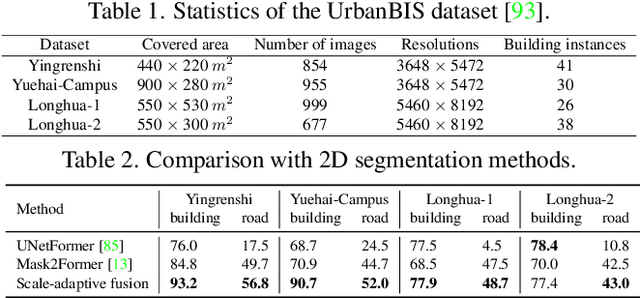
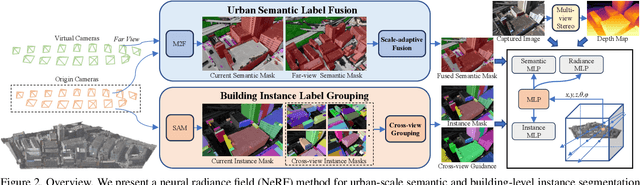
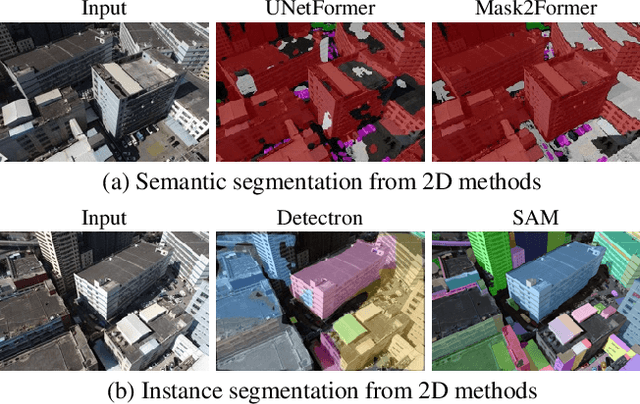
We present a neural radiance field method for urban-scale semantic and building-level instance segmentation from aerial images by lifting noisy 2D labels to 3D. This is a challenging problem due to two primary reasons. Firstly, objects in urban aerial images exhibit substantial variations in size, including buildings, cars, and roads, which pose a significant challenge for accurate 2D segmentation. Secondly, the 2D labels generated by existing segmentation methods suffer from the multi-view inconsistency problem, especially in the case of aerial images, where each image captures only a small portion of the entire scene. To overcome these limitations, we first introduce a scale-adaptive semantic label fusion strategy that enhances the segmentation of objects of varying sizes by combining labels predicted from different altitudes, harnessing the novel-view synthesis capabilities of NeRF. We then introduce a novel cross-view instance label grouping strategy based on the 3D scene representation to mitigate the multi-view inconsistency problem in the 2D instance labels. Furthermore, we exploit multi-view reconstructed depth priors to improve the geometric quality of the reconstructed radiance field, resulting in enhanced segmentation results. Experiments on multiple real-world urban-scale datasets demonstrate that our approach outperforms existing methods, highlighting its effectiveness.
NWPU-MOC: A Benchmark for Fine-grained Multi-category Object Counting in Aerial Images
Jan 19, 2024Object counting is a hot topic in computer vision, which aims to estimate the number of objects in a given image. However, most methods only count objects of a single category for an image, which cannot be applied to scenes that need to count objects with multiple categories simultaneously, especially in aerial scenes. To this end, this paper introduces a Multi-category Object Counting (MOC) task to estimate the numbers of different objects (cars, buildings, ships, etc.) in an aerial image. Considering the absence of a dataset for this task, a large-scale Dataset (NWPU-MOC) is collected, consisting of 3,416 scenes with a resolution of 1024 $\times$ 1024 pixels, and well-annotated using 14 fine-grained object categories. Besides, each scene contains RGB and Near Infrared (NIR) images, of which the NIR spectrum can provide richer characterization information compared with only the RGB spectrum. Based on NWPU-MOC, the paper presents a multi-spectrum, multi-category object counting framework, which employs a dual-attention module to fuse the features of RGB and NIR and subsequently regress multi-channel density maps corresponding to each object category. In addition, to modeling the dependency between different channels in the density map with each object category, a spatial contrast loss is designed as a penalty for overlapping predictions at the same spatial position. Experimental results demonstrate that the proposed method achieves state-of-the-art performance compared with some mainstream counting algorithms. The dataset, code and models are publicly available at https://github.com/lyongo/NWPU-MOC.