 Add to Chrome
 Add to Firefox
 Add to Edge
AutoMine Solution for AV2 2026 Scenario Mining Challenge
Jun 10, 2026
With the development of autonomous driving systems, mining high-value, safety-critical, and planning-relevant scenarios from large-scale driving logs has become essential for data-driven evaluation. In this paper, we propose AutoMine, a robust self-refining scenario mining method based on LLMs and VLMs. AutoMine uses semantics-preserving prompt augmentation to reduce LLM prompt sensitivity, combines robust trajectory atomic functions with VLM-based functions to handle perception noise and open-world visual cues, and refines generated code through execution feedback from real logs. In the Argoverse 2 Scenario Mining Competition at CVPR 2026, AutoMine achieves a HOTA-Temporal score of 36.38 and a Timestamp BA score of 77.21.

GMS-VINS:Multi-category Dynamic Objects Semantic Segmentation for Enhanced Visual-Inertial Odometry Using a Promptable Foundation Model
Nov 28, 2024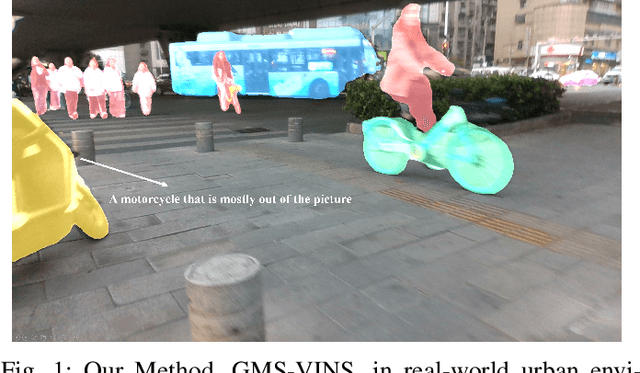

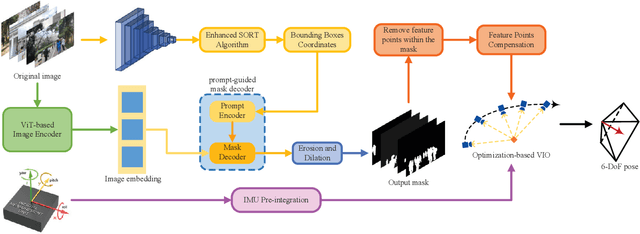
Visual-inertial odometry (VIO) is widely used in various fields, such as robots, drones, and autonomous vehicles, due to its low cost and complementary sensors. Most VIO methods presuppose that observed objects are static and time-invariant. However, real-world scenes often feature dynamic objects, compromising the accuracy of pose estimation. These moving entities include cars, trucks, buses, motorcycles, and pedestrians. The diversity and partial occlusion of these objects present a tough challenge for existing dynamic object removal techniques. To tackle this challenge, we introduce GMS-VINS, which integrates an enhanced SORT algorithm along with a robust multi-category segmentation framework into VIO, thereby improving pose estimation accuracy in environments with diverse dynamic objects and frequent occlusions. Leveraging the promptable foundation model, our solution efficiently tracks and segments a wide range of object categories. The enhanced SORT algorithm significantly improves the reliability of tracking multiple dynamic objects, especially in urban settings with partial occlusions or swift movements. We evaluated our proposed method using multiple public datasets representing various scenes, as well as in a real-world scenario involving diverse dynamic objects. The experimental results demonstrate that our proposed method performs impressively in multiple scenarios, outperforming other state-of-the-art methods. This highlights its remarkable generalization and adaptability in diverse dynamic environments, showcasing its potential to handle various dynamic objects in practical applications.