 Add to Chrome
 Add to Firefox
 Add to Edge
AlloBench: Measuring Online Tool Allocation Capability in LLM Agents
Jul 25, 2026
Creating a reusable tool is an investment: an agent pays a fixed cost now in exchange for the potential of future reuse. Therefore, a user should prefer an agent that creates a small number of highly reusable tools, rather than many one-offs. We introduce a paired benchmark that tests whether LLM agents exhibit conscious allocation behavior under a fixed budget in two contexts: an abstract text-based formulation and a code-construction task. We find that every frontier model we test---Claude Haiku, Claude Opus, GPT-5.4-mini, and GPT-5.6 Sol---acts near-optimally in the abstract framing but fails to transfer this ability to script-writing. Through further experiments, we identify the particular failure modes for each model. Notably, the first three models fail even when the scripts are not evaluated, while GPT-5.6 Sol stays selective under that weaker manipulation and collapses only at full construction. Furthermore, an open-source Qwen model policy-trained for abstract allocation generalizes this ability across held-out lexical variations, but sees no improvement at script allocation. Together, these results establish online tool allocation as a significant capability boundary, even for modern frontier models.

Lomekwi: Resource-Bounded Tool Discovery in LLM Agents
Jul 18, 2026Existing tool-use benchmarks report a single success rate for complex, multistep tasks. Inspired by ideas from cognitive science, we distinguish tool use from tool discovery and decompose the latter into curiosity (the model's ability to discover the parts needed to build the tool), recognition (the model's ability to discover the process of creating the tool), and efficiency (the model's use of the tool after creation). We show that this framework can be applied to existing discovery tasks, such as Voyager. In addition, we provide evidence that recognition inversely scales with model size, and we introduce and analyze a class of combinatorial games that demonstrates this. We further observe inverse scaling in a separate environment designed to emulate real-world tasks.
SWE-Marathon: Can Agents Autonomously Complete Ultra-Long-Horizon Software Work?
Jun 05, 2026AI agents are increasingly expected to complete long-horizon workflows that require sustained progress over hours, millions of tokens, and complex environments. Yet current agent benchmarks largely evaluate short-form tasks, such as single pull requests, small tickets, or 5-10 minute exercises, limiting our ability to measure agents' capabilities in planning, long-context understanding, and memory use. We introduce SWE-Marathon, a benchmark of 20 long-horizon tasks spanning software engineering and adjacent technical domains. Each task consists of a unique executable environment, a human-written reference solution, and a multi-layer verification suite. Logged agent attempts average 27.2M total tokens, making SWE-Marathon substantially longer-horizon than existing SWE and command-line agent benchmarks. Current frontier coding agents solve fewer than 30% of tasks. Failures often arise from poor self-verification, self-reported infeasibility, and premature termination. We also observe reward-hacking behavior in 13.8% of rollouts, where agents attempt to exploit the environment or verifier to bypass the intended workflow. SWE-Marathon includes adversarial review of test suites and execution environments, as well as multi-layer checks designed to prevent shortcut solutions. We release SWE-Marathon, evaluation code, and agent trajectories at https://swe-marathon.org/.
Beyond ReinMax: Low-Variance Gradient Estimators for Discrete Latent Variables
Mar 09, 2026Machine learning models involving discrete latent variables require gradient estimators to facilitate backpropagation in a computationally efficient manner. The most recent addition to the Straight-Through family of estimators, ReinMax, can be viewed from a numerical ODE perspective as incorporating an approximation via Heun's method to reduce bias, but at the cost of high variance. In this work, we introduce the ReinMax-Rao and ReinMax-CV estimators which incorporate Rao-Blackwellisation and control variate techniques into ReinMax to reduce its variance. Our estimators demonstrate superior performance on training variational autoencoders with discrete latent spaces. Furthermore, we investigate the possibility of leveraging alternative numerical methods for constructing more accurate gradient approximations and present an alternative view of ReinMax from a simpler numerical integration perspective.
A Microservice-Based Platform for Sustainable and Intelligent SLO Fulfilment and Service Management
Feb 13, 2026The Microservices Architecture (MSA) design pattern has become a staple for modern applications, allowing functionalities to be divided across fine-grained microservices, fostering reusability, distribution, and interoperability. As MSA-based applications are deployed to the Computing Continuum (CC), meeting their Service Level Objectives (SLOs) becomes a challenge. Trading off performance and sustainability SLOs is especially challenging. This challenge can be addressed with intelligent decision systems, able to reconfigure the services during runtime to meet the SLOs. However, developing these agents while adhering to the MSA pattern is complex, especially because CC providers, who have key know-how and information to fulfill these SLOs, must comply with the privacy requirements of application developers. This work presents the Carbon-Aware SLO and Control plAtform (CASCA), an open-source MSA-based platform that allows CC providers to reconfigure services and fulfill their SLOs while maintaining the privacy of developers. CASCA is architected to be highly reusable, distributable, and easy to use, extend, and modify. CASCA has been evaluated in a real CC testbed for a media streaming service, where decision systems implemented in Bash, Rust, and Python successfully reconfigured the service, unaffected by upholding privacy.
ODE-GS: Latent ODEs for Dynamic Scene Extrapolation with 3D Gaussian Splatting
Jun 05, 2025We present ODE-GS, a novel method that unifies 3D Gaussian Splatting with latent neural ordinary differential equations (ODEs) to forecast dynamic 3D scenes far beyond the time span seen during training. Existing neural rendering systems - whether NeRF- or 3DGS-based - embed time directly in a deformation network and therefore excel at interpolation but collapse when asked to predict the future, where timestamps are strictly out-of-distribution. ODE-GS eliminates this dependency: after learning a high-fidelity, time-conditioned deformation model for the training window, we freeze it and train a Transformer encoder that summarizes past Gaussian trajectories into a latent state whose continuous evolution is governed by a neural ODE. Numerical integration of this latent flow yields smooth, physically plausible Gaussian trajectories that can be queried at any future instant and rendered in real time. Coupled with a variational objective and a lightweight second-derivative regularizer, ODE-GS attains state-of-the-art extrapolation on D-NeRF and NVFI benchmarks, improving PSNR by up to 10 dB and halving perceptual error (LPIPS) relative to the strongest baselines. Our results demonstrate that continuous-time latent dynamics are a powerful, practical route to photorealistic prediction of complex 3D scenes.
Efficient Interactive 3D Multi-Object Removal
Jan 30, 2025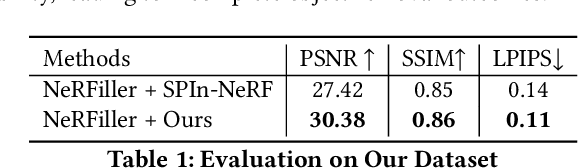
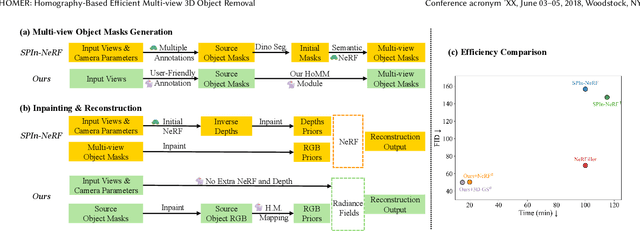
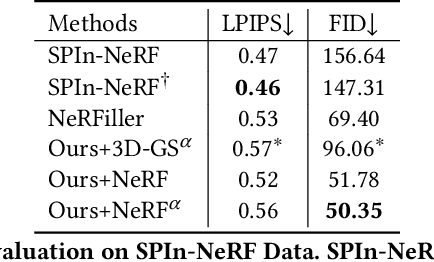
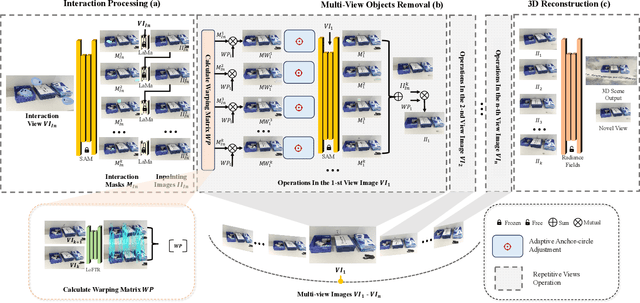
Object removal is of great significance to 3D scene understanding, essential for applications in content filtering and scene editing. Current mainstream methods primarily focus on removing individual objects, with a few methods dedicated to eliminating an entire area or all objects of a certain category. They however confront the challenge of insufficient granularity and flexibility for real-world applications, where users demand tailored excision and preservation of objects within defined zones. In addition, most of the current methods require kinds of priors when addressing multi-view inpainting, which is time-consuming. To address these limitations, we propose an efficient and user-friendly pipeline for 3D multi-object removal, enabling users to flexibly select areas and define objects for removal or preservation. Concretely, to ensure object consistency and correspondence across multiple views, we propose a novel mask matching and refinement module, which integrates homography-based warping with high-confidence anchor points for segmentation. By leveraging the IoU joint shape context distance loss, we enhance the accuracy of warped masks and improve subsequent inpainting processes. Considering the current immaturity of 3D multi-object removal, we provide a new evaluation dataset to bridge the developmental void. Experimental results demonstrate that our method significantly reduces computational costs, achieving processing speeds more than 80% faster than state-of-the-art methods while maintaining equivalent or higher reconstruction quality.
PriorDiffusion: Leverage Language Prior in Diffusion Models for Monocular Depth Estimation
Nov 24, 2024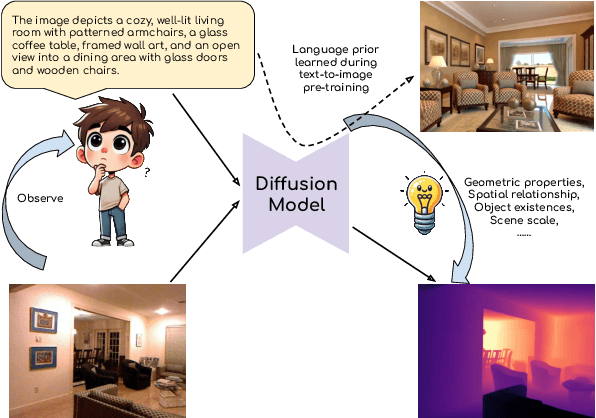
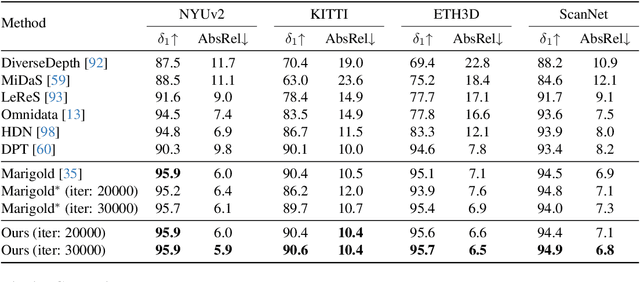
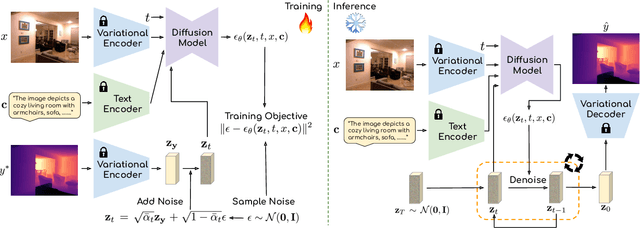
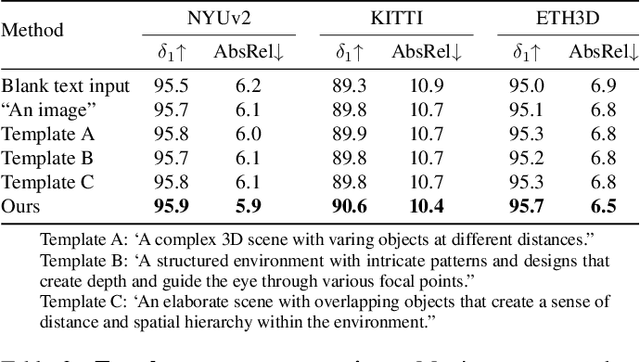
This paper explores the potential of leveraging language priors learned by text-to-image diffusion models to address ambiguity and visual nuisance in monocular depth estimation. Particularly, traditional monocular depth estimation suffers from inherent ambiguity due to the absence of stereo or multi-view depth cues, and nuisance due to lack of robustness of vision. We argue that language prior in diffusion models can enhance monocular depth estimation by leveraging the geometric prior aligned with the language description, which is learned during text-to-image pre-training. To generate images that reflect the text properly, the model must comprehend the size and shape of specified objects, their spatial relationship, and the scale of the scene. Thus, we propose PriorDiffusion, using a pre-trained text-to-image diffusion model that takes both image and text description that aligned with the scene to infer affine-invariant depth through a denoising process. We also show that language priors can guide the model's attention to specific regions and help it perceive the 3D scene in alignment with user intent. Simultaneously, it acts as a constraint to accelerate the convergence of the diffusion trajectory, since learning 3D properties from a condensed, low-dimensional language feature is more efficient compared with learning from a redundant, high-dimensional image feature. By training on HyperSim and Virtual KITTI, we achieve state-of-the-art zero-shot performance and a faster convergence speed, compared with other diffusion-based depth estimators, across NYUv2, KITTI, ETH3D, and ScanNet.
Comparing Fairness of Generative Mobility Models
Nov 07, 2024This work examines the fairness of generative mobility models, addressing the often overlooked dimension of equity in model performance across geographic regions. Predictive models built on crowd flow data are instrumental in understanding urban structures and movement patterns; however, they risk embedding biases, particularly in spatiotemporal contexts where model performance may reflect and reinforce existing inequities tied to geographic distribution. We propose a novel framework for assessing fairness by measuring the utility and equity of generated traces. Utility is assessed via the Common Part of Commuters (CPC), a similarity metric comparing generated and real mobility flows, while fairness is evaluated using demographic parity. By reformulating demographic parity to reflect the difference in CPC distribution between two groups, our analysis reveals disparities in how various models encode biases present in the underlying data. We utilized four models (Gravity, Radiation, Deep Gravity, and Non-linear Gravity) and our results indicate that traditional gravity and radiation models produce fairer outcomes, although Deep Gravity achieves higher CPC. This disparity underscores a trade-off between model accuracy and equity, with the feature-rich Deep Gravity model amplifying pre-existing biases in community representations. Our findings emphasize the importance of integrating fairness metrics in mobility modeling to avoid perpetuating inequities.
RSA: Resolving Scale Ambiguities in Monocular Depth Estimators through Language Descriptions
Oct 03, 2024
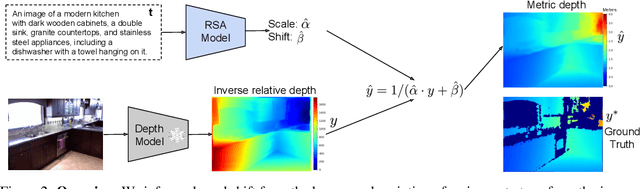
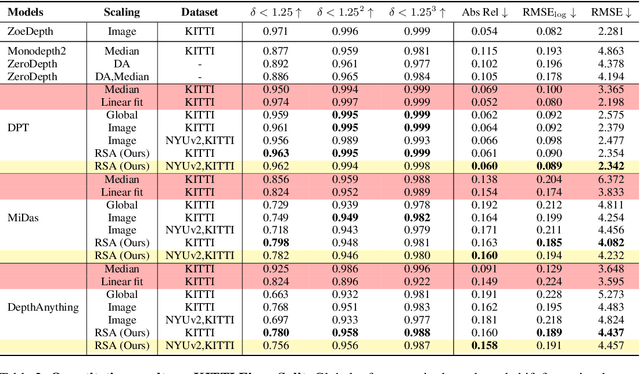
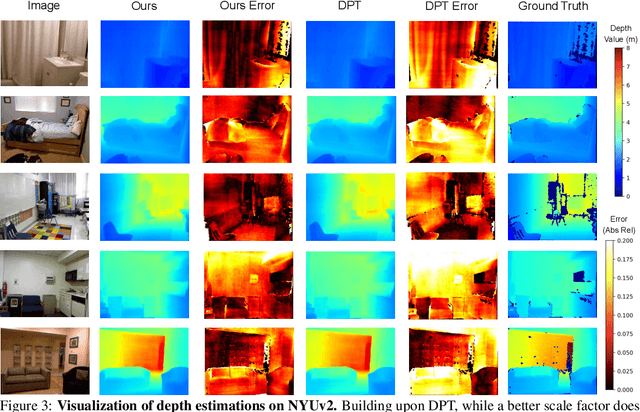
We propose a method for metric-scale monocular depth estimation. Inferring depth from a single image is an ill-posed problem due to the loss of scale from perspective projection during the image formation process. Any scale chosen is a bias, typically stemming from training on a dataset; hence, existing works have instead opted to use relative (normalized, inverse) depth. Our goal is to recover metric-scaled depth maps through a linear transformation. The crux of our method lies in the observation that certain objects (e.g., cars, trees, street signs) are typically found or associated with certain types of scenes (e.g., outdoor). We explore whether language descriptions can be used to transform relative depth predictions to those in metric scale. Our method, RSA, takes as input a text caption describing objects present in an image and outputs the parameters of a linear transformation which can be applied globally to a relative depth map to yield metric-scaled depth predictions. We demonstrate our method on recent general-purpose monocular depth models on indoors (NYUv2) and outdoors (KITTI). When trained on multiple datasets, RSA can serve as a general alignment module in zero-shot settings. Our method improves over common practices in aligning relative to metric depth and results in predictions that are comparable to an upper bound of fitting relative depth to ground truth via a linear transformation.