 Add to Chrome
 Add to Firefox
 Add to Edge
Co-LMLM: Continuous-Query Limited Memory Language Models
Jul 08, 2026
Limited memory language models (LMLMs) externalize factual knowledge during pretraining to a knowledge base (KB), rather than memorizing it in their weights. During generation, the model then fetches knowledge from the KB as needed. This recently introduced paradigm provides multiple advantages, including knowledge control capabilities that remain beyond conventional LLMs. We propose continuous-query LMLM (CO-LMLM), where the KB pairs continuous keys with textual knowledge values, a significant departure from prior reliance on relational KB and queries. CO-LMLM generates flexible vector queries at minimal cost, while still integrating human-readable and attributable retrieved knowledge into its generation. We pair this design with an annotation pipeline that tags free-form factual spans in arbitrary text, removing prior work's restriction to Wikipedia. Across pretraining on Wikipedia and FineWeb-Edu and at multiple model scales, CO-LMLM outperforms prior LMLMs and vanilla LLMs in both perplexity and factual precision. At 360M scale, this includes lower perplexity than models pretrained on 40x more data, and SimpleQA-verified performance that is in line with gpt-4o-mini and higher than Claude Sonnet 4.5.

Self-Augmenting Retrieval for Diffusion Language Models
Jun 04, 2026Discrete diffusion language models generate text by iteratively denoising an entire response in parallel. At each step, they predict tentative tokens for every masked position, committing the confident predictions to the output and discarding the unconfident ones. We show that the discarded tokens are in fact a useful lookahead signal for retrieval-augmented generation: even low-confidence tokens often surface salient entities early in the denoising trajectory, enabling retrieval of stronger evidence before the output is finalized. We exploit this through Self-Augmenting Retrieval for Diffusion Language Models (SARDI), a dynamic RAG framework that uses these lookahead tokens to guide retrieval during denoising. SARDI is training-free, retriever-agnostic, and applicable to any reasoning-capable discrete diffusion language model. Across five multi-hop QA benchmarks, SARDI outperforms current training-free diffusion and autoregressive retrieval baselines at up to $8\times$ higher throughput.
Music Transcription with (Almost) No Supervision
May 22, 2026Competitive music transcription models require large amounts of paired audio-score data, which is scarce due to collection costs, alignment difficulty, and copyright restrictions. Meanwhile, vast quantities of unpaired audio recordings and symbolic scores are freely available but have gone unused. We adopt a cycle-consistent translation framework in which a small amount of paired data acts as a minimal anchor, unlocking the full potential of the unpaired pool. We find that: unpaired data yields surprisingly large gains, especially under limited supervision; unpaired audio contributes more than unpaired scores; incorporating unlabeled audio from a new instrument during training improves transcription for that instrument without any paired supervision. Together, these results suggest that scaling unpaired data offers a practical path toward high-quality transcription for instruments where labeled data remains scarce.
Adaptive Moments are Surprisingly Effective for Plug-and-Play Diffusion Sampling
Mar 17, 2026Guided diffusion sampling relies on approximating often intractable likelihood scores, which introduces significant noise into the sampling dynamics. We propose using adaptive moment estimation to stabilize these noisy likelihood scores during sampling. Despite its simplicity, our approach achieves state-of-the-art results on image restoration and class-conditional generation tasks, outperforming more complicated methods, which are often computationally more expensive. We provide empirical analysis of our method on both synthetic and real data, demonstrating that mitigating gradient noise through adaptive moments offers an effective way to improve alignment.
Learning from Synthetic Data Improves Multi-hop Reasoning
Mar 02, 2026Reinforcement Learning (RL) has been shown to significantly boost reasoning capabilities of large language models (LLMs) in math, coding, and multi-hop reasoning tasks. However, RL fine-tuning requires abundant high-quality verifiable data, often sourced from human annotations, generated from frontier LLMs, or scored by LLM-based verifiers. All three have considerable limitations: human-annotated datasets are small and expensive to curate, LLM-generated data is hallucination-prone and costly, and LLM-based verifiers are inaccurate and slow. In this work, we investigate a cheaper alternative: RL fine-tuning on rule-generated synthetic data for multi-hop reasoning tasks. We discover that LLMs fine-tuned on synthetic data perform significantly better on popular real-world question-answering benchmarks, despite the synthetic data containing only fictional knowledge. On stratifying performance by question difficulty, we find that synthetic data teaches LLMs to compose knowledge -- a fundamental and generalizable reasoning skill. Our work highlights rule-generated synthetic reasoning data as a free and scalable resource to improve LLM reasoning capabilities.
Stop-Think-AutoRegress: Language Modeling with Latent Diffusion Planning
Feb 24, 2026The Stop-Think-AutoRegress Language Diffusion Model (STAR-LDM) integrates latent diffusion planning with autoregressive generation. Unlike conventional autoregressive language models limited to token-by-token decisions, STAR-LDM incorporates a "thinking" phase that pauses generation to refine a semantic plan through diffusion before continuing. This enables global planning in continuous space prior to committing to discrete tokens. Evaluations show STAR-LDM significantly outperforms similar-sized models on language understanding benchmarks and achieves $>70\%$ win rates in LLM-as-judge comparisons for narrative coherence and commonsense reasoning. The architecture also allows straightforward control through lightweight classifiers, enabling fine-grained steering of attributes without model retraining while maintaining better fluency-control trade-offs than specialized approaches.
Improving Multislice Electron Ptychography with a Generative Prior
Jul 23, 2025Multislice electron ptychography (MEP) is an inverse imaging technique that computationally reconstructs the highest-resolution images of atomic crystal structures from diffraction patterns. Available algorithms often solve this inverse problem iteratively but are both time consuming and produce suboptimal solutions due to their ill-posed nature. We develop MEP-Diffusion, a diffusion model trained on a large database of crystal structures specifically for MEP to augment existing iterative solvers. MEP-Diffusion is easily integrated as a generative prior into existing reconstruction methods via Diffusion Posterior Sampling (DPS). We find that this hybrid approach greatly enhances the quality of the reconstructed 3D volumes, achieving a 90.50% improvement in SSIM over existing methods.
Memento: Note-Taking for Your Future Self
Jun 25, 2025Large language models (LLMs) excel at reasoning-only tasks, but struggle when reasoning must be tightly coupled with retrieval, as in multi-hop question answering. To overcome these limitations, we introduce a prompting strategy that first decomposes a complex question into smaller steps, then dynamically constructs a database of facts using LLMs, and finally pieces these facts together to solve the question. We show how this three-stage strategy, which we call Memento, can boost the performance of existing prompting strategies across diverse settings. On the 9-step PhantomWiki benchmark, Memento doubles the performance of chain-of-thought (CoT) when all information is provided in context. On the open-domain version of 2WikiMultiHopQA, CoT-RAG with Memento improves over vanilla CoT-RAG by more than 20 F1 percentage points and over the multi-hop RAG baseline, IRCoT, by more than 13 F1 percentage points. On the challenging MuSiQue dataset, Memento improves ReAct by more than 3 F1 percentage points, demonstrating its utility in agentic settings.
Pre-training Large Memory Language Models with Internal and External Knowledge
May 21, 2025Neural language models are black-boxes -- both linguistic patterns and factual knowledge are distributed across billions of opaque parameters. This entangled encoding makes it difficult to reliably inspect, verify, or update specific facts. We propose a new class of language models, Large Memory Language Models (LMLM) with a pre-training recipe that stores factual knowledge in both internal weights and an external database. Our approach strategically masks externally retrieved factual values from the training loss, thereby teaching the model to perform targeted lookups rather than relying on memorization in model weights. Our experiments demonstrate that LMLMs achieve competitive performance compared to significantly larger, knowledge-dense LLMs on standard benchmarks, while offering the advantages of explicit, editable, and verifiable knowledge bases. This work represents a fundamental shift in how language models interact with and manage factual knowledge.
INPROVF: Leveraging Large Language Models to Repair High-level Robot Controllers from Assumption Violations
Mar 17, 2025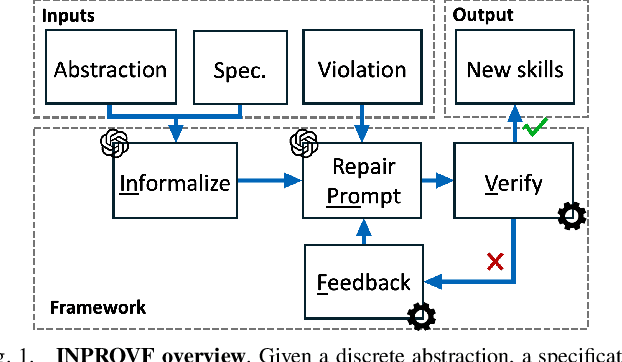
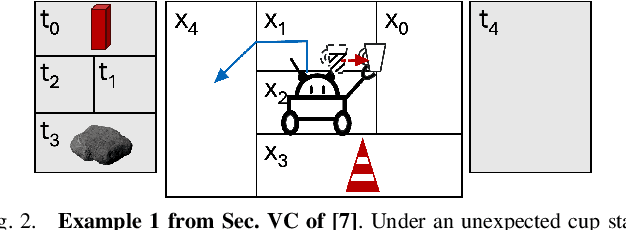
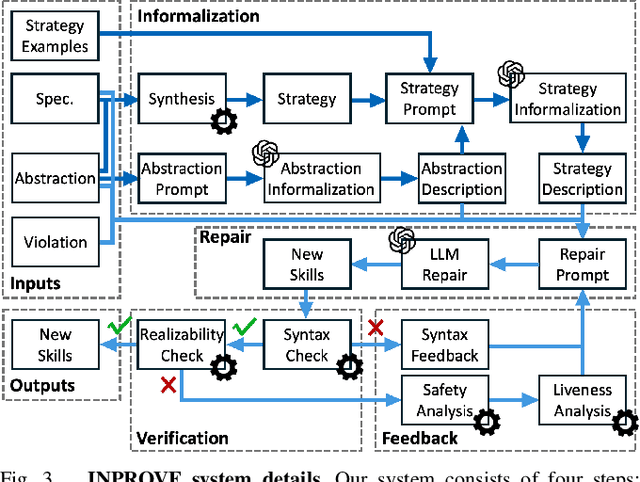
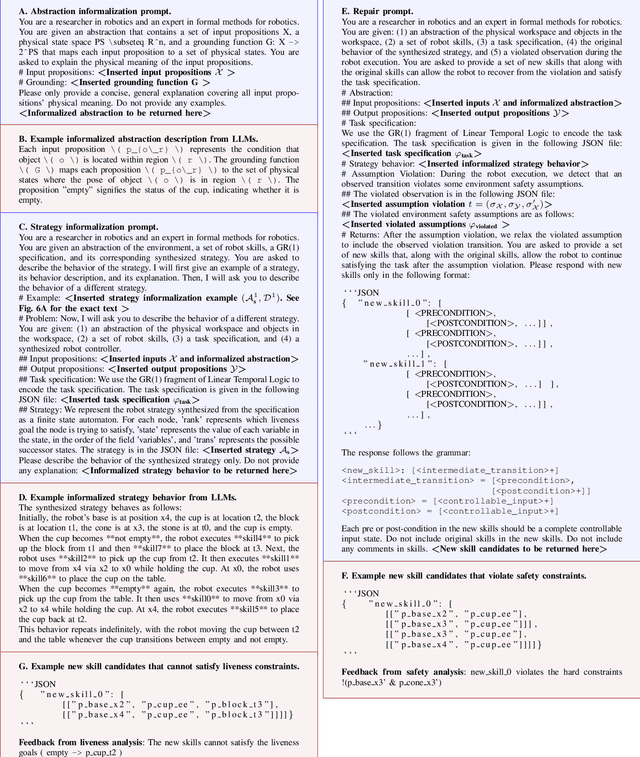
This paper presents INPROVF, an automatic framework that combines large language models (LLMs) and formal methods to speed up the repair process of high-level robot controllers. Previous approaches based solely on formal methods are computationally expensive and cannot scale to large state spaces. In contrast, INPROVF uses LLMs to generate repair candidates, and formal methods to verify their correctness. To improve the quality of these candidates, our framework first translates the symbolic representations of the environment and controllers into natural language descriptions. If a candidate fails the verification, INPROVF provides feedback on potential unsafe behaviors or unsatisfied tasks, and iteratively prompts LLMs to generate improved solutions. We demonstrate the effectiveness of INPROVF through 12 violations with various workspaces, tasks, and state space sizes.