 Add to Chrome
 Add to Firefox
 Add to Edge
Intern-S2-Preview: Scientific Agentic Foundation Model
Aug 13, 2026
Scientific discovery increasingly requires AI systems that can reason over scientific evidence of heterogeneous modalities, interact with scientific tools and environments, and sustain progress across long task horizons. We present Intern-S2-Preview, a series of scientific agentic foundation models designed to support multimodal scientific understanding, reasoning, generation, and long-horizon tasks. The training pipeline begins with scientific multimodal pre-training over rendered scientific documents, interleaved image-text data, and diverse scientific corpora. Starting from the pretrained checkpoint, we apply a unified post-training pipeline consisting of supervised fine-tuning, scalable multi-task reinforcement learning (RL), black- and white-box agentic RL, and on-policy distillation. This pipeline is supported by practical techniques that improve rollout and training stability and efficiency, including partial rollout with off-policy correction, adaptive length regularization, online speculative decoding, robust multi-task optimization, and trace-aware experience assembly for agentic tasks. At the architecture level, Intern-S2-Preview-397B extends time series modelling from efficient long-sequence understanding to numerical forecasting, while Memory Decoder is studied as a separate memory-augmented path for rapid scientific specialization without modifying the frozen 397B backbone. Evaluations across scientific, multimodal, agentic, and general-purpose benchmarks show that Intern-S2-Preview-397B achieves competitive or leading results in multiple settings. The time series modules improve scientific signal understanding and forecasting on SciTS, while the separate Intern-MemDec-4B extension improves the Biology-Instructions average score from 56.92 to 60.32 without modifying the frozen 397B backbone.

Agentic Instruction Data Selection: Let DataMaster Interpret Your Intent
Aug 11, 2026Although existing instruction data selection methods have introduced various metrics, the inherent complexity of real-world datasets makes it impractical for any single metric to generalize across all scenarios. Developers are thus often forced to manually inspect data and craft heuristic rules for each new application---a tedious and error-prone process. In this paper, we propose a paradigm shift from manual configuration to automated orchestration via the Instruction Data Selection Agent (DataMaster), which interprets user intent and autonomously composes optimal selection strategies. By allowing users to specify data needs through natural language descriptions, DataMaster simplifies data curation and removes the burden of manual strategy design. Extensive experiments across the math, medical, and code domains show that DataMaster outperforms static baselines in most settings and surpasses full-pool training in a substantial number of cases. The implementation of DataMaster and the scripts needed to reproduce the reported pipeline are publicly available at https://github.com/nju-websoft/DataMaster.
Kernel-Smith: A Unified Recipe for Evolutionary Kernel Optimization
Mar 30, 2026We present Kernel-Smith, a framework for high-performance GPU kernel and operator generation that combines a stable evaluation-driven evolutionary agent with an evolution-oriented post-training recipe. On the agent side, Kernel-Smith maintains a population of executable candidates and iteratively improves them using an archive of top-performing and diverse programs together with structured execution feedback on compilation, correctness, and speedup. To make this search reliable, we build backend-specific evaluation services for Triton on NVIDIA GPUs and Maca on MetaX GPUs. On the training side, we convert long-horizon evolution trajectories into step-centric supervision and reinforcement learning signals by retaining correctness-preserving, high-gain revisions, so that the model is optimized as a strong local improver inside the evolutionary loop rather than as a one-shot generator. Under a unified evolutionary protocol, Kernel-Smith-235B-RL achieves state-of-the-art overall performance on KernelBench with Nvidia Triton backend, attaining the best average speedup ratio and outperforming frontier proprietary models including Gemini-3.0-pro and Claude-4.6-opus. We further validate the framework on the MetaX MACA backend, where our Kernel-Smith-MACA-30B surpasses large-scale counterparts such as DeepSeek-V3.2-think and Qwen3-235B-2507-think, highlighting potential for seamless adaptation across heterogeneous platforms. Beyond benchmark results, the same workflow produces upstream contributions to production systems including SGLang and LMDeploy, demonstrating that LLM-driven kernel optimization can transfer from controlled evaluation to practical deployment.
Intern-S1-Pro: Scientific Multimodal Foundation Model at Trillion Scale
Mar 26, 2026We introduce Intern-S1-Pro, the first one-trillion-parameter scientific multimodal foundation model. Scaling to this unprecedented size, the model delivers a comprehensive enhancement across both general and scientific domains. Beyond stronger reasoning and image-text understanding capabilities, its intelligence is augmented with advanced agent capabilities. Simultaneously, its scientific expertise has been vastly expanded to master over 100 specialized tasks across critical science fields, including chemistry, materials, life sciences, and earth sciences. Achieving this massive scale is made possible by the robust infrastructure support of XTuner and LMDeploy, which facilitates highly efficient Reinforcement Learning (RL) training at the 1-trillion parameter level while ensuring strict precision consistency between training and inference. By seamlessly integrating these advancements, Intern-S1-Pro further fortifies the fusion of general and specialized intelligence, working as a Specializable Generalist, demonstrating its position in the top tier of open-source models for general capabilities, while outperforming proprietary models in the depth of specialized scientific tasks.
TAPO: Translation Augmented Policy Optimization for Multilingual Mathematical Reasoning
Mar 26, 2026Large Language Models (LLMs) have demonstrated remarkable proficiency in English mathematical reasoning, yet a significant performance disparity persists in multilingual contexts, largely attributed to deficiencies in language understanding. To bridge this gap, we introduce Translation-Augmented Policy Optimization (TAPO), a novel reinforcement learning framework built upon GRPO. TAPO enforces an explicit alignment strategy where the model leverages English as a pivot and follows an understand-then-reason paradigm. Crucially, we employ a step-level relative advantage mechanism that decouples understanding from reasoning, allowing the integration of translation quality rewards without introducing optimization conflicts. Extensive experiments reveal that TAPO effectively synergizes language understanding with reasoning capabilities and is compatible with various models. It outperforms baseline methods in both multilingual mathematical reasoning and translation tasks, while generalizing well to unseen languages and out-of-domain tasks.
ExpLang: Improved Exploration and Exploitation in LLM Reasoning with On-Policy Thinking Language Selection
Feb 25, 2026Current large reasoning models (LRMs) have shown strong ability on challenging tasks after reinforcement learning (RL) based post-training. However, previous work mainly focuses on English reasoning in expectation of the strongest performance, despite the demonstrated potential advantage of multilingual thinking, as well as the requirement for native thinking traces by global users. In this paper, we propose ExpLang, a novel LLM post-training pipeline that enables on-policy thinking language selection to improve exploration and exploitation during RL with the use of multiple languages. The results show that our method steadily outperforms English-only training with the same training budget, while showing high thinking language compliance for both seen and unseen languages. Analysis shows that, by enabling on-policy thinking language selection as an action during RL, ExpLang effectively extends the RL exploration space with diversified language preference and improves the RL exploitation outcome with leveraged non-English advantage. The method is orthogonal to most RL algorithms and opens up a new perspective on using multilinguality to improve LRMs.
OdysseyArena: Benchmarking Large Language Models For Long-Horizon, Active and Inductive Interactions
Feb 05, 2026The rapid advancement of Large Language Models (LLMs) has catalyzed the development of autonomous agents capable of navigating complex environments. However, existing evaluations primarily adopt a deductive paradigm, where agents execute tasks based on explicitly provided rules and static goals, often within limited planning horizons. Crucially, this neglects the inductive necessity for agents to discover latent transition laws from experience autonomously, which is the cornerstone for enabling agentic foresight and sustaining strategic coherence. To bridge this gap, we introduce OdysseyArena, which re-centers agent evaluation on long-horizon, active, and inductive interactions. We formalize and instantiate four primitives, translating abstract transition dynamics into concrete interactive environments. Building upon this, we establish OdysseyArena-Lite for standardized benchmarking, providing a set of 120 tasks to measure an agent's inductive efficiency and long-horizon discovery. Pushing further, we introduce OdysseyArena-Challenge to stress-test agent stability across extreme interaction horizons (e.g., > 200 steps). Extensive experiments on 15+ leading LLMs reveal that even frontier models exhibit a deficiency in inductive scenarios, identifying a critical bottleneck in the pursuit of autonomous discovery in complex environments. Our code and data are available at https://github.com/xufangzhi/Odyssey-Arena
MindMerger: Efficient Boosting LLM Reasoning in non-English Languages
May 27, 2024Reasoning capabilities are crucial for Large Language Models (LLMs), yet a notable gap exists between English and non-English languages. To bridge this disparity, some works fine-tune LLMs to relearn reasoning capabilities in non-English languages, while others replace non-English inputs with an external model's outputs such as English translation text to circumvent the challenge of LLM understanding non-English. Unfortunately, these methods often underutilize the built-in skilled reasoning and useful language understanding capabilities of LLMs. In order to better utilize the minds of reasoning and language understanding in LLMs, we propose a new method, namely MindMerger, which merges LLMs with the external language understanding capabilities from multilingual models to boost the multilingual reasoning performance. Furthermore, a two-step training scheme is introduced to first train to embeded the external capabilities into LLMs and then train the collaborative utilization of the external capabilities and the built-in capabilities in LLMs. Experiments on three multilingual reasoning datasets and a language understanding dataset demonstrate that MindMerger consistently outperforms all baselines, especially in low-resource languages. Without updating the parameters of LLMs, the average accuracy improved by 6.7% and 8.0% across all languages and low-resource languages on the MGSM dataset, respectively.
Enhancing In-Context Learning with Answer Feedback for Multi-Span Question Answering
Jun 07, 2023Whereas the recent emergence of large language models (LLMs) like ChatGPT has exhibited impressive general performance, it still has a large gap with fully-supervised models on specific tasks such as multi-span question answering. Previous researches found that in-context learning is an effective approach to exploiting LLM, by using a few task-related labeled data as demonstration examples to construct a few-shot prompt for answering new questions. A popular implementation is to concatenate a few questions and their correct answers through simple templates, informing LLM of the desired output. In this paper, we propose a novel way of employing labeled data such that it also informs LLM of some undesired output, by extending demonstration examples with feedback about answers predicted by an off-the-shelf model, e.g., correct, incorrect, or incomplete. Experiments on three multi-span question answering datasets as well as a keyphrase extraction dataset show that our new prompting strategy consistently improves LLM's in-context learning performance.
Clues Before Answers: Generation-Enhanced Multiple-Choice QA
Apr 30, 2022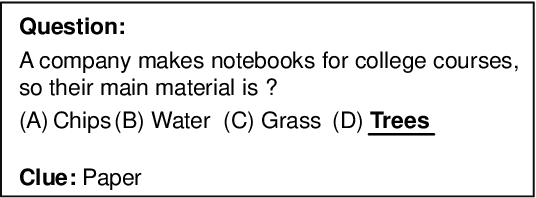
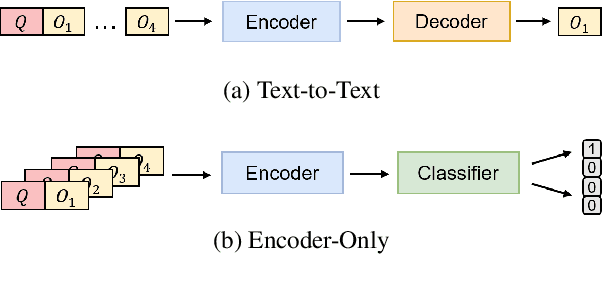
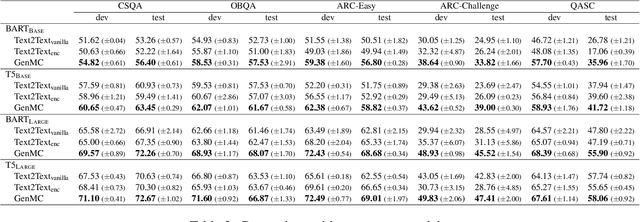
A trending paradigm for multiple-choice question answering (MCQA) is using a text-to-text framework. By unifying data in different tasks into a single text-to-text format, it trains a generative encoder-decoder model which is both powerful and universal. However, a side effect of twisting a generation target to fit the classification nature of MCQA is the under-utilization of the decoder and the knowledge that can be decoded. To exploit the generation capability and underlying knowledge of a pre-trained encoder-decoder model, in this paper, we propose a generation-enhanced MCQA model named GenMC. It generates a clue from the question and then leverages the clue to enhance a reader for MCQA. It outperforms text-to-text models on multiple MCQA datasets.