 Add to Chrome
 Add to Firefox
 Add to Edge
Architecture-Aware Reinforcement Learning Makes Sliding-Window Attention Competitive in Math Reasoning
Jun 10, 2026
The rapid progress of reasoning and agentic large language models (LLMs) has increased the demand for long-context inference, but self-attention (SA) scales quadratically with context length. To address this, we study SWARR (Sliding-Window Attention with Reinforced Adaptation for Math Reasoning), a practical recipe for adapting SWA models to mathematical reasoning. SWARR has two stages: (1) efficient conversion from a pretrained SA model to SWA with supervised fine-tuning (SFT), which avoids pretraining a new base model, and (2) policy adaptation with reinforcement learning (RL). We find that SWA still underperforms SA after SFT, and we hypothesize that this gap is caused in part by a data-architecture mismatch: most SFT data are prepared for SA models and may contain long-range dependencies that are difficult for SWA to model. Because on-policy RL optimizes self-generated trajectories under the SWA constraint, it can adapt trajectories to better match SWA. Experiments on mathematical reasoning benchmarks show that this recipe substantially narrows the gap between SWA and SA, recovering much of the accuracy lost during SWA conversion while preserving the efficiency benefits of linear-complexity attention. Our central contribution is the empirical finding that RL changes the conclusion one would draw from conversion and SFT alone about SWA's viability for math reasoning.

TREX: Automating LLM Fine-tuning via Agent-Driven Tree-based Exploration
Apr 15, 2026While Large Language Models (LLMs) have empowered AI research agents to perform isolated scientific tasks, automating complex, real-world workflows, such as LLM training, remains a significant challenge. In this paper, we introduce TREX, a multi-agent system that automates the entire LLM training life-cycle. By orchestrating collaboration between two core modules-the Researcher and the Executor-the system seamlessly performs requirement analysis, open-domain literature and data research, formulation of training strategies, preparation of data recipes, and model training and evaluation. The multi-round experimental process is modeled as a search tree, enabling the system to efficiently plan exploration paths, reuse historical results, and distill high-level insights from iterative trials. To evaluate the capability of automated LLM training, we construct FT-Bench, a benchmark comprising 10 tasks derived from real-world scenarios, ranging from optimizing fundamental model capabilities to enhancing performance on domain-specific tasks. Experimental results demonstrate that the TREX agent consistently optimizes model performance on target tasks.
Kernel-Smith: A Unified Recipe for Evolutionary Kernel Optimization
Mar 30, 2026We present Kernel-Smith, a framework for high-performance GPU kernel and operator generation that combines a stable evaluation-driven evolutionary agent with an evolution-oriented post-training recipe. On the agent side, Kernel-Smith maintains a population of executable candidates and iteratively improves them using an archive of top-performing and diverse programs together with structured execution feedback on compilation, correctness, and speedup. To make this search reliable, we build backend-specific evaluation services for Triton on NVIDIA GPUs and Maca on MetaX GPUs. On the training side, we convert long-horizon evolution trajectories into step-centric supervision and reinforcement learning signals by retaining correctness-preserving, high-gain revisions, so that the model is optimized as a strong local improver inside the evolutionary loop rather than as a one-shot generator. Under a unified evolutionary protocol, Kernel-Smith-235B-RL achieves state-of-the-art overall performance on KernelBench with Nvidia Triton backend, attaining the best average speedup ratio and outperforming frontier proprietary models including Gemini-3.0-pro and Claude-4.6-opus. We further validate the framework on the MetaX MACA backend, where our Kernel-Smith-MACA-30B surpasses large-scale counterparts such as DeepSeek-V3.2-think and Qwen3-235B-2507-think, highlighting potential for seamless adaptation across heterogeneous platforms. Beyond benchmark results, the same workflow produces upstream contributions to production systems including SGLang and LMDeploy, demonstrating that LLM-driven kernel optimization can transfer from controlled evaluation to practical deployment.
Intern-S1-Pro: Scientific Multimodal Foundation Model at Trillion Scale
Mar 26, 2026We introduce Intern-S1-Pro, the first one-trillion-parameter scientific multimodal foundation model. Scaling to this unprecedented size, the model delivers a comprehensive enhancement across both general and scientific domains. Beyond stronger reasoning and image-text understanding capabilities, its intelligence is augmented with advanced agent capabilities. Simultaneously, its scientific expertise has been vastly expanded to master over 100 specialized tasks across critical science fields, including chemistry, materials, life sciences, and earth sciences. Achieving this massive scale is made possible by the robust infrastructure support of XTuner and LMDeploy, which facilitates highly efficient Reinforcement Learning (RL) training at the 1-trillion parameter level while ensuring strict precision consistency between training and inference. By seamlessly integrating these advancements, Intern-S1-Pro further fortifies the fusion of general and specialized intelligence, working as a Specializable Generalist, demonstrating its position in the top tier of open-source models for general capabilities, while outperforming proprietary models in the depth of specialized scientific tasks.
DataChef: Cooking Up Optimal Data Recipes for LLM Adaptation via Reinforcement Learning
Feb 11, 2026In the current landscape of Large Language Models (LLMs), the curation of large-scale, high-quality training data is a primary driver of model performance. A key lever is the \emph{data recipe}, which comprises a data processing pipeline to transform raw sources into training corpora. Despite the growing use of LLMs to automate individual data processing steps, such as data synthesis and filtering, the overall design of data recipes remains largely manual and labor-intensive, requiring substantial human expertise and iteration. To bridge this gap, we formulate \emph{end-to-end data recipe generation} for LLM adaptation. Given a target benchmark and a pool of available data sources, a model is required to output a complete data recipe that adapts a base LLM to the target task. We present DataChef-32B, which performs online reinforcement learning using a proxy reward that predicts downstream performance for candidate recipes. Across six held-out tasks, DataChef-32B produces practical recipes that reach comparable downstream performance to those curated by human experts. Notably, the recipe from DataChef-32B adapts Qwen3-1.7B-Base to the math domain, achieving 66.7 on AIME'25 and surpassing Qwen3-1.7B. This work sheds new light on automating LLM training and developing self-evolving AI systems.
RTMW: Real-Time Multi-Person 2D and 3D Whole-body Pose Estimation
Jul 11, 2024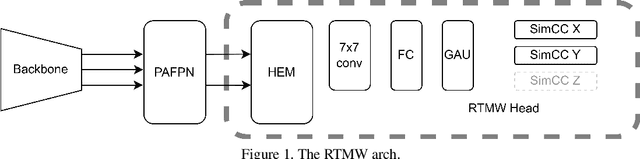
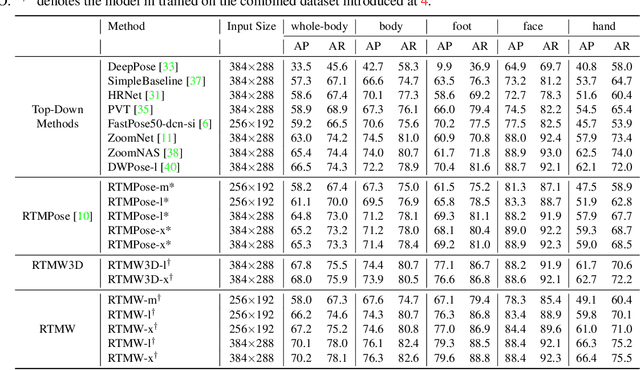
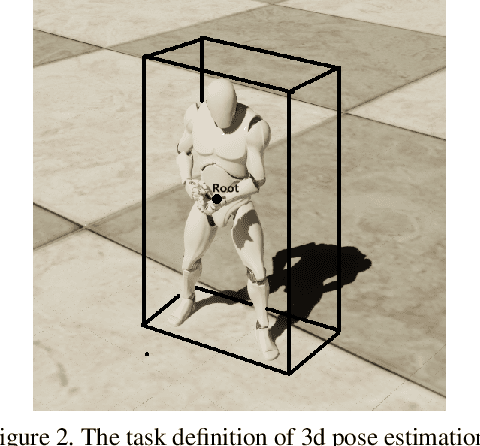
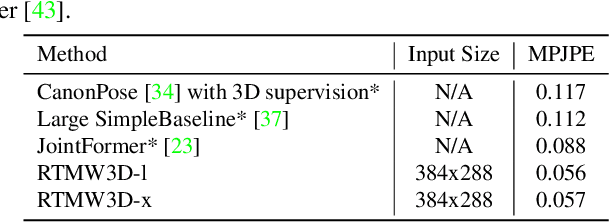
Whole-body pose estimation is a challenging task that requires simultaneous prediction of keypoints for the body, hands, face, and feet. Whole-body pose estimation aims to predict fine-grained pose information for the human body, including the face, torso, hands, and feet, which plays an important role in the study of human-centric perception and generation and in various applications. In this work, we present RTMW (Real-Time Multi-person Whole-body pose estimation models), a series of high-performance models for 2D/3D whole-body pose estimation. We incorporate RTMPose model architecture with FPN and HEM (Hierarchical Encoding Module) to better capture pose information from different body parts with various scales. The model is trained with a rich collection of open-source human keypoint datasets with manually aligned annotations and further enhanced via a two-stage distillation strategy. RTMW demonstrates strong performance on multiple whole-body pose estimation benchmarks while maintaining high inference efficiency and deployment friendliness. We release three sizes: m/l/x, with RTMW-l achieving a 70.2 mAP on the COCO-Wholebody benchmark, making it the first open-source model to exceed 70 mAP on this benchmark. Meanwhile, we explored the performance of RTMW in the task of 3D whole-body pose estimation, conducting image-based monocular 3D whole-body pose estimation in a coordinate classification manner. We hope this work can benefit both academic research and industrial applications. The code and models have been made publicly available at: https://github.com/open-mmlab/mmpose/tree/main/projects/rtmpose