 Add to Chrome
 Add to Firefox
 Add to Edge
TREX: Automating LLM Fine-tuning via Agent-Driven Tree-based Exploration
Apr 15, 2026
While Large Language Models (LLMs) have empowered AI research agents to perform isolated scientific tasks, automating complex, real-world workflows, such as LLM training, remains a significant challenge. In this paper, we introduce TREX, a multi-agent system that automates the entire LLM training life-cycle. By orchestrating collaboration between two core modules-the Researcher and the Executor-the system seamlessly performs requirement analysis, open-domain literature and data research, formulation of training strategies, preparation of data recipes, and model training and evaluation. The multi-round experimental process is modeled as a search tree, enabling the system to efficiently plan exploration paths, reuse historical results, and distill high-level insights from iterative trials. To evaluate the capability of automated LLM training, we construct FT-Bench, a benchmark comprising 10 tasks derived from real-world scenarios, ranging from optimizing fundamental model capabilities to enhancing performance on domain-specific tasks. Experimental results demonstrate that the TREX agent consistently optimizes model performance on target tasks.

Kernel-Smith: A Unified Recipe for Evolutionary Kernel Optimization
Mar 30, 2026We present Kernel-Smith, a framework for high-performance GPU kernel and operator generation that combines a stable evaluation-driven evolutionary agent with an evolution-oriented post-training recipe. On the agent side, Kernel-Smith maintains a population of executable candidates and iteratively improves them using an archive of top-performing and diverse programs together with structured execution feedback on compilation, correctness, and speedup. To make this search reliable, we build backend-specific evaluation services for Triton on NVIDIA GPUs and Maca on MetaX GPUs. On the training side, we convert long-horizon evolution trajectories into step-centric supervision and reinforcement learning signals by retaining correctness-preserving, high-gain revisions, so that the model is optimized as a strong local improver inside the evolutionary loop rather than as a one-shot generator. Under a unified evolutionary protocol, Kernel-Smith-235B-RL achieves state-of-the-art overall performance on KernelBench with Nvidia Triton backend, attaining the best average speedup ratio and outperforming frontier proprietary models including Gemini-3.0-pro and Claude-4.6-opus. We further validate the framework on the MetaX MACA backend, where our Kernel-Smith-MACA-30B surpasses large-scale counterparts such as DeepSeek-V3.2-think and Qwen3-235B-2507-think, highlighting potential for seamless adaptation across heterogeneous platforms. Beyond benchmark results, the same workflow produces upstream contributions to production systems including SGLang and LMDeploy, demonstrating that LLM-driven kernel optimization can transfer from controlled evaluation to practical deployment.
Large Language Models Meet Symbolic Provers for Logical Reasoning Evaluation
Feb 10, 2025First-order logic (FOL) reasoning, which involves sequential deduction, is pivotal for intelligent systems and serves as a valuable task for evaluating reasoning capabilities, particularly in chain-of-thought (CoT) contexts. Existing benchmarks often rely on extensive human annotation or handcrafted templates, making it difficult to achieve the necessary complexity, scalability, and diversity for robust evaluation. To address these limitations, we propose a novel framework called ProverGen that synergizes the generative strengths of Large Language Models (LLMs) with the rigor and precision of symbolic provers, enabling the creation of a scalable, diverse, and high-quality FOL reasoning dataset, ProverQA. ProverQA is also distinguished by its inclusion of accessible and logically coherent intermediate reasoning steps for each problem. Our evaluation shows that state-of-the-art LLMs struggle to solve ProverQA problems, even with CoT prompting, highlighting the dataset's challenging nature. We also finetune Llama3.1-8B-Instruct on a separate training set generated by our framework. The finetuned model demonstrates consistent improvements on both in-distribution and out-of-distribution test sets, suggesting the value of our proposed data generation framework. Code available at: https://github.com/opendatalab/ProverGen
SWE-Fixer: Training Open-Source LLMs for Effective and Efficient GitHub Issue Resolution
Jan 09, 2025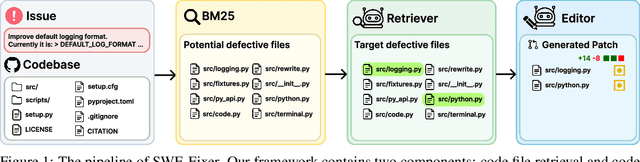


Large Language Models (LLMs) have demonstrated remarkable proficiency across a variety of complex tasks. One significant application of LLMs is in tackling software engineering challenges, particularly in resolving real-world tasks on GitHub by fixing code based on the issues reported by the users. However, many current approaches rely on proprietary LLMs, which limits reproducibility, accessibility, and transparency. The critical components of LLMs for addressing software engineering issues and how their capabilities can be effectively enhanced remain unclear. To address these challenges, we introduce SWE-Fixer, a novel open-source LLM designed to effectively and efficiently resolve GitHub issues. SWE-Fixer comprises two essential modules: a code file retrieval module and a code editing module. The retrieval module employs BM25 along with a lightweight LLM model to achieve coarse-to-fine file retrieval. Subsequently, the code editing module utilizes the other LLM model to generate patches for the identified files. Then, to mitigate the lack of publicly available datasets, we compile an extensive dataset that includes 110K GitHub issues along with their corresponding patches, and train the two modules of SWE-Fixer separately. We assess our approach on the SWE-Bench Lite and Verified benchmarks, achieving state-of-the-art performance among open-source models with scores of 23.3% and 30.2%, respectively. These outcomes highlight the efficacy of our approach. We will make our model, dataset, and code publicly available at https://github.com/InternLM/SWE-Fixer.
DevBench: A Comprehensive Benchmark for Software Development
Mar 15, 2024
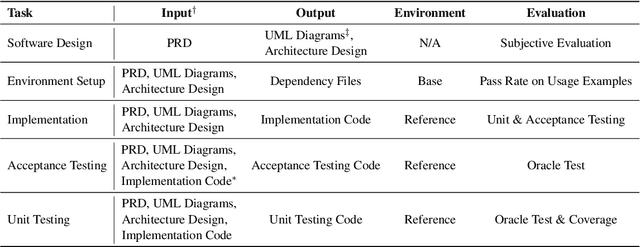
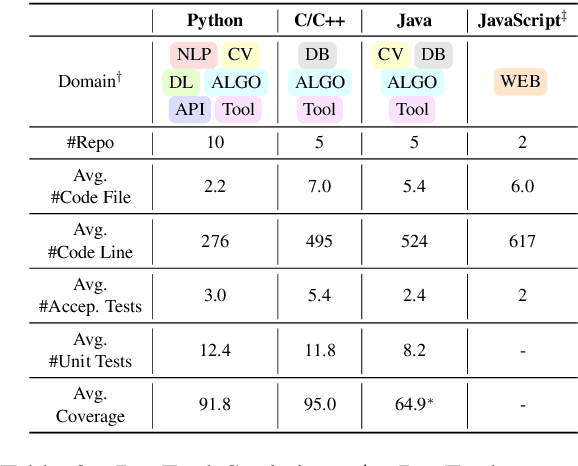

Recent advancements in large language models (LLMs) have significantly enhanced their coding capabilities. However, existing benchmarks predominantly focused on simplified or isolated aspects of programming, such as single-file code generation or repository issue debugging, falling short of measuring the full spectrum of challenges raised by real-world programming activities. To this end, we propose DevBench, a comprehensive benchmark that evaluates LLMs across various stages of the software development lifecycle, including software design, environment setup, implementation, acceptance testing, and unit testing. DevBench features a wide range of programming languages and domains, high-quality data collection, and carefully designed and verified metrics for each task. Empirical studies show that current LLMs, including GPT-4-Turbo, fail to solve the challenges presented within DevBench. Analyses reveal that models struggle with understanding the complex structures in the repository, managing the compilation process, and grasping advanced programming concepts. Our findings offer actionable insights for the future development of LLMs toward real-world programming applications. Our benchmark is available at https://github.com/open-compass/DevBench