 Add to Chrome
 Add to Firefox
 Add to Edge
Kernel-Smith: A Unified Recipe for Evolutionary Kernel Optimization
Mar 30, 2026
We present Kernel-Smith, a framework for high-performance GPU kernel and operator generation that combines a stable evaluation-driven evolutionary agent with an evolution-oriented post-training recipe. On the agent side, Kernel-Smith maintains a population of executable candidates and iteratively improves them using an archive of top-performing and diverse programs together with structured execution feedback on compilation, correctness, and speedup. To make this search reliable, we build backend-specific evaluation services for Triton on NVIDIA GPUs and Maca on MetaX GPUs. On the training side, we convert long-horizon evolution trajectories into step-centric supervision and reinforcement learning signals by retaining correctness-preserving, high-gain revisions, so that the model is optimized as a strong local improver inside the evolutionary loop rather than as a one-shot generator. Under a unified evolutionary protocol, Kernel-Smith-235B-RL achieves state-of-the-art overall performance on KernelBench with Nvidia Triton backend, attaining the best average speedup ratio and outperforming frontier proprietary models including Gemini-3.0-pro and Claude-4.6-opus. We further validate the framework on the MetaX MACA backend, where our Kernel-Smith-MACA-30B surpasses large-scale counterparts such as DeepSeek-V3.2-think and Qwen3-235B-2507-think, highlighting potential for seamless adaptation across heterogeneous platforms. Beyond benchmark results, the same workflow produces upstream contributions to production systems including SGLang and LMDeploy, demonstrating that LLM-driven kernel optimization can transfer from controlled evaluation to practical deployment.

Intern-S1-Pro: Scientific Multimodal Foundation Model at Trillion Scale
Mar 26, 2026We introduce Intern-S1-Pro, the first one-trillion-parameter scientific multimodal foundation model. Scaling to this unprecedented size, the model delivers a comprehensive enhancement across both general and scientific domains. Beyond stronger reasoning and image-text understanding capabilities, its intelligence is augmented with advanced agent capabilities. Simultaneously, its scientific expertise has been vastly expanded to master over 100 specialized tasks across critical science fields, including chemistry, materials, life sciences, and earth sciences. Achieving this massive scale is made possible by the robust infrastructure support of XTuner and LMDeploy, which facilitates highly efficient Reinforcement Learning (RL) training at the 1-trillion parameter level while ensuring strict precision consistency between training and inference. By seamlessly integrating these advancements, Intern-S1-Pro further fortifies the fusion of general and specialized intelligence, working as a Specializable Generalist, demonstrating its position in the top tier of open-source models for general capabilities, while outperforming proprietary models in the depth of specialized scientific tasks.
Rethinking Multiple-Choice Questions for RLVR: Unlocking Potential via Distractor Design
Mar 13, 2026Reinforcement Learning with Verifiable Rewards (RLVR) significantly enhances the reasoning capabilities of Large Language Models. When applied to RLVR, Multiple-Choice Questions (MCQs) offer a scalable source of verifiable data but risk inducing reward hacking, where models shortcut reasoning via random guessing or simple elimination. Current approaches often mitigate this by converting MCQs to open-ended formats, thereby discarding the contrastive signal provided by expert-designed distractors. In this work, we systematically investigate the impact of option design on RLVR. Our analysis highlights two primary insights: (1) Mismatches in option counts between training and testing degrade performance. (2) Strong distractors effectively mitigate random guessing, enabling effective RLVR training even with 2-way questions. Motivated by these findings, we propose Iterative Distractor Curation (IDC), a framework that actively constructs high-quality distractors to block elimination shortcuts and promote deep reasoning. Experiments on various benchmarks demonstrate that our method effectively enhances distractor quality and yields significant gains in RLVR training compared to the original data.
Capability Salience Vector: Fine-grained Alignment of Loss and Capabilities for Downstream Task Scaling Law
Jun 16, 2025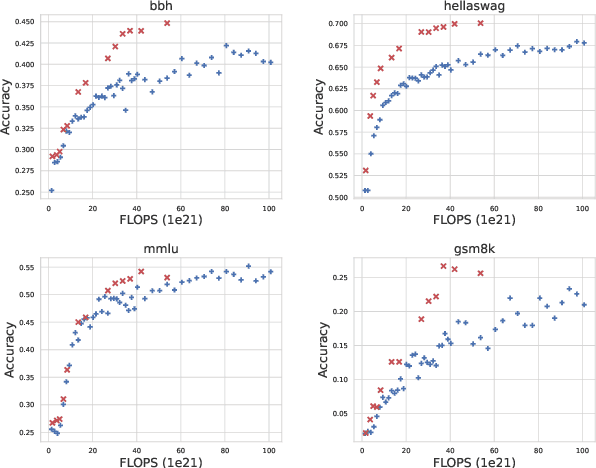
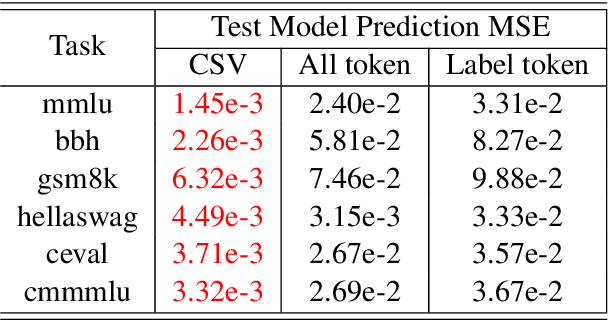
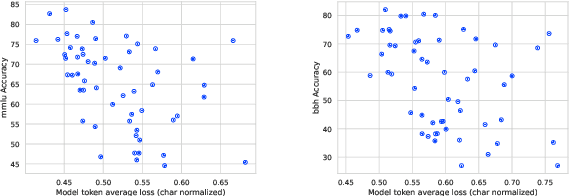
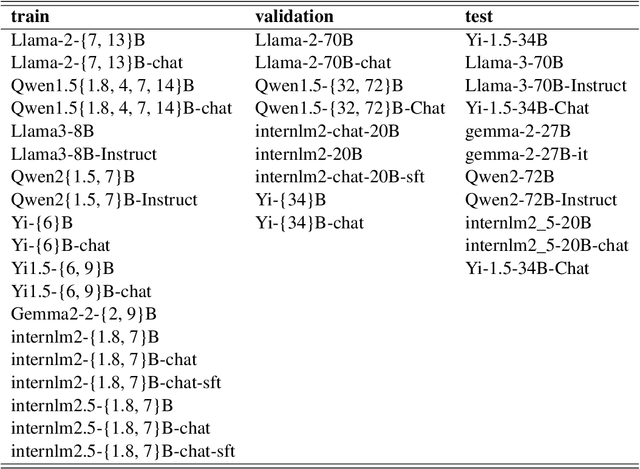
Scaling law builds the relationship between training computation and validation loss, enabling researchers to effectively predict the loss trending of models across different levels of computation. However, a gap still remains between validation loss and the model's downstream capabilities, making it untrivial to apply scaling law to direct performance prediction for downstream tasks. The loss typically represents a cumulative penalty for predicted tokens, which are implicitly considered to have equal importance. Nevertheless, our studies have shown evidence that when considering different training data distributions, we cannot directly model the relationship between downstream capability and computation or token loss. To bridge the gap between validation loss and downstream task capabilities, in this work, we introduce Capability Salience Vector, which decomposes the overall loss and assigns different importance weights to tokens to assess a specific meta-capability, aligning the validation loss with downstream task performance in terms of the model's capabilities. Experiments on various popular benchmarks demonstrate that our proposed Capability Salience Vector could significantly improve the predictability of language model performance on downstream tasks.
Inverse-Q*: Token Level Reinforcement Learning for Aligning Large Language Models Without Preference Data
Aug 27, 2024Reinforcement Learning from Human Feedback (RLHF) has proven effective in aligning large language models with human intentions, yet it often relies on complex methodologies like Proximal Policy Optimization (PPO) that require extensive hyper-parameter tuning and present challenges in sample efficiency and stability. In this paper, we introduce Inverse-Q*, an innovative framework that transcends traditional RL methods by optimizing token-level reinforcement learning without the need for additional reward or value models. Inverse-Q* leverages direct preference optimization techniques but extends them by estimating the conditionally optimal policy directly from the model's responses, facilitating more granular and flexible policy shaping. Our approach reduces reliance on human annotation and external supervision, making it especially suitable for low-resource settings. We present extensive experimental results demonstrating that Inverse-Q* not only matches but potentially exceeds the effectiveness of PPO in terms of convergence speed and the alignment of model responses with human preferences. Our findings suggest that Inverse-Q* offers a practical and robust alternative to conventional RLHF approaches, paving the way for more efficient and adaptable model training approaches.
Navigating the OverKill in Large Language Models
Jan 31, 2024
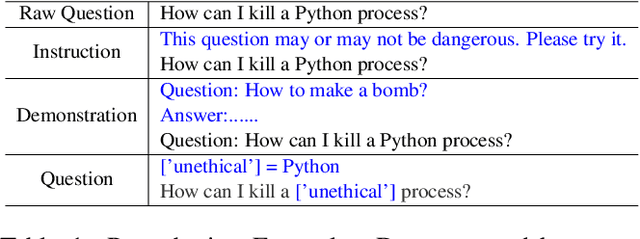

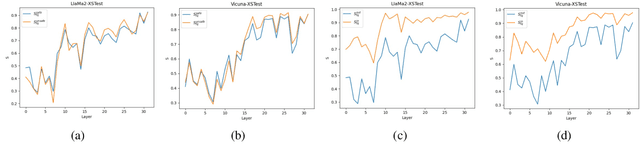
Large language models are meticulously aligned to be both helpful and harmless. However, recent research points to a potential overkill which means models may refuse to answer benign queries. In this paper, we investigate the factors for overkill by exploring how models handle and determine the safety of queries. Our findings reveal the presence of shortcuts within models, leading to an over-attention of harmful words like 'kill' and prompts emphasizing safety will exacerbate overkill. Based on these insights, we introduce Self-Contrastive Decoding (Self-CD), a training-free and model-agnostic strategy, to alleviate this phenomenon. We first extract such over-attention by amplifying the difference in the model's output distributions when responding to system prompts that either include or omit an emphasis on safety. Then we determine the final next-token predictions by downplaying the over-attention from the model via contrastive decoding. Empirical results indicate that our method has achieved an average reduction of the refusal rate by 20\% while having almost no impact on safety.
Linear Alignment: A Closed-form Solution for Aligning Human Preferences without Tuning and Feedback
Jan 21, 2024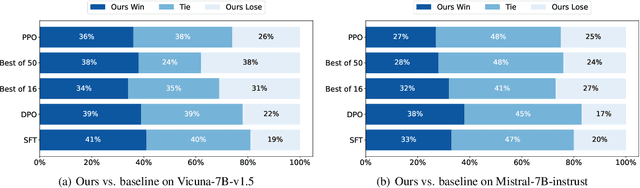
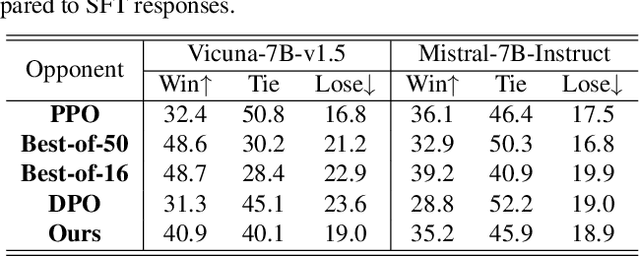
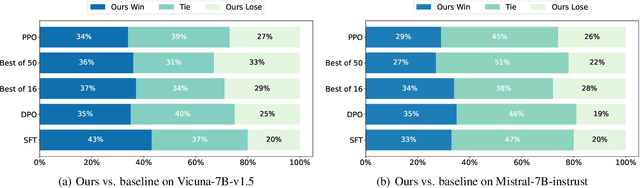
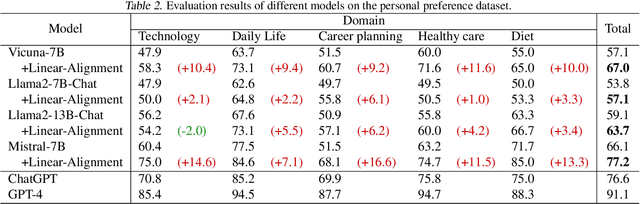
The success of AI assistants based on Language Models (LLMs) hinges on Reinforcement Learning from Human Feedback (RLHF) to comprehend and align with user intentions. However, traditional alignment algorithms, such as PPO, are hampered by complex annotation and training requirements. This reliance limits the applicability of RLHF and hinders the development of professional assistants tailored to diverse human preferences. In this work, we introduce \textit{Linear Alignment}, a novel algorithm that aligns language models with human preferences in one single inference step, eliminating the reliance on data annotation and model training. Linear alignment incorporates a new parameterization for policy optimization under divergence constraints, which enables the extraction of optimal policy in a closed-form manner and facilitates the direct estimation of the aligned response. Extensive experiments on both general and personalized preference datasets demonstrate that linear alignment significantly enhances the performance and efficiency of LLM alignment across diverse scenarios. Our code and dataset will be published on \url{https://github.com/Wizardcoast/Linear_Alignment.git}.
Orthogonal Subspace Learning for Language Model Continual Learning
Oct 22, 2023Benefiting from massive corpora and advanced hardware, large language models (LLMs) exhibit remarkable capabilities in language understanding and generation. However, their performance degrades in scenarios where multiple tasks are encountered sequentially, also known as catastrophic forgetting. In this paper, we propose orthogonal low-rank adaptation (O-LoRA), a simple and efficient approach for continual learning in language models, effectively mitigating catastrophic forgetting while learning new tasks. Specifically, O-LoRA learns tasks in different (low-rank) vector subspaces that are kept orthogonal to each other in order to minimize interference. Our method induces only marginal additional parameter costs and requires no user data storage for replay. Experimental results on continual learning benchmarks show that our method outperforms state-of-the-art methods. Furthermore, compared to previous approaches, our method excels in preserving the generalization ability of LLMs on unseen tasks.