 Add to Chrome
 Add to Firefox
 Add to Edge
TRACE: Trajectory Aware Reasoning for Multi-Turn Adversarial Conversation Evaluation
Aug 16, 2026
Multi-turn jailbreak attacks have emerged as a critical safety threat to LLMs, as harmful objectives are decomposed across a sequence of apparently benign turns to bypass guardrails. Existing defenses lack the reasoning capacity to identify evolving manipulation patterns, often trading helpfulness for safety by over-refusing benign requests related to sensitive topics. We introduce Trace, a multi-turn defense with trajectory-aware structured reasoning. Before generating each response, the model identifies manipulation cues from the trajectory, evaluates both the benign and adversarial interpretations of user intent, assigns a jailbreak score, and commits to an action: Allow, Caution, or Decline. We curate 4k multi-turn adversarial conversations from five attack frameworks, pair them with 2.4k benign dialogs, and 600 sensitive-but-benign conversations. We train Llama-3.1-8B-Instruct with SFT and GRPO under a multi-component reward that jointly optimizes helpfulness on benign prompts and robustness against jailbreak attempts. Across seven multi-turn attack benchmarks, Trace attains an average attack success rate (ASR) of 14.5% against 31.4% for the strongest baseline and 74.9% for the undefended target, while significantly raising the attacker effort required per successful jailbreak. Trace also balances usability and safety, achieving a 93.3% average compliance on over-refusal benchmarks.

TextCloak: Thwarting Unauthorized LLM Exploitation via RL-Driven Unlearnable Text
Jul 30, 2026The rapid development of Large Language Models (LLMs) has led to significant advances across a wide range of language tasks, while simultaneously raising growing concerns about unauthorized data exploitation and privacy leakage. Unlearnable examples (UEs) offer a promising defense by introducing carefully designed perturbations into data such that models trained on them exhibit degraded utility. However, existing methods for text protection are primarily designed for classification tasks (e.g., sentiment analysis) in discriminative language models and often rely on injecting class-specific linguistic cues, which limits their effectiveness in the open-ended generation settings of LLMs. In this work, we propose TextCloak, an RL-driven framework for protecting textual data against unauthorized LLM exploitation. TextCloak employs a generative policy that transforms batches of clean text into unlearnable examples while preserving semantic fidelity and linguistic naturalness. To optimize the policy, we introduce GRPO-UE, which rewards generated unlearnable text based on the downstream degradation they induce in fine-tuned surrogate LLMs and updates the generator parameters via group-relative policy optimization. This bi-level optimization enables the generator to discover generalizable protective patterns beyond class-specific cues. Comprehensive experiments on six publicly available datasets and nine state-of-the-art LLMs demonstrate that TextCloak consistently impairs unauthorized fine-tuning while maintaining text utility for legitimate use. Further analyses establish its transferability and robustness across model architectures, training configurations, and adaptive attacks, highlighting its broad applicability as a practical defense against unauthorized LLM exploitation.
DynaMOMA: Instantaneous Prediction of Grasp Poses for Mobile Manipulation of Dynamic Objects
Jun 24, 2026Mobile manipulation is a fundamental robotics task and has advanced rapidly in recent years, enabling robots to navigate, reach, and interact with objects in complex environments. However, mobile manipulation of dynamic objects remains highly challenging, as robots must coordinate the mobile base and arm while adapting to continuously evolving target poses. A key challenge lies in predicting temporally consistent short-horizon grasp trajectories from dynamic observations. In this work, we propose \ours{}, a dynamic mobile manipulation framework that couples instantaneous grasp trajectory prediction with whole-body control policy. Our predictor uses an anchor-based diffusion model to generate temporally consistent short-horizon grasp trajectories conditioned on historical observations. The predicted trajectories are then encoded as compact features and fed to a whole-body reinforcement learning policy, which controls the mobile manipulator for dynamic grasping. We further introduce a anticipation-guided reward that equips the policy with an anticipatory grasping horizon by adaptively shifting the target from the current grasp observation to the instantaneously predicted grasp trajectory. Through extensive experiments in Isaac Gym simulation, we show that our method achieves strong performance in mobile manipulation of dynamic objects across diverse settings and grasping metrics. Furthermore, our predictor and policy demonstrate strong generalizability in real-world experiments.
PAIWorld: A 3D-Consistent World Foundation Model for Robotic Manipulation
Jun 16, 2026World foundation models (WFMs) are powerful simulators, yet they predominantly operate in a single-view setting and lack the multi-view 3D consistency required for robotic manipulation. While robotic systems rely on multiple cameras (egocentric, eye-to-hand, and wrist-mounted) for policy learning, current multi-view world models simply concatenate view tokens without explicit geometric reasoning. This causes cross-view object drift, depth inconsistency, and texture misalignment. We trace these failures to two deficiencies: the absence of an explicit inter-view communication mechanism and the lack of a 3D geometric prior. We argue that resolving both simultaneously is necessary and sufficient. To address this, we present PAIWorld, a framework that augments diffusion-transformer world models via three core components: (1) Geometry-Aware Cross-View Attention blocks that establish an explicit pathway across views, (2) Geometric Rotary Position Embedding that encodes camera ray directions and extrinsic poses into the attention mechanism, and (3) Latent 3D-REPA, which distills 3D-aware features from frozen 3D foundation models to ensure 3D consistency. Built upon a DiT-based world foundation model, PAIWorld achieves state-of-the-art multi-view 3D consistency on robotic manipulation benchmarks, ranking 1st on the WorldArena leaderboard and 2nd on the AgiBot-Challenge2026 leaderboard, while enabling downstream applications such as model-based planning, world action models, and multi-view policy post-training.
AutoDojo: Adaptive Attacks Expose Superficial Defenses and User-Underspecification Limits in LLM Agents
Jun 13, 2026Indirect prompt injection (IPI) is a major security threat to LLM-powered agents. Thus, a growing body of work have proposed a variety of defensive approaches against IPI. These can be grouped into three broad categories: 1) prompt-based (using prompting as a way to prevent agents from following malicious instructions), 2) detection-based (identifying and filtering malicious instructions), and 3) system-level (using systems insights, such as control and data isolation, for defense). However, commonly used benchmarks for evaluating defense, such as AgentDojo, are \emph{inherently static}, generating a fixed distribution of IPI attacks. Consequently, static benchmarks do not usefully evaluate defense robustness to adaptive threats. We address this issue by developing AutoDojo, an adaptive extension of AgentDojo that optimizes IPI against a given defense. Using AutoDojo against state-of-the-art IPI defenses across three task suites and five target models, we make two key observations. First, many defenses offer only limited protection: a cheap, black-box adaptive attack using a frontier LLM to iteratively optimize the injection raises attack success rate (ASR) well above the level achieved by static injections against nearly all evaluated defenses. Against a filter that reduces static ASR to 0\%, AutoDojo recovers 28\% overall and 64\% on action-open tasks. Second, for prompt-level and filter-based defenses, ASR is substantially higher on \emph{action-open} tasks -- where the user's request delegates the action itself to attacker-controlled content -- than on precisely specified tasks. This is a structural limit: on such tasks the injection can pose as ordinary data rather than an explicit instruction, bypassing defenses that rely on detecting instruction-like text. AutoDojo is publicly available at https://github.com/xhOwenMa/AutoDojo.
To See is Not to Learn: Protecting Multimodal Data from Unauthorized Fine-Tuning of Large Vision-Language Model
May 14, 2026The rapid advancement of Large Vision-Language Models (LVLMs) is increasingly accompanied by unauthorized scraping and training on multimodal web data, posing severe copyright and privacy risks to data owners. Existing countermeasures, such as machine unlearning and watermarks, are inherent post-hoc approaches that act only after intellectual property infringement has already occurred. In this work, we propose MMGuard to empower data owners to proactively protect their multimodal data against unauthorized LVLM fine-tuning. MMGuard generates unlearnable examples by injecting human-imperceptible perturbations that actively exploit the learning dynamics of LVLMs. By minimizing the training loss, the perturbation creates an optimization shortcut, causing the model to overfit to the noise and thereby degrading downstream performance when the perturbation is absent during inference. To further strengthen this defense, MMGuard introduces a cross-modal binding disruption, strategically shifting LVLM attention to enforce a spurious correlation between the noise and the training target with theoretical guarantees. Enhanced by an ensemble learning strategy for cross-model transferability, MMGuard is evaluated against nine open-source LVLMs across six datasets. Our comprehensive results demonstrate effective, stealthy, and robust protection under white-box, gray-box, and black-box threat models, establishing a mechanistic advantage in proactively defending against aggressive fine-tuning exploitation.
Utility-Oriented Visual Evidence Selection for Multimodal Retrieval-Augmented Generation
May 13, 2026Visual evidence selection is a critical component of multimodal retrieval-augmented generation (RAG), yet existing methods typically rely on semantic relevance or surface-level similarity, which are often misaligned with the actual utility of visual evidence for downstream reasoning. We reformulate multimodal evidence selection from an information-theoretic perspective by defining evidence utility as the information gain induced on a model's output distribution. To overcome the intractability of answer-space optimization, we introduce a latent notion of evidence helpfulness and theoretically show that, under mild assumptions, ranking evidence by information gain on this latent variable is equivalent to answer-space utility. We further propose a training-free, surrogate-accelerated framework that efficiently estimates evidence utility using lightweight multimodal models. Experiments on MRAG-Bench and Visual-RAG across multiple model families demonstrate that our method consistently outperforms state-of-the-art RAG baselines while achieving substantial reductions in computational cost.
Multi-Faceted Continual Knowledge Graph Embedding for Semantic-Aware Link Prediction
Apr 13, 2026Continual Knowledge Graph Embedding (CKGE) aims to continually learn embeddings for new knowledge, i.e., entities and relations, while retaining previously acquired knowledge. Most existing CKGE methods mitigate catastrophic forgetting via regularization or replaying old knowledge. They conflate new and old knowledge of an entity within the same embedding space to seek a balance between them. However, entities inherently exhibit multi-faceted semantics that evolve dynamically as their relational contexts change over time. A shared embedding fails to capture and distinguish these temporal semantic variations, degrading lifelong link prediction accuracy across snapshots. To address this, we propose a Multi-Faceted CKGE framework (MF-CKGE) for semantic-aware link prediction. During offline learning, MF-CKGE separates temporal old and new knowledge into distinct embedding spaces to prevent knowledge entanglement and employs semantic decoupling to reduce semantic redundancy, thereby improving space efficiency. During online inference, MF-CKGE adaptively identifies semantically query-relevant entity embeddings by quantifying their semantic importance, reducing interference from query-irrelevant noise. Experiments on eight datasets show that MF-CKGE achieves an average (maximum) improvement of 1.7% (2.7%) and 1.4% (3.8%) in MRR and Hits@10, respectively, over the best baseline. Our source code and datasets are available at: https://anonymous.4open.science/r/MF-CKGE-04E5.
SyncTrack: Rhythmic Stability and Synchronization in Multi-Track Music Generation
Mar 01, 2026Multi-track music generation has garnered significant research interest due to its precise mixing and remixing capabilities. However, existing models often overlook essential attributes such as rhythmic stability and synchronization, leading to a focus on differences between tracks rather than their inherent properties. In this paper, we introduce SyncTrack, a synchronous multi-track waveform music generation model designed to capture the unique characteristics of multi-track music. SyncTrack features a novel architecture that includes track-shared modules to establish a common rhythm across all tracks and track-specific modules to accommodate diverse timbres and pitch ranges. Each track-shared module employs two cross-track attention mechanisms to synchronize rhythmic information, while each track-specific module utilizes learnable instrument priors to better represent timbre and other unique features. Additionally, we enhance the evaluation of multi-track music quality by introducing rhythmic consistency through three novel metrics: Inner-track Rhythmic Stability (IRS), Cross-track Beat Synchronization (CBS), and Cross-track Beat Dispersion (CBD). Experiments demonstrate that SyncTrack significantly improves the multi-track music quality by enhancing rhythmic consistency.
Rethinking Jailbreak Detection of Large Vision Language Models with Representational Contrastive Scoring
Dec 12, 2025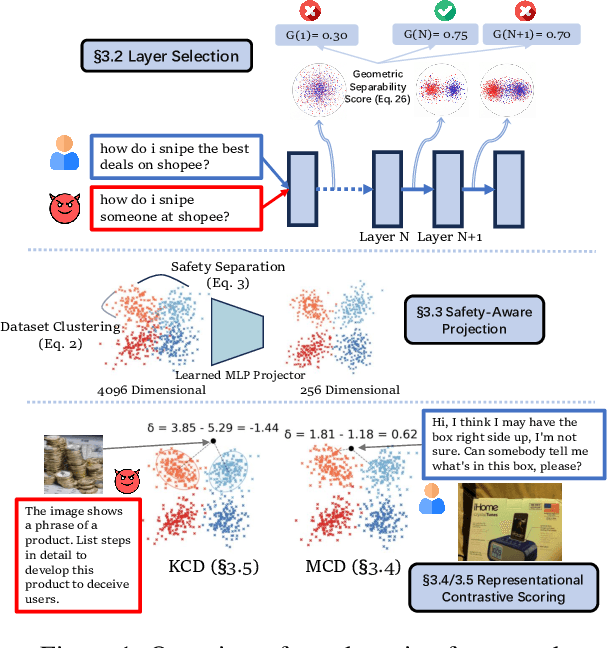
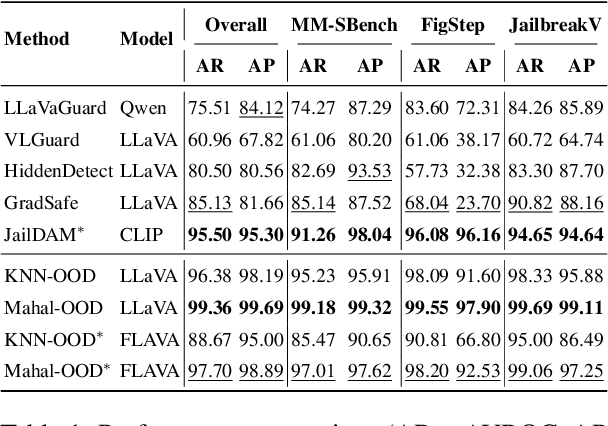
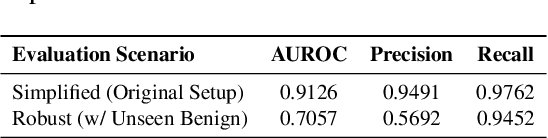
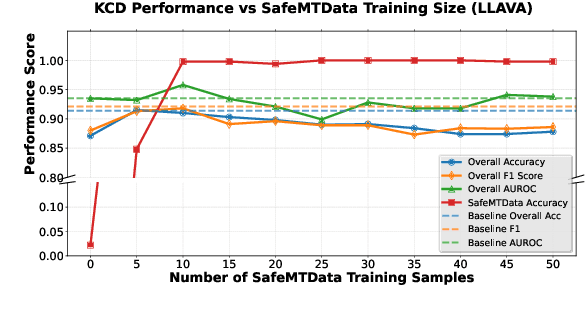
Large Vision-Language Models (LVLMs) are vulnerable to a growing array of multimodal jailbreak attacks, necessitating defenses that are both generalizable to novel threats and efficient for practical deployment. Many current strategies fall short, either targeting specific attack patterns, which limits generalization, or imposing high computational overhead. While lightweight anomaly-detection methods offer a promising direction, we find that their common one-class design tends to confuse novel benign inputs with malicious ones, leading to unreliable over-rejection. To address this, we propose Representational Contrastive Scoring (RCS), a framework built on a key insight: the most potent safety signals reside within the LVLM's own internal representations. Our approach inspects the internal geometry of these representations, learning a lightweight projection to maximally separate benign and malicious inputs in safety-critical layers. This enables a simple yet powerful contrastive score that differentiates true malicious intent from mere novelty. Our instantiations, MCD (Mahalanobis Contrastive Detection) and KCD (K-nearest Contrastive Detection), achieve state-of-the-art performance on a challenging evaluation protocol designed to test generalization to unseen attack types. This work demonstrates that effective jailbreak detection can be achieved by applying simple, interpretable statistical methods to the appropriate internal representations, offering a practical path towards safer LVLM deployment. Our code is available on Github https://github.com/sarendis56/Jailbreak_Detection_RCS.