 Add to Chrome
 Add to Firefox
 Add to Edge
RTSKG: Building a Rail Transit Station Knowledge Graph Dataset
Aug 11, 2026
Rail transit systems play a vital role in urban mobility and economic development. As key components of such systems, rail transit stations function as critical transport hubs that enhance urban accessibility and stimulate development in surrounding areas. City-level rail transit station related tasks (e.g., ridership prediction) require large-scale urban data, but current studies often neglect complex interactions among various urban entities in terms of data organization. In this paper, to address the above issue, we build a Rail Transit Station Knowledge Graph (RTSKG) dataset which explicitly models the spatial and semantic interactions among different kinds of urban entities, to benefit city-level rail transit station related tasks. RTSKG integrates heterogeneous urban entities, such as rail transit stations, road segments, and points of interest, with a specially designed unified schema, and is accessible as Linked Data at https://w3id.org/rtskg/. Evaluations on station-area store recommendation and knowledge-enhanced ridership prediction demonstrate the effectiveness of RTSKG, highlighting its potential to support city-level rail transit station analysis.

Debate-on-Graph: Reliable and Adaptive Reasoning of Large Language Model on Uncertain Knowledge Graph
Jul 19, 2026Large language models (LLMs) have demonstrated remarkable capabilities in natural language processing. However, LLMs often suffer from hallucinations and lack of relevant knowledge when dealing with question answering (QA) tasks. To mitigate these issues, knowledge graphs (KGs) have been utilized to enhance LLM reasoning. Nevertheless, KGs often contain noise and errors, while existing KG-enhanced LLM approaches are generally unable to identify and filter such noisy and erroneous content, which can instead amplify hallucinations and pose challenges for reliable reasoning. Uncertain knowledge graphs (UKGs), which associate each triple with a confidence score to quantify uncertainty, offer a promising direction to address this challenge. Compared with prior work, we investigate how to leverage UKGs to support LLMs for QA. We propose Debate-on-Graph (DoG), a new framework that enables LLMs and UKGs to collaborate adaptively for reliable reasoning. Specifically, we first design a heuristic search algorithm tailored for UKGs to extract reliable and question-relevant subgraphs, thereby reducing noise and errors in retrieved knowledge. We then introduce a Multi-Agent Debate mechanism, which yields reliable answers through adaptive adversarial debates, aiming to fully exploit the knowledge in UKGs while preserving the reliability of retrieved evidence. Extensive experiments on four benchmark QA datasets show that DoG achieves state-of-the-art performance over existing LLM reasoning methods and KG-based baselines, while enabling reliable and adaptive reasoning. Our code is available at https://github.com/seucoin/Debate-on-Graph.
Multi-Faceted Continual Knowledge Graph Embedding for Semantic-Aware Link Prediction
Apr 13, 2026Continual Knowledge Graph Embedding (CKGE) aims to continually learn embeddings for new knowledge, i.e., entities and relations, while retaining previously acquired knowledge. Most existing CKGE methods mitigate catastrophic forgetting via regularization or replaying old knowledge. They conflate new and old knowledge of an entity within the same embedding space to seek a balance between them. However, entities inherently exhibit multi-faceted semantics that evolve dynamically as their relational contexts change over time. A shared embedding fails to capture and distinguish these temporal semantic variations, degrading lifelong link prediction accuracy across snapshots. To address this, we propose a Multi-Faceted CKGE framework (MF-CKGE) for semantic-aware link prediction. During offline learning, MF-CKGE separates temporal old and new knowledge into distinct embedding spaces to prevent knowledge entanglement and employs semantic decoupling to reduce semantic redundancy, thereby improving space efficiency. During online inference, MF-CKGE adaptively identifies semantically query-relevant entity embeddings by quantifying their semantic importance, reducing interference from query-irrelevant noise. Experiments on eight datasets show that MF-CKGE achieves an average (maximum) improvement of 1.7% (2.7%) and 1.4% (3.8%) in MRR and Hits@10, respectively, over the best baseline. Our source code and datasets are available at: https://anonymous.4open.science/r/MF-CKGE-04E5.
LLM+Graph@VLDB'2025 Workshop Summary
Apr 03, 2026The integration of large language models (LLMs) with graph-structured data has become a pivotal and fast evolving research frontier, drawing strong interest from both academia and industry. The 2nd LLM+Graph Workshop, co-located with the 51st International Conference on Very Large Data Bases (VLDB 2025) in London, focused on advancing algorithms and systems that bridge LLMs, graph data management, and graph machine learning for practical applications. This report highlights the key research directions, challenges, and innovative solutions presented by the workshop's speakers.
LSGQuant: Layer-Sensitivity Guided Quantization for One-Step Diffusion Real-World Video Super-Resolution
Feb 03, 2026One-Step Diffusion Models have demonstrated promising capability and fast inference in video super-resolution (VSR) for real-world. Nevertheless, the substantial model size and high computational cost of Diffusion Transformers (DiTs) limit downstream applications. While low-bit quantization is a common approach for model compression, the effectiveness of quantized models is challenged by the high dynamic range of input latent and diverse layer behaviors. To deal with these challenges, we introduce LSGQuant, a layer-sensitivity guided quantizing approach for one-step diffusion-based real-world VSR. Our method incorporates a Dynamic Range Adaptive Quantizer (DRAQ) to fit video token activations. Furthermore, we estimate layer sensitivity and implement a Variance-Oriented Layer Training Strategy (VOLTS) by analyzing layer-wise statistics in calibration. We also introduce Quantization-Aware Optimization (QAO) to jointly refine the quantized branch and a retained high-precision branch. Extensive experiments demonstrate that our method has nearly performance to origin model with full-precision and significantly exceeds existing quantization techniques. Code is available at: https://github.com/zhengchen1999/LSGQuant.
OneEval: Benchmarking LLM Knowledge-intensive Reasoning over Diverse Knowledge Bases
Jun 14, 2025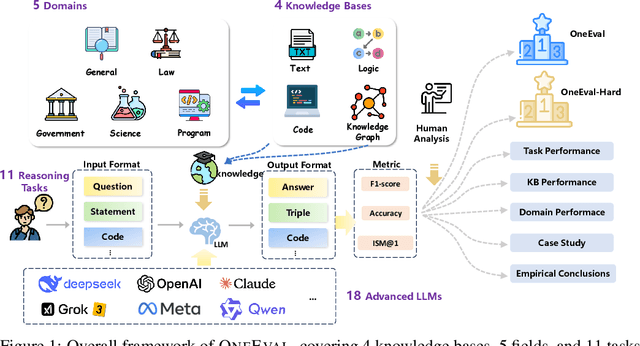
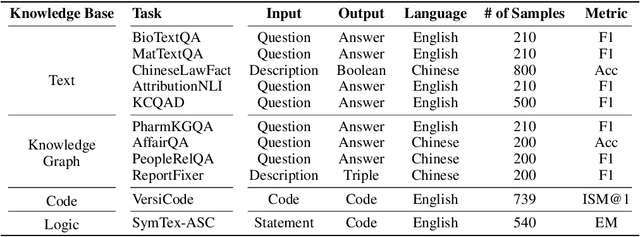
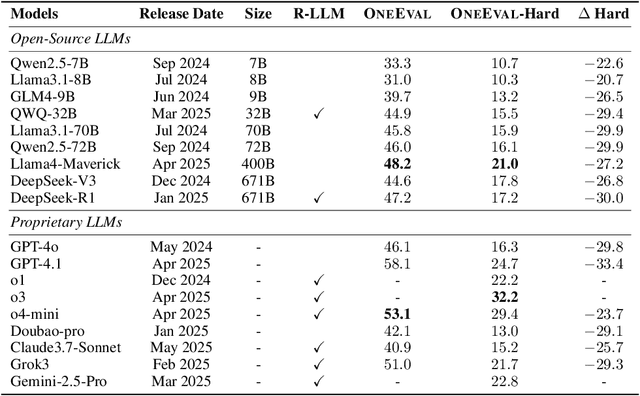
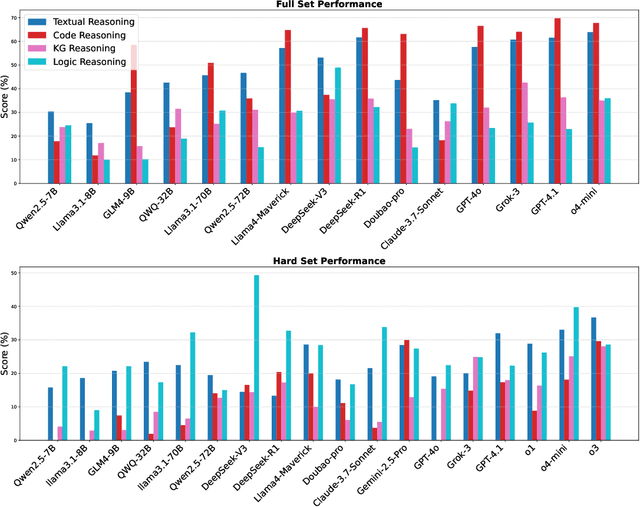
Large Language Models (LLMs) have demonstrated substantial progress on reasoning tasks involving unstructured text, yet their capabilities significantly deteriorate when reasoning requires integrating structured external knowledge such as knowledge graphs, code snippets, or formal logic. This limitation is partly due to the absence of benchmarks capable of systematically evaluating LLM performance across diverse structured knowledge modalities. To address this gap, we introduce \textbf{\textsc{OneEval}}, a comprehensive benchmark explicitly designed to assess the knowledge-intensive reasoning capabilities of LLMs across four structured knowledge modalities, unstructured text, knowledge graphs, code, and formal logic, and five critical domains (general knowledge, government, science, law, and programming). \textsc{OneEval} comprises 4,019 carefully curated instances and includes a challenging subset, \textsc{OneEval}\textsubscript{Hard}, consisting of 1,285 particularly difficult cases. Through extensive evaluation of 18 state-of-the-art open-source and proprietary LLMs, we establish three core findings: a) \emph{persistent limitations in structured reasoning}, with even the strongest model achieving only 32.2\% accuracy on \textsc{OneEval}\textsubscript{Hard}; b) \emph{performance consistently declines as the structural complexity of the knowledge base increases}, with accuracy dropping sharply from 53\% (textual reasoning) to 25\% (formal logic); and c) \emph{diminishing returns from extended reasoning chains}, highlighting the critical need for models to adapt reasoning depth appropriately to task complexity. We release the \textsc{OneEval} datasets, evaluation scripts, and baseline results publicly, accompanied by a leaderboard to facilitate ongoing advancements in structured knowledge reasoning.
Electricity Cost Minimization for Multi-Workflow Allocation in Geo-Distributed Data Centers
Apr 27, 2025Worldwide, Geo-distributed Data Centers (GDCs) provide computing and storage services for massive workflow applications, resulting in high electricity costs that vary depending on geographical locations and time. How to reduce electricity costs while satisfying the deadline constraints of workflow applications is important in GDCs, which is determined by the execution time of servers, power, and electricity price. Determining the completion time of workflows with different server frequencies can be challenging, especially in scenarios with heterogeneous computing resources in GDCs. Moreover, the electricity price is also different in geographical locations and may change dynamically. To address these challenges, we develop a geo-distributed system architecture and propose an Electricity Cost aware Multiple Workflows Scheduling algorithm (ECMWS) for servers of GDCs with fixed frequency and power. ECMWS comprises four stages, namely workflow sequencing, deadline partitioning, task sequencing, and resource allocation where two graph embedding models and a policy network are constructed to solve the Markov Decision Process (MDP). After statistically calibrating parameters and algorithm components over a comprehensive set of workflow instances, the proposed algorithms are compared with the state-of-the-art methods over two types of workflow instances. The experimental results demonstrate that our proposed algorithm significantly outperforms other algorithms, achieving an improvement of over 15\% while maintaining an acceptable computational time. The source codes are available at https://gitee.com/public-artifacts/ecmws-experiments.
Enhancing Environmental Robustness in Few-shot Learning via Conditional Representation Learning
Feb 03, 2025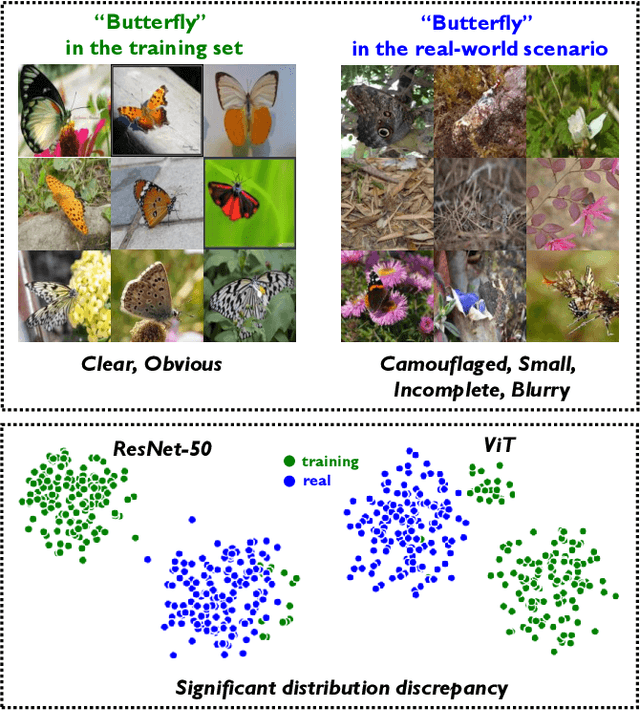
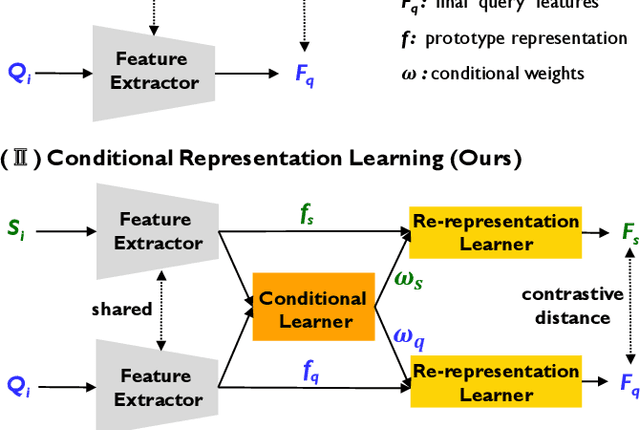
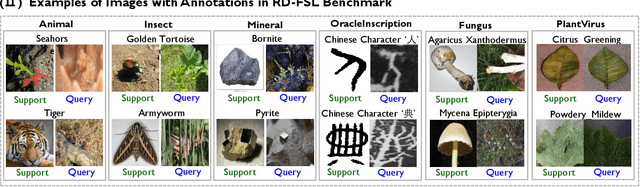
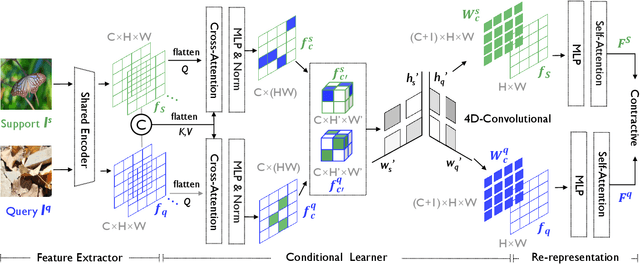
Few-shot learning (FSL) has recently been extensively utilized to overcome the scarcity of training data in domain-specific visual recognition. In real-world scenarios, environmental factors such as complex backgrounds, varying lighting conditions, long-distance shooting, and moving targets often cause test images to exhibit numerous incomplete targets or noise disruptions. However, current research on evaluation datasets and methodologies has largely ignored the concept of "environmental robustness", which refers to maintaining consistent performance in complex and diverse physical environments. This neglect has led to a notable decline in the performance of FSL models during practical testing compared to their training performance. To bridge this gap, we introduce a new real-world multi-domain few-shot learning (RD-FSL) benchmark, which includes four domains and six evaluation datasets. The test images in this benchmark feature various challenging elements, such as camouflaged objects, small targets, and blurriness. Our evaluation experiments reveal that existing methods struggle to utilize training images effectively to generate accurate feature representations for challenging test images. To address this problem, we propose a novel conditional representation learning network (CRLNet) that integrates the interactions between training and testing images as conditional information in their respective representation processes. The main goal is to reduce intra-class variance or enhance inter-class variance at the feature representation level. Finally, comparative experiments reveal that CRLNet surpasses the current state-of-the-art methods, achieving performance improvements ranging from 6.83% to 16.98% across diverse settings and backbones. The source code and dataset are available at https://github.com/guoqianyu-alberta/Conditional-Representation-Learning.
MM-Retinal V2: Transfer an Elite Knowledge Spark into Fundus Vision-Language Pretraining
Jan 27, 2025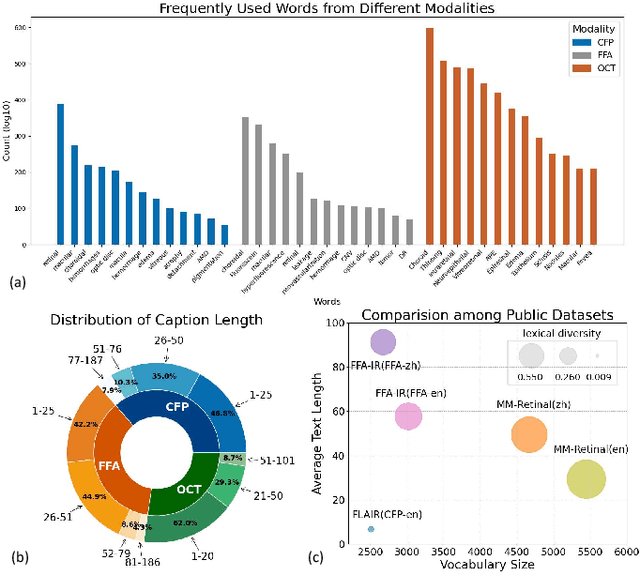


Vision-language pretraining (VLP) has been investigated to generalize across diverse downstream tasks for fundus image analysis. Although recent methods showcase promising achievements, they significantly rely on large-scale private image-text data but pay less attention to the pretraining manner, which limits their further advancements. In this work, we introduce MM-Retinal V2, a high-quality image-text paired dataset comprising CFP, FFA, and OCT image modalities. Then, we propose a novel fundus vision-language pretraining model, namely KeepFIT V2, which is pretrained by integrating knowledge from the elite data spark into categorical public datasets. Specifically, a preliminary textual pretraining is adopted to equip the text encoder with primarily ophthalmic textual knowledge. Moreover, a hybrid image-text knowledge injection module is designed for knowledge transfer, which is essentially based on a combination of global semantic concepts from contrastive learning and local appearance details from generative learning. Extensive experiments across zero-shot, few-shot, and linear probing settings highlight the generalization and transferability of KeepFIT V2, delivering performance competitive to state-of-the-art fundus VLP models trained on large-scale private image-text datasets. Our dataset and model are publicly available via https://github.com/lxirich/MM-Retinal.
LLM+KG@VLDB'24 Workshop Summary
Oct 02, 2024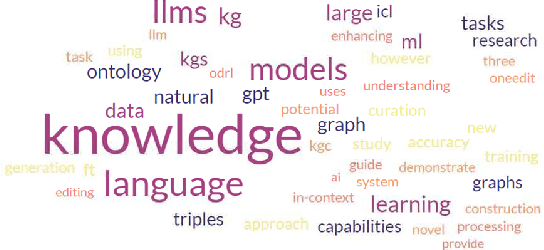
The unification of large language models (LLMs) and knowledge graphs (KGs) has emerged as a hot topic. At the LLM+KG'24 workshop, held in conjunction with VLDB 2024 in Guangzhou, China, one of the key themes explored was important data management challenges and opportunities due to the effective interaction between LLMs and KGs. This report outlines the major directions and approaches presented by various speakers during the LLM+KG'24 workshop.