 Add to Chrome
 Add to Firefox
 Add to Edge
Behavioral Skill Reconstruction: Reconstructing Hidden Functionality from LLM Agent Skills
Aug 04, 2026
Closed source agent skills may encode proprietary instructions, scripts, constants, and data. Providers may offer their capabilities as services while keeping the underlying packages hidden. Prior work focuses on prompt injection attacks that directly disclose these artifacts, and existing defenses accordingly aim to prevent such leakage. However, preventing file disclosure does not prevent users from recovering the functionality those files implement. This raises a fundamental question: can a user reconstruct a skill's functionality through ordinary use while its files remain hidden? We study behavioral skill reconstruction (BSR), in which an attacker uses valid task requests and observed responses to build a functional clone of a hidden skill. We introduce SkillClone, a black-box attack that clones a target skill by forming an interface hypothesis from its public advertisement, issuing structured benign probes, synthesizing an executable replica, and iteratively repairing it through differential validation against the victim skill. Across 30 skills spanning rules, tables, procedures, and algorithms, SkillClone achieves exact or partial recovery on held-out inputs for several targets. Iterative requerying closes gaps missed by single-round reconstruction. Because SkillClone uses only legitimate interactions, disclosure-focused defenses provide limited coverage, and less detailed skill descriptions offer limited protection. These results show that file secrecy alone does not ensure functional secrecy. Defenses must also limit cumulative information leakage from ordinary use.

Rethinking Jailbreak Detection of Large Vision Language Models with Representational Contrastive Scoring
Dec 12, 2025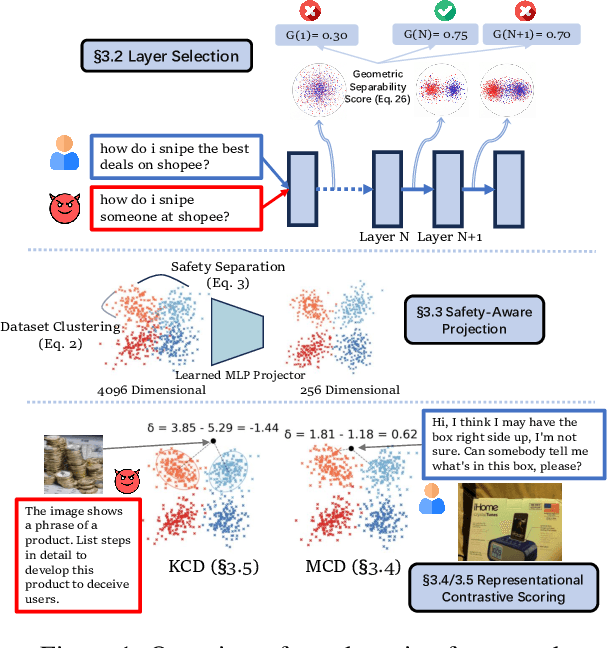
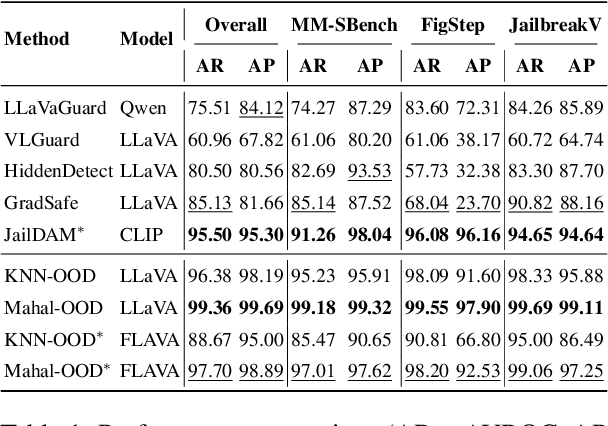
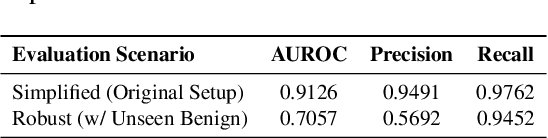
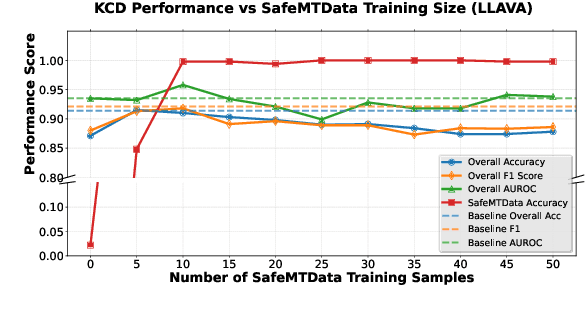
Large Vision-Language Models (LVLMs) are vulnerable to a growing array of multimodal jailbreak attacks, necessitating defenses that are both generalizable to novel threats and efficient for practical deployment. Many current strategies fall short, either targeting specific attack patterns, which limits generalization, or imposing high computational overhead. While lightweight anomaly-detection methods offer a promising direction, we find that their common one-class design tends to confuse novel benign inputs with malicious ones, leading to unreliable over-rejection. To address this, we propose Representational Contrastive Scoring (RCS), a framework built on a key insight: the most potent safety signals reside within the LVLM's own internal representations. Our approach inspects the internal geometry of these representations, learning a lightweight projection to maximally separate benign and malicious inputs in safety-critical layers. This enables a simple yet powerful contrastive score that differentiates true malicious intent from mere novelty. Our instantiations, MCD (Mahalanobis Contrastive Detection) and KCD (K-nearest Contrastive Detection), achieve state-of-the-art performance on a challenging evaluation protocol designed to test generalization to unseen attack types. This work demonstrates that effective jailbreak detection can be achieved by applying simple, interpretable statistical methods to the appropriate internal representations, offering a practical path towards safer LVLM deployment. Our code is available on Github https://github.com/sarendis56/Jailbreak_Detection_RCS.