 Add to Chrome
 Add to Firefox
 Add to Edge
PAIWorld: A 3D-Consistent World Foundation Model for Robotic Manipulation
Jun 16, 2026
World foundation models (WFMs) are powerful simulators, yet they predominantly operate in a single-view setting and lack the multi-view 3D consistency required for robotic manipulation. While robotic systems rely on multiple cameras (egocentric, eye-to-hand, and wrist-mounted) for policy learning, current multi-view world models simply concatenate view tokens without explicit geometric reasoning. This causes cross-view object drift, depth inconsistency, and texture misalignment. We trace these failures to two deficiencies: the absence of an explicit inter-view communication mechanism and the lack of a 3D geometric prior. We argue that resolving both simultaneously is necessary and sufficient. To address this, we present PAIWorld, a framework that augments diffusion-transformer world models via three core components: (1) Geometry-Aware Cross-View Attention blocks that establish an explicit pathway across views, (2) Geometric Rotary Position Embedding that encodes camera ray directions and extrinsic poses into the attention mechanism, and (3) Latent 3D-REPA, which distills 3D-aware features from frozen 3D foundation models to ensure 3D consistency. Built upon a DiT-based world foundation model, PAIWorld achieves state-of-the-art multi-view 3D consistency on robotic manipulation benchmarks, ranking 1st on the WorldArena leaderboard and 2nd on the AgiBot-Challenge2026 leaderboard, while enabling downstream applications such as model-based planning, world action models, and multi-view policy post-training.

StyleBrush: Style Extraction and Transfer from a Single Image
Aug 18, 2024
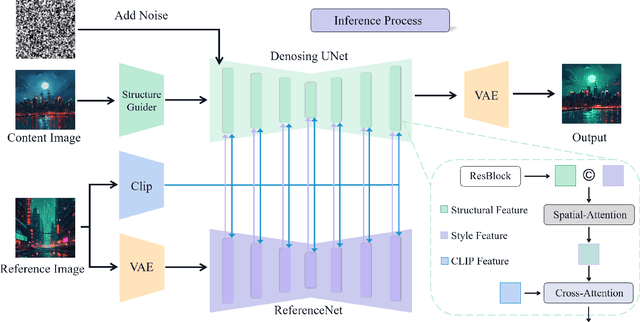
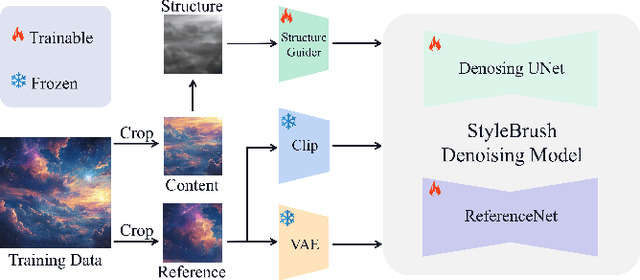
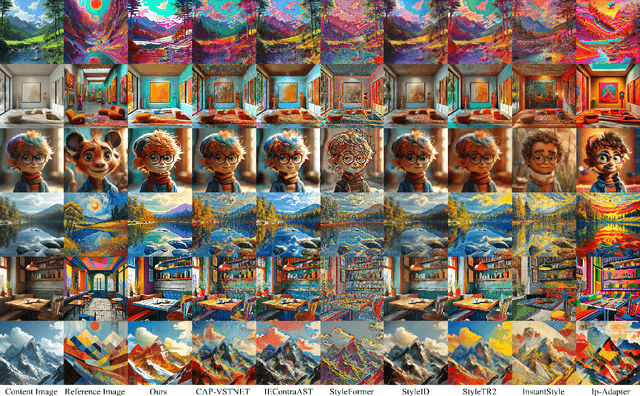
Stylization for visual content aims to add specific style patterns at the pixel level while preserving the original structural features. Compared with using predefined styles, stylization guided by reference style images is more challenging, where the main difficulty is to effectively separate style from structural elements. In this paper, we propose StyleBrush, a method that accurately captures styles from a reference image and ``brushes'' the extracted style onto other input visual content. Specifically, our architecture consists of two branches: ReferenceNet, which extracts style from the reference image, and Structure Guider, which extracts structural features from the input image, thus enabling image-guided stylization. We utilize LLM and T2I models to create a dataset comprising 100K high-quality style images, encompassing a diverse range of styles and contents with high aesthetic score. To construct training pairs, we crop different regions of the same training image. Experiments show that our approach achieves state-of-the-art results through both qualitative and quantitative analyses. We will release our code and dataset upon acceptance of the paper.