 Add to Chrome
 Add to Firefox
 Add to Edge
R^3: Advertisement Compliance Rectification via Group-Relative Experience Extractor and Curriculum Reinforcement
Jul 08, 2026
Rigorous content moderation is crucial for online advertising but leads to millions of daily rejections. This scale renders manual rectification infeasible, particularly for video advertisements. However, existing safety-driven methods often suffer from aggressive over-editing, which compromises the advertiser's original semantic intent merely to satisfy compliance. In this work, we target the rectification of textual violations in video ads, covering both speech transcripts and on-screen text. We propose R^3, a novel framework designed to harmonize compliance with original semantic intent preservation. Our approach integrates three key innovations: (1) an experience-driven data synthesis framework that bootstraps high-quality supervision via a group-Relative compliance experience extractor; (2) a curriculum Reinforcement learning strategy with hierarchical rewards designed to enforce compliance while maximizing semantic consistency; and (3) a comprehensive video Rectification framework seamlessly integrating text recognition, rewriting, and re-rendering for industrial deployment. Extensive experiments on industrial datasets and online A/B testing demonstrate that R^3 significantly outperforms state-of-the-art baselines, achieving an optimal trade-off between violation rectification and intent preservation.

Workflow-GYM: Towards Long-Horizon Evaluation of Computer-use Agentic tasks in Real-World Professional Fields
Jun 09, 2026Recent years have witnessed the rapid evolution of AI agents toward handling increasingly complex, real-world tasks. However, existing benchmarks rarely evaluate whether agents can operate graphical user interfaces to complete long-horizon, high-value professional workflows across diverse domains. Current GUI benchmarks still predominantly focus on general-purpose software, relatively simple applications, and short-horizon tasks, leaving it largely unknown whether modern agents can follow user instructions to autonomously operate domain-specific professional software and accomplish economically valuable work in an end-to-end manner. To bridge this gap, we introduce Workflow-GYM, a benchmark for long-horizon GUI tasks centered on professional domains and specialized software environments. Through extensive experiments on state-of-the-art models, we find that even the strongest models achieve only slightly above 30% success rates, highlighting that professional long-horizon GUI workflows remain highly challenging for current GUI agents. Further analysis reveals that current agents struggle to maintain long-horizon workflow consistency, frequently exhibiting workflow stage omission, error propagation, objective drift, and insufficient understanding of professional software environments. Our findings provide important insights into the limitations of current agent systems and suggest key directions for the next generation of GUI-agent research.
Pave-GRPO: Beyond Instantaneous Guidance through Principled Average Velocity Decomposition
Jun 01, 2026Post-training via Group Relative Policy Optimization (GRPO) has emerged as a powerful paradigm for aligning flow-based generative models with human preferences. However, the iterative denoising nature of flow models incurs substantial costs when generating group rollouts for policy-gradient updates, compelling existing methods to train with extremely few denoising steps. This temporal sparsity severely restricts preference optimization: reward feedback can only reach a handful of stages per trajectory, leaving the vast majority of intermediate denoising steps without direct supervision and thus compromising alignment granularity. To address this, we propose Pave-GRPO, which reformulates the GRPO objective through Principled average velocity decomposition. Rather than generating expensive high-step rollouts, we maintain efficient few-step group sampling but decompose each coarse transition into an equivalent ensemble of finer sub-trajectories spanning multiple intermediate timesteps. This propagates reward feedback to a denser set of temporal stages for more comprehensive preference alignment without additional generation cost. This design offers two benefits: (i) zero-cost horizon expansion: through the direct reuse of piece-wise group samples and their associated rewards, Pave-GRPO significantly broadens the effective optimization scope under fixed sampling budgets; and (ii) comprehensive temporal supervision: by equivalently decomposing an instantaneous velocity target into a multi-timestep ensemble, it distributes reward signals across more intermediate stages of the denoising process, enabling finer-grained and more thorough preference optimization. Extensive experiments validate that Pave-GRPO effectively advances preference alignment across different reward settings, offering comprehensive performance enhancement.
SlimDiffSR: Toward Lightweight and Efficient Remote Sensing Image Super-Resolution via Diffusion Model Distillation
May 04, 2026Diffusion models have recently achieved remarkable performance in image super-resolution (SR), but their high computational cost limits practical deployment in remote sensing applications. To address this issue, we propose SlimDiffSR, a lightweight and efficient diffusion-based framework for real-world remote sensing image super-resolution. Unlike existing single-step diffusion methods that rely on fixed timesteps, we first introduce an uncertainty-guided timestep assignment strategy to construct a stronger single-step teacher model, where reconstruction difficulty is explicitly linked to diffusion timesteps, enabling adaptive generative strength. Building upon this teacher, we further present a structured pruning strategy tailored to remote sensing imagery, which systematically removes redundant semantic modules and replaces standard operations with lightweight designs, including frequency-separable convolution, direction-separable convolution, and a query-driven global aggregation module. These components explicitly exploit the unique characteristics of remote sensing data, such as sparse high-frequency details, strong directional patterns, and long-range spatial dependencies. To enhance knowledge transfer, we incorporate Maximum Mean Discrepancy (MMD) into the distillation process to align feature distributions between the teacher and student models. Extensive experiments on multiple remote sensing benchmarks demonstrate that SlimDiffSR achieves a favorable balance between efficiency and reconstruction quality. In particular, it attains up to $200\times$ inference acceleration and a $20\times$ reduction in model parameters compared with multi-step diffusion models, while achieving competitive perceptual quality and clearly outperforming existing lightweight diffusion baselines in efficiency. The code is available at: https://github.com/wwangcece/SlimDiffSR.
Disentangling to Re-couple: Resolving the Similarity-Controllability Paradox in Subject-Driven Text-to-Image Generation
Apr 01, 2026Subject-Driven Text-to-Image (T2I) Generation aims to preserve a subject's identity while editing its context based on a text prompt. A core challenge in this task is the "similarity-controllability paradox", where enhancing textual control often degrades the subject's fidelity, and vice-versa. We argue this paradox stems from the ambiguous role of text prompts, which are often tasked with describing both the subject and the desired modifications, leading to conflicting signals for the model. To resolve this, we propose DisCo, a novel framework that first Disntangles and then re-Couples visual and textual information. First, our textual-visual decoupling module isolates the sources of information: subject identity is extracted exclusively from the reference image with the entity word of the subject, while the text prompt is simplified to contain only the modification command, where the subject refers to general pronouns, eliminating descriptive ambiguity. However, this strict separation can lead to unnatural compositions between the subject and its contexts. We address this by designing a dedicated reward signal and using reinforcement learning to seamlessly recouple the visually-defined subject and the textually-generated context. Our approach effectively resolves the paradox, enabling simultaneous high-fidelity subject preservation and precise textual control. Extensive experiments demonstrate that our method achieves state-of-the-art performance, producing highly realistic and coherent images.
InstaVSR: Taming Diffusion for Efficient and Temporally Consistent Video Super-Resolution
Mar 27, 2026Video super-resolution (VSR) seeks to reconstruct high-resolution frames from low-resolution inputs. While diffusion-based methods have substantially improved perceptual quality, extending them to video remains challenging for two reasons: strong generative priors can introduce temporal instability, and multi-frame diffusion pipelines are often too expensive for practical deployment. To address both challenges simultaneously, we propose InstaVSR, a lightweight diffusion framework for efficient video super-resolution. InstaVSR combines three ingredients: (1) a pruned one-step diffusion backbone that removes several costly components from conventional diffusion-based VSR pipelines, (2) recurrent training with flow-guided temporal regularization to improve frame-to-frame stability, and (3) dual-space adversarial learning in latent and pixel spaces to preserve perceptual quality after backbone simplification. On an NVIDIA RTX 4090, InstaVSR processes a 30-frame video at 2K$\times$2K resolution in under one minute with only 7 GB of memory usage, substantially reducing the computational cost compared to existing diffusion-based methods while maintaining favorable perceptual quality with significantly smoother temporal transitions.
DSH-Bench: A Difficulty- and Scenario-Aware Benchmark with Hierarchical Subject Taxonomy for Subject-Driven Text-to-Image Generation
Mar 09, 2026Significant progress has been achieved in subject-driven text-to-image (T2I) generation, which aims to synthesize new images depicting target subjects according to user instructions. However, evaluating these models remains a significant challenge. Existing benchmarks exhibit critical limitations: 1) insufficient diversity and comprehensiveness in subject images, 2) inadequate granularity in assessing model performance across different subject difficulty levels and prompt scenarios, and 3) a profound lack of actionable insights and diagnostic guidance for subsequent model refinement. To address these limitations, we propose DSH-Bench, a comprehensive benchmark that enables systematic multi-perspective analysis of subject-driven T2I models through four principal innovations: 1) a hierarchical taxonomy sampling mechanism ensuring comprehensive subject representation across 58 fine-grained categories, 2) an innovative classification scheme categorizing both subject difficulty level and prompt scenario for granular capability assessment, 3) a novel Subject Identity Consistency Score (SICS) metric demonstrating a 9.4\% higher correlation with human evaluation compared to existing measures in quantifying subject preservation, and 4) a comprehensive set of diagnostic insights derived from the benchmark, offering critical guidance for optimizing future model training paradigms and data construction strategies. Through an extensive empirical evaluation of 19 leading models, DSH-Bench uncovers previously obscured limitations in current approaches, establishing concrete directions for future research and development.
SCUBA: Salesforce Computer Use Benchmark
Sep 30, 2025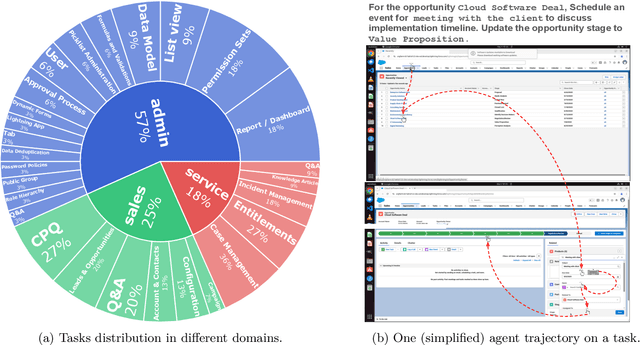



We introduce SCUBA, a benchmark designed to evaluate computer-use agents on customer relationship management (CRM) workflows within the Salesforce platform. SCUBA contains 300 task instances derived from real user interviews, spanning three primary personas, platform administrators, sales representatives, and service agents. The tasks test a range of enterprise-critical abilities, including Enterprise Software UI navigation, data manipulation, workflow automation, information retrieval, and troubleshooting. To ensure realism, SCUBA operates in Salesforce sandbox environments with support for parallel execution and fine-grained evaluation metrics to capture milestone progress. We benchmark a diverse set of agents under both zero-shot and demonstration-augmented settings. We observed huge performance gaps in different agent design paradigms and gaps between the open-source model and the closed-source model. In the zero-shot setting, open-source model powered computer-use agents that have strong performance on related benchmarks like OSWorld only have less than 5\% success rate on SCUBA, while methods built on closed-source models can still have up to 39% task success rate. In the demonstration-augmented settings, task success rates can be improved to 50\% while simultaneously reducing time and costs by 13% and 16%, respectively. These findings highlight both the challenges of enterprise tasks automation and the promise of agentic solutions. By offering a realistic benchmark with interpretable evaluation, SCUBA aims to accelerate progress in building reliable computer-use agents for complex business software ecosystems.
Unifying Dimensions: A Linear Adaptive Approach to Lightweight Image Super-Resolution
Sep 26, 2024Window-based transformers have demonstrated outstanding performance in super-resolution tasks due to their adaptive modeling capabilities through local self-attention (SA). However, they exhibit higher computational complexity and inference latency than convolutional neural networks. In this paper, we first identify that the adaptability of the Transformers is derived from their adaptive spatial aggregation and advanced structural design, while their high latency results from the computational costs and memory layout transformations associated with the local SA. To simulate this aggregation approach, we propose an effective convolution-based linear focal separable attention (FSA), allowing for long-range dynamic modeling with linear complexity. Additionally, we introduce an effective dual-branch structure combined with an ultra-lightweight information exchange module (IEM) to enhance the aggregation of information by the Token Mixer. Finally, with respect to the structure, we modify the existing spatial-gate-based feedforward neural networks by incorporating a self-gate mechanism to preserve high-dimensional channel information, enabling the modeling of more complex relationships. With these advancements, we construct a convolution-based Transformer framework named the linear adaptive mixer network (LAMNet). Extensive experiments demonstrate that LAMNet achieves better performance than existing SA-based Transformer methods while maintaining the computational efficiency of convolutional neural networks, which can achieve a \(3\times\) speedup of inference time. The code will be publicly available at: https://github.com/zononhzy/LAMNet.
Strengthened Symbol Binding Makes Large Language Models Reliable Multiple-Choice Selectors
Jun 03, 2024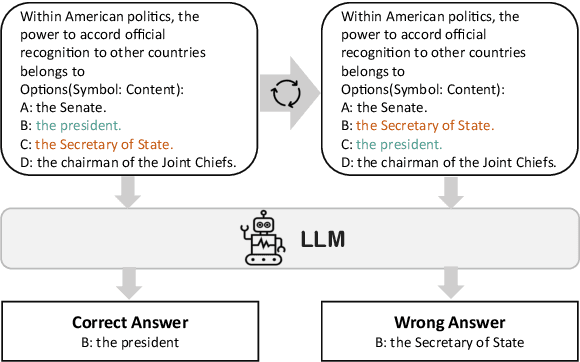
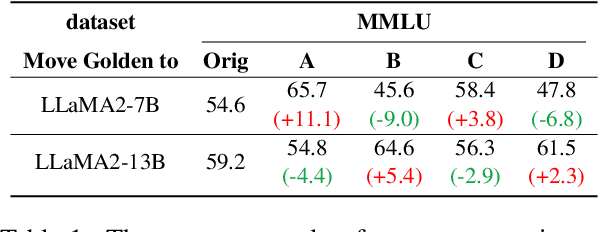
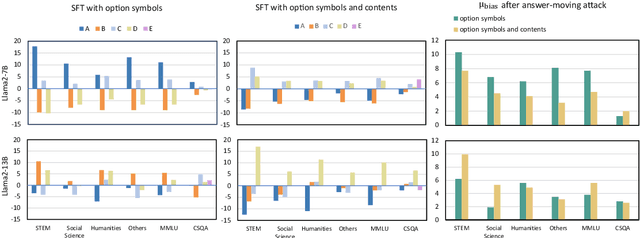

Multiple-Choice Questions (MCQs) constitute a critical area of research in the study of Large Language Models (LLMs). Previous works have investigated the selection bias problem in MCQs within few-shot scenarios, in which the LLM's performance may be influenced by the presentation of answer choices, leaving the selection bias during Supervised Fine-Tuning (SFT) unexplored. In this paper, we reveal that selection bias persists in the SFT phase , primarily due to the LLM's inadequate Multiple Choice Symbol Binding (MCSB) ability. This limitation implies that the model struggles to associate the answer options with their corresponding symbols (e.g., A/B/C/D) effectively. To enhance the model's MCSB capability, we first incorporate option contents into the loss function and subsequently adjust the weights of the option symbols and contents, guiding the model to understand the option content of the current symbol. Based on this, we introduce an efficient SFT algorithm for MCQs, termed Point-wise Intelligent Feedback (PIF). PIF constructs negative instances by randomly combining the incorrect option contents with all candidate symbols, and proposes a point-wise loss to provide feedback on these negative samples into LLMs. Our experimental results demonstrate that PIF significantly reduces the model's selection bias by improving its MCSB capability. Remarkably, PIF exhibits a substantial enhancement in the accuracy for MCQs.
* Accept at ACL2024 Main