 Add to Chrome
 Add to Firefox
 Add to Edge
MONA: Muon Optimizer with Nesterov Acceleration for Scalable Language Model Training
May 26, 2026
The Muon optimizer has recently offered a promising alternative to AdamW for large language model training, leveraging matrix orthogonalization to produce geometry-aware updates. However, like all first-order methods, Muon can become trapped in sharp local minima. In this work, we present MONA, an optimizer that bridges Muon's orthogonalization framework with curvature-aware acceleration. MONA adds an acceleration term directly into Muon's gradient processing pipeline. This term is calculated from the exponential moving average of gradient differences. We provide a detailed convergence analysis for MONA, showing that the acceleration term enables escape from sharp minima while preserving Muon's spectral-norm regularization. Empirically, MONA achieves better convergence and downstream task performance compared to both Muon and AdamW across three scales of Mixture-of-Experts pretraining, spanning from 1B to 68B parameters, with the largest model trained on 1 trillion tokens. Furthermore, we conduct supervised fine-tuning on the MOE-68B-A3B model and evaluate it on general capability, mathematical reasoning, and code generation benchmarks, where MONA achieves SOTA performance.

FG$^2$-GDN: Enhancing Long-Context Gated Delta Networks with Doubly Fine-Grained Control
Apr 21, 2026Linear attention mechanisms have emerged as promising alternatives to softmax attention, offering linear-time complexity during inference. Recent advances such as Gated DeltaNet (GDN) and Kimi Delta Attention (KDA) have demonstrated that the delta rule, an online gradient descent update, enables superior associative recall compared to simple additive updates. While KDA refined the coarse head-wise decay gate into channel-wise decay, the learning rate $β_t$ in the delta update remains a scalar, limiting the model's capacity for dimension-specific adaptation. We introduce FG$^2$-GDN, which replaces the scalar $β_t$ with a channel-wise vector analogous to the transition from SGD to per-coordinate adaptive optimizers such as AdaGrad and Adam. We further propose FG$^2$-GDN+, which decouples the scaling for keys and values, enabling independent control of erasure strength and write strength. Experiments on synthetic and real-world benchmarks show that FG$^2$-GDN and its variant improve associative recall and long-context understanding over GDN and KDA, with comparable computational efficiency.
SparseBalance: Load-Balanced Long Context Training with Dynamic Sparse Attention
Apr 15, 2026While sparse attention mitigates the computational bottleneck of long-context LLM training, its distributed training process exhibits extreme heterogeneity in both \textit{1)} sequence length and \textit{2)} sparsity sensitivity, leading to a severe imbalance problem and sub-optimal model accuracy. Existing algorithms and training frameworks typically focus on single issue, failing to systematically co-optimize these two problems. Therefore, we propose SparseBalance, a novel algorithm-system co-design framework, which exploits the sparsity and sequence heterogeneity to optimize model accuracy and system efficiency jointly. First, we propose workload-aware dynamic sparsity tuning, which employs a bidirectional sparsity adjustment to eliminate stragglers and exploit inherent bubbles for free accuracy. Second, we propose a sparsity-aware batching strategy to achieve coarse-grained balance, which complements dynamic sparsity tuning. Experimental results demonstrate that SparseBalance achieves up to a 1.33$\times$ end-to-end speedup while still improving the long-context capability by 0.46\% on the LongBench benchmark.
AsyncTLS: Efficient Generative LLM Inference with Asynchronous Two-level Sparse Attention
Apr 09, 2026Long-context inference in LLMs faces the dual challenges of quadratic attention complexity and prohibitive KV cache memory. While token-level sparse attention offers superior accuracy, its indexing overhead is costly; block-level methods improve efficiency but sacrifice precision. We propose AsyncTLS, a hierarchical sparse attention system that combines coarse-grained block filtering with fine-grained token selection to balance accuracy and efficiency, coupled with an asynchronous offloading engine that overlaps KV cache transfers with computation via temporal locality exploitation. Evaluated on Qwen3 and GLM-4.7-Flash across GQA, and MLA architectures, AsyncTLS achieves accuracy comparable to full attention while delivering 1.2x - 10.0x operator speedups and 1.3x - 4.7x end-to-end throughput improvements on 48k - 96k contexts.
AFA-LoRA: Enabling Non-Linear Adaptations in LoRA with Activation Function Annealing
Dec 27, 2025Low-Rank Adaptation (LoRA) is a widely adopted parameter-efficient fine-tuning (PEFT) method. However, its linear adaptation process limits its expressive power. This means there is a gap between the expressive power of linear training and non-linear training. To bridge this gap, we propose AFA-LoRA, a novel training strategy that brings non-linear expressivity to LoRA while maintaining its seamless mergeability. Our key innovation is an annealed activation function that transitions from a non-linear to a linear transformation during training, allowing the adapter to initially adopt stronger representational capabilities before converging to a mergeable linear form. We implement our method on supervised fine-tuning, reinforcement learning, and speculative decoding. The results show that AFA-LoRA reduces the performance gap between LoRA and full-parameter training. This work enables a more powerful and practical paradigm of parameter-efficient adaptation.
Accelerate Speculative Decoding with Sparse Computation in Verification
Dec 26, 2025Speculative decoding accelerates autoregressive language model inference by verifying multiple draft tokens in parallel. However, the verification stage often becomes the dominant computational bottleneck, especially for long-context inputs and mixture-of-experts (MoE) models. Existing sparsification methods are designed primarily for standard token-by-token autoregressive decoding to remove substantial computational redundancy in LLMs. This work systematically adopts different sparse methods on the verification stage of the speculative decoding and identifies structured redundancy across multiple dimensions. Based on these observations, we propose a sparse verification framework that jointly sparsifies attention, FFN, and MoE components during the verification stage to reduce the dominant computation cost. The framework further incorporates an inter-draft token and inter-layer retrieval reuse strategy to further reduce redundant computation without introducing additional training. Extensive experiments across summarization, question answering, and mathematical reasoning datasets demonstrate that the proposed methods achieve favorable efficiency-accuracy trade-offs, while maintaining stable acceptance length.
C2T: A Classifier-Based Tree Construction Method in Speculative Decoding
Feb 19, 2025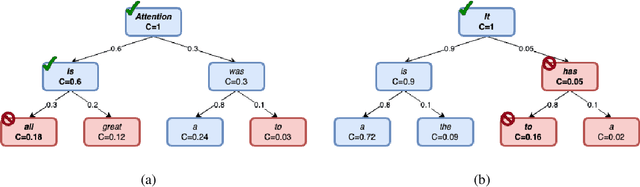
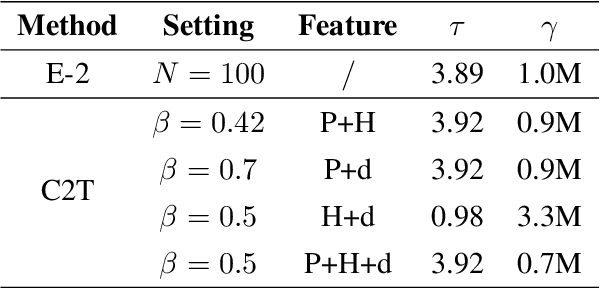

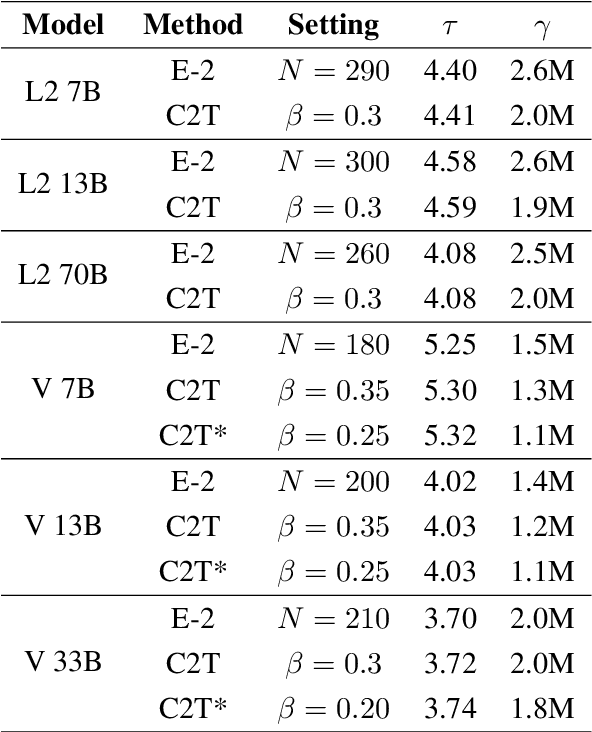
The growing scale of Large Language Models (LLMs) has exacerbated inference latency and computational costs. Speculative decoding methods, which aim to mitigate these issues, often face inefficiencies in the construction of token trees and the verification of candidate tokens. Existing strategies, including chain mode, static tree, and dynamic tree approaches, have limitations in accurately preparing candidate token trees for verification. We propose a novel method named C2T that adopts a lightweight classifier to generate and prune token trees dynamically. Our classifier considers additional feature variables beyond the commonly used joint probability to predict the confidence score for each draft token to determine whether it is the candidate token for verification. This method outperforms state-of-the-art (SOTA) methods such as EAGLE-2 on multiple benchmarks, by reducing the total number of candidate tokens by 25% while maintaining or even improving the acceptance length.
MaskPrune: Mask-based LLM Pruning for Layer-wise Uniform Structures
Feb 19, 2025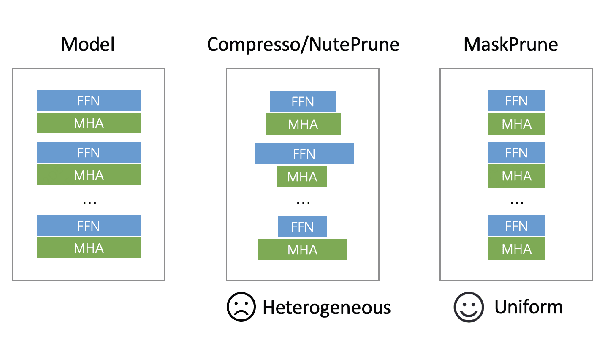
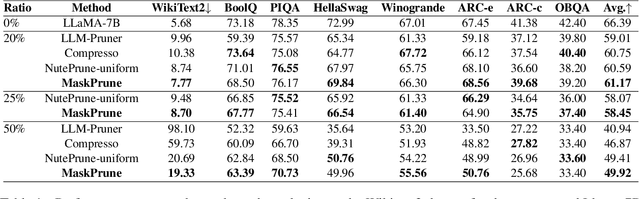
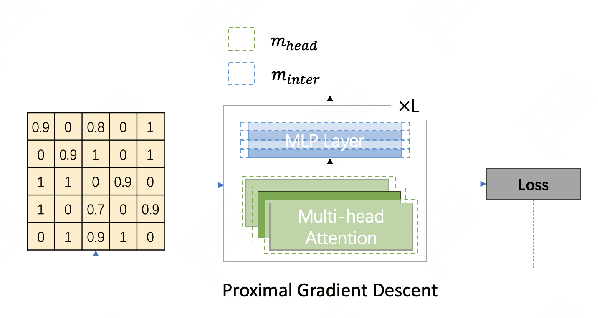

The remarkable performance of large language models (LLMs) in various language tasks has attracted considerable attention. However, the ever-increasing size of these models presents growing challenges for deployment and inference. Structured pruning, an effective model compression technique, is gaining increasing attention due to its ability to enhance inference efficiency. Nevertheless, most previous optimization-based structured pruning methods sacrifice the uniform structure across layers for greater flexibility to maintain performance. The heterogeneous structure hinders the effective utilization of off-the-shelf inference acceleration techniques and impedes efficient configuration for continued training. To address this issue, we propose a novel masking learning paradigm based on minimax optimization to obtain the uniform pruned structure by optimizing the masks under sparsity regularization. Extensive experimental results demonstrate that our method can maintain high performance while ensuring the uniformity of the pruned model structure, thereby outperforming existing SOTA methods.
PrefixKV: Adaptive Prefix KV Cache is What Vision Instruction-Following Models Need for Efficient Generation
Dec 04, 2024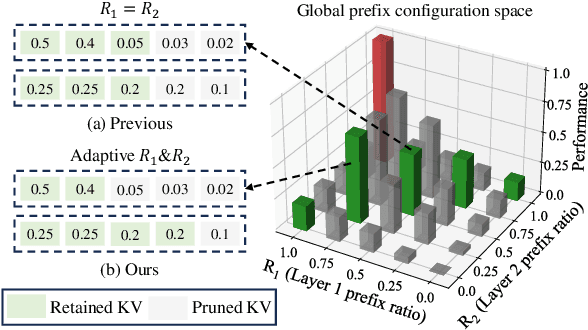
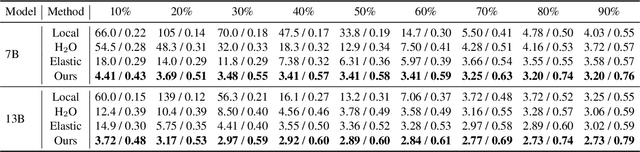
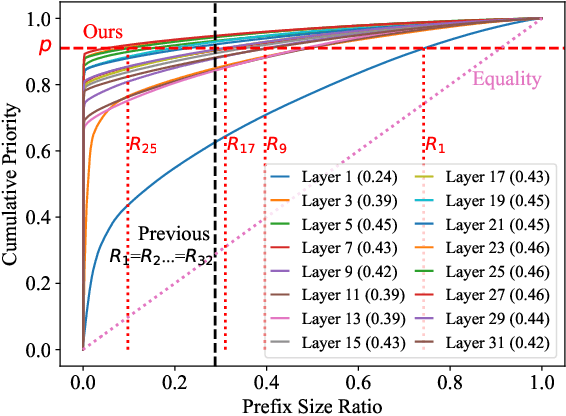
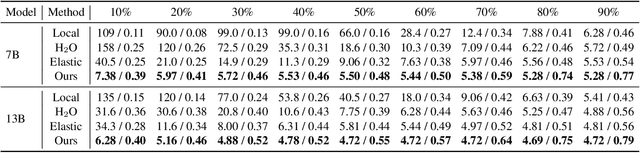
Recently, large vision-language models (LVLMs) have rapidly gained popularity for their strong generation and reasoning capabilities given diverse multimodal inputs. However, these models incur significant computational and memory overhead during inference, which greatly hinders the efficient deployment in practical scenarios. The extensive key-value (KV) cache, necessitated by the lengthy input and output sequences, notably contributes to the high inference cost. Based on this, recent works have investigated ways to reduce the KV cache size for higher efficiency. Although effective, they generally overlook the distinct importance distributions of KV vectors across layers and maintain the same cache size for each layer during the next token prediction. This results in the significant contextual information loss for certain layers, leading to notable performance decline. To address this, we present PrefixKV. It reframes the challenge of determining KV cache sizes for all layers into the task of searching for the optimal global prefix configuration. With an adaptive layer-wise KV retention recipe based on binary search, the maximum contextual information can thus be preserved in each layer, facilitating the generation. Extensive experiments demonstrate that our method achieves the state-of-the-art performance compared with others. It exhibits superior inference efficiency and generation quality trade-offs, showing promising potential for practical applications. Code is available at \url{https://github.com/THU-MIG/PrefixKV}.
EPS-MoE: Expert Pipeline Scheduler for Cost-Efficient MoE Inference
Oct 16, 2024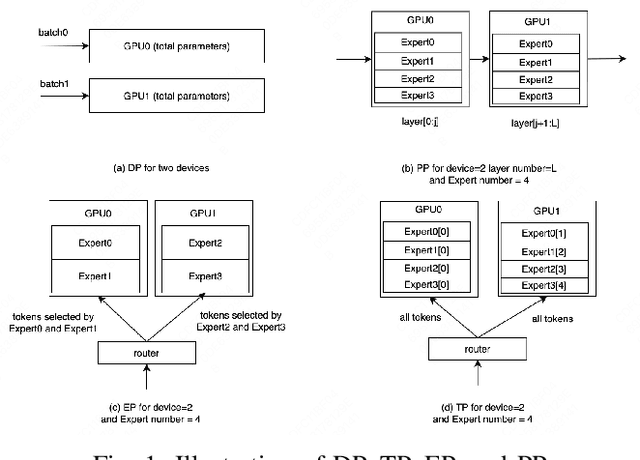
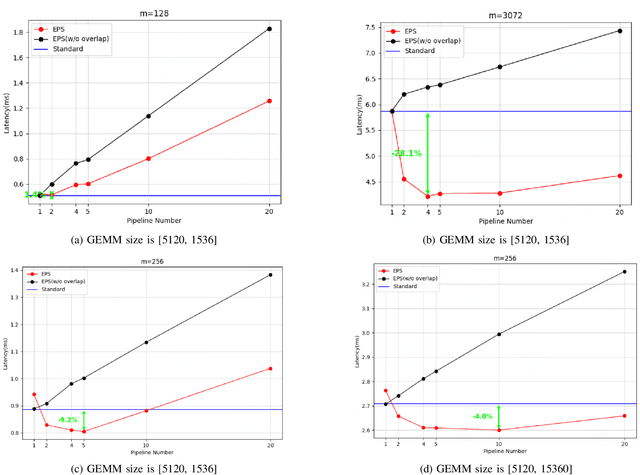
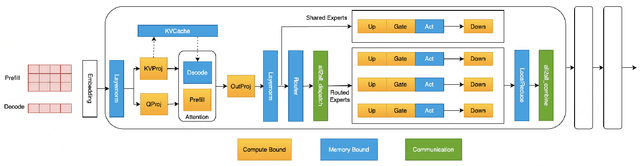
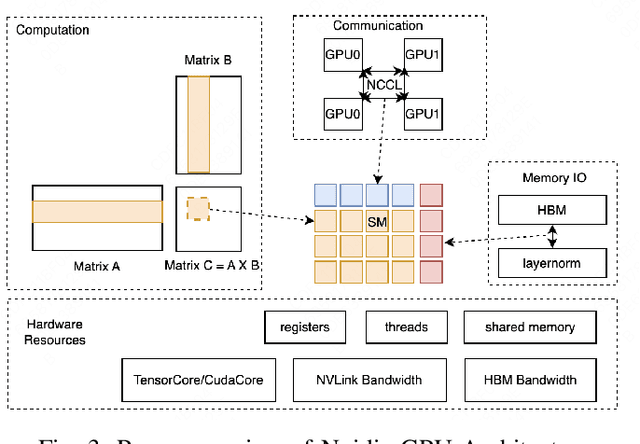
Large Language Model (LLM) has revolutionized the field of artificial intelligence, with their capabilities expanding rapidly due to advances in deep learning and increased computational resources. The mixture-of-experts (MoE) model has emerged as a prominent architecture in the field of LLM, better balancing the model performance and computational efficiency. MoE architecture allows for effective scaling and efficient parallel processing, but the GEMM (General Matrix Multiply) of MoE and the large parameters introduce challenges in terms of computation efficiency and communication overhead, which becomes the throughput bottleneck during inference. Applying a single parallelism strategy like EP, DP, PP, etc. to MoE architecture usually achieves sub-optimal inference throughput, the straightforward combinations of existing different parallelisms on MoE can not obtain optimal inference throughput yet. This paper introduces EPS-MoE, a novel expert pipeline scheduler for MoE that goes beyond the existing inference parallelism schemes. Our approach focuses on optimizing the computation of MoE FFN (FeedForward Network) modules by dynamically selecting the best kernel implementation of GroupGemm and DenseGemm for different loads and adaptively overlapping these computations with \textit{all2all} communication, leading to a substantial increase in throughput. Our experimental results demonstrate an average 21% improvement in prefill throughput over existing parallel inference methods. Specifically, we validated our method on DeepSeekV2, a highly optimized model claimed to achieve a prefill throughput of 100K tokens per second. By applying EPS-MoE, we further accelerated it to at least 120K tokens per second.