 Add to Chrome
 Add to Firefox
 Add to Edge
ABot-N1: Toward a General Visual Language Navigation Foundation Model
Jul 14, 2026
Visual Language Navigation foundation models aim to unify deep reasoning for grounded spatial decisions with broad versatility for diverse embodied tasks. Current approaches typically achieve this integration via monolithic policies that map observations directly to actions, yet they often suffer from coordinate drift and poor handling of long-tail semantics. Furthermore, these black-box mappings lack interpretability, hindering the simultaneous achievement of generality, robustness, and transparency. We present ABot-N1, a step toward a general Visual Language Navigation foundation model, that addresses these challenges by decoupling cognition from control via a slow-fast architecture guided by dual visual-language signals. More specifically, a slow vision-language reasoner performs explicit Chain-of-Thought reasoning while producing a pixel goal. This compact set of image-space anchor points serves as a universal interface for diverse tasks, including point-goal, object-goal, poi-goal, instruction-following, and person-following. Subsequently, a fast action expert leverages both the textual cues and the pixel guidance to generate continuous waypoints at the native control frequency. By bridging high-level intents and low-level control through pixel-grounded anchors paired with explicit linguistic traces, our approach ensures robust, generalizable, and interpretable navigation across simulation and real-world benchmarks. ABot-N1 establishes new state-of-the-art records, delivering massive gains specifically in urban-scale navigation: boosting POI arrival by 35.0% (to 77.3%) and achieving 95.4%/92.9% SR in complex indoor and outdoor scenes. It also maintains superior robustness across object-reaching, person-following, and instruction-following tasks. New Point-Goal/POI-Goal benchmarks are released as open source to advance the field of urban-scale navigation.

ABot-AgentOS: A General Robotic Agent OS with Lifelong Multi-modal Memory
Jul 11, 2026Recent VLM and VLA systems have improved robotic perception and action prediction, yet long-horizon embodied agents still require a general runtime layer for reasoning, memory, tool use, verification, and cross-embodiment execution. We present ABot-AgentOS, a general robotic Agent Operating System that sits above low-level controllers and provides a deliberative agent layer for scene-conditioned planning, context-isolated skill execution, multi-stage verification, multi-modal memory, and edge-cloud collaboration. To evaluate such systems, we introduce EmbodiedWorldBench, an executable benchmark with 16 indoor, outdoor, and hybrid scenes, four difficulty levels, and over 200 tasks involving navigation, object search, NPC dialogue, dynamic events, and trace-grounded scoring. ABot-AgentOS further introduces Universal Multi-modal Graph Memory, a persistent source-grounded substrate that converts dialogue, visual observations, spatial context, temporal relations, and task traces into typed nodes and edges. A failure-driven self-evolution loop converts diagnosed memory failures into gated runtime evo-assets that are promoted only to later evaluation splits, preventing current-split ground-truth leakage while enabling continual improvement. On an initial EmbodiedWorldBench subset, ABot-AgentOS improves over a single-controller baseline in both task success and goal completion. Across memory benchmarks, ABot-AgentOS Static achieves 87.5 on LoCoMo, 59.9 on OpenEQA EM-EQA, 88.6 on Mem-Gallery, and 76.5 Acc@All on NExT-QA; self-evolution further improves LoCoMo to 88.7, OpenEQA to 60.4, and Mem-Gallery to 89.0. These results suggest that a general Agent OS layer can improve long-horizon embodied execution while providing persistent, auditable memory for continual interaction.
Behavior Foundations for Quadruped Robots: ABot-C0 Technical Report
Jul 09, 2026The motion controller is one of the most fundamental modules in embodied intelligence systems. Driven by large-scale human motion-capture data and the motion-tracking paradigm, humanoid control has achieved remarkable progress in recent years. However, migrating this recipe to the quadrupedal setting is far less straightforward: animal motion data is scarcer and harder to capture at scale than human data, and cross-embodiment retargeting remains fragile. We present ABot-C0, a generalist motion-control system for quadruped robots that establishes three complementary behavior foundations: a scalable multi-source motion-data pipeline, robust policy learning across motion tracking, locomotion, and scene interaction, and a unified deployment stack for reliable real-world operation. Fundamentally, we construct a data pyramid through conditional video-generation synthesis, annotated motion capture, teleoperation, and human design, producing 16,074 physically feasible motion clips as the data foundation for diverse motion-learning demands. With large-scale motion data, a Flow-Matching generalist policy demonstrates, for the first time, a scaling law for quadruped motion tracking: performance improves consistently as training scales up, with zero-shot capability to track unseen motions. We then go a step further toward robust all-terrain locomotion by adopting a three-stage privileged-to-perceptive framework with temporal LiDAR memory and terrain-predictive supervision. Collectively, these components form a motion generalist that coordinates multi-policy execution, smooth behavior transitions, energy-efficient control, and safety mechanisms for real-world deployment. Extensive experiments on urban-terrain autonomous navigation and companion-style multimodal interaction demonstrate that quadruped robots can move beyond functional demos toward product-level behavioral intelligence.
ABot-N0: Technical Report on the VLA Foundation Model for Versatile Embodied Navigation
Feb 12, 2026Embodied navigation has long been fragmented by task-specific architectures. We introduce ABot-N0, a unified Vision-Language-Action (VLA) foundation model that achieves a ``Grand Unification'' across 5 core tasks: Point-Goal, Object-Goal, Instruction-Following, POI-Goal, and Person-Following. ABot-N0 utilizes a hierarchical ``Brain-Action'' architecture, pairing an LLM-based Cognitive Brain for semantic reasoning with a Flow Matching-based Action Expert for precise, continuous trajectory generation. To support large-scale learning, we developed the ABot-N0 Data Engine, curating 16.9M expert trajectories and 5.0M reasoning samples across 7,802 high-fidelity 3D scenes (10.7 $\text{km}^2$). ABot-N0 achieves new SOTA performance across 7 benchmarks, significantly outperforming specialized models. Furthermore, our Agentic Navigation System integrates a planner with hierarchical topological memory, enabling robust, long-horizon missions in dynamic real-world environments.
Strengthened Symbol Binding Makes Large Language Models Reliable Multiple-Choice Selectors
Jun 03, 2024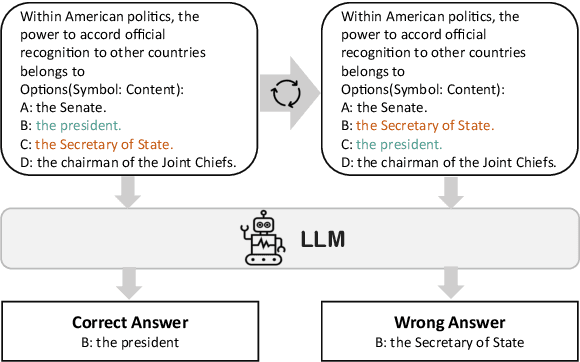
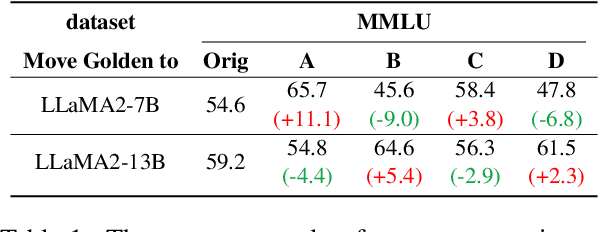
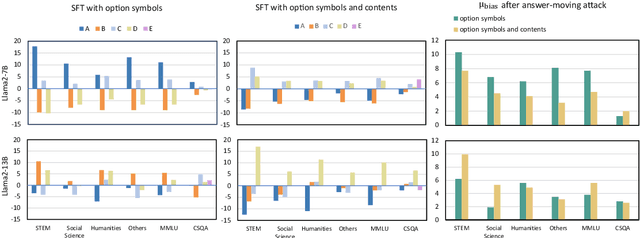

Multiple-Choice Questions (MCQs) constitute a critical area of research in the study of Large Language Models (LLMs). Previous works have investigated the selection bias problem in MCQs within few-shot scenarios, in which the LLM's performance may be influenced by the presentation of answer choices, leaving the selection bias during Supervised Fine-Tuning (SFT) unexplored. In this paper, we reveal that selection bias persists in the SFT phase , primarily due to the LLM's inadequate Multiple Choice Symbol Binding (MCSB) ability. This limitation implies that the model struggles to associate the answer options with their corresponding symbols (e.g., A/B/C/D) effectively. To enhance the model's MCSB capability, we first incorporate option contents into the loss function and subsequently adjust the weights of the option symbols and contents, guiding the model to understand the option content of the current symbol. Based on this, we introduce an efficient SFT algorithm for MCQs, termed Point-wise Intelligent Feedback (PIF). PIF constructs negative instances by randomly combining the incorrect option contents with all candidate symbols, and proposes a point-wise loss to provide feedback on these negative samples into LLMs. Our experimental results demonstrate that PIF significantly reduces the model's selection bias by improving its MCSB capability. Remarkably, PIF exhibits a substantial enhancement in the accuracy for MCQs.
* Accept at ACL2024 Main
Enhancing Reinforcement Learning with Label-Sensitive Reward for Natural Language Understanding
May 30, 2024


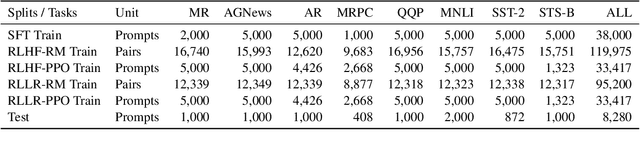
Recent strides in large language models (LLMs) have yielded remarkable performance, leveraging reinforcement learning from human feedback (RLHF) to significantly enhance generation and alignment capabilities. However, RLHF encounters numerous challenges, including the objective mismatch issue, leading to suboptimal performance in Natural Language Understanding (NLU) tasks. To address this limitation, we propose a novel Reinforcement Learning framework enhanced with Label-sensitive Reward (RLLR) to amplify the performance of LLMs in NLU tasks. By incorporating label-sensitive pairs into reinforcement learning, our method aims to adeptly capture nuanced label-sensitive semantic features during RL, thereby enhancing natural language understanding. Experiments conducted on five diverse foundation models across eight tasks showcase promising results. In comparison to Supervised Fine-tuning models (SFT), RLLR demonstrates an average performance improvement of 1.54%. Compared with RLHF models, the improvement averages at 0.69%. These results reveal the effectiveness of our method for LLMs in NLU tasks. Code and data available at: https://github.com/MagiaSN/ACL2024_RLLR.