 Add to Chrome
 Add to Firefox
 Add to Edge
Beyond Action Imitation: Learning a Decision-Aware User Simulator for Online Advertising
Jul 29, 2026
Recent advances in LLM-based user simulation have shown promise for offline evaluation of recommendation and advertising systems. However, existing simulators typically infer user preferences from single-domain interaction histories and are primarily optimized to reproduce observable actions such as clicks. Consequently, they capture only a partial view of user preferences, while action-only prediction easily induces model shortcuts and limits both the fidelity and diagnostic value of simulation. To address these challenges, we propose DASH, a decision-aware user simulator that jointly generates thinking traces and predicts behavioral actions from heterogeneous cross-domain histories. DASH first introduces a Context Engineering stage that folds heterogeneous cross-domain histories into decision-relevant context, together with prompt optimization for effective reasoning over the folded context. To train a user simulator, DASH distills thinking trajectories from strong LLMs as SFT data, and further tailors a rubric-based reward model that evaluates thinking traces along form, content, and logic for RL training. Combined with the action reward, these signals jointly improve action prediction and thinking quality. Extensive experiments on real-world Tencent advertising data spanning five heterogeneous content domains demonstrate the effectiveness, efficiency, fidelity, and diagnostic value of DASH.

Diffusion Language Model for Recommendation
Jul 23, 2026Large language model (LLM)-empowered recommender systems have emerged as a promising paradigm for generative recommendation, leveraging their strong semantic reasoning and generative capacity to model complex, diverse user preferences. However, most existing approaches rely on an autoregressive paradigm that is suboptimal for recommendation. The next-token objective emphasizes sequential order rather than the structural inter-item dependencies underlying user preferences. In addition, prefix-constrained generation restricts bidirectional context and commits to left-to-right decoding, causing early errors to accumulate without correction. Inspired by the success of diffusion language models, we propose \textbf{DLMRec}, a discrete diffusion language model tailored for recommendation that offers a compelling alternative to autoregressive generation. Specifically, DLMRec introduces three key components to bridge diffusion language modeling with recommendation. First, a collaborative-aware stochastic tokenizer encodes multi-hop collaborative signals into expressive discrete tokens compatible with diffusion modeling. Second, a curriculum-driven training strategy aligns the denoising process with preference recovery through progressive item- and token-level learning. Third, a stability-aware voting mechanism aggregates iterative predictions to improve generation consistency and robustness.
SIREN: Unified Multi-Granularity Semantic Interaction for Multi-Modal Lifelong User Interest Modeling
May 25, 2026Industrial recommender systems increasingly leverage lifelong user behavior histories and rich multi-modal content to capture evolving user preferences. However, effectively integrating multi-modal features into lifelong interest modeling remains challenging due to the inherent misalignment between multi-modal and collaborative spaces. Existing paradigms typically rely on separate modeling of multi-modal sequence and behavior sequence, and late fusion to alleviate the modality gap, which results in coarse-grained multi-modal representation and limited integration. In this paper, we propose SIREN, a unified multi-granularity semantic interaction framework for multi-modal lifelong user interest modeling. In the General Search Unit stage, we introduce two alternative retrieval strategies: multi-modal similarity-based soft retrieval for retrieval effectiveness, and Semantic ID (SemID)-based hard retrieval for efficient industrial serving. For the Exact Search Unit stage, we explicitly incorporate target-aware relevance via coarse similarity buckets and fine-grained prefix-encoded SemIDs, enabling unified interaction with collaborative ID features within the target-conditioned transformer architecture. Extensive experiments on the offline dataset demonstrate that SIREN achieves a state-of-the-art GAUC. Online A/B tests further demonstrate consistent GMV gains across multiple production scenarios, including +2.28% in Weixin Moments, +3.87% in Weixin Official Accounts, and +1.61% in Weixin Channels. From July 2025, SIREN has been fully launched for full-traffic serving in Tencent's advertising platform.
RankUp: Towards High-rank Representations for Large Scale Advertising Recommender Systems
Apr 21, 2026The scaling laws for recommender systems have been increasingly validated, where MetaFormer-based architectures consistently benefit from increased model depth, hidden dimensionality, and user behavior sequence length. However, whether representation capacity scales proportionally with parameter growth remains largely unexplored. Prior studies on RankMixer reveal that the effective rank of token representations exhibits a damped oscillatory trajectory across layers, failing to increase consistently with depth and even degrading in deeper layers. Motivated by this observation, we propose \textbf{RankUp}, an architecture designed to mitigate representation collapse and enhance expressive capacity through randomized permutation splitting over sparse features, a multi-embedding paradigm, global token integration, crossed pretrained embedding tokens and task-specific token decoupling. RankUp has been fully deployed in large-scale production across Weixin Video Accounts, Official Accounts and Moments, yielding GMV improvements of 3.41\%, 4.81\% and 2.21\%, respectively.
TokenFormer: Unify the Multi-Field and Sequential Recommendation Worlds
Apr 15, 2026Recommender systems have historically developed along two largely independent paradigms: feature interaction models for modeling correlations among multi-field categorical features, and sequential models for capturing user behavior dynamics from historical interaction sequences. Although recent trends attempt to bridge these paradigms within shared backbones, we empirically reveal that naive unifying these two branches may lead to a failure mode of Sequential Collapse Propagation (SCP). That is, the interaction with those dimensionally ill non-sequence fields leads to the dimensional collapse of the sequence features. To overcome this challenge, we propose TokenFormer, a unified recommendation architecture with the following innovations. First, we introduce a Bottom-Full-Top-Sliding (BFTS) attention scheme, which applies full self-attention in the lower layers and shrinking-window sliding attention in the upper layers. Second, we introduce a Non-Linear Interaction Representation (NLIR) that applies one-sided non-linear multiplicative transformations to the hidden states. Extensive experiments on public benchmarks and Tencent's advertising platform demonstrate state-of-the-art performance, while detailed analysis confirm that TokenFormer significantly improves dimensional robustness and representation discriminability under unified modeling.
Tencent Advertising Algorithm Challenge 2025: All-Modality Generative Recommendation
Apr 04, 2026Generative recommender systems are rapidly emerging as a new paradigm for recommendation, where collaborative identifiers and/or multi-modal content are mapped into discrete token spaces and user behavior is modelled with autoregressive sequence models. Despite progress on multi-modal recommendation datasets, there is still a lack of public benchmarks that jointly offer large-scale, realistic and fully all-modality data designed specifically for generative recommendation (GR) in industrial advertising. To foster research in this direction, we organised the Tencent Advertising Algorithm Challenge 2025, a global competition built on top of two all-modality datasets for GR: TencentGR-1M and TencentGR-10M. Both datasets are constructed from real de-identified Tencent Ads logs and contain rich collaborative IDs and multi-modal representations extracted with state-of-the-art embedding models. The preliminary track (TencentGR-1M) provides 1 million user sequences with up to 100 interacted items each, where each interaction is labeled with exposure and click signals, while the final track (TencentGR-10M) scales this to 10 million users and explicitly distinguishes between click and conversion events at both the sequence and target level. This paper presents the task definition, data construction process, feature schema, baseline GR model, evaluation protocol, and key findings from top-ranked and award-winning solutions. Our datasets focus on multi-modal sequence generation in an advertising setting and introduce weighted evaluation for high-value conversion events. We release our datasets at https://huggingface.co/datasets/TAAC2025 and baseline implementations at https://github.com/TencentAdvertisingAlgorithmCompetition/baseline_2025 to enable future research on all-modality generative recommendation at an industrial scale. The official website is https://algo.qq.com/2025.
Large Foundation Model for Ads Recommendation
Aug 20, 2025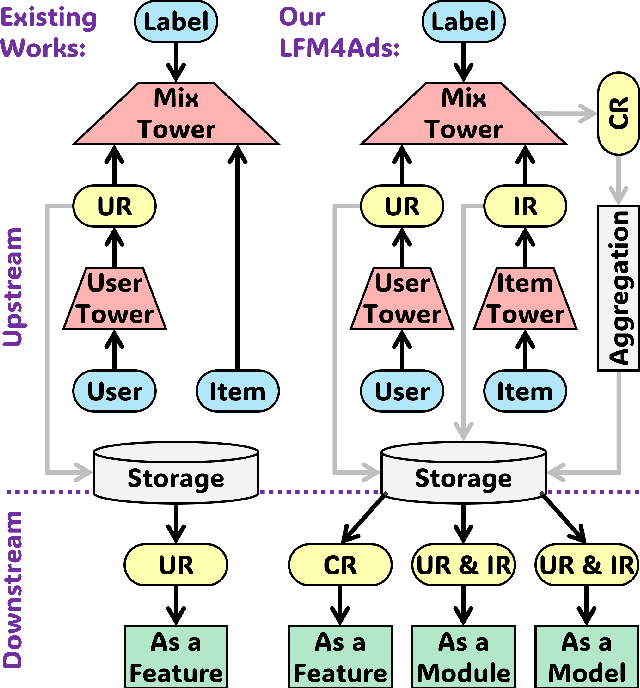
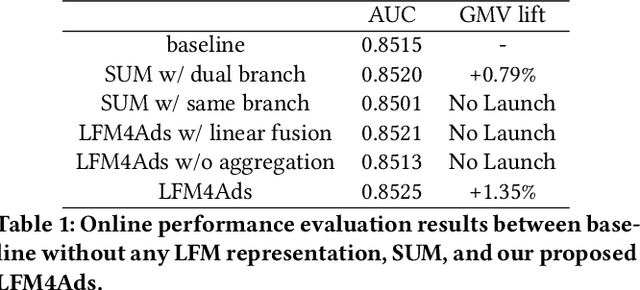
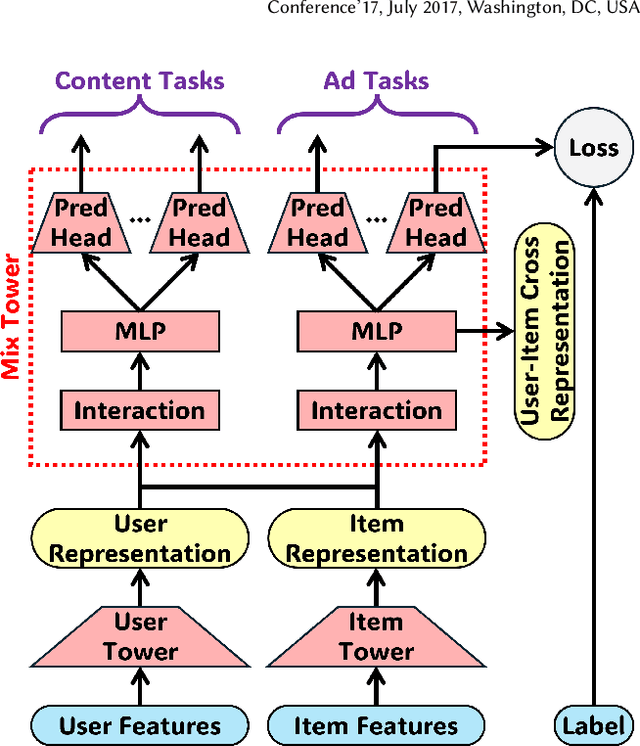
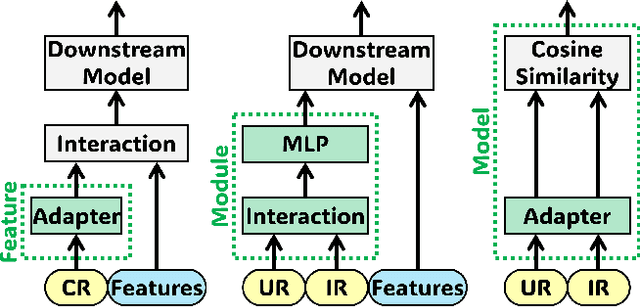
Online advertising relies on accurate recommendation models, with recent advances using pre-trained large-scale foundation models (LFMs) to capture users' general interests across multiple scenarios and tasks. However, existing methods have critical limitations: they extract and transfer only user representations (URs), ignoring valuable item representations (IRs) and user-item cross representations (CRs); and they simply use a UR as a feature in downstream applications, which fails to bridge upstream-downstream gaps and overlooks more transfer granularities. In this paper, we propose LFM4Ads, an All-Representation Multi-Granularity transfer framework for ads recommendation. It first comprehensively transfers URs, IRs, and CRs, i.e., all available representations in the pre-trained foundation model. To effectively utilize the CRs, it identifies the optimal extraction layer and aggregates them into transferable coarse-grained forms. Furthermore, we enhance the transferability via multi-granularity mechanisms: non-linear adapters for feature-level transfer, an Isomorphic Interaction Module for module-level transfer, and Standalone Retrieval for model-level transfer. LFM4Ads has been successfully deployed in Tencent's industrial-scale advertising platform, processing tens of billions of daily samples while maintaining terabyte-scale model parameters with billions of sparse embedding keys across approximately two thousand features. Since its production deployment in Q4 2024, LFM4Ads has achieved 10+ successful production launches across various advertising scenarios, including primary ones like Weixin Moments and Channels. These launches achieve an overall GMV lift of 2.45% across the entire platform, translating to estimated annual revenue increases in the hundreds of millions of dollars.
Strengthened Symbol Binding Makes Large Language Models Reliable Multiple-Choice Selectors
Jun 03, 2024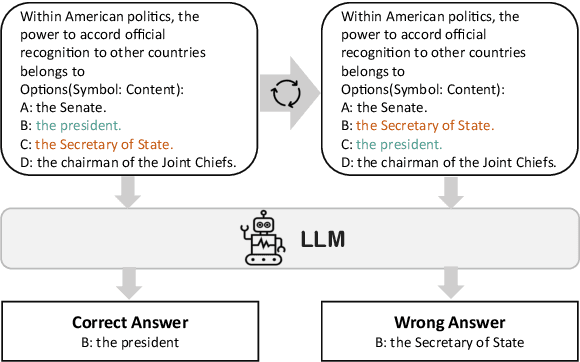
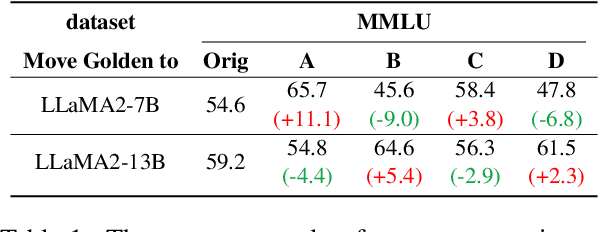
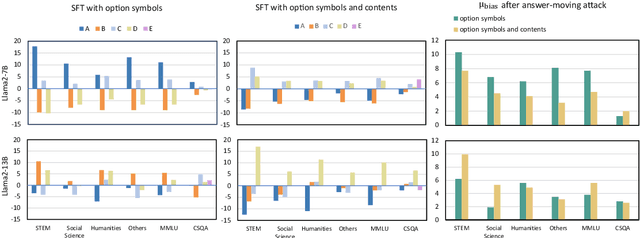

Multiple-Choice Questions (MCQs) constitute a critical area of research in the study of Large Language Models (LLMs). Previous works have investigated the selection bias problem in MCQs within few-shot scenarios, in which the LLM's performance may be influenced by the presentation of answer choices, leaving the selection bias during Supervised Fine-Tuning (SFT) unexplored. In this paper, we reveal that selection bias persists in the SFT phase , primarily due to the LLM's inadequate Multiple Choice Symbol Binding (MCSB) ability. This limitation implies that the model struggles to associate the answer options with their corresponding symbols (e.g., A/B/C/D) effectively. To enhance the model's MCSB capability, we first incorporate option contents into the loss function and subsequently adjust the weights of the option symbols and contents, guiding the model to understand the option content of the current symbol. Based on this, we introduce an efficient SFT algorithm for MCQs, termed Point-wise Intelligent Feedback (PIF). PIF constructs negative instances by randomly combining the incorrect option contents with all candidate symbols, and proposes a point-wise loss to provide feedback on these negative samples into LLMs. Our experimental results demonstrate that PIF significantly reduces the model's selection bias by improving its MCSB capability. Remarkably, PIF exhibits a substantial enhancement in the accuracy for MCQs.
* Accept at ACL2024 Main
Enhancing Reinforcement Learning with Label-Sensitive Reward for Natural Language Understanding
May 30, 2024


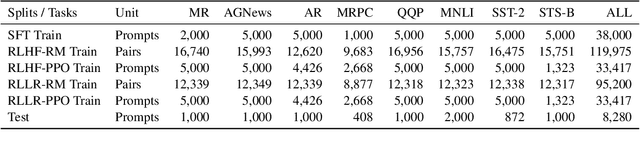
Recent strides in large language models (LLMs) have yielded remarkable performance, leveraging reinforcement learning from human feedback (RLHF) to significantly enhance generation and alignment capabilities. However, RLHF encounters numerous challenges, including the objective mismatch issue, leading to suboptimal performance in Natural Language Understanding (NLU) tasks. To address this limitation, we propose a novel Reinforcement Learning framework enhanced with Label-sensitive Reward (RLLR) to amplify the performance of LLMs in NLU tasks. By incorporating label-sensitive pairs into reinforcement learning, our method aims to adeptly capture nuanced label-sensitive semantic features during RL, thereby enhancing natural language understanding. Experiments conducted on five diverse foundation models across eight tasks showcase promising results. In comparison to Supervised Fine-tuning models (SFT), RLLR demonstrates an average performance improvement of 1.54%. Compared with RLHF models, the improvement averages at 0.69%. These results reveal the effectiveness of our method for LLMs in NLU tasks. Code and data available at: https://github.com/MagiaSN/ACL2024_RLLR.
VLMixer: Unpaired Vision-Language Pre-training via Cross-Modal CutMix
Jun 17, 2022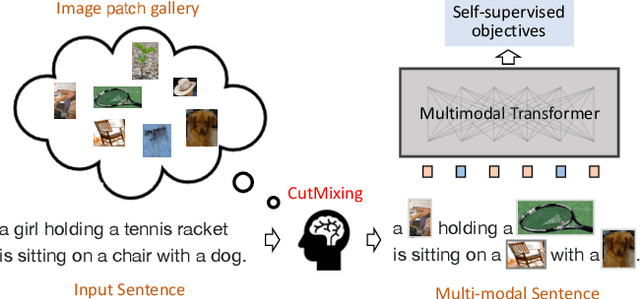
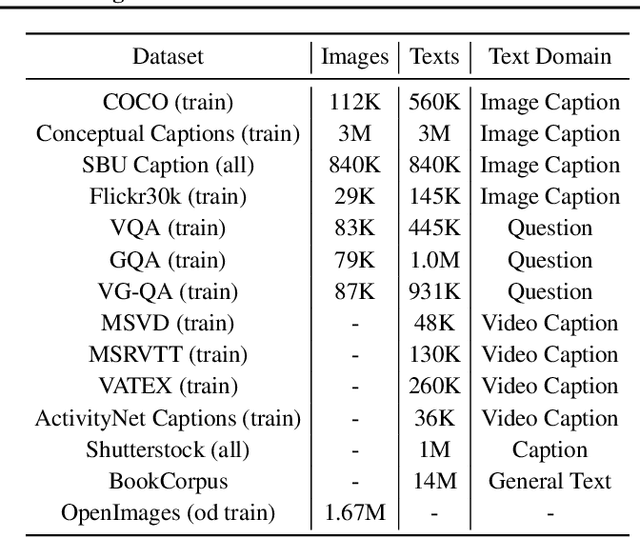
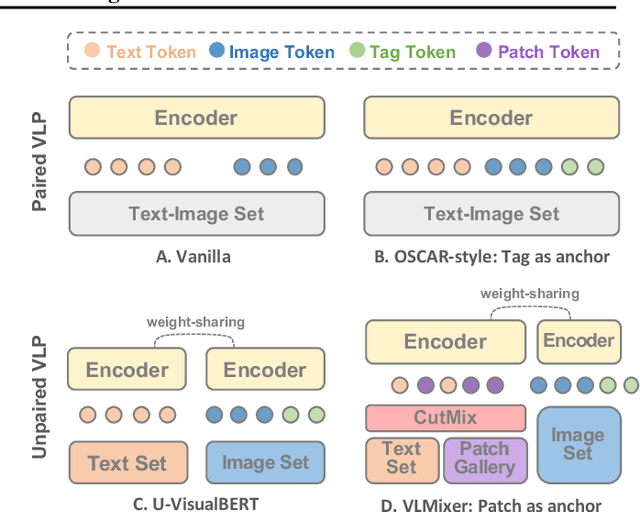
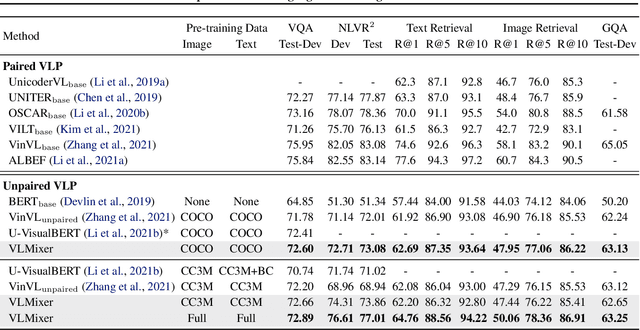
Existing vision-language pre-training (VLP) methods primarily rely on paired image-text datasets, which are either annotated by enormous human labors, or crawled from the internet followed by elaborate data cleaning techniques. To reduce the dependency on well-aligned image-text pairs, it is promising to directly leverage the large-scale text-only and image-only corpora. This paper proposes a data augmentation method, namely cross-modal CutMix (CMC), for implicit cross-modal alignment learning in unpaired VLP. Specifically, CMC transforms natural sentences from the textual view into a multi-modal view, where visually-grounded words in a sentence are randomly replaced by diverse image patches with similar semantics. There are several appealing proprieties of the proposed CMC. First, it enhances the data diversity while keeping the semantic meaning intact for tackling problems where the aligned data are scarce; Second, by attaching cross-modal noise on uni-modal data, it guides models to learn token-level interactions across modalities for better denoising. Furthermore, we present a new unpaired VLP method, dubbed as VLMixer, that integrates CMC with contrastive learning to pull together the uni-modal and multi-modal views for better instance-level alignments among different modalities. Extensive experiments on five downstream tasks show that VLMixer could surpass previous state-of-the-art unpaired VLP methods.