 Add to Chrome
 Add to Firefox
 Add to Edge
Smile upon the Face but Sadness in the Eyes: Emotion Recognition based on Facial Expressions and Eye Behaviors
Nov 19, 2024


Emotion Recognition (ER) is the process of identifying human emotions from given data. Currently, the field heavily relies on facial expression recognition (FER) because facial expressions contain rich emotional cues. However, it is important to note that facial expressions may not always precisely reflect genuine emotions and FER-based results may yield misleading ER. To understand and bridge this gap between FER and ER, we introduce eye behaviors as an important emotional cues for the creation of a new Eye-behavior-aided Multimodal Emotion Recognition (EMER) dataset. Different from existing multimodal ER datasets, the EMER dataset employs a stimulus material-induced spontaneous emotion generation method to integrate non-invasive eye behavior data, like eye movements and eye fixation maps, with facial videos, aiming to obtain natural and accurate human emotions. Notably, for the first time, we provide annotations for both ER and FER in the EMER, enabling a comprehensive analysis to better illustrate the gap between both tasks. Furthermore, we specifically design a new EMERT architecture to concurrently enhance performance in both ER and FER by efficiently identifying and bridging the emotion gap between the two.Specifically, our EMERT employs modality-adversarial feature decoupling and multi-task Transformer to augment the modeling of eye behaviors, thus providing an effective complement to facial expressions. In the experiment, we introduce seven multimodal benchmark protocols for a variety of comprehensive evaluations of the EMER dataset. The results show that the EMERT outperforms other state-of-the-art multimodal methods by a great margin, revealing the importance of modeling eye behaviors for robust ER. To sum up, we provide a comprehensive analysis of the importance of eye behaviors in ER, advancing the study on addressing the gap between FER and ER for more robust ER performance.

Enhancing the Reasoning Ability of Multimodal Large Language Models via Mixed Preference Optimization
Nov 15, 2024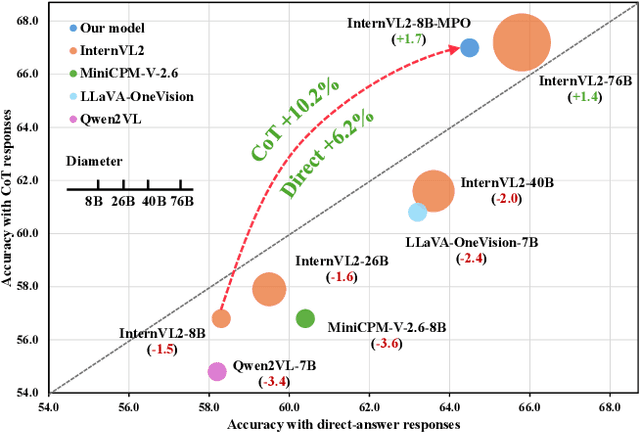

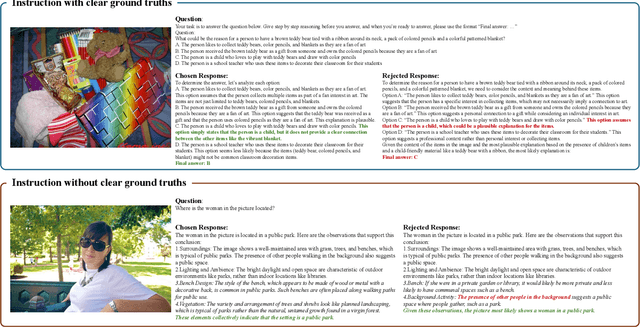
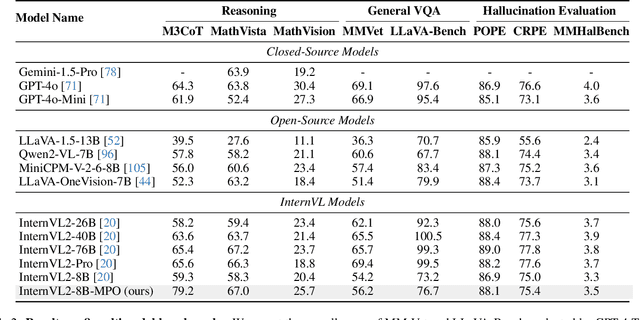
Existing open-source multimodal large language models (MLLMs) generally follow a training process involving pre-training and supervised fine-tuning. However, these models suffer from distribution shifts, which limit their multimodal reasoning, particularly in the Chain-of-Thought (CoT) performance. To address this, we introduce a preference optimization (PO) process to enhance the multimodal reasoning capabilities of MLLMs. Specifically, (1) on the data side, we design an automated preference data construction pipeline to create MMPR, a high-quality, large-scale multimodal reasoning preference dataset. and (2) on the model side, we explore integrating PO with MLLMs, developing a simple yet effective method, termed Mixed Preference Optimization (MPO), which boosts multimodal CoT performance. Our approach demonstrates improved performance across multiple benchmarks, particularly in multimodal reasoning tasks. Notably, our model, InternVL2-8B-MPO, achieves an accuracy of 67.0 on MathVista, outperforming InternVL2-8B by 8.7 points and achieving performance comparable to the 10x larger InternVL2-76B. We hope this study could inspire further advancements in MLLMs. Code, data, and model shall be publicly released.
Mini-InternVL: A Flexible-Transfer Pocket Multimodal Model with 5% Parameters and 90% Performance
Oct 21, 2024


Multimodal large language models (MLLMs) have demonstrated impressive performance in vision-language tasks across a broad spectrum of domains. However, the large model scale and associated high computational costs pose significant challenges for training and deploying MLLMs on consumer-grade GPUs or edge devices, thereby hindering their widespread application. In this work, we introduce Mini-InternVL, a series of MLLMs with parameters ranging from 1B to 4B, which achieves 90% of the performance with only 5% of the parameters. This significant improvement in efficiency and effectiveness makes our models more accessible and applicable in various real-world scenarios. To further promote the adoption of our models, we develop a unified adaptation framework for Mini-InternVL, which enables our models to transfer and outperform specialized models in downstream tasks, including autonomous driving, medical images, and remote sensing. We believe that our study can provide valuable insights and resources to advance the development of efficient and effective MLLMs. Code is available at https://github.com/OpenGVLab/InternVL.
MMFuser: Multimodal Multi-Layer Feature Fuser for Fine-Grained Vision-Language Understanding
Oct 15, 2024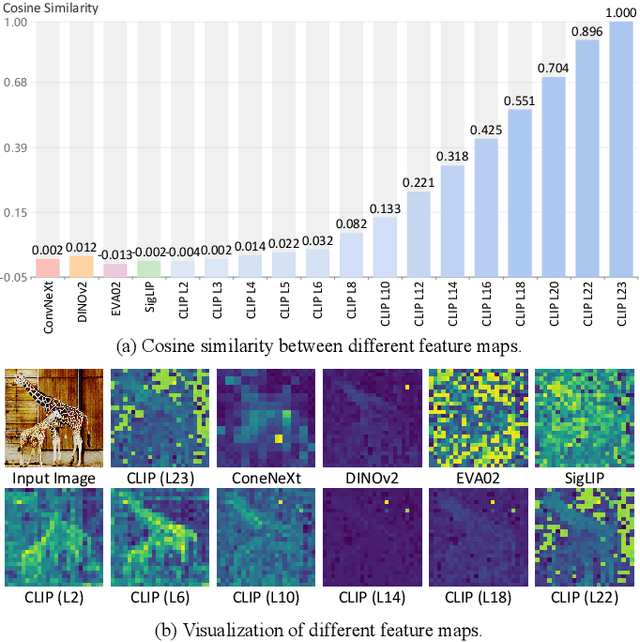

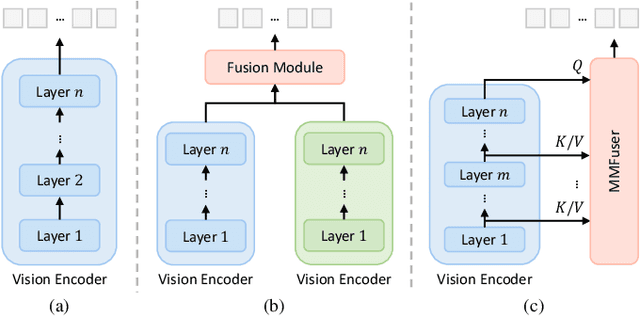
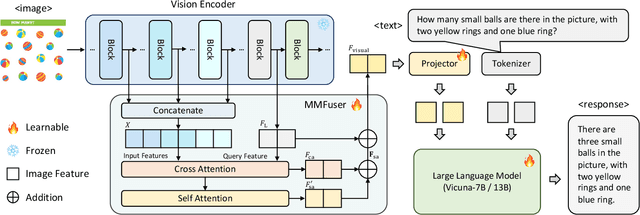
Despite significant advancements in Multimodal Large Language Models (MLLMs) for understanding complex human intentions through cross-modal interactions, capturing intricate image details remains challenging. Previous methods integrating multiple vision encoders to enhance visual detail introduce redundancy and computational overhead. We observe that most MLLMs utilize only the last-layer feature map of the vision encoder for visual representation, neglecting the rich fine-grained information in shallow feature maps. To address this issue, we propose \modelname, a simple yet effective multi-layer feature fuser that efficiently integrates deep and shallow features from Vision Transformers (ViTs). Specifically, it leverages semantically aligned deep features as queries to dynamically extract missing details from shallow features, thus preserving semantic alignment while enriching the representation with fine-grained information. Applied to the LLaVA-1.5 model, \modelname~achieves significant improvements in visual representation and benchmark performance, providing a more flexible and lightweight solution compared to multi-encoder ensemble methods. The code and model have been released at https://github.com/yuecao0119/MMFuser.
Tracing Human Stress from Physiological Signals using UWB Radar
Oct 14, 2024Stress tracing is an important research domain that supports many applications, such as health care and stress management; and its closest related works are derived from stress detection. However, these existing works cannot well address two important challenges facing stress detection. First, most of these studies involve asking users to wear physiological sensors to detect their stress states, which has a negative impact on the user experience. Second, these studies have failed to effectively utilize multimodal physiological signals, which results in less satisfactory detection results. This paper formally defines the stress tracing problem, which emphasizes the continuous detection of human stress states. A novel deep stress tracing method, named DST, is presented. Note that DST proposes tracing human stress based on physiological signals collected by a noncontact ultrawideband radar, which is more friendly to users when collecting their physiological signals. In DST, a signal extraction module is carefully designed at first to robustly extract multimodal physiological signals from the raw RF data of the radar, even in the presence of body movement. Afterward, a multimodal fusion module is proposed in DST to ensure that the extracted multimodal physiological signals can be effectively fused and utilized. Extensive experiments are conducted on three real-world datasets, including one self-collected dataset and two publicity datasets. Experimental results show that the proposed DST method significantly outperforms all the baselines in terms of tracing human stress states. On average, DST averagely provides a 6.31% increase in detection accuracy on all datasets, compared with the best baselines.
t-READi: Transformer-Powered Robust and Efficient Multimodal Inference for Autonomous Driving
Oct 13, 2024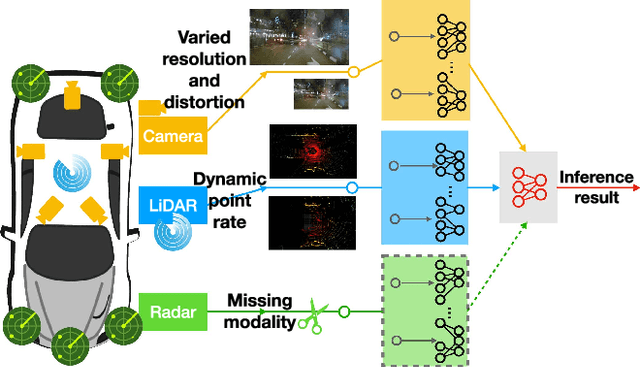
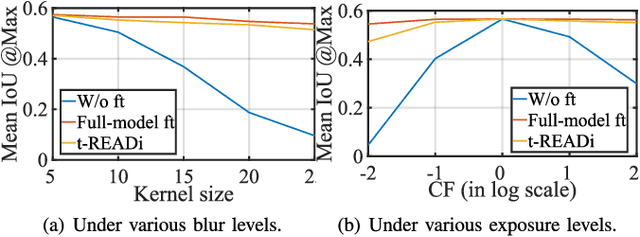
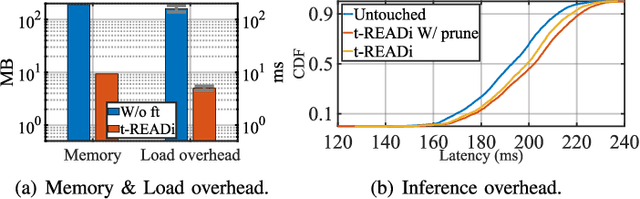
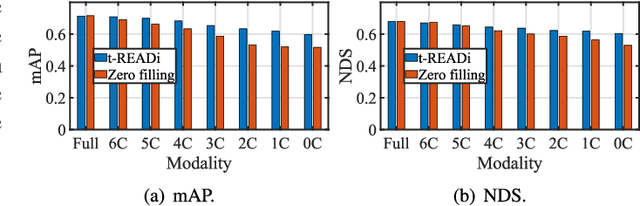
Given the wide adoption of multimodal sensors (e.g., camera, lidar, radar) by autonomous vehicles (AVs), deep analytics to fuse their outputs for a robust perception become imperative. However, existing fusion methods often make two assumptions rarely holding in practice: i) similar data distributions for all inputs and ii) constant availability for all sensors. Because, for example, lidars have various resolutions and failures of radars may occur, such variability often results in significant performance degradation in fusion. To this end, we present tREADi, an adaptive inference system that accommodates the variability of multimodal sensory data and thus enables robust and efficient perception. t-READi identifies variation-sensitive yet structure-specific model parameters; it then adapts only these parameters while keeping the rest intact. t-READi also leverages a cross-modality contrastive learning method to compensate for the loss from missing modalities. Both functions are implemented to maintain compatibility with existing multimodal deep fusion methods. The extensive experiments evidently demonstrate that compared with the status quo approaches, t-READi not only improves the average inference accuracy by more than 6% but also reduces the inference latency by almost 15x with the cost of only 5% extra memory overhead in the worst case under realistic data and modal variations.
Learning to Discover Generalized Facial Expressions
Sep 30, 2024
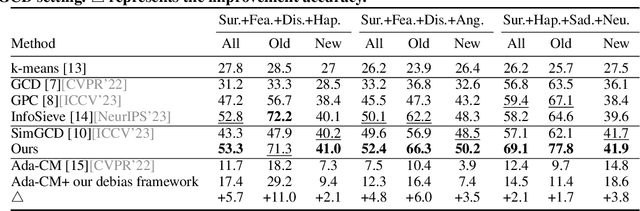

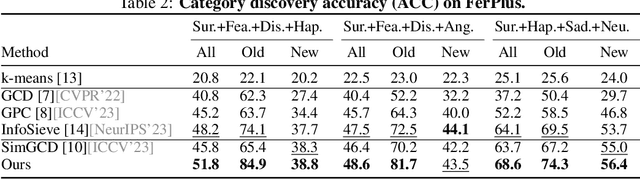
We introduce Facial Expression Category Discovery (FECD), a novel task in the domain of open-world facial expression recognition (O-FER). While Generalized Category Discovery (GCD) has been explored in natural image datasets, applying it to facial expressions presents unique challenges. Specifically, we identify two key biases to better understand these challenges: Theoretical Bias-arising from the introduction of new categories in unlabeled training data, and Practical Bias-stemming from the imbalanced and fine-grained nature of facial expression data. To address these challenges, we propose FER-GCD, an adversarial approach that integrates both implicit and explicit debiasing components. In the implicit debiasing process, we devise F-discrepancy, a novel metric used to estimate the upper bound of Theoretical Bias, helping the model minimize this upper bound through adversarial training. The explicit debiasing process further optimizes the feature generator and classifier to reduce Practical Bias. Extensive experiments on GCD-based FER datasets demonstrate that our FER-GCD framework significantly improves accuracy on both old and new categories, achieving an average improvement of 9.8% over the baseline and outperforming state-of-the-art methods.
Towards Modality-agnostic Label-efficient Segmentation with Entropy-Regularized Distribution Alignment
Aug 29, 2024


Label-efficient segmentation aims to perform effective segmentation on input data using only sparse and limited ground-truth labels for training. This topic is widely studied in 3D point cloud segmentation due to the difficulty of annotating point clouds densely, while it is also essential for cost-effective segmentation on 2D images. Until recently, pseudo-labels have been widely employed to facilitate training with limited ground-truth labels, and promising progress has been witnessed in both the 2D and 3D segmentation. However, existing pseudo-labeling approaches could suffer heavily from the noises and variations in unlabelled data, which would result in significant discrepancies between generated pseudo-labels and current model predictions during training. We analyze that this can further confuse and affect the model learning process, which shows to be a shared problem in label-efficient learning across both 2D and 3D modalities. To address this issue, we propose a novel learning strategy to regularize the pseudo-labels generated for training, thus effectively narrowing the gaps between pseudo-labels and model predictions. More specifically, our method introduces an Entropy Regularization loss and a Distribution Alignment loss for label-efficient learning, resulting in an ERDA learning strategy. Interestingly, by using KL distance to formulate the distribution alignment loss, ERDA reduces to a deceptively simple cross-entropy-based loss which optimizes both the pseudo-label generation module and the segmentation model simultaneously. In addition, we innovate in the pseudo-label generation to make our ERDA consistently effective across both 2D and 3D data modalities for segmentation. Enjoying simplicity and more modality-agnostic pseudo-label generation, our method has shown outstanding performance in fully utilizing all unlabeled data points for training across ...
ChemVLM: Exploring the Power of Multimodal Large Language Models in Chemistry Area
Aug 16, 2024

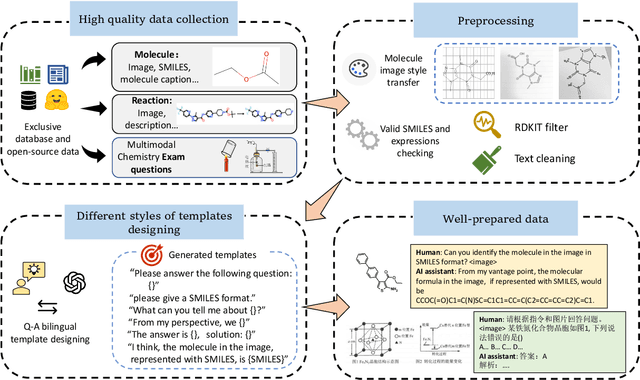

Large Language Models (LLMs) have achieved remarkable success and have been applied across various scientific fields, including chemistry. However, many chemical tasks require the processing of visual information, which cannot be successfully handled by existing chemical LLMs. This brings a growing need for models capable of integrating multimodal information in the chemical domain. In this paper, we introduce \textbf{ChemVLM}, an open-source chemical multimodal large language model specifically designed for chemical applications. ChemVLM is trained on a carefully curated bilingual multimodal dataset that enhances its ability to understand both textual and visual chemical information, including molecular structures, reactions, and chemistry examination questions. We develop three datasets for comprehensive evaluation, tailored to Chemical Optical Character Recognition (OCR), Multimodal Chemical Reasoning (MMCR), and Multimodal Molecule Understanding tasks. We benchmark ChemVLM against a range of open-source and proprietary multimodal large language models on various tasks. Experimental results demonstrate that ChemVLM achieves competitive performance across all evaluated tasks. Our model can be found at https://huggingface.co/AI4Chem/ChemVLM-26B.
Seeing and Understanding: Bridging Vision with Chemical Knowledge Via ChemVLM
Aug 14, 2024In this technical report, we propose ChemVLM, the first open-source multimodal large language model dedicated to the fields of chemistry, designed to address the incompatibility between chemical image understanding and text analysis. Built upon the VIT-MLP-LLM architecture, we leverage ChemLLM-20B as the foundational large model, endowing our model with robust capabilities in understanding and utilizing chemical text knowledge. Additionally, we employ InternVIT-6B as a powerful image encoder. We have curated high-quality data from the chemical domain, including molecules, reaction formulas, and chemistry examination data, and compiled these into a bilingual multimodal question-answering dataset. We test the performance of our model on multiple open-source benchmarks and three custom evaluation sets. Experimental results demonstrate that our model achieves excellent performance, securing state-of-the-art results in five out of six involved tasks. Our model can be found at https://huggingface.co/AI4Chem/ChemVLM-26B.