 Add to Chrome
 Add to Firefox
 Add to Edge
MMShopBench: A Real-Log Benchmark for Multimodal, Multi-Turn Shopping Agents
Jul 31, 2026
Online shoppers increasingly turn to AI shopping assistants, using images and multi-turn dialogue to express and refine product needs that are difficult to articulate in text alone. However, existing benchmarks largely rely on text-only or synthetic requests, underrepresenting complex real-world shopping requirements jointly expressed through images and language. We introduce MMShopBench, the first real-log benchmark for multimodal, multi-turn shopping agents. Built from carefully cleaned and manually annotated shopping logs, MMShopBench provides ground-truth annotations of each request's purchase intent and mandatory product requirements. Agents must infer these requirements jointly from user images and multi-turn dialogue, retrieve candidate products through image and text search, and verify that each candidate satisfies all requirements using its product images and structured attributes. We evaluate representative open-source and proprietary models using an evidence-grounded multimodal protocol and construct a companion training set for fine-tuning an open-source model. To ensure reproducible experimentation, we build an offline shopping sandbox, where fine-tuning substantially narrows the performance gap between our open-source model and leading proprietary models, demonstrating the effectiveness of our training data.

ChemVLM: Exploring the Power of Multimodal Large Language Models in Chemistry Area
Aug 16, 2024

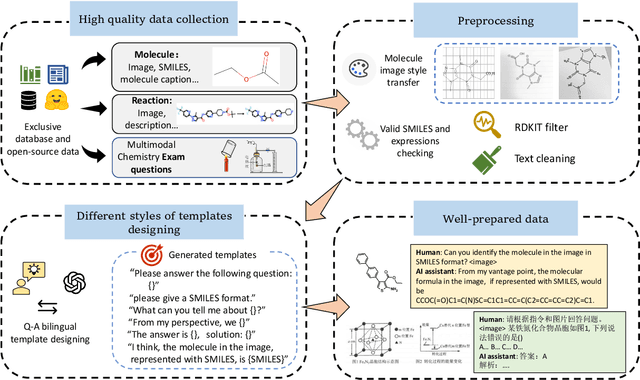

Large Language Models (LLMs) have achieved remarkable success and have been applied across various scientific fields, including chemistry. However, many chemical tasks require the processing of visual information, which cannot be successfully handled by existing chemical LLMs. This brings a growing need for models capable of integrating multimodal information in the chemical domain. In this paper, we introduce \textbf{ChemVLM}, an open-source chemical multimodal large language model specifically designed for chemical applications. ChemVLM is trained on a carefully curated bilingual multimodal dataset that enhances its ability to understand both textual and visual chemical information, including molecular structures, reactions, and chemistry examination questions. We develop three datasets for comprehensive evaluation, tailored to Chemical Optical Character Recognition (OCR), Multimodal Chemical Reasoning (MMCR), and Multimodal Molecule Understanding tasks. We benchmark ChemVLM against a range of open-source and proprietary multimodal large language models on various tasks. Experimental results demonstrate that ChemVLM achieves competitive performance across all evaluated tasks. Our model can be found at https://huggingface.co/AI4Chem/ChemVLM-26B.
Seeing and Understanding: Bridging Vision with Chemical Knowledge Via ChemVLM
Aug 14, 2024In this technical report, we propose ChemVLM, the first open-source multimodal large language model dedicated to the fields of chemistry, designed to address the incompatibility between chemical image understanding and text analysis. Built upon the VIT-MLP-LLM architecture, we leverage ChemLLM-20B as the foundational large model, endowing our model with robust capabilities in understanding and utilizing chemical text knowledge. Additionally, we employ InternVIT-6B as a powerful image encoder. We have curated high-quality data from the chemical domain, including molecules, reaction formulas, and chemistry examination data, and compiled these into a bilingual multimodal question-answering dataset. We test the performance of our model on multiple open-source benchmarks and three custom evaluation sets. Experimental results demonstrate that our model achieves excellent performance, securing state-of-the-art results in five out of six involved tasks. Our model can be found at https://huggingface.co/AI4Chem/ChemVLM-26B.