 Add to Chrome
 Add to Firefox
 Add to Edge
GeoSeg-OV: Bridging Geospatial Gaps with Structural Guidance for Open-Vocabulary Remote Sensing Segmentation
Aug 11, 2026
Open-vocabulary remote sensing segmentation has recently emerged as a promising paradigm that enables pixel-level recognition of arbitrary categories specified by natural language, including classes unseen during training. However, geospatial domain shifts caused by heterogeneous regions, spatial resolutions, and acquisition platforms weaken visual-text matching and limit cross-dataset generalization. Recent attempts have begun to incorporate auxiliary vision foundation models (VFMs), typically coupling their features with text embeddings as additional matching evidence. However, this strategy may introduce inconsistent matching signals while leaving the structure-sensitive representations of VFMs insufficiently exploited. We therefore propose GeoSeg-OV, which decouples auxiliary VFM features from visual-text matching and repurposes them as structural guidance for cost aggregation and decoding. GeoSeg-OV constructs an orientation-robust cost volume from multi-rotation CLIP features, while a frozen VFM extracts multi-scale structure-sensitive features in parallel. We propose Structure-Guided Aggregation (SGA), which integrates cost tokens and CLIP semantic guidance with VFM-derived pairwise structural biases for coherent spatial propagation, followed by text-conditioned class-wise reasoning. We further introduce Cost-Aware Decoding (CAD) to adaptively refine and fuse multi-scale semantic and structural guidance based on the current decoder context. On the global High-Resolution Land Cover (HRLC) benchmark spanning seven datasets across six continents, GeoSeg-OV outperforms the state-of-the-art by +2.5 and +2.7 average mIoU under two training settings. A large-scale zero-shot case study further demonstrates its generalization across geographic domains and category systems without target-domain annotations or retraining.

Reading is not Reasoning: Bridging the Agentic Policy Gap in Vision-Text Compression
Aug 09, 2026Multi-step language-model agents repeatedly process growing interaction histories, leading to substantial context costs. Vision--text compression reduces these costs by rendering history as images, but the resulting modality shift creates a marked capability gap. Through controlled evaluations of history recovery, matched-state decisions, and complete trajectories, we show that this gap cannot be explained by OCR quality alone. Visual-history agents exhibit systematic drift in action selection, query formulation, stopping, and evidence use, revealing an agentic policy gap. We introduce \textbf{CAPS}, a two-stage \textbf{C}ross-modal \textbf{A}gentic \textbf{P}olicy \textbf{S}elf-distillation framework that uses the same model's stronger text-history policy to supervise its visual-history counterpart. Offline trajectory self-distillation transfers successful text-policy behavior to visual-history inputs, while online policy self-distillation provides dense supervision on states visited by the visual-history policy during reinforcement learning. On SearchQA, CAPS improves over AgentOCR by 5.0\% and 3.4\% with 3B and 7B backbones, respectively. On full-history ALFWorld, the corresponding gains are 15.6\% and 14.5\%. Across settings, CAPS reduces average memory-context cost by up to 63.3\% and peak cost by up to 83.4\% relative to matched text-history policies. These results show that explicit cross-modal policy self-distillation can preserve agent capability under vision--text compression. Our code will be made publicly available in a future release.
RoRA: Role-Oriented Regional Allocation for Visual Token Pruning in MLLMs
Aug 07, 2026Multimodal large language models (MLLMs) encode images as long visual token sequences, making prefilling and KV-cache storage expensive. Existing training-free pruning methods select tokens by importance, diversity, or spatial coverage, but treat retained tokens as interchangeable and do not explicitly track which object-related regions are already covered. We present RoRA, a training-free framework that casts visual token pruning as role-oriented regional evidence allocation. Given a fixed budget, RoRA partitions tokens into a protected semantic core, complementary context, and fine-grained detail. It first calibrates text-conditioned attention with a positional prior and a prompt-calibrated object prior, then builds Attention-Anchored Regions (AARs) from high-confidence anchors as lightweight proxies for covered object support. Context is explored mainly outside AARs, while a small AAR-guided budget restores local detail; pairwise similarity is used only for context-stage redundancy filtering. Under matched budgets, RoRA consistently outperforms strong training-free baselines across LLaVA and Qwen-VL families, retaining most of the unpruned accuracy even at aggressive pruning ratios, e.g., 96.5% of full performance at 88.9% pruning on LLaVA-1.5, and improving over D2Pruner by about 5% on Qwen3-VL at 75-90% pruning. At a 66.7% pruning ratio, RoRA requires only 0.7 ms for token selection and reduces end-to-end inference time by 24.6%, corresponding to a 1.33x speedup over unpruned inference on an NVIDIA H800.
CROSS: Cascaded Distillation and Dual-Constraint Grounding for Remote Sensing Referring Segmentation
Aug 05, 2026Referring Remote Sensing Image Segmentation (RRSIS) has achieved significant progress through the integration of VLMs and the Segment Anything Model (SAM). However, this progress largely relies on strong pre-trained capabilities, while leaving two fundamental limitations insufficiently addressed: (1) Architectural Weak-Coupling, where the unidirectional flow forces reliance on coarse VLM prompts and wastes SAM's pixel-level structural guidance, causing localization drift; and (2) Object-Centric Semantic Bias, where models overemphasize dominant object semantics while remaining insensitive to spatial reasoning crucial for RRSIS. Motivated by these observations, we propose CROSS, a tightly integrated paradigm for RRSIS. First, we introduce Linguistic-Guided Cascaded Distillation (LGCD) to bridge the architectural gap, which distills SAM's geometric affinities as soft regularizers into VLM intermediate layers, injecting dense structural priors to refine localization. Second, Perspective-Spatial Contrastive Learning (PSCL) imposes cross-anchored constraints by mining mask-filtered deceptive distractors and spatial-linguistic counterfactuals as hard negatives, explicitly shattering semantic shortcuts to enforce genuine logical consistency. Extensive experiments on RRSIS benchmarks demonstrate that CROSS achieves state-of-the-art performance and maintains precise localization even under severe spatial description perturbations, standing as a robust new paradigm for RRSIS.
TACG: Trajectory-Aware Commit Gating for Diffusion Language Model Decoding
Jul 03, 2026Diffusion language models (DLLMs) generate text by iteratively denoising masked positions, exposing a trajectory of predictive distributions rather than a single instantaneous belief. Most existing decoders ignore this trajectory and commit tokens from the current snapshot alone, conflating confidence with commitment readiness: a transient top-1 peak under incomplete context can be locked in, while candidates with consistent cross-step support are delayed. We propose Trajectory-Aware Commit Gating (TACG), a training-free gate-level decoder that anchors token identities to the base posterior and uses trajectory-aware signals only to decide whether the current proposal is ready to commit. TACG combines Temporal Implicit Logits Guidance (TILG), which keeps an exponential moving average of past logits as a self-reference and contrasts the current logits against this reference in natural-parameter space, with a History Gate (HG) that enforces short-term proposal persistence before commitment. Together with a capped extra-promotion budget, these components yield a stability-constrained commit rule without auxiliary networks or extra forward passes. We evaluate TACG on LLaDA, Dream, and LLaDA2-Mini across code (HumanEval, MBPP) and math (GSM8K, MATH500) benchmarks; it typically improves or preserves accuracy while reducing denoising steps and increasing tokens per forward (TPF). The code is publicly available at https://github.com/Clarence-CV/TACG-DLLM.
From Question Answering to Task Completion: A Survey on Agent System and Harness Design
Jun 14, 2026LLM-based agents mark a shift from passive question answering to active task completion: they perceive environments, invoke tools, maintain state, and act over extended horizons. As agent systems have evolved from prompt engineering to workflows and context engineering, harness engineering, and agent-native training with co-evolution, a central question has become increasingly important: where does the bottleneck in agent performance reside, in the foundation model, in the execution harness, or in the coupling between them? This survey examines LLM-based agents through a model-harness lens. We first clarify the functional definition of agents and the implementation view of an LLM-based agent as a foundation model coupled with an execution harness. We then analyze the limits of model-centric scaling, trace four paradigms of agent engineering, and decompose the execution harness into six coupled runtime responsibilities: observation, context, control, action, state, and verification. Using this decomposition, we map task properties and domain pressures to harness configurations, review benchmark and evaluation practices, and synthesize model-harness evidence on how runtime design affects long-horizon task completion, efficiency, and reliability. Finally, we identify open challenges in value-aware evaluation, safety, harness generalization, and model-harness co-evolution. Rather than treating agents as models with auxiliary tools, this survey argues that agent quality -- including success, efficiency, safety, and generalization -- emerges from the interaction between model capability, runtime infrastructure, task structure, and evaluation design. A collection of papers discussed in this survey is provided in https://github.com/ggjy/Awesome-Agent-Engineering.
An Ensemble of Evolutionary Algorithms With Both Crisscross Search and Sparrow Search for Processing Inferior Individuals
Jan 15, 2026In the field of artificial intelligence, real parameter single objective optimization is an important direction. Both the Differential Evolution (DE) and the Covariance Matrix Adaptation Evolution Strategy (CMA-ES) demonstrate good performance for real parameter single objective optimization. Nevertheless, there exist other types of evolutionary algorithm for the purpose. In recent years, researchers begin to study long-term search. EA4eig - an ensemble of three DE variants and CMA-ES - performs well for long-term search. In this paper, we introduce two types of evolutionary algorithm proposed recently - crisscross search and sparrow search - into EA4eig as secondary evolutionary algorithms to process inferior individuals. Thus, EA4eigCS is obtained. In our ensemble, the secondary evolutionary algorithms are expected to vary distribution of the population for breaking stagnation. Experimental results show that our EA4eigCS outperforms EA4eig and is competitive when compared with state-of-the-art algorithms. Code and supplementary material are available at:https://anonymous.4open.science/r/EA4eigCS-2A43.
Learning to Discover Generalized Facial Expressions
Sep 30, 2024
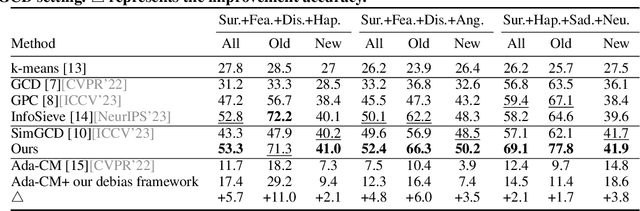

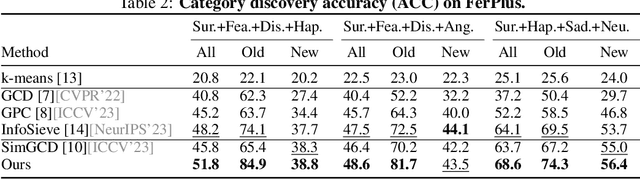
We introduce Facial Expression Category Discovery (FECD), a novel task in the domain of open-world facial expression recognition (O-FER). While Generalized Category Discovery (GCD) has been explored in natural image datasets, applying it to facial expressions presents unique challenges. Specifically, we identify two key biases to better understand these challenges: Theoretical Bias-arising from the introduction of new categories in unlabeled training data, and Practical Bias-stemming from the imbalanced and fine-grained nature of facial expression data. To address these challenges, we propose FER-GCD, an adversarial approach that integrates both implicit and explicit debiasing components. In the implicit debiasing process, we devise F-discrepancy, a novel metric used to estimate the upper bound of Theoretical Bias, helping the model minimize this upper bound through adversarial training. The explicit debiasing process further optimizes the feature generator and classifier to reduce Practical Bias. Extensive experiments on GCD-based FER datasets demonstrate that our FER-GCD framework significantly improves accuracy on both old and new categories, achieving an average improvement of 9.8% over the baseline and outperforming state-of-the-art methods.
Contextuality Helps Representation Learning for Generalized Category Discovery
Jul 29, 2024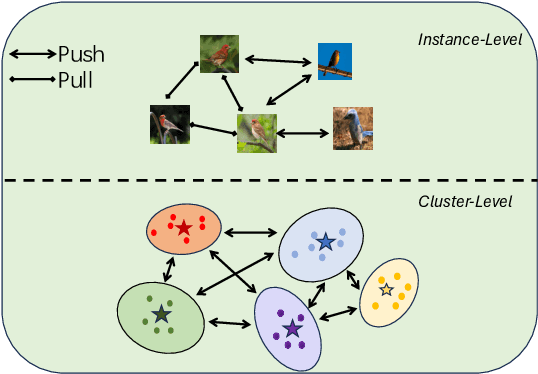
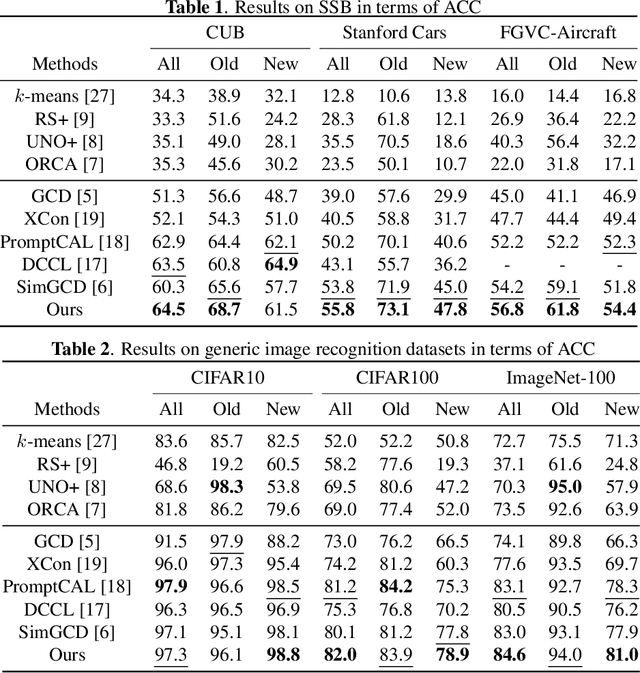
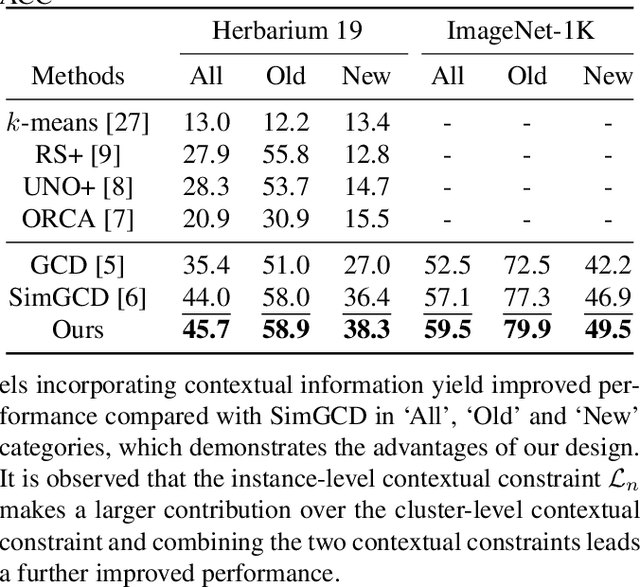
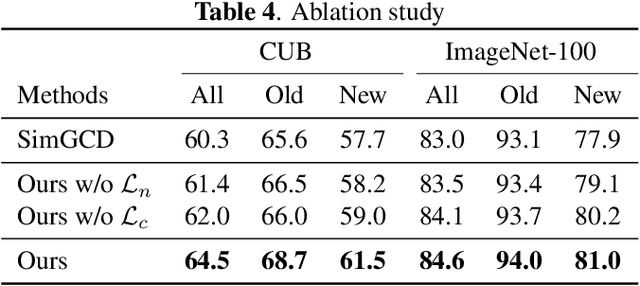
This paper introduces a novel approach to Generalized Category Discovery (GCD) by leveraging the concept of contextuality to enhance the identification and classification of categories in unlabeled datasets. Drawing inspiration from human cognition's ability to recognize objects within their context, we propose a dual-context based method. Our model integrates two levels of contextuality: instance-level, where nearest-neighbor contexts are utilized for contrastive learning, and cluster-level, employing prototypical contrastive learning based on category prototypes. The integration of the contextual information effectively improves the feature learning and thereby the classification accuracy of all categories, which better deals with the real-world datasets. Different from the traditional semi-supervised and novel category discovery techniques, our model focuses on a more realistic and challenging scenario where both known and novel categories are present in the unlabeled data. Extensive experimental results on several benchmark data sets demonstrate that the proposed model outperforms the state-of-the-art. Code is available at: https://github.com/Clarence-CV/Contexuality-GCD