 Add to Chrome
 Add to Firefox
 Add to Edge
Action-to-Action Flow Matching
Feb 07, 2026
Diffusion-based policies have recently achieved remarkable success in robotics by formulating action prediction as a conditional denoising process. However, the standard practice of sampling from random Gaussian noise often requires multiple iterative steps to produce clean actions, leading to high inference latency that incurs a major bottleneck for real-time control. In this paper, we challenge the necessity of uninformed noise sampling and propose Action-to-Action flow matching (A2A), a novel policy paradigm that shifts from random sampling to initialization informed by the previous action. Unlike existing methods that treat proprioceptive action feedback as static conditions, A2A leverages historical proprioceptive sequences, embedding them into a high-dimensional latent space as the starting point for action generation. This design bypasses costly iterative denoising while effectively capturing the robot's physical dynamics and temporal continuity. Extensive experiments demonstrate that A2A exhibits high training efficiency, fast inference speed, and improved generalization. Notably, A2A enables high-quality action generation in as few as a single inference step (0.56 ms latency), and exhibits superior robustness to visual perturbations and enhanced generalization to unseen configurations. Lastly, we also extend A2A to video generation, demonstrating its broader versatility in temporal modeling. Project site: https://lorenzo-0-0.github.io/A2A_Flow_Matching.

Trace-Focused Diffusion Policy for Multi-Modal Action Disambiguation in Long-Horizon Robotic Manipulation
Feb 07, 2026Generative model-based policies have shown strong performance in imitation-based robotic manipulation by learning action distributions from demonstrations. However, in long-horizon tasks, visually similar observations often recur across execution stages while requiring distinct actions, which leads to ambiguous predictions when policies are conditioned only on instantaneous observations, termed multi-modal action ambiguity (MA2). To address this challenge, we propose the Trace-Focused Diffusion Policy (TF-DP), a simple yet effective diffusion-based framework that explicitly conditions action generation on the robot's execution history. TF-DP represents historical motion as an explicit execution trace and projects it into the visual observation space, providing stage-aware context when current observations alone are insufficient. In addition, the induced trace-focused field emphasizes task-relevant regions associated with historical motion, improving robustness to background visual disturbances. We evaluate TF-DP on real-world robotic manipulation tasks exhibiting pronounced multi-modal action ambiguity and visually cluttered conditions. Experimental results show that TF-DP improves temporal consistency and robustness, outperforming the vanilla diffusion policy by 80.56 percent on tasks with multi-modal action ambiguity and by 86.11 percent under visual disturbances, while maintaining inference efficiency with only a 6.4 percent runtime increase. These results demonstrate that execution-trace conditioning offers a scalable and principled approach for robust long-horizon robotic manipulation within a single policy.
Sparse-RL: Breaking the Memory Wall in LLM Reinforcement Learning via Stable Sparse Rollouts
Jan 15, 2026Reinforcement Learning (RL) has become essential for eliciting complex reasoning capabilities in Large Language Models (LLMs). However, the substantial memory overhead of storing Key-Value (KV) caches during long-horizon rollouts acts as a critical bottleneck, often prohibiting efficient training on limited hardware. While existing KV compression techniques offer a remedy for inference, directly applying them to RL training induces a severe policy mismatch, leading to catastrophic performance collapse. To address this, we introduce Sparse-RL empowers stable RL training under sparse rollouts. We show that instability arises from a fundamental policy mismatch among the dense old policy, the sparse sampler policy, and the learner policy. To mitigate this issue, Sparse-RL incorporates Sparsity-Aware Rejection Sampling and Importance-based Reweighting to correct the off-policy bias introduced by compression-induced information loss. Experimental results show that Sparse-RL reduces rollout overhead compared to dense baselines while preserving the performance. Furthermore, Sparse-RL inherently implements sparsity-aware training, significantly enhancing model robustness during sparse inference deployment.
TableCache: Primary Foreign Key Guided KV Cache Precomputation for Low Latency Text-to-SQL
Jan 13, 2026In Text-to-SQL tasks, existing LLM-based methods often include extensive database schemas in prompts, leading to long context lengths and increased prefilling latency. While user queries typically focus on recurrent table sets-offering an opportunity for KV cache sharing across queries-current inference engines, such as SGLang and vLLM, generate redundant prefix cache copies when processing user queries with varying table orders. To address this inefficiency, we propose precomputing table representations as KV caches offline and querying the required ones online. A key aspect of our approach is the computation of table caches while preserving primary foreign key relationships between tables. Additionally, we construct a Table Trie structure to facilitate efficient KV cache lookups during inference. To enhance cache performance, we introduce a cache management system with a query reranking strategy to improve cache hit rates and a computation loading pipeline for parallelizing model inference and cache loading. Experimental results show that our proposed TableCache achieves up to a 3.62x speedup in Time to First Token (TTFT) with negligible performance degradation.
WaveMan: mmWave-Based Room-Scale Human Interaction Perception for Humanoid Robots
Jan 12, 2026Reliable humanoid-robot interaction (HRI) in household environments is constrained by two fundamental requirements, namely robustness to unconstrained user positions and preservation of user privacy. Millimeter-wave (mmWave) sensing inherently supports privacy-preserving interaction, making it a promising modality for room-scale HRI. However, existing mmWave-based interaction-sensing systems exhibit poor spatial generalization at unseen distances or viewpoints. To address this challenge, we introduce WaveMan, a spatially adaptive room-scale perception system that restores reliable human interaction sensing across arbitrary user positions. WaveMan integrates viewpoint alignment and spectrogram enhancement for spatial consistency, with dual-channel attention for robust feature extraction. Experiments across five participants show that, under fixed-position evaluation, WaveMan achieves the same cross-position accuracy as the baseline with five times fewer training positions. In random free-position testing, accuracy increases from 33.00% to 94.33%, enabled by the proposed method. These results demonstrate the feasibility of reliable, privacy-preserving interaction for household humanoid robots across unconstrained user positions.
Ideological Isolation in Online Social Networks: A Survey of Computational Definitions, Metrics, and Mitigation Strategies
Jan 12, 2026The proliferation of online social networks has significantly reshaped the way individuals access and engage with information. While these platforms offer unprecedented connectivity, they may foster environments where users are increasingly exposed to homogeneous content and like-minded interactions. Such dynamics are associated with selective exposure and the emergence of filter bubbles, echo chambers, tunnel vision, and polarization, which together can contribute to ideological isolation and raise concerns about information diversity and public discourse. This survey provides a comprehensive computational review of existing studies that define, analyze, quantify, and mitigate ideological isolation in online social networks. We examine the mechanisms underlying content personalization, user behavior patterns, and network structures that reinforce content-exposure concentration and narrowing dynamics. This paper also systematically reviews methodological approaches for detecting and measuring these isolation-related phenomena, covering network-, content-, and behavior-based metrics. We further organize computational mitigation strategies, including network-topological interventions and recommendation-level controls, and discuss their trade-offs and deployment considerations. By integrating definitions, metrics, and interventions across structural/topological, content-based, interactional, and cognitive isolation, this survey provides a unified computational framework. It serves as a reference for understanding and addressing the key challenges and opportunities in promoting information diversity and reducing ideological fragmentation in the digital age.
Accelerate Speculative Decoding with Sparse Computation in Verification
Dec 26, 2025Speculative decoding accelerates autoregressive language model inference by verifying multiple draft tokens in parallel. However, the verification stage often becomes the dominant computational bottleneck, especially for long-context inputs and mixture-of-experts (MoE) models. Existing sparsification methods are designed primarily for standard token-by-token autoregressive decoding to remove substantial computational redundancy in LLMs. This work systematically adopts different sparse methods on the verification stage of the speculative decoding and identifies structured redundancy across multiple dimensions. Based on these observations, we propose a sparse verification framework that jointly sparsifies attention, FFN, and MoE components during the verification stage to reduce the dominant computation cost. The framework further incorporates an inter-draft token and inter-layer retrieval reuse strategy to further reduce redundant computation without introducing additional training. Extensive experiments across summarization, question answering, and mathematical reasoning datasets demonstrate that the proposed methods achieve favorable efficiency-accuracy trade-offs, while maintaining stable acceptance length.
MathCanvas: Intrinsic Visual Chain-of-Thought for Multimodal Mathematical Reasoning
Oct 16, 2025While Large Language Models (LLMs) have excelled in textual reasoning, they struggle with mathematical domains like geometry that intrinsically rely on visual aids. Existing approaches to Visual Chain-of-Thought (VCoT) are often limited by rigid external tools or fail to generate the high-fidelity, strategically-timed diagrams necessary for complex problem-solving. To bridge this gap, we introduce MathCanvas, a comprehensive framework designed to endow unified Large Multimodal Models (LMMs) with intrinsic VCoT capabilities for mathematics. Our approach consists of two phases. First, a Visual Manipulation stage pre-trains the model on a novel 15.2M-pair corpus, comprising 10M caption-to-diagram pairs (MathCanvas-Imagen) and 5.2M step-by-step editing trajectories (MathCanvas-Edit), to master diagram generation and editing. Second, a Strategic Visual-Aided Reasoning stage fine-tunes the model on MathCanvas-Instruct, a new 219K-example dataset of interleaved visual-textual reasoning paths, teaching it when and how to leverage visual aids. To facilitate rigorous evaluation, we introduce MathCanvas-Bench, a challenging benchmark with 3K problems that require models to produce interleaved visual-textual solutions. Our model, BAGEL-Canvas, trained under this framework, achieves an 86% relative improvement over strong LMM baselines on MathCanvas-Bench, demonstrating excellent generalization to other public math benchmarks. Our work provides a complete toolkit-framework, datasets, and benchmark-to unlock complex, human-like visual-aided reasoning in LMMs. Project Page: https://mathcanvas.github.io/
PeftCD: Leveraging Vision Foundation Models with Parameter-Efficient Fine-Tuning for Remote Sensing Change Detection
Sep 11, 2025To tackle the prevalence of pseudo changes, the scarcity of labeled samples, and the difficulty of cross-domain generalization in multi-temporal and multi-source remote sensing imagery, we propose PeftCD, a change detection framework built upon Vision Foundation Models (VFMs) with Parameter-Efficient Fine-Tuning (PEFT). At its core, PeftCD employs a weight-sharing Siamese encoder derived from a VFM, into which LoRA and Adapter modules are seamlessly integrated. This design enables highly efficient task adaptation by training only a minimal set of additional parameters. To fully unlock the potential of VFMs, we investigate two leading backbones: the Segment Anything Model v2 (SAM2), renowned for its strong segmentation priors, and DINOv3, a state-of-the-art self-supervised representation learner. The framework is complemented by a deliberately lightweight decoder, ensuring the focus remains on the powerful feature representations from the backbones. Extensive experiments demonstrate that PeftCD achieves state-of-the-art performance across multiple public datasets, including SYSU-CD (IoU 73.81%), WHUCD (92.05%), MSRSCD (64.07%), MLCD (76.89%), CDD (97.01%), S2Looking (52.25%) and LEVIR-CD (85.62%), with notably precise boundary delineation and strong suppression of pseudo-changes. In summary, PeftCD presents an optimal balance of accuracy, efficiency, and generalization. It offers a powerful and scalable paradigm for adapting large-scale VFMs to real-world remote sensing change detection applications. The code and pretrained models will be released at https://github.com/dyzy41/PeftCD.
LongEmotion: Measuring Emotional Intelligence of Large Language Models in Long-Context Interaction
Sep 09, 2025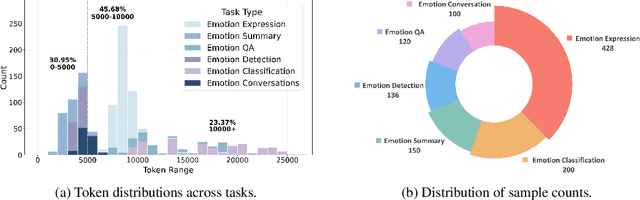
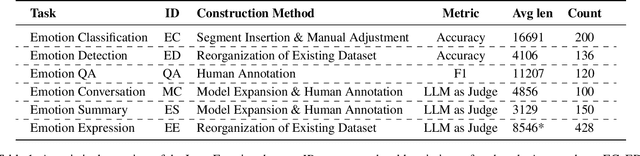
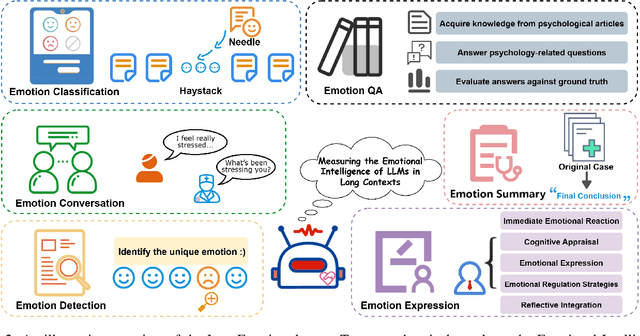
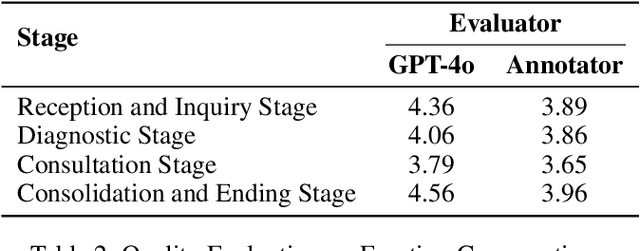
Large language models (LLMs) make significant progress in Emotional Intelligence (EI) and long-context understanding. However, existing benchmarks tend to overlook certain aspects of EI in long-context scenarios, especially under realistic, practical settings where interactions are lengthy, diverse, and often noisy. To move towards such realistic settings, we present LongEmotion, a benchmark specifically designed for long-context EI tasks. It covers a diverse set of tasks, including Emotion Classification, Emotion Detection, Emotion QA, Emotion Conversation, Emotion Summary, and Emotion Expression. On average, the input length for these tasks reaches 8,777 tokens, with long-form generation required for Emotion Expression. To enhance performance under realistic constraints, we incorporate Retrieval-Augmented Generation (RAG) and Collaborative Emotional Modeling (CoEM), and compare them with standard prompt-based methods. Unlike conventional approaches, our RAG method leverages both the conversation context and the large language model itself as retrieval sources, avoiding reliance on external knowledge bases. The CoEM method further improves performance by decomposing the task into five stages, integrating both retrieval augmentation and limited knowledge injection. Experimental results show that both RAG and CoEM consistently enhance EI-related performance across most long-context tasks, advancing LLMs toward more practical and real-world EI applications. Furthermore, we conducted a comparative case study experiment on the GPT series to demonstrate the differences among various models in terms of EI. Code is available on GitHub at https://github.com/LongEmotion/LongEmotion, and the project page can be found at https://longemotion.github.io/.