 Add to Chrome
 Add to Firefox
 Add to Edge
Real-time Whole-Body Motion Planning for Mobile Manipulators Carrying Arbitrarily Shaped Payloads via Kinematically-Coupled SVSDF
Aug 07, 2026
Mobile manipulators are increasingly tasked with transporting large, non-convex payloads through cluttered environments, yet existing planners either oversimplify the payload geometry or fail to handle the kinematic coupling between manipulator links, leading to lost feasible space or stalled optimization. This letter presents a real-time whole-body motion planning framework for mobile manipulators carrying arbitrarily shaped payloads. The front-end employs a chain-decomposed kernel-based collision check that preserves the true geometry of the robot and payload, with compact storage and fast bit-level queries. A mid-end preprocessing stage converts the front-end path into a continuous trajectory enforcing smoothness and feasibility, and executes it directly when collision-free to bypass the costly back-end. When refinement is required, the back-end performs trajectory optimization built on a Kinematically-Coupled SVSDF (KC-SVSDF), which propagates collision-avoidance gradients along the kinematic chain to produce coherent whole-body escape directions. Ablation studies, comparative benchmarks against state-of-the-art baselines, and real-world experiments on a differential-drive mobile manipulator demonstrate that the proposed framework reliably transports large, non-convex payloads through tight passages and cluttered environments.

The Seriality Gap in Video Diffusion Models
Jul 14, 2026When one ball strikes another, then another, video models should predict the consequences of each bounce. In controlled experiments on multi-ball hard-sphere dynamics, we find that the performance of standard bidirectional video diffusion degrades as the causal chain lengthens, even when provided more denoising steps. In a length-matched single-ball control, where ball-ball interactions are absent, the degradation largely disappears, isolating dependent-event structure rather than video length as the cause. Across intervention studies, methods that increase effective serial computation improve performance disproportionately, including autoregressive/blockwise generation and architectural depth. We identify this pattern as the seriality gap: a mismatch between tasks requiring growing serial computation and video diffusion models whose denoising loop does not provide scalable serial compute. We then prove that, for deterministic video prediction, denoising steps do not add serial computation beyond the backbone, indicating a structural obstacle for video diffusion on serial reasoning and simulation tasks.
RhinoVLA Technical Report
Jun 05, 2026Vision-Language-Action (VLA) models have shown strong potential for robotic manipulation, but real-time deployment on edge hardware remains challenging. In this work, we identify VLM visual and context tokens as a major source of deployment latency: for GEMM-dominated projection operators, computation grows linearly with the number of input tokens when model dimensions are fixed. Motivated by this observation, we propose RhinoVLA, a deployment-oriented VLA model co-designed with the Huixi R1 edge SoC. RhinoVLA adopts a token-efficient Qwen3-VL backbone and a continuous Action Expert, reducing the VLM-side token and computation burden while preserving pretrained multimodal capability. To support cross-robot learning, RhinoVLA further introduces a unified interface that combines View Registry, 72D physical state-action slot space, and robotinstance LoRA, allowing heterogeneous robot observations and action schemas to be aligned under a shared policy. On the deployment side, RhinoVLA is optimized through hardware-aware compilation, mixed-precision execution, and parallel visual encoding. Experiments show that RhinoVLA achieves downstream performance comparable to π0.5 at a similar parameter scale, while reaching 11.69 Hz end-to-end inference on Huixi R1, meeting the 10 Hz real-time closedloop control target. The project will be open-sourced at https://github.com/HuixiAI/RhinoVLA.
RoPeSLR: 3D RoPE-driven Sparse-LowRank Attention for Efficient Diffusion Transformers
May 20, 2026Diffusion Transformers (DiTs) have revolutionized high-fidelity video generation, yet their $\mathcal{O}(L^2)$ attention complexity poses a formidable bottleneck for long-sequence synthesis. While recent sparse-linear attention hybrids aim to mitigate this, their performance severely degrades at extreme sparsity due to the "RoPE Dilemma": standard linear attention fails to preserve the orthogonal relative-position structure of 3D Rotary Position Embeddings (RoPE), neutralizing vital distance awareness. To address this, we propose \textbf{RoPeSLR}, a 3D RoPE-guided Sparse-LowRank attention framework. We establish that under empirically validated assumptions, the DiT attention manifold admits a decoupling into a high-frequency semantic spike set (bounded by $\mathcal{O}(L^{3/2})$ sparsity) and an extreme low-rank ($\mathcal{O}(d_h \log L)$) background continuum. Guided by this structural prior, RoPeSLR eschews standard linear attention for a head-wise low-rank parameterization equipped with a learnable 3D Absolute Positional Embedding (PE) injection, seamlessly synthesizing long-range relative distance decay. By guaranteeing sub-quadratic sparsity and sub-linear rank growth, RoPeSLR is exceptionally suited for scaling to ultra-long video inference. Extensive evaluations validate this scalable superiority: at 90\% sparsity, RoPeSLR achieves up to $10\times$ fewer FLOPs on Wan2.1-1.3B and delivers a $2.26\times$ end-to-end inference speedup on the ultra-long 100K+ token sequences of HunyuanVideo-13B, all while maintaining near-lossless generation fidelity (less than 1.3\% average VBench degradation).
Trace-Focused Diffusion Policy for Multi-Modal Action Disambiguation in Long-Horizon Robotic Manipulation
Feb 07, 2026Generative model-based policies have shown strong performance in imitation-based robotic manipulation by learning action distributions from demonstrations. However, in long-horizon tasks, visually similar observations often recur across execution stages while requiring distinct actions, which leads to ambiguous predictions when policies are conditioned only on instantaneous observations, termed multi-modal action ambiguity (MA2). To address this challenge, we propose the Trace-Focused Diffusion Policy (TF-DP), a simple yet effective diffusion-based framework that explicitly conditions action generation on the robot's execution history. TF-DP represents historical motion as an explicit execution trace and projects it into the visual observation space, providing stage-aware context when current observations alone are insufficient. In addition, the induced trace-focused field emphasizes task-relevant regions associated with historical motion, improving robustness to background visual disturbances. We evaluate TF-DP on real-world robotic manipulation tasks exhibiting pronounced multi-modal action ambiguity and visually cluttered conditions. Experimental results show that TF-DP improves temporal consistency and robustness, outperforming the vanilla diffusion policy by 80.56 percent on tasks with multi-modal action ambiguity and by 86.11 percent under visual disturbances, while maintaining inference efficiency with only a 6.4 percent runtime increase. These results demonstrate that execution-trace conditioning offers a scalable and principled approach for robust long-horizon robotic manipulation within a single policy.
Aggregation Queries over Unstructured Text: Benchmark and Agentic Method
Feb 03, 2026Aggregation query over free text is a long-standing yet underexplored problem. Unlike ordinary question answering, aggregate queries require exhaustive evidence collection and systems are required to "find all," not merely "find one." Existing paradigms such as Text-to-SQL and Retrieval-Augmented Generation fail to achieve this completeness. In this work, we formalize entity-level aggregation querying over text in a corpus-bounded setting with strict completeness requirement. To enable principled evaluation, we introduce AGGBench, a benchmark designed to evaluate completeness-oriented aggregation under realistic large-scale corpus. To accompany the benchmark, we propose DFA (Disambiguation--Filtering--Aggregation), a modular agentic baseline that decomposes aggregation querying into interpretable stages and exposes key failure modes related to ambiguity, filtering, and aggregation. Empirical results show that DFA consistently improves aggregation evidence coverage over strong RAG and agentic baselines. The data and code are available in \href{https://anonymous.4open.science/r/DFA-A4C1}.
DSFedMed: Dual-Scale Federated Medical Image Segmentation via Mutual Distillation Between Foundation and Lightweight Models
Jan 22, 2026Foundation Models (FMs) have demonstrated strong generalization across diverse vision tasks. However, their deployment in federated settings is hindered by high computational demands, substantial communication overhead, and significant inference costs. We propose DSFedMed, a dual-scale federated framework that enables mutual knowledge distillation between a centralized foundation model and lightweight client models for medical image segmentation. To support knowledge distillation, a set of high-quality medical images is generated to replace real public datasets, and a learnability-guided sample selection strategy is proposed to enhance efficiency and effectiveness in dual-scale distillation. This mutual distillation enables the foundation model to transfer general knowledge to lightweight clients, while also incorporating client-specific insights to refine the foundation model. Evaluations on five medical imaging segmentation datasets show that DSFedMed achieves an average 2 percent improvement in Dice score while reducing communication costs and inference time by nearly 90 percent compared to existing federated foundation model baselines. These results demonstrate significant efficiency gains and scalability for resource-limited federated deployments.
Mixture of Distributions Matters: Dynamic Sparse Attention for Efficient Video Diffusion Transformers
Jan 14, 2026While Diffusion Transformers (DiTs) have achieved notable progress in video generation, this long-sequence generation task remains constrained by the quadratic complexity inherent to self-attention mechanisms, creating significant barriers to practical deployment. Although sparse attention methods attempt to address this challenge, existing approaches either rely on oversimplified static patterns or require computationally expensive sampling operations to achieve dynamic sparsity, resulting in inaccurate pattern predictions and degraded generation quality. To overcome these limitations, we propose a \underline{\textbf{M}}ixtrue-\underline{\textbf{O}}f-\underline{\textbf{D}}istribution \textbf{DiT} (\textbf{MOD-DiT}), a novel sampling-free dynamic attention framework that accurately models evolving attention patterns through a two-stage process. First, MOD-DiT leverages prior information from early denoising steps and adopts a {distributed mixing approach} to model an efficient linear approximation model, which is then used to predict mask patterns for a specific denoising interval. Second, an online block masking strategy dynamically applies these predicted masks while maintaining historical sparsity information, eliminating the need for repetitive sampling operations. Extensive evaluations demonstrate consistent acceleration and quality improvements across multiple benchmarks and model architectures, validating MOD-DiT's effectiveness for efficient, high-quality video generation while overcoming the computational limitations of traditional sparse attention approaches.
Neural B-frame Video Compression with Bi-directional Reference Harmonization
Nov 12, 2025Neural video compression (NVC) has made significant progress in recent years, while neural B-frame video compression (NBVC) remains underexplored compared to P-frame compression. NBVC can adopt bi-directional reference frames for better compression performance. However, NBVC's hierarchical coding may complicate continuous temporal prediction, especially at some hierarchical levels with a large frame span, which could cause the contribution of the two reference frames to be unbalanced. To optimize reference information utilization, we propose a novel NBVC method, termed Bi-directional Reference Harmonization Video Compression (BRHVC), with the proposed Bi-directional Motion Converge (BMC) and Bi-directional Contextual Fusion (BCF). BMC converges multiple optical flows in motion compression, leading to more accurate motion compensation on a larger scale. Then BCF explicitly models the weights of reference contexts under the guidance of motion compensation accuracy. With more efficient motions and contexts, BRHVC can effectively harmonize bi-directional references. Experimental results indicate that our BRHVC outperforms previous state-of-the-art NVC methods, even surpassing the traditional coding, VTM-RA (under random access configuration), on the HEVC datasets. The source code is released at https://github.com/kwai/NVC.
Unsupervised Active Learning via Natural Feature Progressive Framework
Oct 06, 2025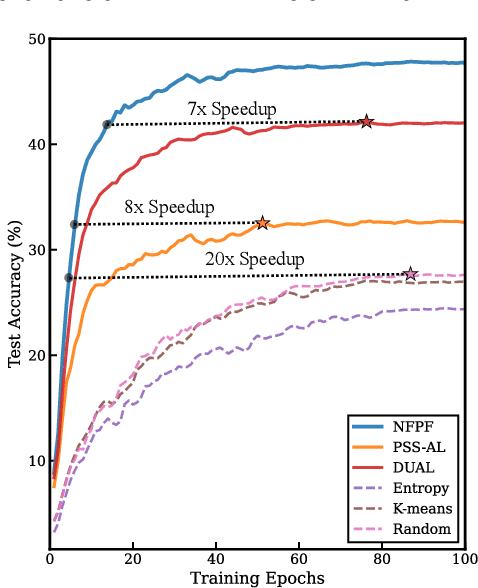
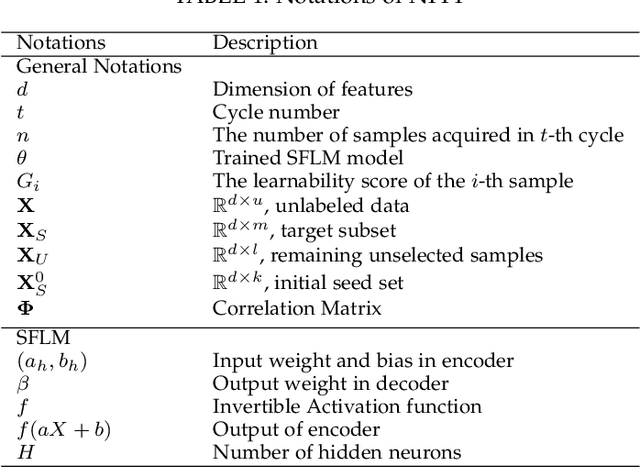
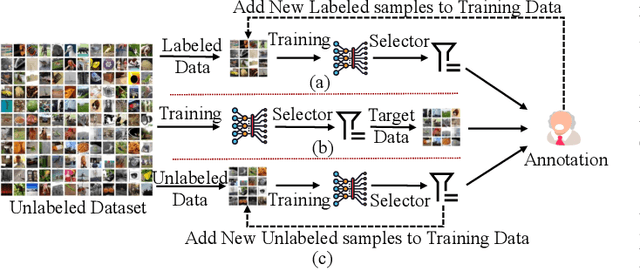
The effectiveness of modern deep learning models is predicated on the availability of large-scale, human-annotated datasets, a process that is notoriously expensive and time-consuming. While Active Learning (AL) offers a strategic solution by labeling only the most informative and representative data, its iterative nature still necessitates significant human involvement. Unsupervised Active Learning (UAL) presents an alternative by shifting the annotation burden to a single, post-selection step. Unfortunately, prevailing UAL methods struggle to achieve state-of-the-art performance. These approaches typically rely on local, gradient-based scoring for sample importance estimation, which not only makes them vulnerable to ambiguous and noisy data but also hinders their capacity to select samples that adequately represent the full data distribution. Moreover, their use of shallow, one-shot linear selection falls short of a true UAL paradigm. In this paper, we propose the Natural Feature Progressive Framework (NFPF), a UAL method that revolutionizes how sample importance is measured. At its core, NFPF employs a Specific Feature Learning Machine (SFLM) to effectively quantify each sample's contribution to model performance. We further utilize the SFLM to define a powerful Reconstruction Difference metric for initial sample selection. Our comprehensive experiments show that NFPF significantly outperforms all established UAL methods and achieves performance on par with supervised AL methods on vision datasets. Detailed ablation studies and qualitative visualizations provide compelling evidence for NFPF's superior performance, enhanced robustness, and improved data distribution coverage.