 Add to Chrome
 Add to Firefox
 Add to Edge
RoboTTT: Context Scaling for Robot Policies
Jul 16, 2026
Recent robot foundation models operate with single-step or short-history visuomotor context. We introduce Test-Time-Training Robot Policies (RoboTTT), a robot model and training recipe that scale visuomotor context to 8K timesteps, three orders of magnitude beyond state-of-the-art policies, without growing inference latency. At this context length, we unlock new robot capabilities: one-shot in-context imitation from human video demonstrations, on-the-fly policy improvement, robustness to perturbations, and stronger performance on multi-stage, long-horizon tasks. We also observe, for the first time, steady gains in closed-loop performance as pretraining context length scales. At its core, RoboTTT integrates Test-Time Training into robot foundation models such as Vision-Language-Action policies, yielding a sequence model whose recurrent state consists of fast weights, parameters updated by gradient descent during both training and inference, compressing histories into weight space and retrieving contextual information for long-context conditioning. To scale training context length, the recipe combines sequence action forcing with truncated backpropagation through time. On challenging real-robot manipulation tasks, RoboTTT improves overall performance by 87% over the single-step context baseline and fully completes a five-minute, ten-stage assembly task, which no baseline ever does. RoboTTT trained with 8K-timestep context outperforms the same model pretrained with 1K timesteps by 62%, suggesting context length as a new scaling axis for robot foundation models. Videos are available at https://research.nvidia.com/labs/gear/robottt/

SimFoundry: Modular and Automated Scene Generation for Policy Learning and Evaluation
Jun 26, 2026Training and evaluating robot policies in the real world is costly and difficult to scale. We introduce SimFoundry, a modular and automated system for zero-shot real-to-sim scene construction from a video. SimFoundry generates sim-ready digital twins and supports object, scene, and task editing, enabling the automated generation of diverse digital cousins: affordance-preserving variations of reconstructed real-world scenes. Policies trained on SimFoundry data transfer zero-shot to challenging real tasks involving multi-step manipulation, articulated object interaction, and bimanual interaction, and its digital cousins (variations of the original scene, objects, and tasks) facilitate generalization to new real-world conditions. Across 7 manipulation tasks and 5 policy architectures, SimFoundry simulation evaluations strongly predict real-world performance, with mean Pearson correlation 0.911 and mean maximum ranking violation 0.018. When evaluating sim-trained policies zero-shot in the real world, policies trained with object, scene, and task cousins in simulation show average task success rate improvements of 17%, 21%, and 40%, respectively. Additional details at https://research.nvidia.com/labs/gear/simfoundry/ .
T-Rex: Tactile-Reactive Dexterous Manipulation
Jun 15, 2026The ability to react dynamically to tactile signals has long been considered crucial to agile human-level dexterity. Yet contemporary learning-based Vision-Language-Action (VLA) models for robotic manipulation generally either overlook the tactile modality or are limited to encoders with static cues, due in part to the scarcity of diverse training data and standardized evaluation, architectural constraints in current VLA models, and limitations of static tactile encoders. In this paper, we push the frontier of tactile-reactive manipulation by addressing all of these limitations. We propose a large-scale, 100-hour tactile-rich dataset collected via a novel, data-efficient recipe that prioritizes elementary motor primitives. To effectively exploit naturally high-frequency touch signals without sacrificing the existing capabilities of existing VLAs, we introduce a variable-rate Mixture-of-Transformers (MoT) architecture equipped with a novel temporal tactile VQ-VAE encoder. We demonstrate the effectiveness of tactile-reactive policies on 12 manipulation tasks requiring delicate force control and deformable object manipulation, achieving over 30% higher average success rate than the strongest baseline.
StereoPolicy: Improving Robotic Manipulation Policies via Stereo Perception
May 11, 2026Recent advances in robot imitation learning have yielded powerful visuomotor policies capable of manipulating a wide variety of objects directly from monocular visual inputs. However, monocular observations inherently lack reliable depth cues and spatial awareness, which are critical for precise manipulation in cluttered or geometrically complex scenes. To address this limitation, we introduce StereoPolicy, a new visuomotor policy learning framework that directly leverages synchronized stereo image pairs to strengthen geometric reasoning, without requiring explicit 3D reconstruction or camera calibration. StereoPolicy employs pretrained 2D vision encoders to process each image independently and fuses the resulting representations through a Stereo Transformer. This design implicitly captures spatial correspondence and disparity cues. The framework integrates seamlessly with diffusion-based and pretrained vision-language-action (VLA) policies, delivering consistent improvements over RGB, RGB-D, point cloud, and multi-view baselines across three simulation benchmarks: RoboMimic, RoboCasa, and OmniGibson. We further validate StereoPolicy on real-robot experiments spanning both tabletop and bimanual mobile manipulation settings. Our results underscore stereo vision as a scalable and robust modality that bridges 2D pretrained representations with 3D geometric understanding for robotic manipulation.
EgoScale: Scaling Dexterous Manipulation with Diverse Egocentric Human Data
Feb 18, 2026Human behavior is among the most scalable sources of data for learning physical intelligence, yet how to effectively leverage it for dexterous manipulation remains unclear. While prior work demonstrates human to robot transfer in constrained settings, it is unclear whether large scale human data can support fine grained, high degree of freedom dexterous manipulation. We present EgoScale, a human to dexterous manipulation transfer framework built on large scale egocentric human data. We train a Vision Language Action (VLA) model on over 20,854 hours of action labeled egocentric human video, more than 20 times larger than prior efforts, and uncover a log linear scaling law between human data scale and validation loss. This validation loss strongly correlates with downstream real robot performance, establishing large scale human data as a predictable supervision source. Beyond scale, we introduce a simple two stage transfer recipe: large scale human pretraining followed by lightweight aligned human robot mid training. This enables strong long horizon dexterous manipulation and one shot task adaptation with minimal robot supervision. Our final policy improves average success rate by 54% over a no pretraining baseline using a 22 DoF dexterous robotic hand, and transfers effectively to robots with lower DoF hands, indicating that large scale human motion provides a reusable, embodiment agnostic motor prior.
BEHAVIOR Robot Suite: Streamlining Real-World Whole-Body Manipulation for Everyday Household Activities
Mar 07, 2025Real-world household tasks present significant challenges for mobile manipulation robots. An analysis of existing robotics benchmarks reveals that successful task performance hinges on three key whole-body control capabilities: bimanual coordination, stable and precise navigation, and extensive end-effector reachability. Achieving these capabilities requires careful hardware design, but the resulting system complexity further complicates visuomotor policy learning. To address these challenges, we introduce the BEHAVIOR Robot Suite (BRS), a comprehensive framework for whole-body manipulation in diverse household tasks. Built on a bimanual, wheeled robot with a 4-DoF torso, BRS integrates a cost-effective whole-body teleoperation interface for data collection and a novel algorithm for learning whole-body visuomotor policies. We evaluate BRS on five challenging household tasks that not only emphasize the three core capabilities but also introduce additional complexities, such as long-range navigation, interaction with articulated and deformable objects, and manipulation in confined spaces. We believe that BRS's integrated robotic embodiment, data collection interface, and learning framework mark a significant step toward enabling real-world whole-body manipulation for everyday household tasks. BRS is open-sourced at https://behavior-robot-suite.github.io/
ACDC: Automated Creation of Digital Cousins for Robust Policy Learning
Oct 09, 2024

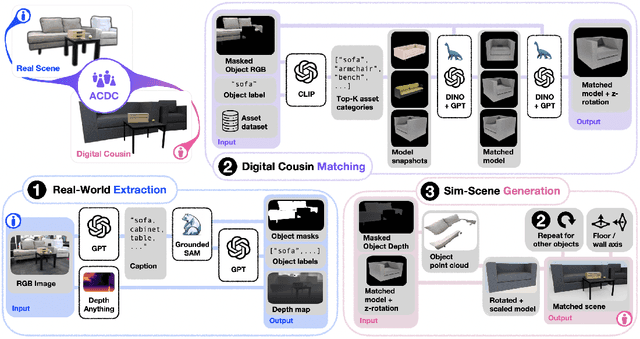

Training robot policies in the real world can be unsafe, costly, and difficult to scale. Simulation serves as an inexpensive and potentially limitless source of training data, but suffers from the semantics and physics disparity beween simulated and real-world environments. These discrepancies can be minimized by training in digital twins,which serve as virtual replicas of a real scene but are expensive to generate and cannot produce cross-domain generalization. To address these limitations, we propose the concept of digital cousins, a virtual asset or scene that, unlike a digital twin,does not explicitly model a real-world counterpart but still exhibits similar geometric and semantic affordances. As a result, digital cousins simultaneously reduce the cost of generating an analogous virtual environment while also facilitating better robustness during sim-to-real domain transfer by providing a distribution of similar training scenes. Leveraging digital cousins, we introduce a novel method for the Automatic Creation of Digital Cousins (ACDC), and propose a fully automated real-to-sim-to-real pipeline for generating fully interactive scenes and training robot policies that can be deployed zero-shot in the original scene. We find that ACDC can produce digital cousin scenes that preserve geometric and semantic affordances, and can be used to train policies that outperform policies trained on digital twins, achieving 90% vs. 25% under zero-shot sim-to-real transfer. Additional details are available at https://digital-cousins.github.io/.
TRANSIC: Sim-to-Real Policy Transfer by Learning from Online Correction
May 16, 2024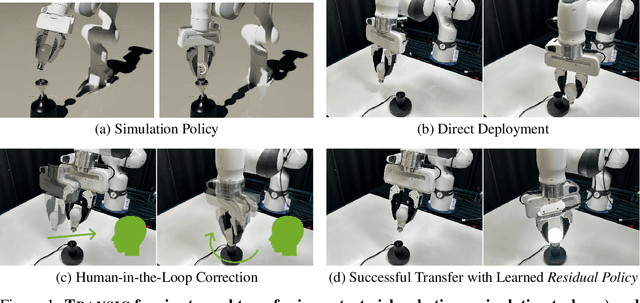

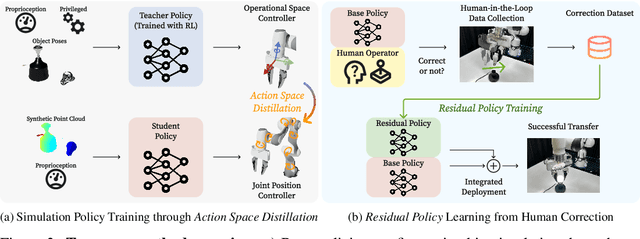
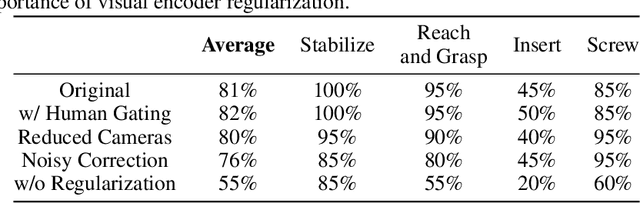
Learning in simulation and transferring the learned policy to the real world has the potential to enable generalist robots. The key challenge of this approach is to address simulation-to-reality (sim-to-real) gaps. Previous methods often require domain-specific knowledge a priori. We argue that a straightforward way to obtain such knowledge is by asking humans to observe and assist robot policy execution in the real world. The robots can then learn from humans to close various sim-to-real gaps. We propose TRANSIC, a data-driven approach to enable successful sim-to-real transfer based on a human-in-the-loop framework. TRANSIC allows humans to augment simulation policies to overcome various unmodeled sim-to-real gaps holistically through intervention and online correction. Residual policies can be learned from human corrections and integrated with simulation policies for autonomous execution. We show that our approach can achieve successful sim-to-real transfer in complex and contact-rich manipulation tasks such as furniture assembly. Through synergistic integration of policies learned in simulation and from humans, TRANSIC is effective as a holistic approach to addressing various, often coexisting sim-to-real gaps. It displays attractive properties such as scaling with human effort. Videos and code are available at https://transic-robot.github.io/
Cross-Episodic Curriculum for Transformer Agents
Oct 12, 2023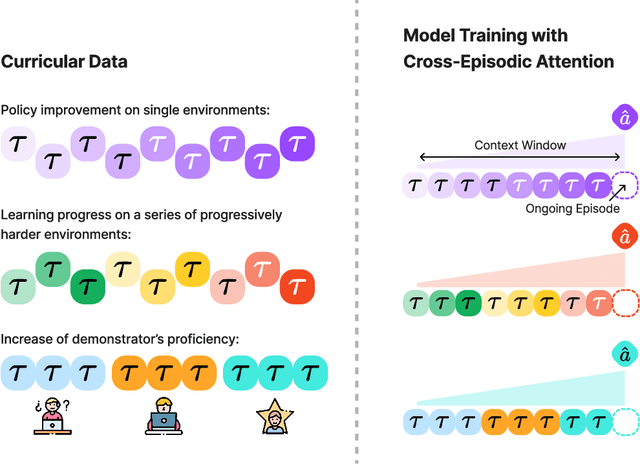

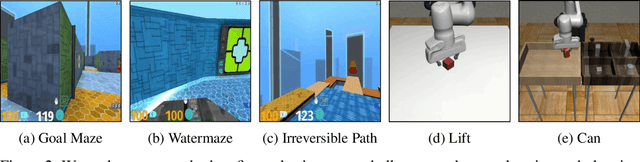

We present a new algorithm, Cross-Episodic Curriculum (CEC), to boost the learning efficiency and generalization of Transformer agents. Central to CEC is the placement of cross-episodic experiences into a Transformer's context, which forms the basis of a curriculum. By sequentially structuring online learning trials and mixed-quality demonstrations, CEC constructs curricula that encapsulate learning progression and proficiency increase across episodes. Such synergy combined with the potent pattern recognition capabilities of Transformer models delivers a powerful cross-episodic attention mechanism. The effectiveness of CEC is demonstrated under two representative scenarios: one involving multi-task reinforcement learning with discrete control, such as in DeepMind Lab, where the curriculum captures the learning progression in both individual and progressively complex settings; and the other involving imitation learning with mixed-quality data for continuous control, as seen in RoboMimic, where the curriculum captures the improvement in demonstrators' expertise. In all instances, policies resulting from CEC exhibit superior performance and strong generalization. Code is open-sourced at https://cec-agent.github.io/ to facilitate research on Transformer agent learning.
Voyager: An Open-Ended Embodied Agent with Large Language Models
May 25, 2023We introduce Voyager, the first LLM-powered embodied lifelong learning agent in Minecraft that continuously explores the world, acquires diverse skills, and makes novel discoveries without human intervention. Voyager consists of three key components: 1) an automatic curriculum that maximizes exploration, 2) an ever-growing skill library of executable code for storing and retrieving complex behaviors, and 3) a new iterative prompting mechanism that incorporates environment feedback, execution errors, and self-verification for program improvement. Voyager interacts with GPT-4 via blackbox queries, which bypasses the need for model parameter fine-tuning. The skills developed by Voyager are temporally extended, interpretable, and compositional, which compounds the agent's abilities rapidly and alleviates catastrophic forgetting. Empirically, Voyager shows strong in-context lifelong learning capability and exhibits exceptional proficiency in playing Minecraft. It obtains 3.3x more unique items, travels 2.3x longer distances, and unlocks key tech tree milestones up to 15.3x faster than prior SOTA. Voyager is able to utilize the learned skill library in a new Minecraft world to solve novel tasks from scratch, while other techniques struggle to generalize. We open-source our full codebase and prompts at https://voyager.minedojo.org/.