 Add to Chrome
 Add to Firefox
 Add to Edge
CoSA: Accelerating Long-Context Inference via Proxy-Kernel Co-Designed Sparse Attention
Jul 28, 2026
The quadratic cost of self-attention makes long-context inference prohibitively expensive, and proxy-based block-sparse attention has become a practical remedy. Existing methods typically rely on a proxy to predict a binary sparse mask and a kernel to consume this mask and perform sparse attention computation. Such an approach is effective under moderate budgets. However, as the budget tightens, the estimated proxy inevitably drops some salient blocks, while the kernel can only apply the sparse mask mechanically, leading to an evident drop in model accuracy. We propose CoSA, a two-stage training-free Sparse Attention under proxy-kernel CO-design, which couples a Kernel-Aware Proxy (KAP) with an Ordered-Skipping Kernel (OSK). In the first stage, the KAP selects blocks under a moderate budget and produces an ordered mask that prescribes the order in which KV pages are visited in the kernel inner loop. In the second stage, the OSK applies this mask and skips more blocks under a tightened budget given online-softmax statistics. Across mainstream LLM backbones and long-context benchmarks, CoSA attains higher accuracy at lower budgets. Impressively, CoSA achieves a 4.93$\times$ attention speedup and reduces end-to-end Time-to-First-Token by 2.53$\times$ under a context length of 128K with negligible performance degradation.

PIVOT: Efficient Query-Group Indexing for Token-Level Sparse Attention
Jul 27, 2026Token-level sparse attention, as implemented by DeepSeek Sparse Attention (DSA) in production systems, makes the downstream attention efficient but shifts the bottleneck to the indexer that feeds it. To select the top-k tokens for each query, the indexer must still score every preceding token, incurring a cost of O(L^2) per layer for a sequence of length L. We observe that this per-query scan is largely redundant: nearby queries select highly overlapping top-k tokens, and the indexer scores are long-tailed along the key axis. We exploit these properties in PIVOT, Proxy Indexing Via One full-prefix Traversal, a training-free, drop-in replacement for the DSA indexer that shares one prefix scan across a group of nearby queries. PIVOT aggregates a group into a single proxy query, performs one shared full-prefix scan to obtain a candidate set, and then selects a top-k for each query from that set. Two variants trade speed for fidelity: PIVOT-Reuse shares the proxy top-k across the group for maximum speed, whereas PIVOT-Refine re-scores the candidate set with the indexer of each query and then selects an individual top-k, matching the dense indexer at a small additional cost. A single algorithm covers both inference phases, differing only in how groups are formed: fixed-size groups of consecutive queries in prefill, and the queries decoded together in one multi-token prediction (MTP) step in decode. On DeepSeek-V3.2 and GLM-5.1 across LongBench and RULER, PIVOT matches the accuracy of the dense DSA indexer while accelerating it by up to 4x and reducing end-to-end latency by up to 1.6x at long context.
A Definition and Roadmap for World Models
Jul 07, 2026World models -- internal simulators that learn the structure and dynamics of an environment -- have become one of the most actively debated concepts in AI. From model-based reinforcement learning and video generation to embodied robotics and ultimately, physical AI, researchers across AI subfields are building systems that they call "world models", yet there is no consensus on what a world model fundamentally is, what it should predict, or how it should be built. This perspective article provides a scientific definition of world models, discussions of their key technical aspects, and a staged roadmap for developing effective world models.
Flash-VAED: Plug-and-Play VAE Decoders for Efficient Video Generation
Feb 22, 2026Latent diffusion models have enabled high-quality video synthesis, yet their inference remains costly and time-consuming. As diffusion transformers become increasingly efficient, the latency bottleneck inevitably shifts to VAE decoders. To reduce their latency while maintaining quality, we propose a universal acceleration framework for VAE decoders that preserves full alignment with the original latent distribution. Specifically, we propose (1) an independence-aware channel pruning method to effectively mitigate severe channel redundancy, and (2) a stage-wise dominant operator optimization strategy to address the high inference cost of the widely used causal 3D convolutions in VAE decoders. Based on these innovations, we construct a Flash-VAED family. Moreover, we design a three-phase dynamic distillation framework that efficiently transfers the capabilities of the original VAE decoder to Flash-VAED. Extensive experiments on Wan and LTX-Video VAE decoders demonstrate that our method outperforms baselines in both quality and speed, achieving approximately a 6$\times$ speedup while maintaining the reconstruction performance up to 96.9%. Notably, Flash-VAED accelerates the end-to-end generation pipeline by up to 36% with negligible quality drops on VBench-2.0.
Scalable and General Whole-Body Control for Cross-Humanoid Locomotion
Feb 05, 2026Learning-based whole-body controllers have become a key driver for humanoid robots, yet most existing approaches require robot-specific training. In this paper, we study the problem of cross-embodiment humanoid control and show that a single policy can robustly generalize across a wide range of humanoid robot designs with one-time training. We introduce XHugWBC, a novel cross-embodiment training framework that enables generalist humanoid control through: (1) physics-consistent morphological randomization, (2) semantically aligned observation and action spaces across diverse humanoid robots, and (3) effective policy architectures modeling morphological and dynamical properties. XHugWBC is not tied to any specific robot. Instead, it internalizes a broad distribution of morphological and dynamical characteristics during training. By learning motion priors from diverse randomized embodiments, the policy acquires a strong structural bias that supports zero-shot transfer to previously unseen robots. Experiments on twelve simulated humanoids and seven real-world robots demonstrate the strong generalization and robustness of the resulting universal controller.
Embodiment-Aware Generalist Specialist Distillation for Unified Humanoid Whole-Body Control
Feb 03, 2026Humanoid Whole-Body Controllers trained with reinforcement learning (RL) have recently achieved remarkable performance, yet many target a single robot embodiment. Variations in dynamics, degrees of freedom (DoFs), and kinematic topology still hinder a single policy from commanding diverse humanoids. Moreover, obtaining a generalist policy that not only transfers across embodiments but also supports richer behaviors-beyond simple walking to squatting, leaning-remains especially challenging. In this work, we tackle these obstacles by introducing EAGLE, an iterative generalist-specialist distillation framework that produces a single unified policy that controls multiple heterogeneous humanoids without per-robot reward tuning. During each cycle, embodiment-specific specialists are forked from the current generalist, refined on their respective robots, and new skills are distilled back into the generalist by training on the pooled embodiment set. Repeating this loop until performance convergence produces a robust Whole-Body Controller validated on robots such as Unitree H1, G1, and Fourier N1. We conducted experiments on five different robots in simulation and four in real-world settings. Through quantitative evaluations, EAGLE achieves high tracking accuracy and robustness compared to other methods, marking a step toward scalable, fleet-level humanoid control. See more details at https://eagle-wbc.github.io/
A Unified and General Humanoid Whole-Body Controller for Fine-Grained Locomotion
Feb 06, 2025Locomotion is a fundamental skill for humanoid robots. However, most existing works made locomotion a single, tedious, unextendable, and passive movement. This limits the kinematic capabilities of humanoid robots. In contrast, humans possess versatile athletic abilities-running, jumping, hopping, and finely adjusting walking parameters such as frequency, and foot height. In this paper, we investigate solutions to bring such versatility into humanoid locomotion and thereby propose HUGWBC: a unified and general humanoid whole-body controller for fine-grained locomotion. By designing a general command space in the aspect of tasks and behaviors, along with advanced techniques like symmetrical loss and intervention training for learning a whole-body humanoid controlling policy in simulation, HugWBC enables real-world humanoid robots to produce various natural gaits, including walking (running), jumping, standing, and hopping, with customizable parameters such as frequency, foot swing height, further combined with different body height, waist rotation, and body pitch, all in one single policy. Beyond locomotion, HUGWBC also supports real-time interventions from external upper-body controllers like teleoperation, enabling loco-manipulation while maintaining precise control under any locomotive behavior. Our experiments validate the high tracking accuracy and robustness of HUGWBC with/without upper-body intervention for all commands, and we further provide an in-depth analysis of how the various commands affect humanoid movement and offer insights into the relationships between these commands. To our knowledge, HugWBC is the first humanoid whole-body controller that supports such fine-grained locomotion behaviors with high robustness and flexibility.
Ask1: Development and Reinforcement Learning-Based Control of a Custom Quadruped Robot
Dec 11, 2024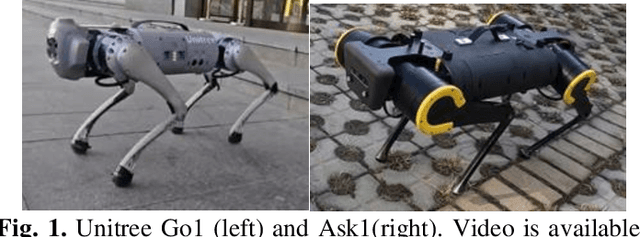
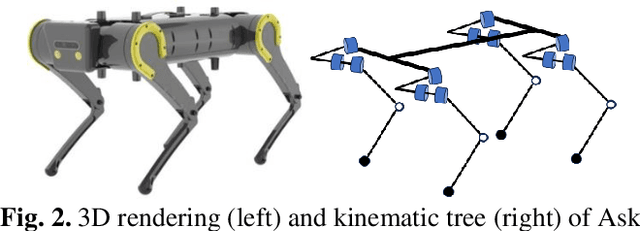
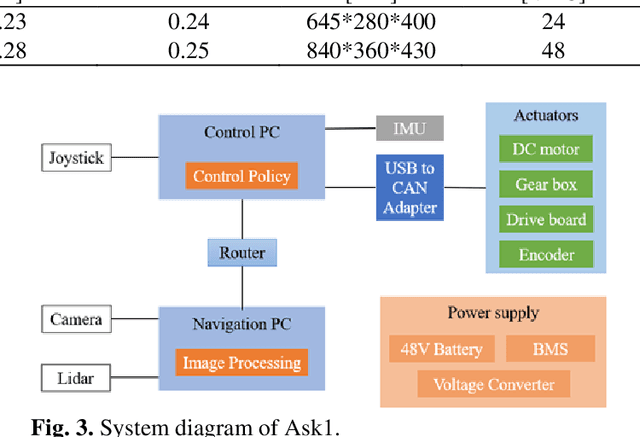
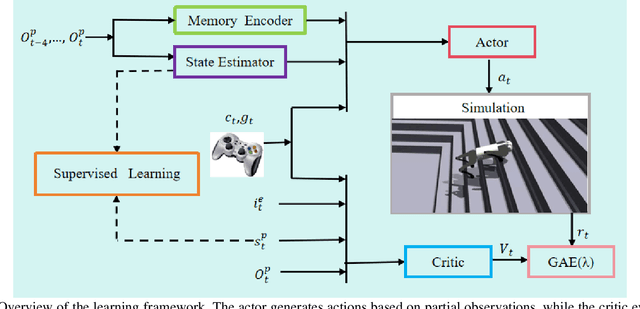
In this work, we present the design, development, and experimental validation of a custom-built quadruped robot, Ask1. The Ask1 robot shares similar morphology with the Unitree Go1, but features custom hardware components and a different control architecture. We transfer and extend previous reinforcement learning (RL)-based control methods to the Ask1 robot, demonstrating the applicability of our approach in real-world scenarios. By eliminating the need for Adversarial Motion Priors (AMP) and reference trajectories, we introduce a novel reward function to guide the robot's motion style. We demonstrate the generalization capability of the proposed RL algorithm by training it on both the Go1 and Ask1 robots. Simulation and real-world experiments validate the effectiveness of this method, showing that Ask1, like the Go1, is capable of navigating various rugged terrains.
Experience-Learning Inspired Two-Step Reward Method for Efficient Legged Locomotion Learning Towards Natural and Robust Gaits
Jan 22, 2024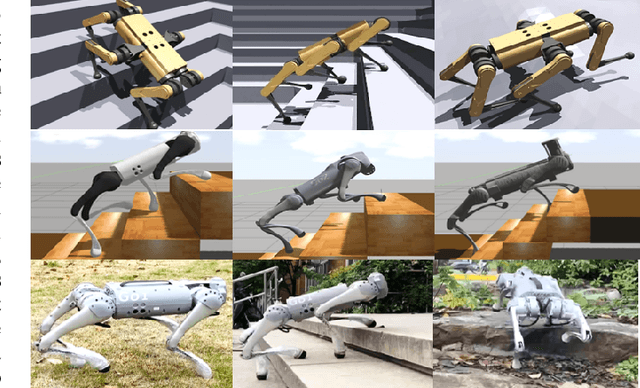
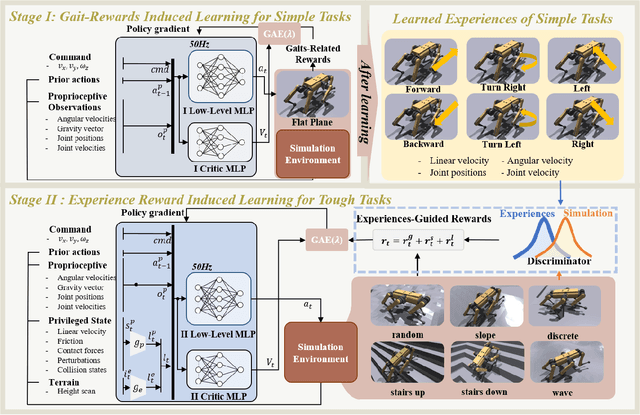
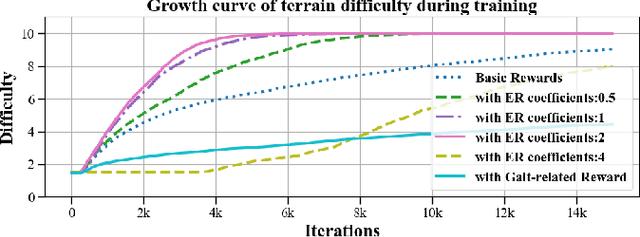
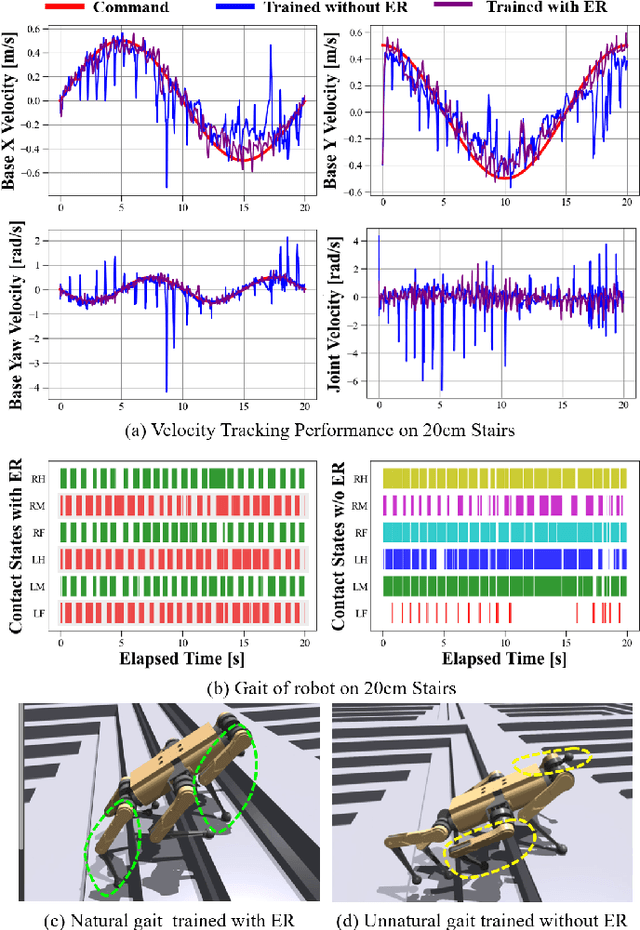
Multi-legged robots offer enhanced stability in complex terrains, yet autonomously learning natural and robust motions in such environments remains challenging. Drawing inspiration from animals' progressive learning patterns, from simple to complex tasks, we introduce a universal two-stage learning framework with two-step reward setting based on self-acquired experience, which efficiently enables legged robots to incrementally learn natural and robust movements. In the first stage, robots learn through gait-related rewards to track velocity on flat terrain, acquiring natural, robust movements and generating effective motion experience data. In the second stage, mirroring animal learning from existing experiences, robots learn to navigate challenging terrains with natural and robust movements using adversarial imitation learning. To demonstrate our method's efficacy, we trained both quadruped robots and a hexapod robot, and the policy were successfully transferred to a physical quadruped robot GO1, which exhibited natural gait patterns and remarkable robustness in various terrains.
Learning Multiple Gaits within Latent Space for Quadruped Robots
Aug 06, 2023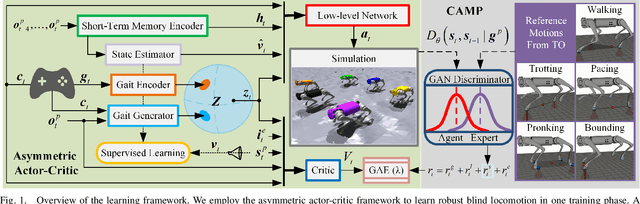


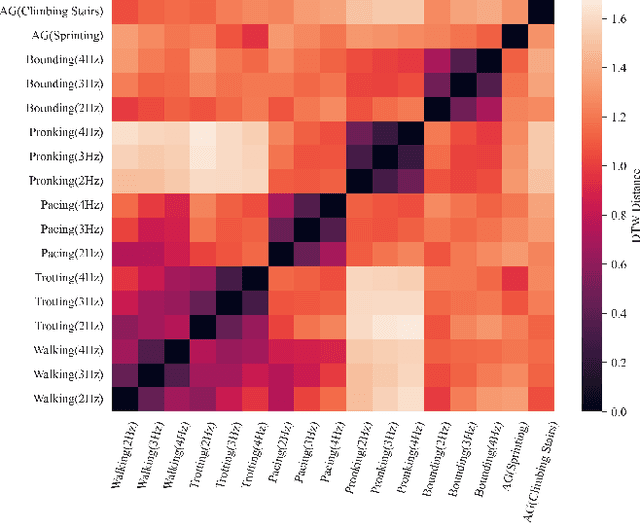
Learning multiple gaits is non-trivial for legged robots, especially when encountering different terrains and velocity commands. In this work, we present an end-to-end training framework for learning multiple gaits for quadruped robots, tailored to the needs of robust locomotion, agile locomotion, and user's commands. A latent space is constructed concurrently by a gait encoder and a gait generator, which helps the agent to reuse multiple gait skills to achieve adaptive gait behaviors. To learn natural behaviors for multiple gaits, we design gait-dependent rewards that are constructed explicitly from gait parameters and implicitly from conditional adversarial motion priors (CAMP). We demonstrate such multiple gaits control on a quadruped robot Go1 with only proprioceptive sensors.