 Add to Chrome
 Add to Firefox
 Add to Edge
FACT: Failure-Aware Causal Training for World-Action Models
Aug 10, 2026
Recent world-action models (WAMs) show that co-training policies with future prediction can provide physical priors for action generation. Building on the future-prediction ability of video models, many WAMs generate future videos and recover actions with inverse-dynamics models, or use these predicted videos as goal conditions for action generation. In both cases, the world model is trained mostly on successful demonstrations and has little reason to predict the consequences of bad actions. We introduce FACT, a causal World-Action Model that predicts future video and task progress conditioned on the executed action. This action-conditioned interface allows failure rollouts to supervise action consequences, turning bad actions into valid future targets rather than being discarded. Failure-aware training makes the progress predictor aware of both successful and failed action outcomes, which can optionally be used to score sampled action candidates at inference. Extensive experiments on simulation and real-world bimanual manipulation tasks show that FACT outperforms many existing baselines, improves as failure data are incorporated into training, and reduces success-biased future hallucination under bad actions. See more details at https://fact-wam.github.io/

ConTrack: Constrained Hand Motion Tracking with Adaptive Trade-off Control
Jun 02, 2026Human demonstrations provide strong priors for robot manipulation, yet it is non-trivial to transfer them to execute on real robots due to the kinematic gap. In dexterous manipulation, it remains challenging to track long-horizon, contact-rich sequences even in simulators: a reference-tracking policy must keep objects on their target trajectories while preserving demonstrated joint motion and contact timing. Existing approaches often rely on hand-crafted reward tuning that require per-sequence tuning and break under limited interaction budgets. We introduce ConTrack, a reinforcement learning (RL) framework that scales with tracking data. ConTrack treats object tracking as a constraint and allocates remaining control authority to motion fidelity, which allows it to adapt task--style trade-offs online using a dual-variable update. In addition, ConTrack also stabilizes long-horizon learning with an adaptive mid-trajectory reset library that reuses policy-reachable simulator states. Our qualitative and quantitative results in simulation tracking and real robot demonstrate that ConTrack improves success and object pose accuracy significantly over prior arts while preserving joint and contact fidelity. Website: https://www.lyt0112.com/projects/ConTrack.
Embodiment-Aware Generalist Specialist Distillation for Unified Humanoid Whole-Body Control
Feb 03, 2026Humanoid Whole-Body Controllers trained with reinforcement learning (RL) have recently achieved remarkable performance, yet many target a single robot embodiment. Variations in dynamics, degrees of freedom (DoFs), and kinematic topology still hinder a single policy from commanding diverse humanoids. Moreover, obtaining a generalist policy that not only transfers across embodiments but also supports richer behaviors-beyond simple walking to squatting, leaning-remains especially challenging. In this work, we tackle these obstacles by introducing EAGLE, an iterative generalist-specialist distillation framework that produces a single unified policy that controls multiple heterogeneous humanoids without per-robot reward tuning. During each cycle, embodiment-specific specialists are forked from the current generalist, refined on their respective robots, and new skills are distilled back into the generalist by training on the pooled embodiment set. Repeating this loop until performance convergence produces a robust Whole-Body Controller validated on robots such as Unitree H1, G1, and Fourier N1. We conducted experiments on five different robots in simulation and four in real-world settings. Through quantitative evaluations, EAGLE achieves high tracking accuracy and robustness compared to other methods, marking a step toward scalable, fleet-level humanoid control. See more details at https://eagle-wbc.github.io/
Human-Agent Joint Learning for Efficient Robot Manipulation Skill Acquisition
Jul 02, 2024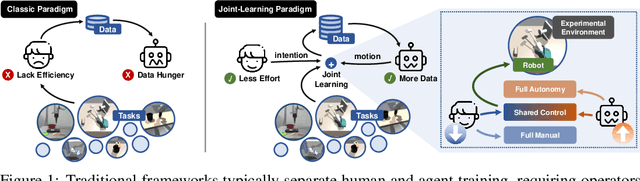
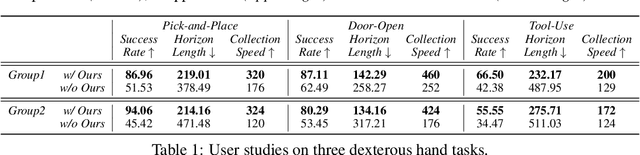
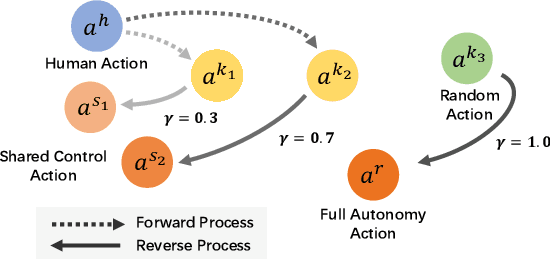
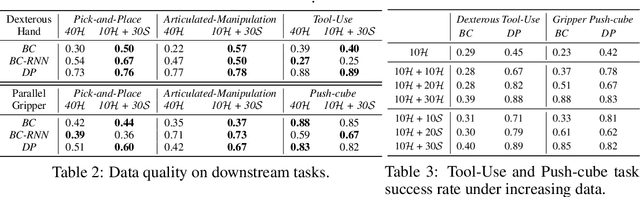
Employing a teleoperation system for gathering demonstrations offers the potential for more efficient learning of robot manipulation. However, teleoperating a robot arm equipped with a dexterous hand or gripper, via a teleoperation system poses significant challenges due to its high dimensionality, complex motions, and differences in physiological structure. In this study, we introduce a novel system for joint learning between human operators and robots, that enables human operators to share control of a robot end-effector with a learned assistive agent, facilitating simultaneous human demonstration collection and robot manipulation teaching. In this setup, as data accumulates, the assistive agent gradually learns. Consequently, less human effort and attention are required, enhancing the efficiency of the data collection process. It also allows the human operator to adjust the control ratio to achieve a trade-off between manual and automated control. We conducted experiments in both simulated environments and physical real-world settings. Through user studies and quantitative evaluations, it is evident that the proposed system could enhance data collection efficiency and reduce the need for human adaptation while ensuring the collected data is of sufficient quality for downstream tasks. Videos are available at https://norweig1an.github.io/human-agent-joint-learning.github.io/.