 Add to Chrome
 Add to Firefox
 Add to Edge
Enabling Robust Cloth Manipulation via Inference-Time Simulator-in-the-Loop Refinement
Jun 23, 2026
Simulator-in-the-loop optimization offers a promising inference-time mechanism for robot manipulation. It uses a physical simulator as a backend rollout engine to evaluate candidate trajectories in parallel and refine nominal actions online, a paradigm proven effective in rigid-body manipulation where state and contact are relatively tractable. We bring this paradigm to real-world cloth manipulation from a single RGB input through three pillars. (i) We design a scalable synthetic-data generation and inference-time rollout pipeline built on FLASH, a deformable-object simulator that provides a practical balance among physical fidelity, numerical stability, and rollout efficiency. (ii) We develop a real-to-sim module, trained purely on synthetic data, that maps a single RGB observation to simulation-compatible cloth state by fusing pretrained visual features with learnable canonical tokens. (iii) We perform online planning by coupling a sparse-mesh rollout backend with prior-guided MPPI, anchored at an offline-distilled policy trajectory, preserving manipulation-relevant deformation and contact while enabling sufficient parallel rollout batches. Real-robot experiments show higher success rates and stronger robustness than baseline methods.

PPL: Point Cloud Supervised Proprioceptive Locomotion Reinforcement Learning for Legged Robots in Crawl Spaces
Aug 13, 2025The legged locomotion in spatially constrained structures (called crawl spaces) is challenging. In crawl spaces, current exteroceptive locomotion learning methods are limited by large noises and errors of the sensors in possible low visibility conditions, and current proprioceptive locomotion learning methods are difficult in traversing crawl spaces because only ground features are inferred. In this study, a point cloud supervised proprioceptive locomotion reinforcement learning method for legged robots in crawl spaces is proposed. A state estimation network is designed to estimate the robot's surrounding ground and spatial features as well as the robot's collision states using historical proprioceptive sensor data. The point cloud is represented in polar coordinate frame and a point cloud processing method is proposed to efficiently extract the ground and spatial features that are used to supervise the state estimation network learning. Comprehensive reward functions that guide the robot to traverse through crawl spaces after collisions are designed. Experiments demonstrate that, compared to existing methods, our method exhibits more agile locomotion in crawl spaces. This study enhances the ability of legged robots to traverse spatially constrained environments without requiring exteroceptive sensors.
Ask1: Development and Reinforcement Learning-Based Control of a Custom Quadruped Robot
Dec 11, 2024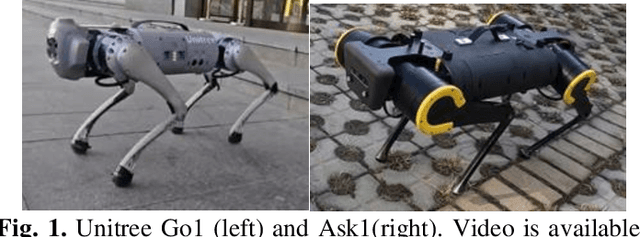
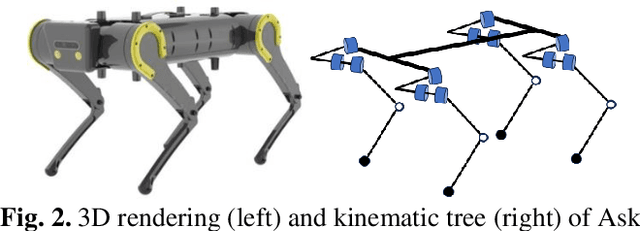
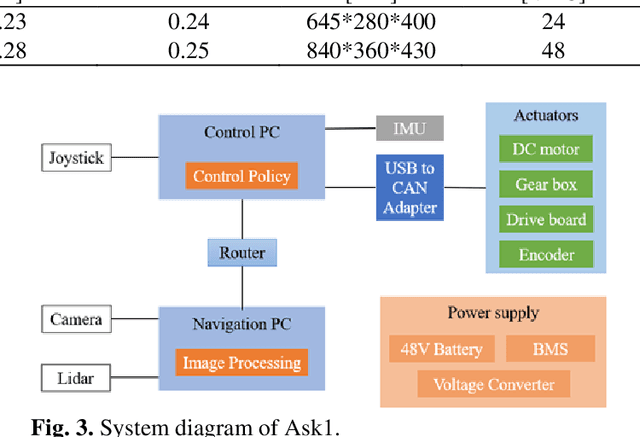
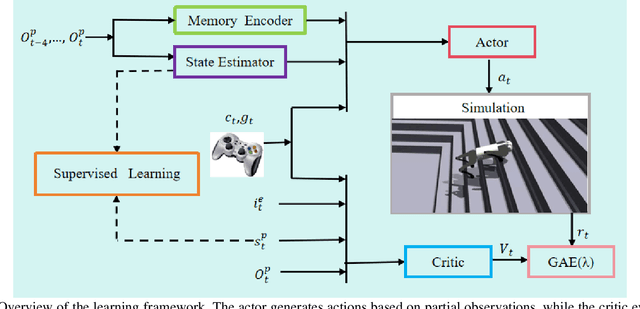
In this work, we present the design, development, and experimental validation of a custom-built quadruped robot, Ask1. The Ask1 robot shares similar morphology with the Unitree Go1, but features custom hardware components and a different control architecture. We transfer and extend previous reinforcement learning (RL)-based control methods to the Ask1 robot, demonstrating the applicability of our approach in real-world scenarios. By eliminating the need for Adversarial Motion Priors (AMP) and reference trajectories, we introduce a novel reward function to guide the robot's motion style. We demonstrate the generalization capability of the proposed RL algorithm by training it on both the Go1 and Ask1 robots. Simulation and real-world experiments validate the effectiveness of this method, showing that Ask1, like the Go1, is capable of navigating various rugged terrains.
Learning Multiple Gaits within Latent Space for Quadruped Robots
Aug 06, 2023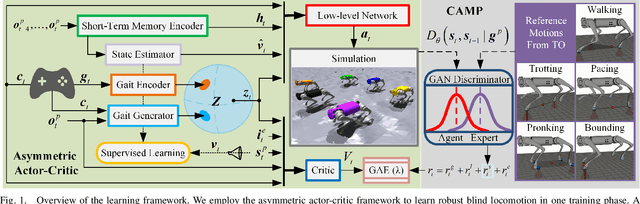


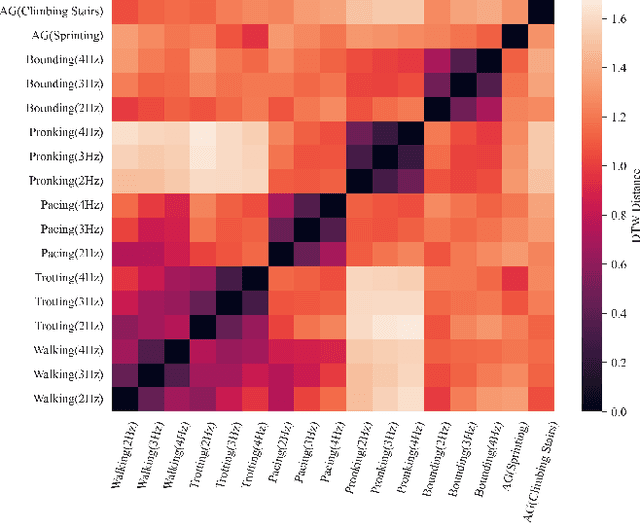
Learning multiple gaits is non-trivial for legged robots, especially when encountering different terrains and velocity commands. In this work, we present an end-to-end training framework for learning multiple gaits for quadruped robots, tailored to the needs of robust locomotion, agile locomotion, and user's commands. A latent space is constructed concurrently by a gait encoder and a gait generator, which helps the agent to reuse multiple gait skills to achieve adaptive gait behaviors. To learn natural behaviors for multiple gaits, we design gait-dependent rewards that are constructed explicitly from gait parameters and implicitly from conditional adversarial motion priors (CAMP). We demonstrate such multiple gaits control on a quadruped robot Go1 with only proprioceptive sensors.