 Add to Chrome
 Add to Firefox
 Add to Edge
ClinEnv: An Interactive Multi-Stage Long Horizon EHR Environment for Agents
Jun 01, 2026
Clinical practice is not the selection of an answer from enumerated options: a physician gathers heterogeneous information incrementally and commits to sequential, irreversible decisions under uncertainty. Static benchmarks cannot probe and existing interactive medical benchmarks each compromise on at least one of them. We present ClinEnv, an interactive benchmark that evaluates LLMs as attending physicians over real inpatient admissions under a paradigm we term Longitudinal Inpatient Simulation. Each case is automatically constructed into an ordered sequence of decision stages; at every stage the model must actively query four specialized agents before committing to medications, procedures, and diagnoses. ClinEnv scores both what the model decides, through deterministic ontology-grounded matching, and how it gathers information. Across seven models, the strongest reaches only 0.31 decision F1, and outcome quality is sharply decoupled from process quality. Difficulty concentrates in management decisions and later stages, where models recover discharge diagnoses far more reliably than management actions (0.51 vs. 0.17 F1) and continue to issue redundant queries as cases progress. ClinEnv makes this information-acquisition gap, invisible to outcome-only evaluation, directly measurable.

RADA: Region-Aware Dual-encoder Auxiliary learning for Barely-supervised Medical Image Segmentation
Apr 13, 2026Deep learning has greatly advanced medical image segmentation, but its success relies heavily on fully supervised learning, which requires dense annotations that are costly and time-consuming for 3D volumetric scans. Barely-supervised learning reduces annotation burden by using only a few labeled slices per volume. Existing methods typically propagate sparse annotations to unlabeled slices through geometric continuity to generate pseudo-labels, but this strategy lacks semantic understanding, often resulting in low-quality pseudo-labels. Furthermore, medical image segmentation is inherently a pixel-level visual understanding task, where accuracy fundamentally depends on the quality of local, fine-grained visual features. Inspired by this, we propose RADA, a novel Region-Aware Dual-encoder Auxiliary learning pipeline which introduces a dual-encoder framework pre-trained on Alpha-CLIP to extract fine-grained, region-specific visual features from the original images and limited annotations. The framework combines image-level fine-grained visual features with text-level semantic guidance, providing region-aware semantic supervision that bridges image-level semantics and pixel-level segmentation. Integrated into a triple-view training framework, RADA achieves SOTA performance under extremely sparse annotation settings on LA2018, KiTS19 and LiTS, demonstrating robust generalization across diverse datasets.
One Panel Does Not Fit All: Case-Adaptive Multi-Agent Deliberation for Clinical Prediction
Mar 31, 2026Large language models applied to clinical prediction exhibit case-level heterogeneity: simple cases yield consistent outputs, while complex cases produce divergent predictions under minor prompt changes. Existing single-agent strategies sample from one role-conditioned distribution, and multi-agent frameworks use fixed roles with flat majority voting, discarding the diagnostic signal in disagreement. We propose CAMP (Case-Adaptive Multi-agent Panel), where an attending-physician agent dynamically assembles a specialist panel tailored to each case's diagnostic uncertainty. Each specialist evaluates candidates via three-valued voting (KEEP/REFUSE/NEUTRAL), enabling principled abstention outside one's expertise. A hybrid router directs each diagnosis through strong consensus, fallback to the attending physician's judgment, or evidence-based arbitration that weighs argument quality over vote counts. On diagnostic prediction and brief hospital course generation from MIMIC-IV across four LLM backbones, CAMP consistently outperforms strong baselines while consuming fewer tokens than most competing multi-agent methods, with voting records and arbitration traces offering transparent decision audits.
Training the Knowledge Base through Evidence Distillation and Write-Back Enrichment
Mar 26, 2026The knowledge base in a retrieval-augmented generation (RAG) system is typically assembled once and never revised, even though the facts a query requires are often fragmented across documents and buried in irrelevant content. We argue that the knowledge base should be treated as a trainable component and propose WriteBack-RAG, a framework that uses labeled examples to identify where retrieval succeeds, isolate the relevant documents, and distill them into compact knowledge units that are indexed alongside the original corpus. Because the method modifies only the corpus, it can be applied once as an offline preprocessing step and combined with any RAG pipeline. Across four RAG methods, six benchmarks, and two LLM backbones, WriteBack-RAG improves every evaluated setting, with gains averaging +2.14%. Cross-method transfer experiments further show that the distilled knowledge benefits RAG pipelines other than the one used to produce it, confirming that the improvement resides in the corpus itself.
EvidenceRL: Reinforcing Evidence Consistency for Trustworthy Language Models
Mar 20, 2026Large Language Models (LLMs) are fluent but prone to hallucinations, producing answers that appear plausible yet are unsupported by available evidence. This failure is especially problematic in high-stakes domains where decisions must be justified by verifiable information. We introduce \textbf{EvidenceRL}, a reinforcement learning framework that enforces evidence adherence during training. EvidenceRL scores candidate responses for grounding (entailment with retrieved evidence and context) and correctness (agreement with reference answers) and optimizes the generator using Group Relative Policy Optimization (GRPO). We evaluate across two high-stakes domains, cardiac diagnosis and legal reasoning, where EvidenceRL consistently improves evidence grounding and faithfulness without sacrificing task accuracy. On cardiac diagnosis, F1@3 increases from 37.0 to 54.5 on Llama-3.2-3B while grounding ($G_{\max}@3$) rises from 47.6 to 78.2; hallucinations drop nearly 5$\times$ and evidence-supported diagnoses increase from 31.8\% to 61.6\%. On legal reasoning, EvidenceRL raises Faithfulness from 32.8\% to 67.6\% on Llama-3.1-8B, demonstrating consistent behavioral change across domains. Our code is open-sourced at https://github.com/Wizaaard/EvidenceRL.git.
DyTopo: Dynamic Topology Routing for Multi-Agent Reasoning via Semantic Matching
Feb 05, 2026Multi-agent systems built from prompted large language models can improve multi-round reasoning, yet most existing pipelines rely on fixed, trajectory-wide communication patterns that are poorly matched to the stage-dependent needs of iterative problem solving. We introduce DyTopo, a manager-guided multi-agent framework that reconstructs a sparse directed communication graph at each round. Conditioned on the manager's round goal, each agent outputs lightweight natural-language query (need) and \key (offer) descriptors; DyTopo embeds these descriptors and performs semantic matching, routing private messages only along the induced edges. Across code generation and mathematical reasoning benchmarks and four LLM backbones, DyTopo consistently outperforms over the strongest baseline (avg. +6.2). Beyond accuracy, DyTopo yields an interpretable coordination trace via the evolving graphs, enabling qualitative inspection of how communication pathways reconfigure across rounds.
LLM-as-RNN: A Recurrent Language Model for Memory Updates and Sequence Prediction
Jan 19, 2026Large language models are strong sequence predictors, yet standard inference relies on immutable context histories. After making an error at generation step t, the model lacks an updatable memory mechanism that improves predictions for step t+1. We propose LLM-as-RNN, an inference-only framework that turns a frozen LLM into a recurrent predictor by representing its hidden state as natural-language memory. This state, implemented as a structured system-prompt summary, is updated at each timestep via feedback-driven text rewrites, enabling learning without parameter updates. Under a fixed token budget, LLM-as-RNN corrects errors and retains task-relevant patterns, effectively performing online learning through language. We evaluate the method on three sequential benchmarks in healthcare, meteorology, and finance across Llama, Gemma, and GPT model families. LLM-as-RNN significantly outperforms zero-shot, full-history, and MemPrompt baselines, improving predictive accuracy by 6.5% on average, while producing interpretable, human-readable learning traces absent in standard context accumulation.
MEDVISTAGYM: A Scalable Training Environment for Thinking with Medical Images via Tool-Integrated Reinforcement Learning
Jan 12, 2026Vision language models (VLMs) achieve strong performance on general image understanding but struggle to think with medical images, especially when performing multi-step reasoning through iterative visual interaction. Medical VLMs often rely on static visual embeddings and single-pass inference, preventing models from re-examining, verifying, or refining visual evidence during reasoning. While tool-integrated reasoning offers a promising path forward, open-source VLMs lack the training infrastructure to learn effective tool selection, invocation, and coordination in multi-modal medical reasoning. We introduce MedVistaGym, a scalable and interactive training environment that incentivizes tool-integrated visual reasoning for medical image analysis. MedVistaGym equips VLMs to determine when and which tools to invoke, localize task-relevant image regions, and integrate single or multiple sub-image evidence into interleaved multimodal reasoning within a unified, executable interface for agentic training. Using MedVistaGym, we train MedVistaGym-R1 to interleave tool use with agentic reasoning through trajectory sampling and end-to-end reinforcement learning. Across six medical VQA benchmarks, MedVistaGym-R1-8B exceeds comparably sized tool-augmented baselines by 19.10% to 24.21%, demonstrating that structured agentic training--not tool access alone--unlocks effective tool-integrated reasoning for medical image analysis.
DoctorRAG: Medical RAG Fusing Knowledge with Patient Analogy through Textual Gradients
May 26, 2025Existing medical RAG systems mainly leverage knowledge from medical knowledge bases, neglecting the crucial role of experiential knowledge derived from similar patient cases -- a key component of human clinical reasoning. To bridge this gap, we propose DoctorRAG, a RAG framework that emulates doctor-like reasoning by integrating both explicit clinical knowledge and implicit case-based experience. DoctorRAG enhances retrieval precision by first allocating conceptual tags for queries and knowledge sources, together with a hybrid retrieval mechanism from both relevant knowledge and patient. In addition, a Med-TextGrad module using multi-agent textual gradients is integrated to ensure that the final output adheres to the retrieved knowledge and patient query. Comprehensive experiments on multilingual, multitask datasets demonstrate that DoctorRAG significantly outperforms strong baseline RAG models and gains improvements from iterative refinements. Our approach generates more accurate, relevant, and comprehensive responses, taking a step towards more doctor-like medical reasoning systems.
Comprehensive Manuscript Assessment with Text Summarization Using 69707 articles
Mar 26, 2025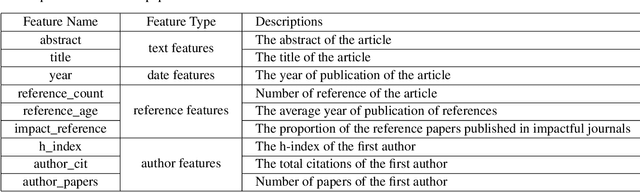
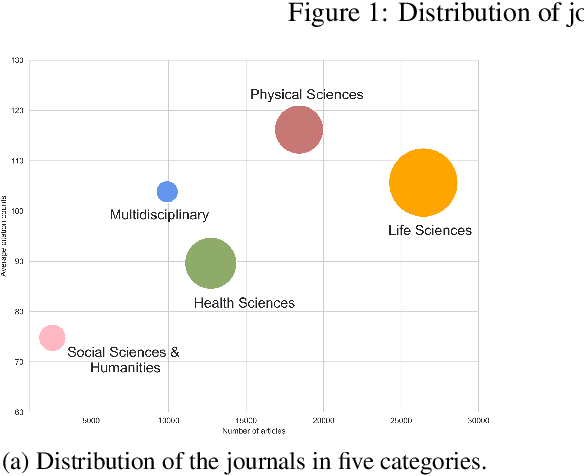

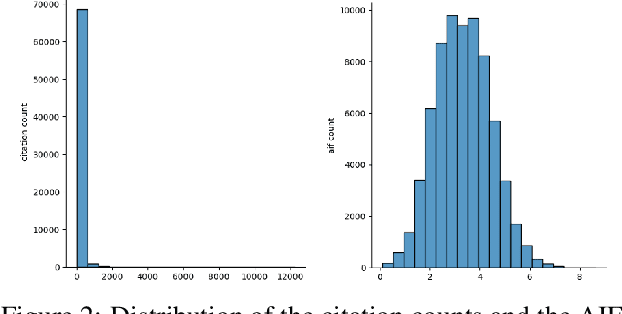
Rapid and efficient assessment of the future impact of research articles is a significant concern for both authors and reviewers. The most common standard for measuring the impact of academic papers is the number of citations. In recent years, numerous efforts have been undertaken to predict citation counts within various citation windows. However, most of these studies focus solely on a specific academic field or require early citation counts for prediction, rendering them impractical for the early-stage evaluation of papers. In this work, we harness Scopus to curate a significantly comprehensive and large-scale dataset of information from 69707 scientific articles sourced from 99 journals spanning multiple disciplines. We propose a deep learning methodology for the impact-based classification tasks, which leverages semantic features extracted from the manuscripts and paper metadata. To summarize the semantic features, such as titles and abstracts, we employ a Transformer-based language model to encode semantic features and design a text fusion layer to capture shared information between titles and abstracts. We specifically focus on the following impact-based prediction tasks using information of scientific manuscripts in pre-publication stage: (1) The impact of journals in which the manuscripts will be published. (2) The future impact of manuscripts themselves. Extensive experiments on our datasets demonstrate the superiority of our proposed model for impact-based prediction tasks. We also demonstrate potentials in generating manuscript's feedback and improvement suggestions.