 Add to Chrome
 Add to Firefox
 Add to Edge
Text2TimeSeries: Enhancing Financial Forecasting through Time Series Prediction Updates with Event-Driven Insights from Large Language Models
Jul 04, 2024
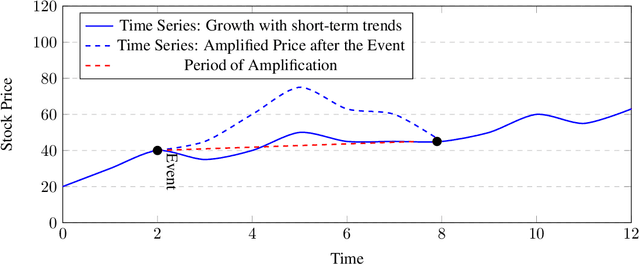

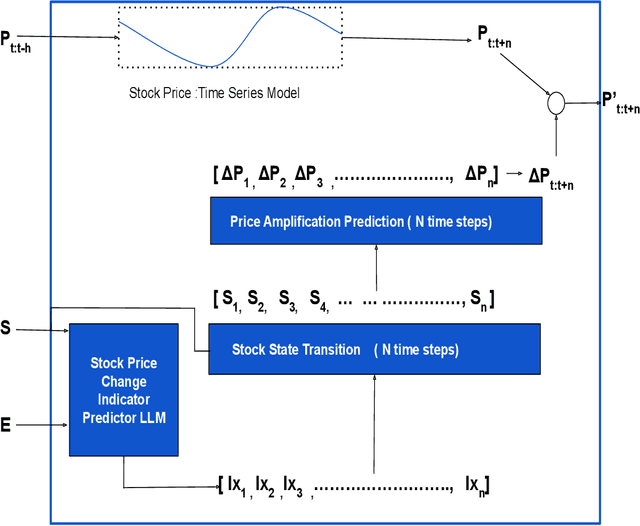

Time series models, typically trained on numerical data, are designed to forecast future values. These models often rely on weighted averaging techniques over time intervals. However, real-world time series data is seldom isolated and is frequently influenced by non-numeric factors. For instance, stock price fluctuations are impacted by daily random events in the broader world, with each event exerting a unique influence on price signals. Previously, forecasts in financial markets have been approached in two main ways: either as time-series problems over price sequence or sentiment analysis tasks. The sentiment analysis tasks aim to determine whether news events will have a positive or negative impact on stock prices, often categorizing them into discrete labels. Recognizing the need for a more comprehensive approach to accurately model time series prediction, we propose a collaborative modeling framework that incorporates textual information about relevant events for predictions. Specifically, we leverage the intuition of large language models about future changes to update real number time series predictions. We evaluated the effectiveness of our approach on financial market data.

The USTC-NERCSLIP Systems for The ICMC-ASR Challenge
Jul 02, 2024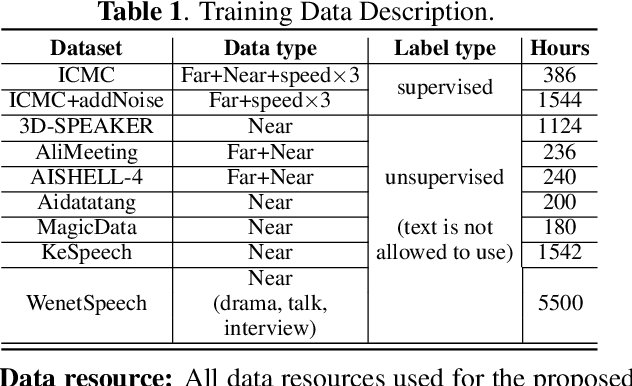
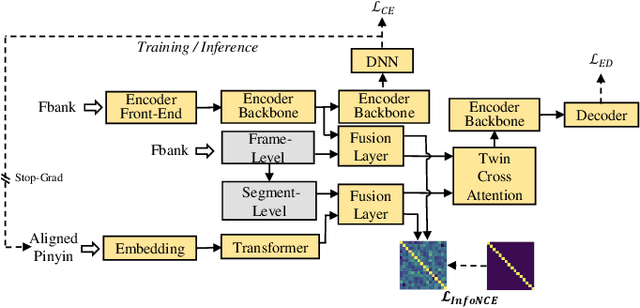
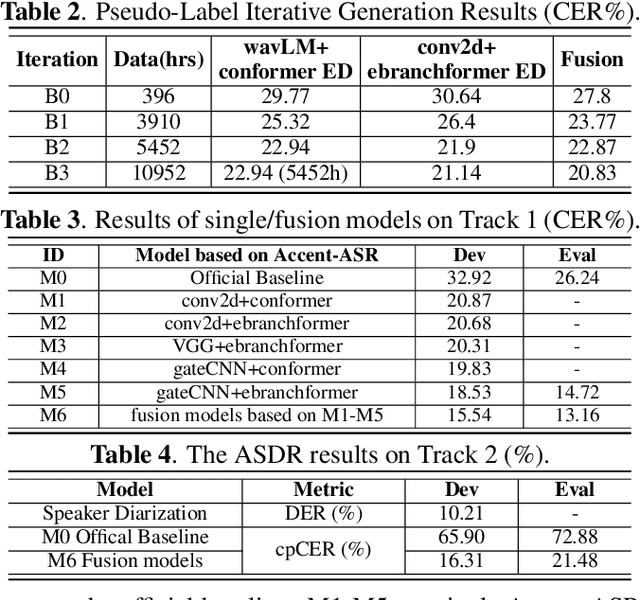
This report describes the submitted system to the In-Car Multi-Channel Automatic Speech Recognition (ICMC-ASR) challenge, which considers the ASR task with multi-speaker overlapping and Mandarin accent dynamics in the ICMC case. We implement the front-end speaker diarization using the self-supervised learning representation based multi-speaker embedding and beamforming using the speaker position, respectively. For ASR, we employ an iterative pseudo-label generation method based on fusion model to obtain text labels of unsupervised data. To mitigate the impact of accent, an Accent-ASR framework is proposed, which captures pronunciation-related accent features at a fine-grained level and linguistic information at a coarse-grained level. On the ICMC-ASR eval set, the proposed system achieves a CER of 13.16% on track 1 and a cpCER of 21.48% on track 2, which significantly outperforms the official baseline system and obtains the first rank on both tracks.
ConU: Conformal Uncertainty in Large Language Models with Correctness Coverage Guarantees
Jun 29, 2024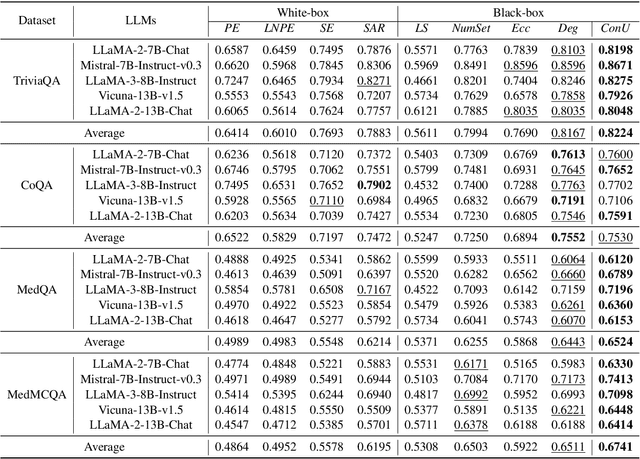
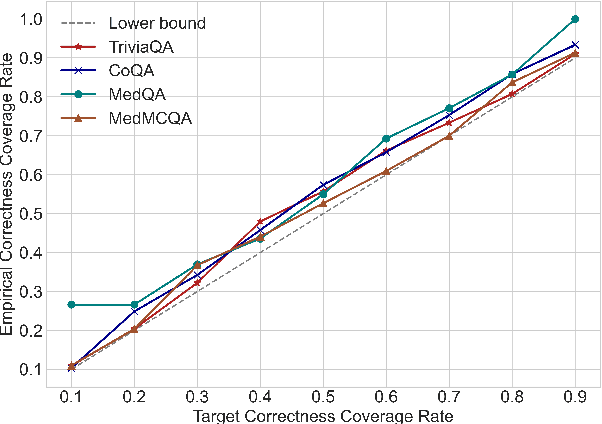
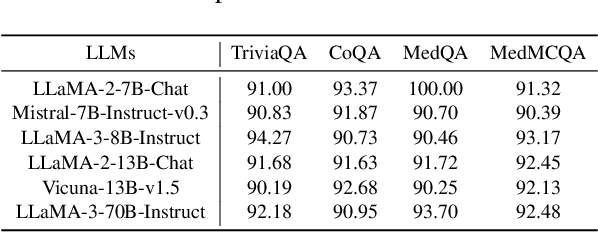
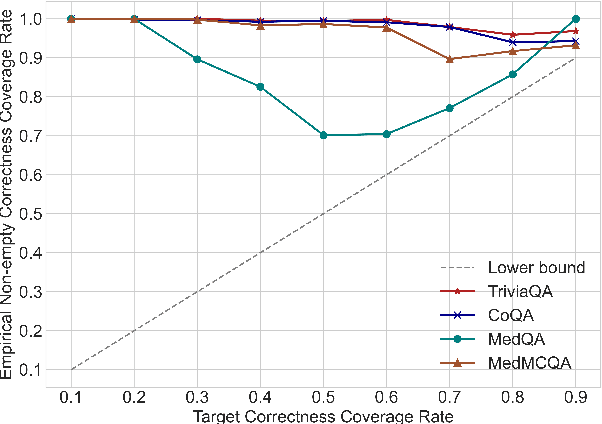
Uncertainty quantification (UQ) in natural language generation (NLG) tasks remains an open challenge, exacerbated by the intricate nature of the recent large language models (LLMs). This study investigates adapting conformal prediction (CP), which can convert any heuristic measure of uncertainty into rigorous theoretical guarantees by constructing prediction sets, for black-box LLMs in open-ended NLG tasks. We propose a sampling-based uncertainty measure leveraging self-consistency and develop a conformal uncertainty criterion by integrating the uncertainty condition aligned with correctness into the design of the CP algorithm. Experimental results indicate that our uncertainty measure generally surpasses prior state-of-the-art methods. Furthermore, we calibrate the prediction sets within the model's unfixed answer distribution and achieve strict control over the correctness coverage rate across 6 LLMs on 4 free-form NLG datasets, spanning general-purpose and medical domains, while the small average set size further highlights the efficiency of our method in providing trustworthy guarantees for practical open-ended NLG applications.
AutoSurvey: Large Language Models Can Automatically Write Surveys
Jun 18, 2024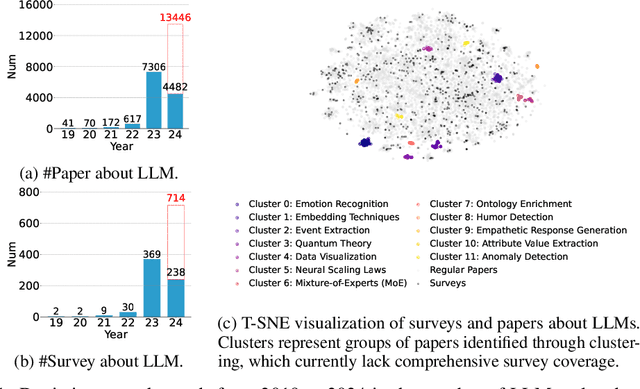
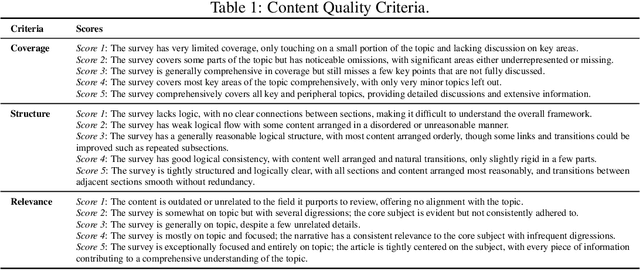
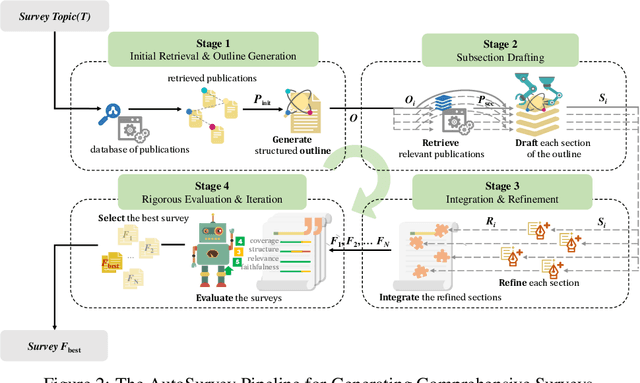
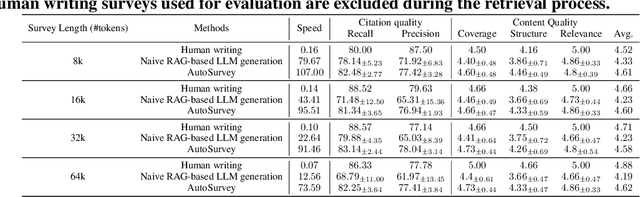
This paper introduces AutoSurvey, a speedy and well-organized methodology for automating the creation of comprehensive literature surveys in rapidly evolving fields like artificial intelligence. Traditional survey paper creation faces challenges due to the vast volume and complexity of information, prompting the need for efficient survey methods. While large language models (LLMs) offer promise in automating this process, challenges such as context window limitations, parametric knowledge constraints, and the lack of evaluation benchmarks remain. AutoSurvey addresses these challenges through a systematic approach that involves initial retrieval and outline generation, subsection drafting by specialized LLMs, integration and refinement, and rigorous evaluation and iteration. Our contributions include a comprehensive solution to the survey problem, a reliable evaluation method, and experimental validation demonstrating AutoSurvey's effectiveness.We open our resources at \url{https://github.com/AutoSurveys/AutoSurvey}.
Synergetic Event Understanding: A Collaborative Approach to Cross-Document Event Coreference Resolution with Large Language Models
Jun 04, 2024Cross-document event coreference resolution (CDECR) involves clustering event mentions across multiple documents that refer to the same real-world events. Existing approaches utilize fine-tuning of small language models (SLMs) like BERT to address the compatibility among the contexts of event mentions. However, due to the complexity and diversity of contexts, these models are prone to learning simple co-occurrences. Recently, large language models (LLMs) like ChatGPT have demonstrated impressive contextual understanding, yet they encounter challenges in adapting to specific information extraction (IE) tasks. In this paper, we propose a collaborative approach for CDECR, leveraging the capabilities of both a universally capable LLM and a task-specific SLM. The collaborative strategy begins with the LLM accurately and comprehensively summarizing events through prompting. Then, the SLM refines its learning of event representations based on these insights during fine-tuning. Experimental results demonstrate that our approach surpasses the performance of both the large and small language models individually, forming a complementary advantage. Across various datasets, our approach achieves state-of-the-art performance, underscoring its effectiveness in diverse scenarios.
Break the Chain: Large Language Models Can be Shortcut Reasoners
Jun 04, 2024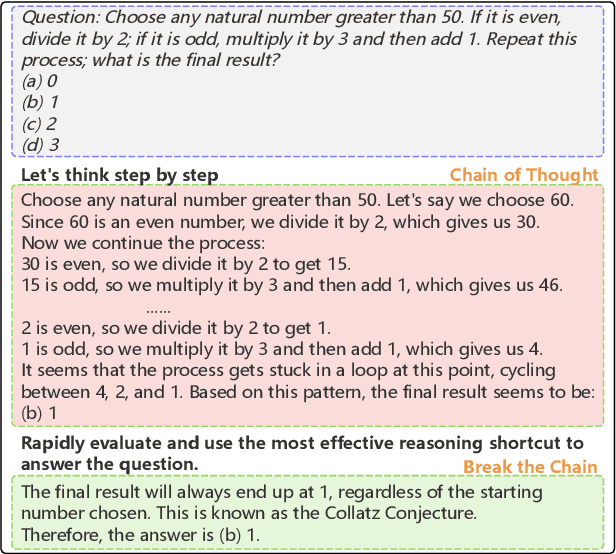

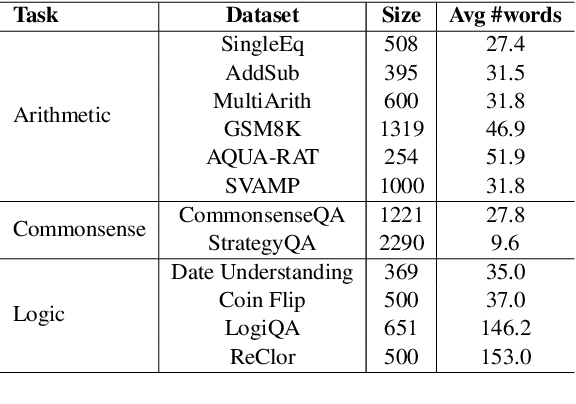
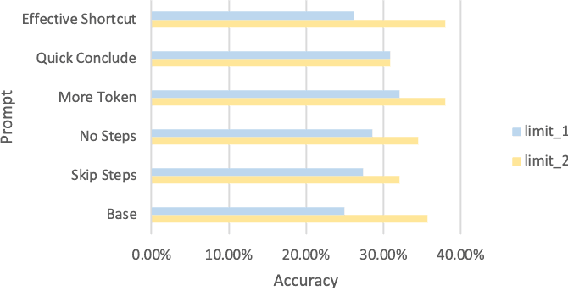
Recent advancements in Chain-of-Thought (CoT) reasoning utilize complex modules but are hampered by high token consumption, limited applicability, and challenges in reproducibility. This paper conducts a critical evaluation of CoT prompting, extending beyond arithmetic to include complex logical and commonsense reasoning tasks, areas where standard CoT methods fall short. We propose the integration of human-like heuristics and shortcuts into language models (LMs) through "break the chain" strategies. These strategies disrupt traditional CoT processes using controlled variables to assess their efficacy. Additionally, we develop innovative zero-shot prompting strategies that encourage the use of shortcuts, enabling LMs to quickly exploit reasoning clues and bypass detailed procedural steps. Our comprehensive experiments across various LMs, both commercial and open-source, reveal that LMs maintain effective performance with "break the chain" strategies. We also introduce ShortcutQA, a dataset specifically designed to evaluate reasoning through shortcuts, compiled from competitive tests optimized for heuristic reasoning tasks such as forward/backward reasoning and simplification. Our analysis confirms that ShortcutQA not only poses a robust challenge to LMs but also serves as an essential benchmark for enhancing reasoning efficiency in AI.
LexMatcher: Dictionary-centric Data Collection for LLM-based Machine Translation
Jun 03, 2024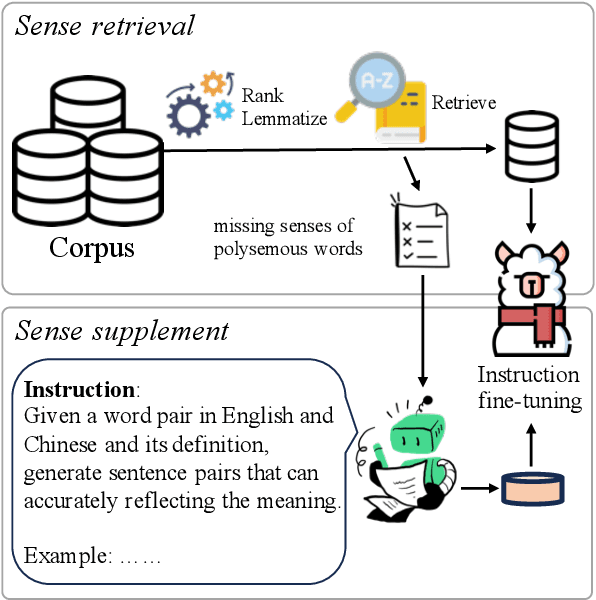
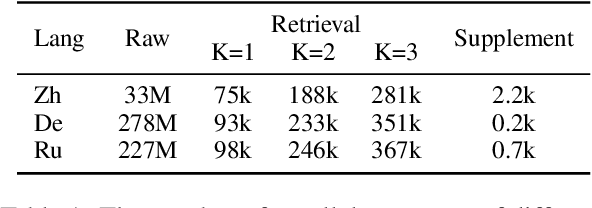

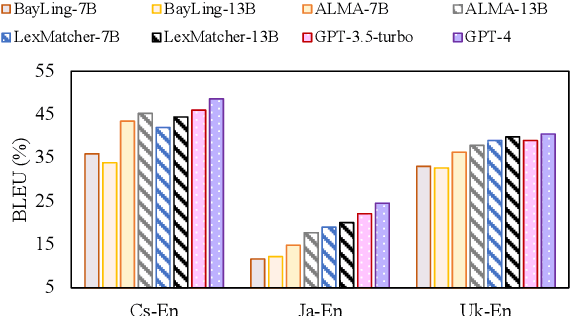
The fine-tuning of open-source large language models (LLMs) for machine translation has recently received considerable attention, marking a shift towards data-centric research from traditional neural machine translation. However, the area of data collection for instruction fine-tuning in machine translation remains relatively underexplored. In this paper, we present LexMatcher, a simple yet effective method for data collection that leverages bilingual dictionaries to generate a dataset, the design of which is driven by the coverage of senses found in these dictionaries. The dataset comprises a subset retrieved from an existing corpus and a smaller synthesized subset which supplements the infrequent senses of polysemous words. Utilizing LLaMA2 as our base model, our approach outperforms the established baselines on the WMT2022 test sets and also exhibits significant performance improvements in tasks related to word sense disambiguation and specialized terminology translation. These results underscore the effectiveness of LexMatcher in enhancing LLM-based machine translation.
Prompt-Aware Adapter: Towards Learning Adaptive Visual Tokens for Multimodal Large Language Models
May 24, 2024To bridge the gap between vision and language modalities, Multimodal Large Language Models (MLLMs) usually learn an adapter that converts visual inputs to understandable tokens for Large Language Models (LLMs). However, most adapters generate consistent visual tokens, regardless of the specific objects of interest mentioned in the prompt. Since these adapters distribute equal attention to every detail in the image and focus on the entire scene, they may increase the cognitive load for LLMs, particularly when processing complex scenes. To alleviate this problem, we propose prompt-aware adapters. These adapters are designed with the capability to dynamically embed visual inputs based on the specific focus of the prompt. Specifically, prompt-aware adapters utilize both global and local textual features to capture the most relevant visual clues from the prompt at both coarse and fine granularity levels. This approach significantly enhances the ability of LLMs to understand and interpret visual content. Experiments on various visual question answering tasks, such as counting and position reasoning, demonstrate the effectiveness of prompt-aware adapters.
RefChecker: Reference-based Fine-grained Hallucination Checker and Benchmark for Large Language Models
May 23, 2024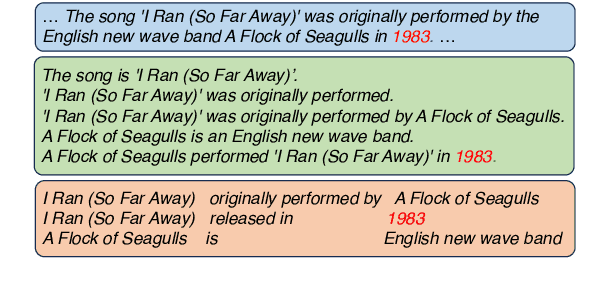


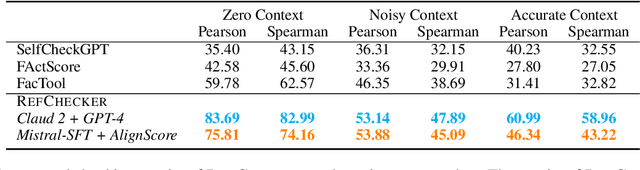
Large Language Models (LLMs) have shown impressive capabilities but also a concerning tendency to hallucinate. This paper presents RefChecker, a framework that introduces claim-triplets to represent claims in LLM responses, aiming to detect fine-grained hallucinations. In RefChecker, an extractor generates claim-triplets from a response, which are then evaluated by a checker against a reference. We delineate three task settings: Zero, Noisy and Accurate Context, to reflect various real-world use cases. We curated a benchmark spanning various NLP tasks and annotated 11k claim-triplets from 2.1k responses by seven LLMs. RefChecker supports both proprietary and open-source models as the extractor and checker. Experiments demonstrate that claim-triplets enable superior hallucination detection, compared to other granularities such as response, sentence and sub-sentence level claims. RefChecker outperforms prior methods by 6.8 to 26.1 points on our benchmark and the checking results of RefChecker are strongly aligned with human judgments. This work is open sourced at https://github.com/amazon-science/RefChecker
Image-of-Thought Prompting for Visual Reasoning Refinement in Multimodal Large Language Models
May 22, 2024


Recent advancements in Chain-of-Thought (CoT) and related rationale-based works have significantly improved the performance of Large Language Models (LLMs) in complex reasoning tasks. With the evolution of Multimodal Large Language Models (MLLMs), enhancing their capability to tackle complex multimodal reasoning problems is a crucial frontier. However, incorporating multimodal rationales in CoT has yet to be thoroughly investigated. We propose the Image-of-Thought (IoT) prompting method, which helps MLLMs to extract visual rationales step-by-step. Specifically, IoT prompting can automatically design critical visual information extraction operations based on the input images and questions. Each step of visual information refinement identifies specific visual rationales that support answers to complex visual reasoning questions. Beyond the textual CoT, IoT simultaneously utilizes visual and textual rationales to help MLLMs understand complex multimodal information. IoT prompting has improved zero-shot visual reasoning performance across various visual understanding tasks in different MLLMs. Moreover, the step-by-step visual feature explanations generated by IoT prompting elucidate the visual reasoning process, aiding in analyzing the cognitive processes of large multimodal models