 Add to Chrome
 Add to Firefox
 Add to Edge
Can Retrievers Find the Same Paper from Different Aspects? A Multi-Aspect Full-Paper Scientific Retrieval Benchmark
Aug 16, 2026
Scientific papers contain multiple searchable facets such as background, methods. However, many paper retrieval benchmarks merely evaluate individual query-paper relevance, while overlooking other facets of the same paper. To bridge this gap, we introduce MAPLE, an expert-validated benchmark for multi-aspect, full-paper retrieval that evaluates whether retrievers can consistently recover the same paper from queries targeting its motivation, method, and experimental findings. MAPLE contains 2,095 queries about recent ML and NLP papers, grounded in both textual and multimodal content. We further propose MAPLE-Synth, a retrieval-based in-context learning pipeline that leverages OpenReview discussions and human-written query exemplars to generate realistic queries reflecting researchers' interests in different aspects of a paper. Our expert validation shows that these queries are comparable in realism to human-written queries and highly relevant to the target papers. Experiments across lexical, scientific-domain, general-purpose text, and multimodal retrievers reveal a substantial gap between retrieving a paper from any one aspect and retrieving it from all aspects: the strongest model achieves 98.1% AnyAspect@20 but only 15.7% AllAspect@20. Experiment/result queries and table-referenced queries are particularly difficult across retrievers. Although multi-chunk aggregation improves multi-aspect paper retrieval, considerable failures persist. MAPLE provides a testbed for evaluating and developing retrievers that represent scientific papers more comprehensively.

Logical Reasoning in Large Language Models: A Survey
Feb 13, 2025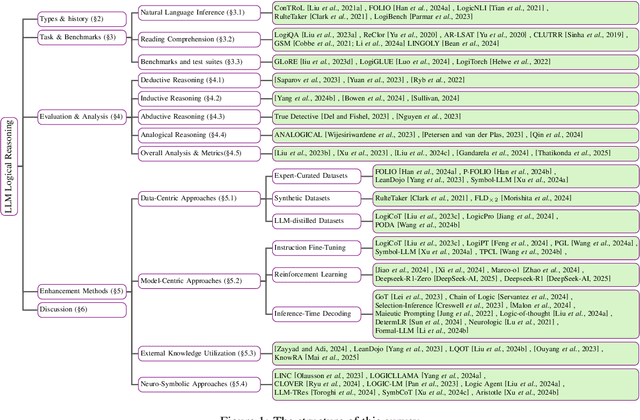
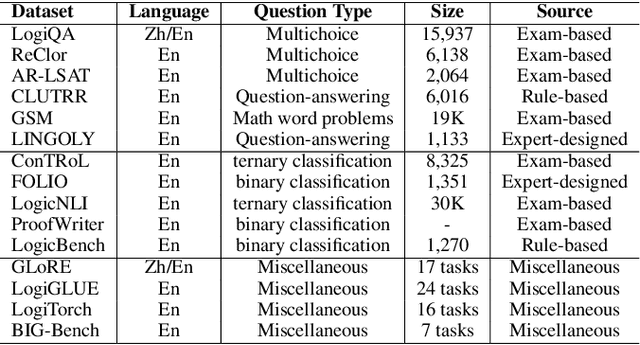
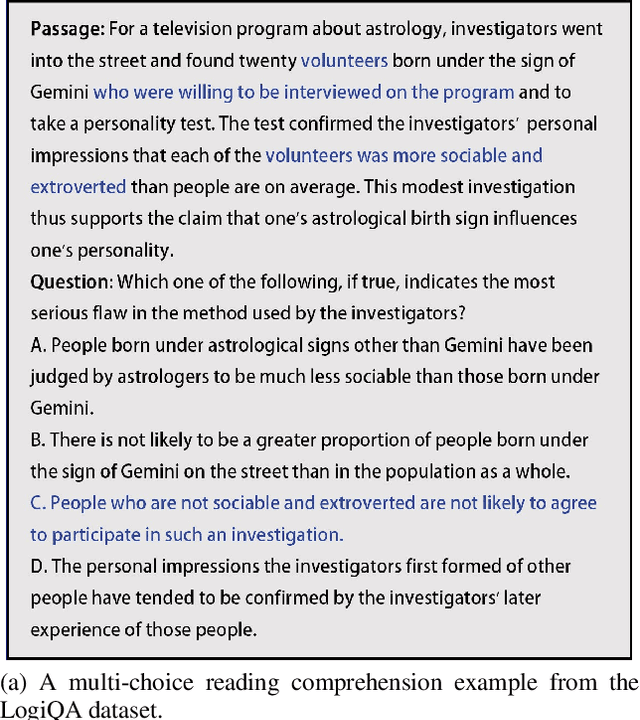
With the emergence of advanced reasoning models like OpenAI o3 and DeepSeek-R1, large language models (LLMs) have demonstrated remarkable reasoning capabilities. However, their ability to perform rigorous logical reasoning remains an open question. This survey synthesizes recent advancements in logical reasoning within LLMs, a critical area of AI research. It outlines the scope of logical reasoning in LLMs, its theoretical foundations, and the benchmarks used to evaluate reasoning proficiency. We analyze existing capabilities across different reasoning paradigms - deductive, inductive, abductive, and analogical - and assess strategies to enhance reasoning performance, including data-centric tuning, reinforcement learning, decoding strategies, and neuro-symbolic approaches. The review concludes with future directions, emphasizing the need for further exploration to strengthen logical reasoning in AI systems.
Break the Chain: Large Language Models Can be Shortcut Reasoners
Jun 04, 2024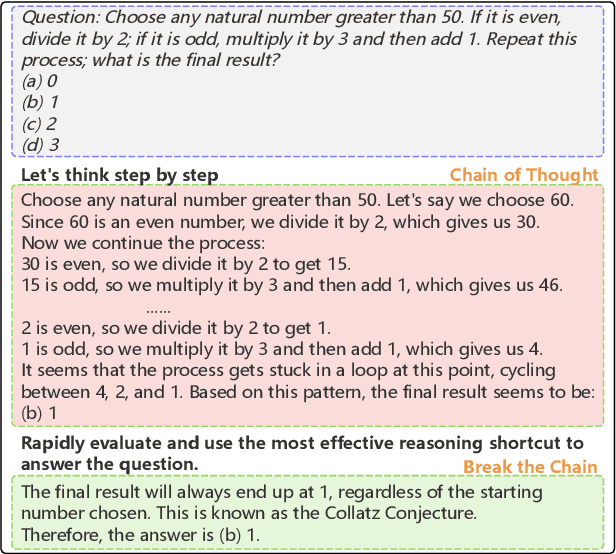

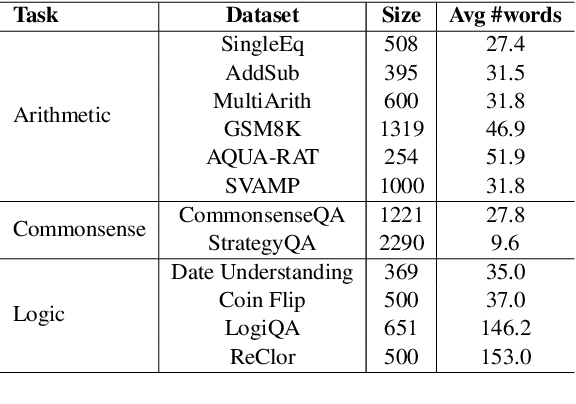
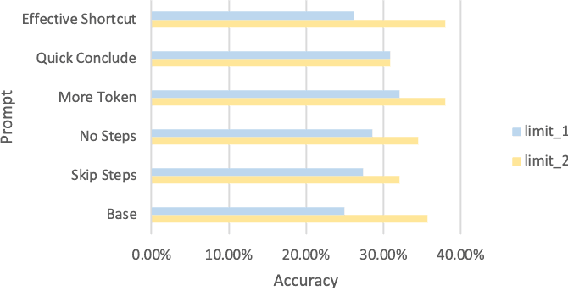
Recent advancements in Chain-of-Thought (CoT) reasoning utilize complex modules but are hampered by high token consumption, limited applicability, and challenges in reproducibility. This paper conducts a critical evaluation of CoT prompting, extending beyond arithmetic to include complex logical and commonsense reasoning tasks, areas where standard CoT methods fall short. We propose the integration of human-like heuristics and shortcuts into language models (LMs) through "break the chain" strategies. These strategies disrupt traditional CoT processes using controlled variables to assess their efficacy. Additionally, we develop innovative zero-shot prompting strategies that encourage the use of shortcuts, enabling LMs to quickly exploit reasoning clues and bypass detailed procedural steps. Our comprehensive experiments across various LMs, both commercial and open-source, reveal that LMs maintain effective performance with "break the chain" strategies. We also introduce ShortcutQA, a dataset specifically designed to evaluate reasoning through shortcuts, compiled from competitive tests optimized for heuristic reasoning tasks such as forward/backward reasoning and simplification. Our analysis confirms that ShortcutQA not only poses a robust challenge to LMs but also serves as an essential benchmark for enhancing reasoning efficiency in AI.