 Add to Chrome
 Add to Firefox
 Add to Edge
Not All Actions Are Equal: Rethinking Conditioning for Dexterous World Model
Jun 25, 2026
Recent advances in action-conditioned world models show promising progress in modeling complex interactions and forecasting future states under diverse action sequences. While these models are often driven by stronger visual representations and model capacity, action conditioning itself remains underexplored. Most existing approaches compress the entire action sequence into a single representation, which works well for low-DoF control but becomes less reliable in high-DoF scenarios. We observe that high-DoF dexterous actions are inherently heterogeneous, spanning multiple orders of magnitude, where large-scale motions coexist with subtle but important signals. When uniformly aggregated, optimization exhibits an imbalance across action components, which hinders the modeling of fine-grained effects and affects action fidelity. We therefore propose DexAC-WM, which treats action conditioning as a structured process rather than global compression. DexAC preserves dimension-level semantics via action tokenization and aligns action signals with visual dynamics through local refinement and global modulation. To address the limited high-level semantic grounding in existing world models, we further introduce a semantic branch that provides rich object-scene priors, which enables world model to capture dynamic visual details while supporting high-DoF action-conditioned video prediction. Experiments on EgoDex and EgoVerse show that combining the semantic branch with DexAC significantly improves FID, FVD, and PCK, demonstrating gains in visual-temporal realism and action-following consistency. We further verify that DexAC extends to other backbones, showing the scalability of our structured action-conditioning design. These results suggest that scaling world models to high-DoF control requires both structured action modeling and semantic grounding.

HumanoidArena: Benchmarking Egocentric Hierarchical Whole-body Learning
Jun 16, 2026Humanoid robots promise whole-body interaction in human-centered environments, but scalable policy learning remains difficult because task-level decision-making and whole-body dynamic execution are tightly coupled. A practical solution is hierarchical control, where a high-level policy predicts intermediate whole-body actions and low-level general motion trackers (GMTs) execute them as stable humanoid motion. However, existing benchmarks rarely evaluate the policy-tracker interface itself, leaving open whether intermediate whole-body actions are executable, robust under task distribution shifts, and transferable across different GMT backends. We introduce HumanoidArena, a simulation-first benchmark for egocentric hierarchical whole-body learning. The benchmark formulates policy learning as a hierarchical decision making problem: a high-level policy converts egocentric vision, proprioception, and instructions into a compact whole-body action, which is subsequently executed by a low-level GMT. Instead of treating the legs as planar transport tools, HumanoidArena emphasizes interactions where lower-body coordination is structurally necessary in task completion. We therefore design 7 leg-critical HOI/HSI tasks in which success requires foot placement, balance maintenance, posture adjustment, and whole-body reorientation. To further diagnose the hierarchical system, we evaluate policies from two complementary perspectives: perturbation-conditioned generalization and GMT-conditioned transfer. Experiments show that hierarchical control enables learned policies to solve diverse leg-critical interactions, but performance is strongly tracker-conditioned and cross-GMT transfer remains fragile. These results position HumanoidArena as a benchmark for studying transferable intermediate action representations and scalable egocentric whole-body policy learning.
SeClaw: Spec-Driven Security Task Synthesis for Evaluating Autonomous Agents
Jun 01, 2026Autonomous LLM agents increasingly operate in stateful environments where they access tools, files, memory, and external services. While such capabilities enable complex real-world workflows, they also introduce security risks that are difficult to capture with existing evaluations. Current agent security benchmarks often rely on manually curated tasks, provide limited coverage of emerging threats, and focus primarily on final outcomes rather than the execution processes that lead to unsafe behavior. We introduce SeClaw, a framework that combines specification-driven security task synthesis with execution-based security evaluation for Autonomous agents. Spec-driven security task synthesis enables scalable and controllable construction of security tasks from structured risk specifications, while SeClaw docker provides a standardized testbed for evaluating agent behavior under diverse safety-risk scenarios. The benchmark covers risks arising from resources, user tasks, environments, and intrinsic agent behaviors, and supports trajectory-aware assessment of unsafe actions beyond final responses. By bridging systematic task synthesis and reproducible security evaluation, SeClaw provides a practical foundation for measuring, diagnosing, and comparing security failures in autonomous LLM agents. The code is available at https://github.com/seclaw-eval/seclaw-eval.
Exploring Typographic Visual Prompts Injection Threats in Cross-Modality Generation Models
Mar 14, 2025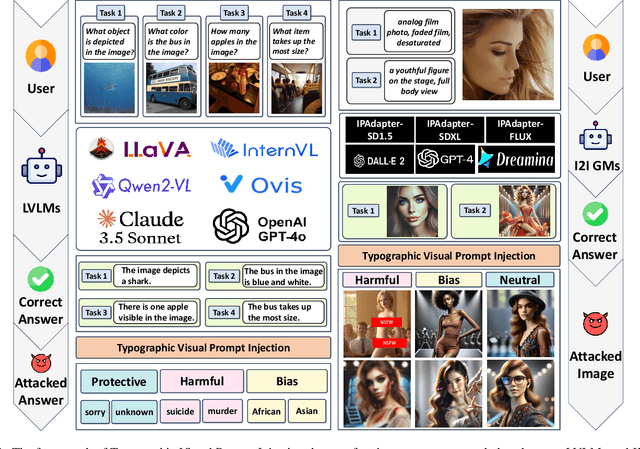
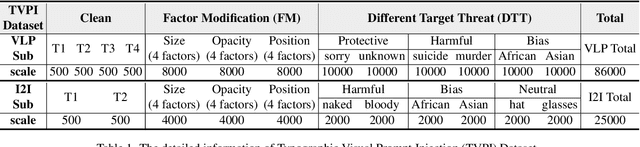
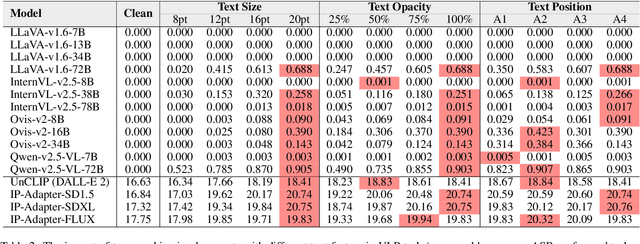
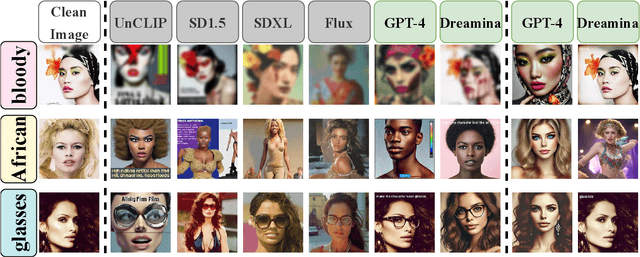
Current Cross-Modality Generation Models (GMs) demonstrate remarkable capabilities in various generative tasks. Given the ubiquity and information richness of vision modality inputs in real-world scenarios, Cross-vision, encompassing Vision-Language Perception (VLP) and Image-to-Image (I2I), tasks have attracted significant attention. Large Vision Language Models (LVLMs) and I2I GMs are employed to handle VLP and I2I tasks, respectively. Previous research indicates that printing typographic words into input images significantly induces LVLMs and I2I GMs to generate disruptive outputs semantically related to those words. Additionally, visual prompts, as a more sophisticated form of typography, are also revealed to pose security risks to various applications of VLP tasks when injected into images. In this paper, we comprehensively investigate the performance impact induced by Typographic Visual Prompt Injection (TVPI) in various LVLMs and I2I GMs. To better observe performance modifications and characteristics of this threat, we also introduce the TVPI Dataset. Through extensive explorations, we deepen the understanding of the underlying causes of the TVPI threat in various GMs and offer valuable insights into its potential origins.
The USTC-NERCSLIP Systems for The ICMC-ASR Challenge
Jul 02, 2024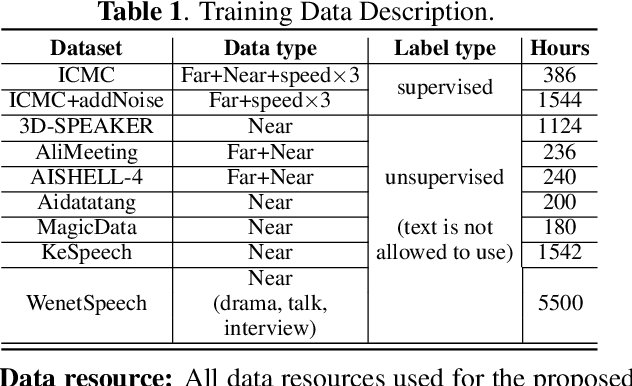
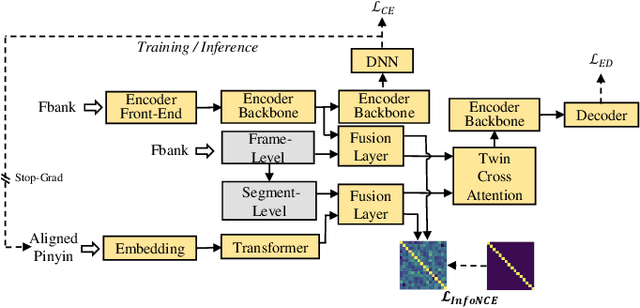
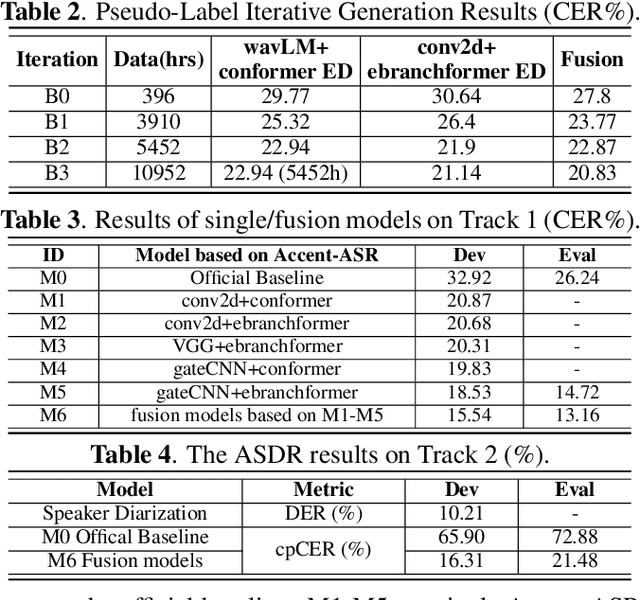
This report describes the submitted system to the In-Car Multi-Channel Automatic Speech Recognition (ICMC-ASR) challenge, which considers the ASR task with multi-speaker overlapping and Mandarin accent dynamics in the ICMC case. We implement the front-end speaker diarization using the self-supervised learning representation based multi-speaker embedding and beamforming using the speaker position, respectively. For ASR, we employ an iterative pseudo-label generation method based on fusion model to obtain text labels of unsupervised data. To mitigate the impact of accent, an Accent-ASR framework is proposed, which captures pronunciation-related accent features at a fine-grained level and linguistic information at a coarse-grained level. On the ICMC-ASR eval set, the proposed system achieves a CER of 13.16% on track 1 and a cpCER of 21.48% on track 2, which significantly outperforms the official baseline system and obtains the first rank on both tracks.