 Add to Chrome
 Add to Firefox
 Add to Edge
MiroThinker: Pushing the Performance Boundaries of Open-Source Research Agents via Model, Context, and Interactive Scaling
Nov 18, 2025
We present MiroThinker v1.0, an open-source research agent designed to advance tool-augmented reasoning and information-seeking capabilities. Unlike previous agents that only scale up model size or context length, MiroThinker explores interaction scaling at the model level, systematically training the model to handle deeper and more frequent agent-environment interactions as a third dimension of performance improvement. Unlike LLM test-time scaling, which operates in isolation and risks degradation with longer reasoning chains, interactive scaling leverages environment feedback and external information acquisition to correct errors and refine trajectories. Through reinforcement learning, the model achieves efficient interaction scaling: with a 256K context window, it can perform up to 600 tool calls per task, enabling sustained multi-turn reasoning and complex real-world research workflows. Across four representative benchmarks-GAIA, HLE, BrowseComp, and BrowseComp-ZH-the 72B variant achieves up to 81.9%, 37.7%, 47.1%, and 55.6% accuracy respectively, surpassing previous open-source agents and approaching commercial counterparts such as GPT-5-high. Our analysis reveals that MiroThinker benefits from interactive scaling consistently: research performance improves predictably as the model engages in deeper and more frequent agent-environment interactions, demonstrating that interaction depth exhibits scaling behaviors analogous to model size and context length. These findings establish interaction scaling as a third critical dimension for building next-generation open research agents, complementing model capacity and context windows.

Aggregating Conformal Prediction Sets via α-Allocation
Nov 15, 2025Conformal prediction offers a distribution-free framework for constructing prediction sets with finite-sample coverage. Yet, efficiently leveraging multiple conformity scores to reduce prediction set size remains a major open challenge. Instead of selecting a single best score, this work introduces a principled aggregation strategy, COnfidence-Level Allocation (COLA), that optimally allocates confidence levels across multiple conformal prediction sets to minimize empirical set size while maintaining provable coverage. Two variants are further developed, COLA-s and COLA-f, which guarantee finite-sample marginal coverage via sample splitting and full conformalization, respectively. In addition, we develop COLA-l, an individualized allocation strategy that promotes local size efficiency while achieving asymptotic conditional coverage. Extensive experiments on synthetic and real-world datasets demonstrate that COLA achieves considerably smaller prediction sets than state-of-the-art baselines while maintaining valid coverage.
Rubric-Based Benchmarking and Reinforcement Learning for Advancing LLM Instruction Following
Nov 13, 2025Recent progress in large language models (LLMs) has led to impressive performance on a range of tasks, yet advanced instruction following (IF)-especially for complex, multi-turn, and system-prompted instructions-remains a significant challenge. Rigorous evaluation and effective training for such capabilities are hindered by the lack of high-quality, human-annotated benchmarks and reliable, interpretable reward signals. In this work, we introduce AdvancedIF (we will release this benchmark soon), a comprehensive benchmark featuring over 1,600 prompts and expert-curated rubrics that assess LLMs ability to follow complex, multi-turn, and system-level instructions. We further propose RIFL (Rubric-based Instruction-Following Learning), a novel post-training pipeline that leverages rubric generation, a finetuned rubric verifier, and reward shaping to enable effective reinforcement learning for instruction following. Extensive experiments demonstrate that RIFL substantially improves the instruction-following abilities of LLMs, achieving a 6.7% absolute gain on AdvancedIF and strong results on public benchmarks. Our ablation studies confirm the effectiveness of each component in RIFL. This work establishes rubrics as a powerful tool for both training and evaluating advanced IF in LLMs, paving the way for more capable and reliable AI systems.
Cambrian-S: Towards Spatial Supersensing in Video
Nov 06, 2025We argue that progress in true multimodal intelligence calls for a shift from reactive, task-driven systems and brute-force long context towards a broader paradigm of supersensing. We frame spatial supersensing as four stages beyond linguistic-only understanding: semantic perception (naming what is seen), streaming event cognition (maintaining memory across continuous experiences), implicit 3D spatial cognition (inferring the world behind pixels), and predictive world modeling (creating internal models that filter and organize information). Current benchmarks largely test only the early stages, offering narrow coverage of spatial cognition and rarely challenging models in ways that require true world modeling. To drive progress in spatial supersensing, we present VSI-SUPER, a two-part benchmark: VSR (long-horizon visual spatial recall) and VSC (continual visual spatial counting). These tasks require arbitrarily long video inputs yet are resistant to brute-force context expansion. We then test data scaling limits by curating VSI-590K and training Cambrian-S, achieving +30% absolute improvement on VSI-Bench without sacrificing general capabilities. Yet performance on VSI-SUPER remains limited, indicating that scale alone is insufficient for spatial supersensing. We propose predictive sensing as a path forward, presenting a proof-of-concept in which a self-supervised next-latent-frame predictor leverages surprise (prediction error) to drive memory and event segmentation. On VSI-SUPER, this approach substantially outperforms leading proprietary baselines, showing that spatial supersensing requires models that not only see but also anticipate, select, and organize experience.
HoloCine: Holistic Generation of Cinematic Multi-Shot Long Video Narratives
Oct 23, 2025State-of-the-art text-to-video models excel at generating isolated clips but fall short of creating the coherent, multi-shot narratives, which are the essence of storytelling. We bridge this "narrative gap" with HoloCine, a model that generates entire scenes holistically to ensure global consistency from the first shot to the last. Our architecture achieves precise directorial control through a Window Cross-Attention mechanism that localizes text prompts to specific shots, while a Sparse Inter-Shot Self-Attention pattern (dense within shots but sparse between them) ensures the efficiency required for minute-scale generation. Beyond setting a new state-of-the-art in narrative coherence, HoloCine develops remarkable emergent abilities: a persistent memory for characters and scenes, and an intuitive grasp of cinematic techniques. Our work marks a pivotal shift from clip synthesis towards automated filmmaking, making end-to-end cinematic creation a tangible future. Our code is available at: https://holo-cine.github.io/.
Fed-PISA: Federated Voice Cloning via Personalized Identity-Style Adaptation
Sep 19, 2025Voice cloning for Text-to-Speech (TTS) aims to generate expressive and personalized speech from text using limited data from a target speaker. Federated Learning (FL) offers a collaborative and privacy-preserving framework for this task, but existing approaches suffer from high communication costs and tend to suppress stylistic heterogeneity, resulting in insufficient personalization. To address these issues, we propose Fed-PISA, which stands for Federated Personalized Identity-Style Adaptation. To minimize communication costs, Fed-PISA introduces a disentangled Low-Rank Adaptation (LoRA) mechanism: the speaker's timbre is retained locally through a private ID-LoRA, while only a lightweight style-LoRA is transmitted to the server, thereby minimizing parameter exchange. To harness heterogeneity, our aggregation method, inspired by collaborative filtering, is introduced to create custom models for each client by learning from stylistically similar peers. Experiments show that Fed-PISA improves style expressivity, naturalness, and speaker similarity, outperforming standard federated baselines with minimal communication costs.
ReBaNO: Reduced Basis Neural Operator Mitigating Generalization Gaps and Achieving Discretization Invariance
Sep 11, 2025We propose a novel data-lean operator learning algorithm, the Reduced Basis Neural Operator (ReBaNO), to solve a group of PDEs with multiple distinct inputs. Inspired by the Reduced Basis Method and the recently introduced Generative Pre-Trained Physics-Informed Neural Networks, ReBaNO relies on a mathematically rigorous greedy algorithm to build its network structure offline adaptively from the ground up. Knowledge distillation via task-specific activation function allows ReBaNO to have a compact architecture requiring minimal computational cost online while embedding physics. In comparison to state-of-the-art operator learning algorithms such as PCA-Net, DeepONet, FNO, and CNO, numerical results demonstrate that ReBaNO significantly outperforms them in terms of eliminating/shrinking the generalization gap for both in- and out-of-distribution tests and being the only operator learning algorithm achieving strict discretization invariance.
Group Expectation Policy Optimization for Stable Heterogeneous Reinforcement Learning in LLMs
Aug 25, 2025As single-center computing approaches power constraints, decentralized training is becoming essential. Reinforcement Learning (RL) post-training enhances Large Language Models (LLMs) but faces challenges in heterogeneous distributed environments due to its tightly-coupled sampling-learning alternation. We propose HeteroRL, an asynchronous RL architecture that decouples rollout sampling from parameter learning, enabling robust deployment across geographically distributed nodes under network delays. We identify that latency-induced KL divergence causes importance sampling failure due to high variance. To address this, we propose Group Expectation Policy Optimization (GEPO), which reduces importance weight variance through a refined sampling mechanism. Theoretically, GEPO achieves exponential variance reduction. Experiments show it maintains superior stability over methods like GRPO, with less than 3% performance degradation under 1800-second delays, demonstrating strong potential for decentralized RL in heterogeneous networks.
4D Visual Pre-training for Robot Learning
Aug 24, 2025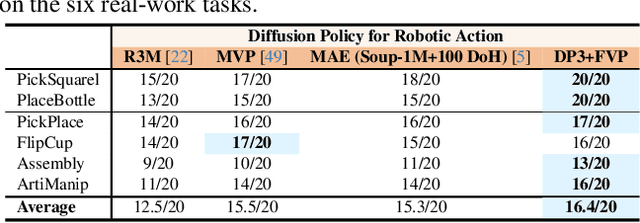
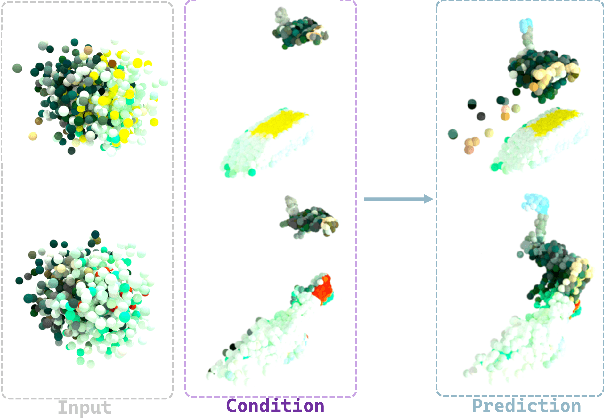
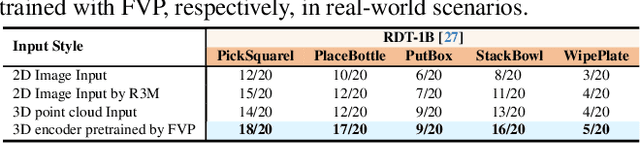
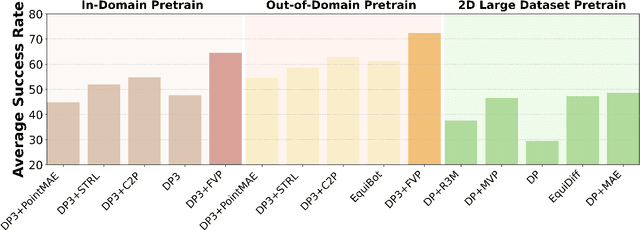
General visual representations learned from web-scale datasets for robotics have achieved great success in recent years, enabling data-efficient robot learning on manipulation tasks; yet these pre-trained representations are mostly on 2D images, neglecting the inherent 3D nature of the world. However, due to the scarcity of large-scale 3D data, it is still hard to extract a universal 3D representation from web datasets. Instead, we are seeking a general visual pre-training framework that could improve all 3D representations as an alternative. Our framework, called FVP, is a novel 4D Visual Pre-training framework for real-world robot learning. FVP frames the visual pre-training objective as a next-point-cloud-prediction problem, models the prediction model as a diffusion model, and pre-trains the model on the larger public datasets directly. Across twelve real-world manipulation tasks, FVP boosts the average success rate of 3D Diffusion Policy (DP3) for these tasks by 28%. The FVP pre-trained DP3 achieves state-of-the-art performance across imitation learning methods. Moreover, the efficacy of FVP adapts across various point cloud encoders and datasets. Finally, we apply FVP to the RDT-1B, a larger Vision-Language-Action robotic model, enhancing its performance on various robot tasks. Our project page is available at: https://4d- visual-pretraining.github.io/.
RAG in the Wild: On the (In)effectiveness of LLMs with Mixture-of-Knowledge Retrieval Augmentation
Jul 26, 2025Retrieval-augmented generation (RAG) enhances large language models (LLMs) by integrating external knowledge retrieved at inference time. While RAG demonstrates strong performance on benchmarks largely derived from general-domain corpora like Wikipedia, its effectiveness under realistic, diverse retrieval scenarios remains underexplored. We evaluated RAG systems using MassiveDS, a large-scale datastore with mixture of knowledge, and identified critical limitations: retrieval mainly benefits smaller models, rerankers add minimal value, and no single retrieval source consistently excels. Moreover, current LLMs struggle to route queries across heterogeneous knowledge sources. These findings highlight the need for adaptive retrieval strategies before deploying RAG in real-world settings. Our code and data can be found at https://github.com/ritaranx/RAG_in_the_Wild.