 Add to Chrome
 Add to Firefox
 Add to Edge
Heterogeneity in Multi-Agent Reinforcement Learning
Dec 28, 2025
Heterogeneity is a fundamental property in multi-agent reinforcement learning (MARL), which is closely related not only to the functional differences of agents, but also to policy diversity and environmental interactions. However, the MARL field currently lacks a rigorous definition and deeper understanding of heterogeneity. This paper systematically discusses heterogeneity in MARL from the perspectives of definition, quantification, and utilization. First, based on an agent-level modeling of MARL, we categorize heterogeneity into five types and provide mathematical definitions. Second, we define the concept of heterogeneity distance and propose a practical quantification method. Third, we design a heterogeneity-based multi-agent dynamic parameter sharing algorithm as an example of the application of our methodology. Case studies demonstrate that our method can effectively identify and quantify various types of agent heterogeneity. Experimental results show that the proposed algorithm, compared to other parameter sharing baselines, has better interpretability and stronger adaptability. The proposed methodology will help the MARL community gain a more comprehensive and profound understanding of heterogeneity, and further promote the development of practical algorithms.

Practical Framework for Privacy-Preserving and Byzantine-robust Federated Learning
Dec 19, 2025Federated Learning (FL) allows multiple clients to collaboratively train a model without sharing their private data. However, FL is vulnerable to Byzantine attacks, where adversaries manipulate client models to compromise the federated model, and privacy inference attacks, where adversaries exploit client models to infer private data. Existing defenses against both backdoor and privacy inference attacks introduce significant computational and communication overhead, creating a gap between theory and practice. To address this, we propose ABBR, a practical framework for Byzantine-robust and privacy-preserving FL. We are the first to utilize dimensionality reduction to speed up the private computation of complex filtering rules in privacy-preserving FL. Additionally, we analyze the accuracy loss of vector-wise filtering in low-dimensional space and introduce an adaptive tuning strategy to minimize the impact of malicious models that bypass filtering on the global model. We implement ABBR with state-of-the-art Byzantine-robust aggregation rules and evaluate it on public datasets, showing that it runs significantly faster, has minimal communication overhead, and maintains nearly the same Byzantine-resilience as the baselines.
Photonics-Enhanced Graph Convolutional Networks
Dec 17, 2025Photonics can offer a hardware-native route for machine learning (ML). However, efficient deployment of photonics-enhanced ML requires hybrid workflows that integrate optical processing with conventional CPU/GPU based neural network architectures. Here, we propose such a workflow that combines photonic positional embeddings (PEs) with advanced graph ML models. We introduce a photonics-based method that augments graph convolutional networks (GCNs) with PEs derived from light propagation on synthetic frequency lattices whose couplings match the input graph. We simulate propagation and readout to obtain internode intensity correlation matrices, which are used as PEs in GCNs to provide global structural information. Evaluated on Long Range Graph Benchmark molecular datasets, the method outperforms baseline GCNs with Laplacian based PEs, achieving $6.3\%$ lower mean absolute error for regression and $2.3\%$ higher average precision for classification tasks using a two-layer GCN as a baseline. When implemented in high repetition rate photonic hardware, correlation measurements can enable fast feature generation by bypassing digital simulation of PEs. Our results show that photonic PEs improve GCN performance and support optical acceleration of graph ML.
Towards Proactive Personalization through Profile Customization for Individual Users in Dialogues
Dec 17, 2025The deployment of Large Language Models (LLMs) in interactive systems necessitates a deep alignment with the nuanced and dynamic preferences of individual users. Current alignment techniques predominantly address universal human values or static, single-turn preferences, thereby failing to address the critical needs of long-term personalization and the initial user cold-start problem. To bridge this gap, we propose PersonalAgent, a novel user-centric lifelong agent designed to continuously infer and adapt to user preferences. PersonalAgent constructs and dynamically refines a unified user profile by decomposing dialogues into single-turn interactions, framing preference inference as a sequential decision-making task. Experiments show that PersonalAgent achieves superior performance over strong prompt-based and policy optimization baselines, not only in idealized but also in noisy conversational contexts, while preserving cross-session preference consistency. Furthermore, human evaluation confirms that PersonalAgent excels at capturing user preferences naturally and coherently. Our findings underscore the importance of lifelong personalization for developing more inclusive and adaptive conversational agents. Our code is available here.
Multi-Agent Deep Research: Training Multi-Agent Systems with M-GRPO
Nov 18, 2025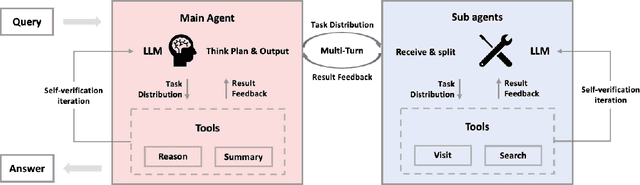
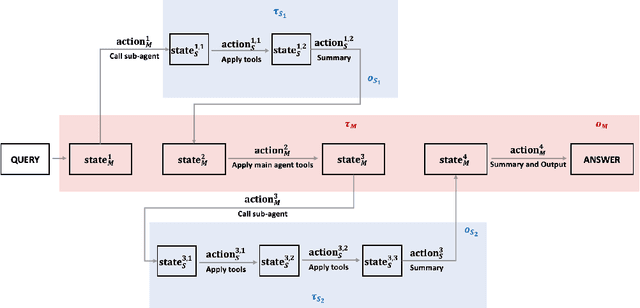
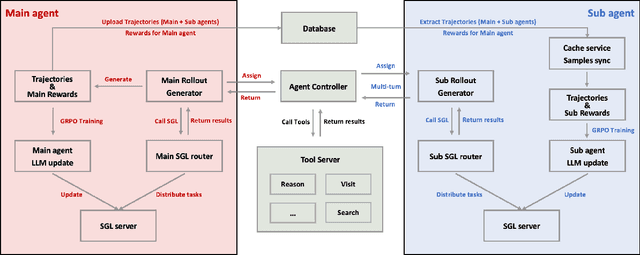
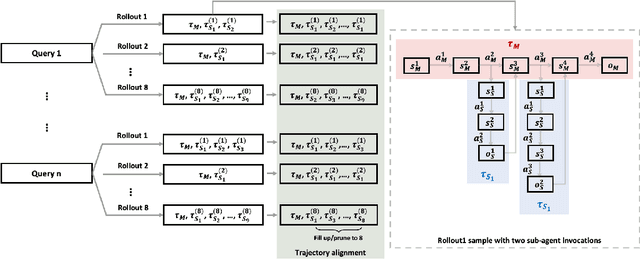
Multi-agent systems perform well on general reasoning tasks. However, the lack of training in specialized areas hinders their accuracy. Current training methods train a unified large language model (LLM) for all agents in the system. This may limit the performances due to different distributions underlying for different agents. Therefore, training multi-agent systems with distinct LLMs should be the next step to solve. However, this approach introduces optimization challenges. For example, agents operate at different frequencies, rollouts involve varying sub-agent invocations, and agents are often deployed across separate servers, disrupting end-to-end gradient flow. To address these issues, we propose M-GRPO, a hierarchical extension of Group Relative Policy Optimization designed for vertical Multi-agent systems with a main agent (planner) and multiple sub-agents (multi-turn tool executors). M-GRPO computes group-relative advantages for both main and sub-agents, maintaining hierarchical credit assignment. It also introduces a trajectory-alignment scheme that generates fixed-size batches despite variable sub-agent invocations. We deploy a decoupled training pipeline in which agents run on separate servers and exchange minimal statistics via a shared store. This enables scalable training without cross-server backpropagation. In experiments on real-world benchmarks (e.g., GAIA, XBench-DeepSearch, and WebWalkerQA), M-GRPO consistently outperforms both single-agent GRPO and multi-agent GRPO with frozen sub-agents, demonstrating improved stability and sample efficiency. These results show that aligning heterogeneous trajectories and decoupling optimization across specialized agents enhances tool-augmented reasoning tasks.
GPR: Towards a Generative Pre-trained One-Model Paradigm for Large-Scale Advertising Recommendation
Nov 13, 2025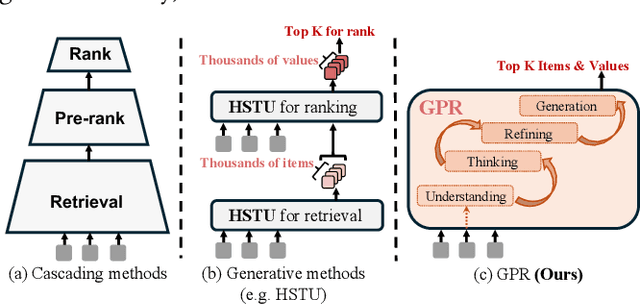
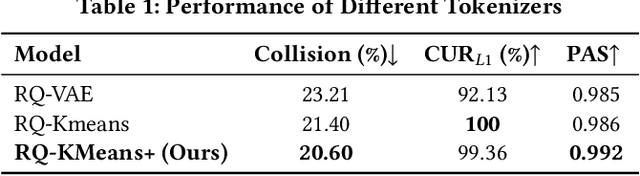
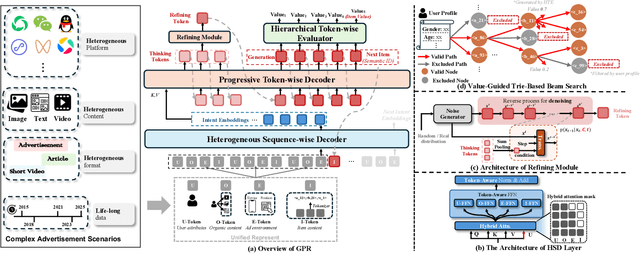
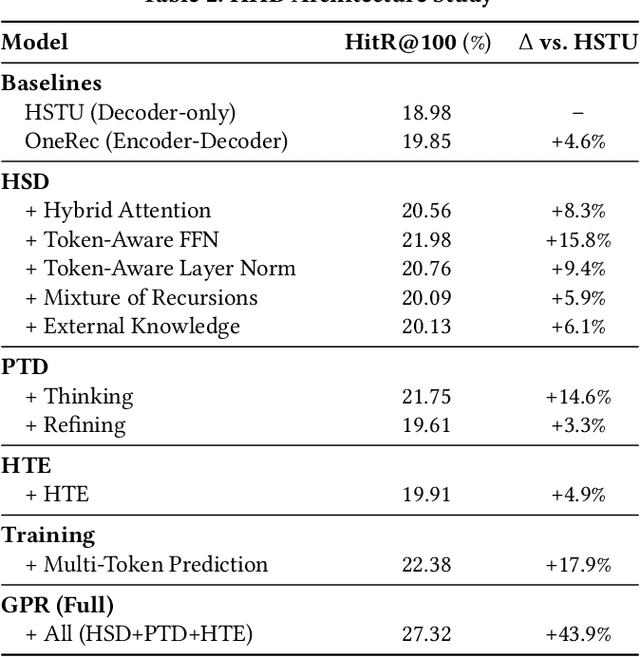
As an intelligent infrastructure connecting users with commercial content, advertising recommendation systems play a central role in information flow and value creation within the digital economy. However, existing multi-stage advertising recommendation systems suffer from objective misalignment and error propagation, making it difficult to achieve global optimality, while unified generative recommendation models still struggle to meet the demands of practical industrial applications. To address these issues, we propose GPR (Generative Pre-trained Recommender), the first one-model framework that redefines advertising recommendation as an end-to-end generative task, replacing the traditional cascading paradigm with a unified generative approach. To realize GPR, we introduce three key innovations spanning unified representation, network architecture, and training strategy. First, we design a unified input schema and tokenization method tailored to advertising scenarios, mapping both ads and organic content into a shared multi-level semantic ID space, thereby enhancing semantic alignment and modeling consistency across heterogeneous data. Second, we develop the Heterogeneous Hierarchical Decoder (HHD), a dual-decoder architecture that decouples user intent modeling from ad generation, achieving a balance between training efficiency and inference flexibility while maintaining strong modeling capacity. Finally, we propose a multi-stage joint training strategy that integrates Multi-Token Prediction (MTP), Value-Aware Fine-Tuning and the Hierarchy Enhanced Policy Optimization (HEPO) algorithm, forming a complete generative recommendation pipeline that unifies interest modeling, value alignment, and policy optimization. GPR has been fully deployed in the Tencent Weixin Channels advertising system, delivering significant improvements in key business metrics including GMV and CTCVR.
Data-Efficient RLVR via Off-Policy Influence Guidance
Oct 30, 2025Data selection is a critical aspect of Reinforcement Learning with Verifiable Rewards (RLVR) for enhancing the reasoning capabilities of large language models (LLMs). Current data selection methods are largely heuristic-based, lacking theoretical guarantees and generalizability. This work proposes a theoretically-grounded approach using influence functions to estimate the contribution of each data point to the learning objective. To overcome the prohibitive computational cost of policy rollouts required for online influence estimation, we introduce an off-policy influence estimation method that efficiently approximates data influence using pre-collected offline trajectories. Furthermore, to manage the high-dimensional gradients of LLMs, we employ sparse random projection to reduce dimensionality and improve storage and computation efficiency. Leveraging these techniques, we develop \textbf{C}urriculum \textbf{R}L with \textbf{O}ff-\textbf{P}olicy \text{I}nfluence guidance (\textbf{CROPI}), a multi-stage RL framework that iteratively selects the most influential data for the current policy. Experiments on models up to 7B parameters demonstrate that CROPI significantly accelerates training. On a 1.5B model, it achieves a 2.66x step-level acceleration while using only 10\% of the data per stage compared to full-dataset training. Our results highlight the substantial potential of influence-based data selection for efficient RLVR.
Modest-Align: Data-Efficient Alignment for Vision-Language Models
Oct 24, 2025Cross-modal alignment aims to map heterogeneous modalities into a shared latent space, as exemplified by models like CLIP, which benefit from large-scale image-text pretraining for strong recognition capabilities. However, when operating in resource-constrained settings with limited or low-quality data, these models often suffer from overconfidence and degraded performance due to the prevalence of ambiguous or weakly correlated image-text pairs. Current contrastive learning approaches, which rely on single positive pairs, further exacerbate this issue by reinforcing overconfidence on uncertain samples. To address these challenges, we propose Modest-Align, a lightweight alignment framework designed for robustness and efficiency. Our approach leverages two complementary strategies -- Random Perturbation, which introduces controlled noise to simulate uncertainty, and Embedding Smoothing, which calibrates similarity distributions in the embedding space. These mechanisms collectively reduce overconfidence and improve performance on noisy or weakly aligned samples. Extensive experiments across multiple benchmark datasets demonstrate that Modest-Align outperforms state-of-the-art methods in retrieval tasks, achieving competitive results with over 100x less training data and 600x less GPU time than CLIP. Our method offers a practical and scalable solution for cross-modal alignment in real-world, low-resource scenarios.
A Case for Declarative LLM-friendly Interfaces for Improved Efficiency of Computer-Use Agents
Oct 06, 2025Computer-use agents (CUAs) powered by large language models (LLMs) have emerged as a promising approach to automating computer tasks, yet they struggle with graphical user interfaces (GUIs). GUIs, designed for humans, force LLMs to decompose high-level goals into lengthy, error-prone sequences of fine-grained actions, resulting in low success rates and an excessive number of LLM calls. We propose Goal-Oriented Interface (GOI), a novel abstraction that transforms existing GUIs into three declarative primitives: access, state, and observation, which are better suited for LLMs. Our key idea is policy-mechanism separation: LLMs focus on high-level semantic planning (policy) while GOI handles low-level navigation and interaction (mechanism). GOI does not require modifying the application source code or relying on application programming interfaces (APIs). We evaluate GOI with Microsoft Office Suite (Word, PowerPoint, Excel) on Windows. Compared to a leading GUI-based agent baseline, GOI improves task success rates by 67% and reduces interaction steps by 43.5%. Notably, GOI completes over 61% of successful tasks with a single LLM call.
TopoSizing: An LLM-aided Framework of Topology-based Understanding and Sizing for AMS Circuits
Sep 17, 2025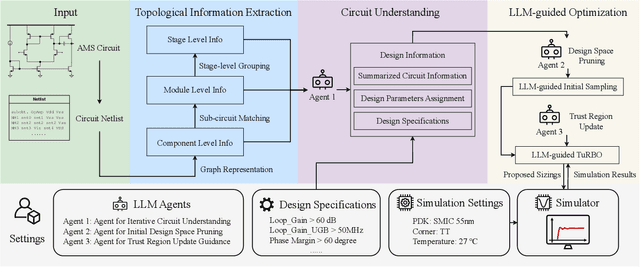
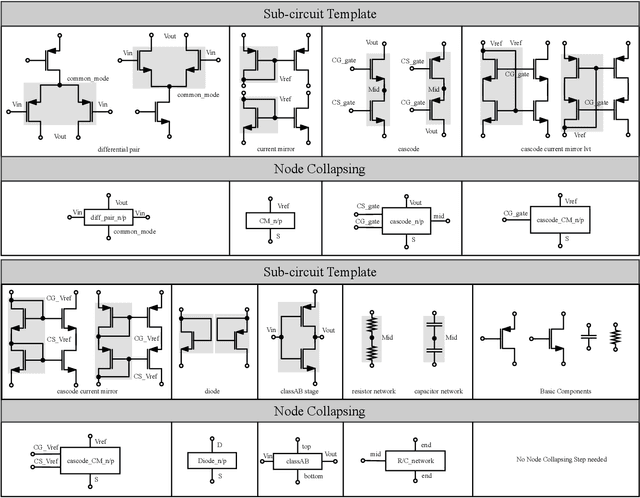
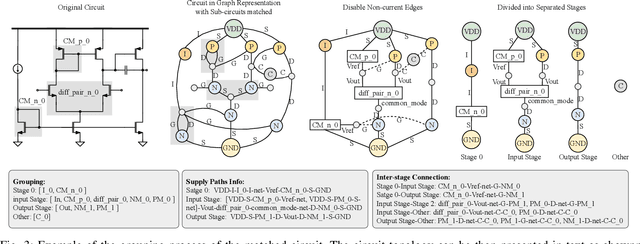
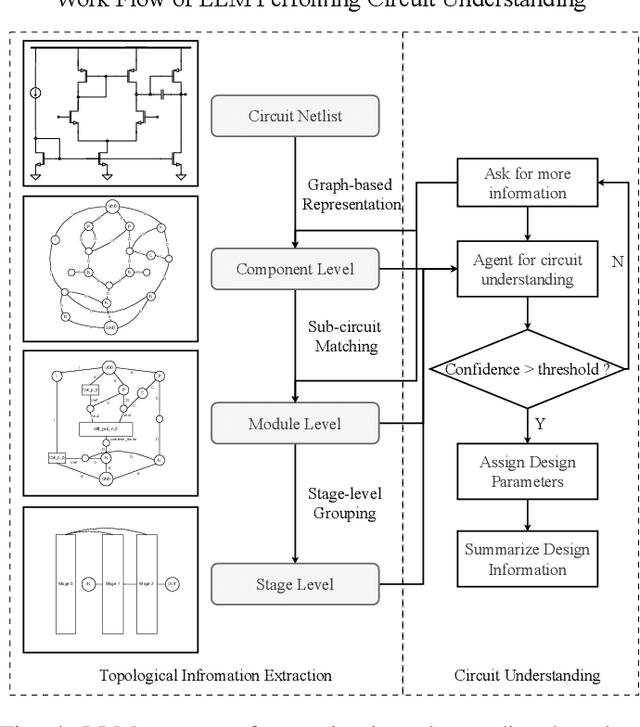
Analog and mixed-signal circuit design remains challenging due to the shortage of high-quality data and the difficulty of embedding domain knowledge into automated flows. Traditional black-box optimization achieves sampling efficiency but lacks circuit understanding, which often causes evaluations to be wasted in low-value regions of the design space. In contrast, learning-based methods embed structural knowledge but are case-specific and costly to retrain. Recent attempts with large language models show potential, yet they often rely on manual intervention, limiting generality and transparency. We propose TopoSizing, an end-to-end framework that performs robust circuit understanding directly from raw netlists and translates this knowledge into optimization gains. Our approach first applies graph algorithms to organize circuits into a hierarchical device-module-stage representation. LLM agents then execute an iterative hypothesis-verification-refinement loop with built-in consistency checks, producing explicit annotations. Verified insights are integrated into Bayesian optimization through LLM-guided initial sampling and stagnation-triggered trust-region updates, improving efficiency while preserving feasibility.