 Add to Chrome
 Add to Firefox
 Add to Edge
T-800: An 800 Hz Data Glove for Precise Hand Gesture Tracking
Mar 27, 2026
Human dexterity relies on rapid, sub-second motor adjustments, yet capturing these high-frequency dynamics remains an enduring challenge in biomechanics and robotics. Existing motion capture paradigms are compromised by a trade-off between temporal resolution and visual occlusion, failing to record the fine-grained hand motion of fast, contact-rich manipulation. Here we introduce T-800, a high-bandwidth data glove system that achieves synchronized, full-hand motion tracking at 800 Hz. By integrating a novel broadcast-based synchronization mechanism with a mechanical stress isolation architecture, our system maintains sub-frame temporal alignment across 18 distributed inertial measurement units (IMUs) during extended, vigorous movements. We demonstrate that T-800 recovers fine-grained manipulation details previously lost to temporal undersampling. Our analysis reveals that human dexterity exhibits significantly high-frequency motion energy (>100 Hz) that was fundamentally inaccessible due to the Nyquist sampling limit imposed by previous hardware constraints. To validate the system's utility for robotic manipulation, we implement a kinematic retargeting algorithm that maps T-800's high-fidelity human gestures onto dexterous robotic hand models. This demonstrates that the high-frequency motion data can be accurately translated while respecting the kinematic constraints of robotic hands, providing the rich behavioral data necessary for training robust control policies in the future.

TopoSizing: An LLM-aided Framework of Topology-based Understanding and Sizing for AMS Circuits
Sep 17, 2025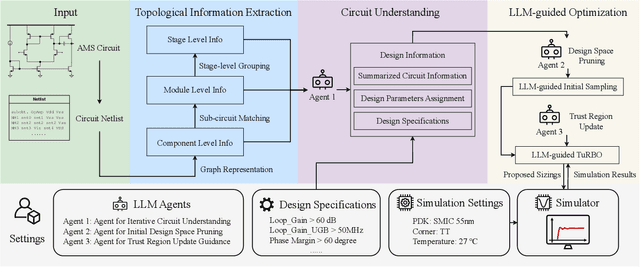
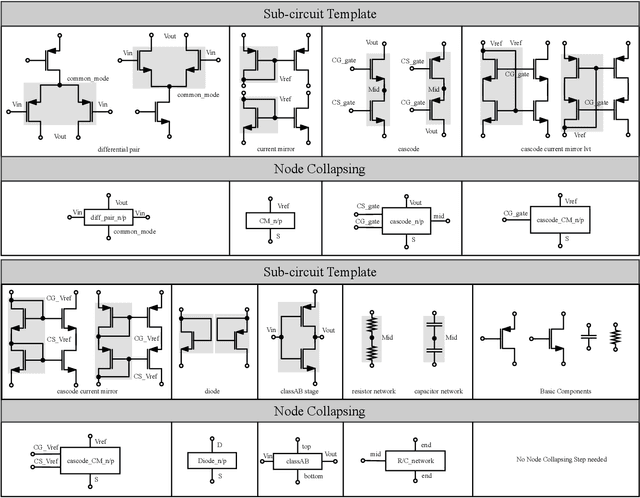
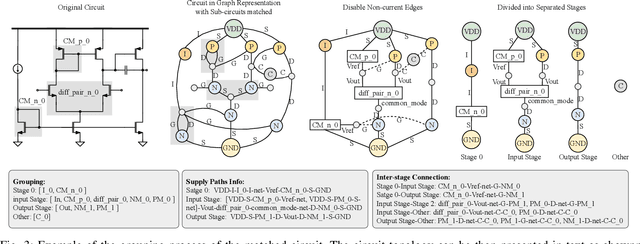
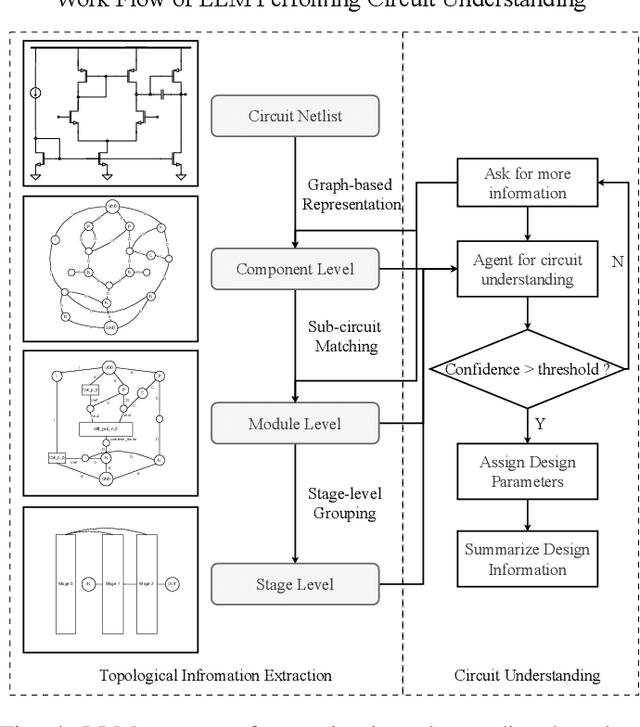
Analog and mixed-signal circuit design remains challenging due to the shortage of high-quality data and the difficulty of embedding domain knowledge into automated flows. Traditional black-box optimization achieves sampling efficiency but lacks circuit understanding, which often causes evaluations to be wasted in low-value regions of the design space. In contrast, learning-based methods embed structural knowledge but are case-specific and costly to retrain. Recent attempts with large language models show potential, yet they often rely on manual intervention, limiting generality and transparency. We propose TopoSizing, an end-to-end framework that performs robust circuit understanding directly from raw netlists and translates this knowledge into optimization gains. Our approach first applies graph algorithms to organize circuits into a hierarchical device-module-stage representation. LLM agents then execute an iterative hypothesis-verification-refinement loop with built-in consistency checks, producing explicit annotations. Verified insights are integrated into Bayesian optimization through LLM-guided initial sampling and stagnation-triggered trust-region updates, improving efficiency while preserving feasibility.
EasyACIM: An End-to-End Automated Analog CIM with Synthesizable Architecture and Agile Design Space Exploration
Apr 12, 2024Analog Computing-in-Memory (ACIM) is an emerging architecture to perform efficient AI edge computing. However, current ACIM designs usually have unscalable topology and still heavily rely on manual efforts. These drawbacks limit the ACIM application scenarios and lead to an undesired time-to-market. This work proposes an end-to-end automated ACIM based on a synthesizable architecture (EasyACIM). With a given array size and customized cell library, EasyACIM can generate layouts for ACIMs with various design specifications end-to-end automatically. Leveraging the multi-objective genetic algorithm (MOGA)-based design space explorer, EasyACIM can obtain high-quality ACIM solutions based on the proposed synthesizable architecture, targeting versatile application scenarios. The ACIM solutions given by EasyACIM have a wide design space and competitive performance compared to the state-of-the-art (SOTA) ACIMs.