 Add to Chrome
 Add to Firefox
 Add to Edge
Data-Efficient Learning of Anomalous Diffusion with Wavelet Representations: Enabling Direct Learning from Experimental Trajectories
Dec 09, 2025
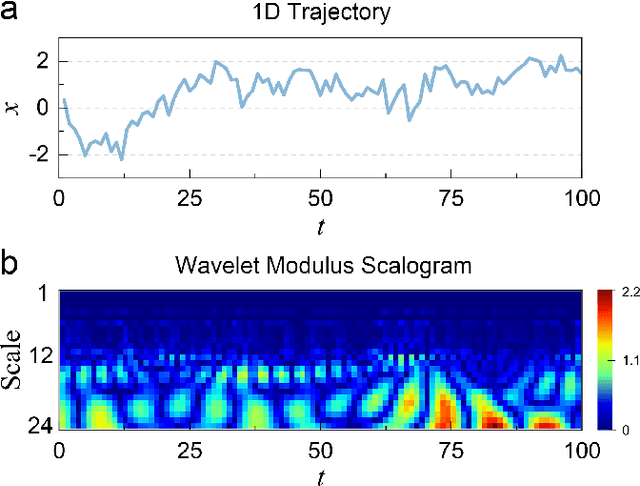
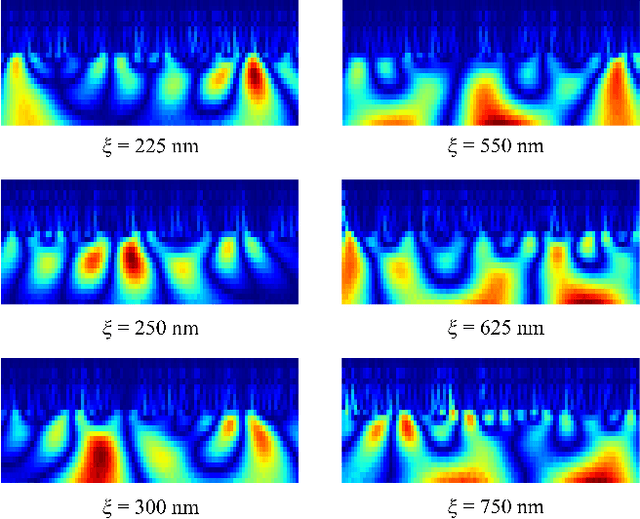
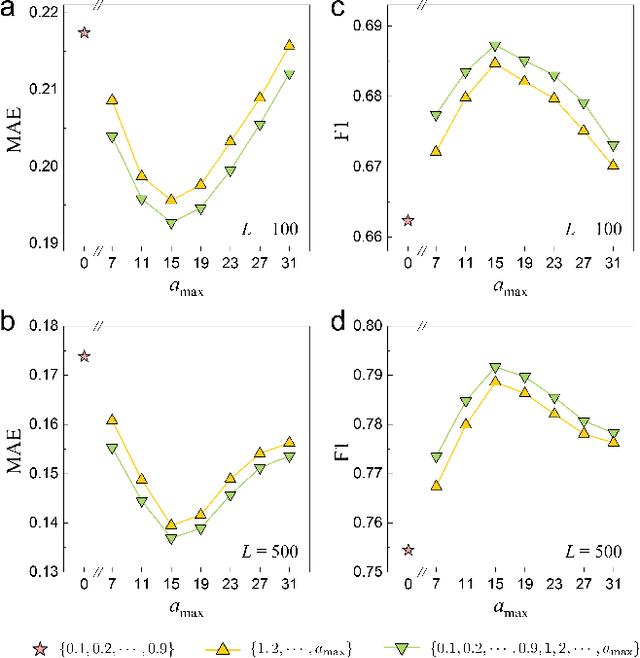
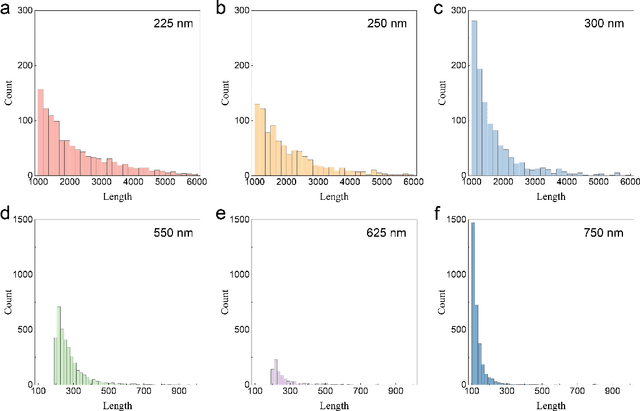
Machine learning (ML) has become a versatile tool for analyzing anomalous diffusion trajectories, yet most existing pipelines are trained on large collections of simulated data. In contrast, experimental trajectories, such as those from single-particle tracking (SPT), are typically scarce and may differ substantially from the idealized models used for simulation, leading to degradation or even breakdown of performance when ML methods are applied to real data. To address this mismatch, we introduce a wavelet-based representation of anomalous diffusion that enables data-efficient learning directly from experimental recordings. This representation is constructed by applying six complementary wavelet families to each trajectory and combining the resulting wavelet modulus scalograms. We first evaluate the wavelet representation on simulated trajectories from the andi-datasets benchmark, where it clearly outperforms both feature-based and trajectory-based methods with as few as 1000 training trajectories and still retains an advantage on large training sets. We then use this representation to learn directly from experimental SPT trajectories of fluorescent beads diffusing in F-actin networks, where the wavelet representation remains superior to existing alternatives for both diffusion-exponent regression and mesh-size classification. In particular, when predicting the diffusion exponents of experimental trajectories, a model trained on 1200 experimental tracks using the wavelet representation achieves significantly lower errors than state-of-the-art deep learning models trained purely on $10^6$ simulated trajectories. We associate this data efficiency with the emergence of distinct scale fingerprints disentangling underlying diffusion mechanisms in the wavelet spectra.

HalluClean: A Unified Framework to Combat Hallucinations in LLMs
Nov 19, 2025Large language models (LLMs) have achieved impressive performance across a wide range of natural language processing tasks, yet they often produce hallucinated content that undermines factual reliability. To address this challenge, we introduce HalluClean, a lightweight and task-agnostic framework for detecting and correcting hallucinations in LLM-generated text. HalluClean adopts a reasoning-enhanced paradigm, explicitly decomposing the process into planning, execution, and revision stages to identify and refine unsupported claims. It employs minimal task-routing prompts to enable zero-shot generalization across diverse domains, without relying on external knowledge sources or supervised detectors. We conduct extensive evaluations on five representative tasks-question answering, dialogue, summarization, math word problems, and contradiction detection. Experimental results show that HalluClean significantly improves factual consistency and outperforms competitive baselines, demonstrating its potential to enhance the trustworthiness of LLM outputs in real-world applications.
Infer As You Train: A Symmetric Paradigm of Masked Generative for Click-Through Rate Prediction
Nov 18, 2025Generative models are increasingly being explored in click-through rate (CTR) prediction field to overcome the limitations of the conventional discriminative paradigm, which rely on a simple binary classification objective. However, existing generative models typically confine the generative paradigm to the training phase, primarily for representation learning. During online inference, they revert to a standard discriminative paradigm, failing to leverage their powerful generative capabilities to further improve prediction accuracy. This fundamental asymmetry between the training and inference phases prevents the generative paradigm from realizing its full potential. To address this limitation, we propose the Symmetric Masked Generative Paradigm for CTR prediction (SGCTR), a novel framework that establishes symmetry between the training and inference phases. Specifically, after acquiring generative capabilities by learning feature dependencies during training, SGCTR applies the generative capabilities during online inference to iteratively redefine the features of input samples, which mitigates the impact of noisy features and enhances prediction accuracy. Extensive experiments validate the superiority of SGCTR, demonstrating that applying the generative paradigm symmetrically across both training and inference significantly unlocks its power in CTR prediction.
Efficient and Effective In-context Demonstration Selection with Coreset
Nov 12, 2025In-context learning (ICL) has emerged as a powerful paradigm for Large Visual Language Models (LVLMs), enabling them to leverage a few examples directly from input contexts. However, the effectiveness of this approach is heavily reliant on the selection of demonstrations, a process that is NP-hard. Traditional strategies, including random, similarity-based sampling and infoscore-based sampling, often lead to inefficiencies or suboptimal performance, struggling to balance both efficiency and effectiveness in demonstration selection. In this paper, we propose a novel demonstration selection framework named Coreset-based Dual Retrieval (CoDR). We show that samples within a diverse subset achieve a higher expected mutual information. To implement this, we introduce a cluster-pruning method to construct a diverse coreset that aligns more effectively with the query while maintaining diversity. Additionally, we develop a dual retrieval mechanism that enhances the selection process by achieving global demonstration selection while preserving efficiency. Experimental results demonstrate that our method significantly improves the ICL performance compared to the existing strategies, providing a robust solution for effective and efficient demonstration selection.
SAFENLIDB: A Privacy-Preserving Safety Alignment Framework for LLM-based Natural Language Database Interfaces
Nov 11, 2025The rapid advancement of Large Language Models (LLMs) has driven significant progress in Natural Language Interface to Database (NLIDB). However, the widespread adoption of LLMs has raised critical privacy and security concerns. During interactions, LLMs may unintentionally expose confidential database contents or be manipulated by attackers to exfiltrate data through seemingly benign queries. While current efforts typically rely on rule-based heuristics or LLM agents to mitigate this leakage risk, these methods still struggle with complex inference-based attacks, suffer from high false positive rates, and often compromise the reliability of SQL queries. To address these challenges, we propose \textsc{SafeNlidb}, a novel privacy-security alignment framework for LLM-based NLIDB. The framework features an automated pipeline that generates hybrid chain-of-thought interaction data from scratch, seamlessly combining implicit security reasoning with SQL generation. Additionally, we introduce reasoning warm-up and alternating preference optimization to overcome the multi-preference oscillations of Direct Preference Optimization (DPO), enabling LLMs to produce security-aware SQL through fine-grained reasoning without the need for human-annotated preference data. Extensive experiments demonstrate that our method outperforms both larger-scale LLMs and ideal-setting baselines, achieving significant security improvements while preserving high utility. WARNING: This work may contain content that is offensive and harmful!
Think Consistently, Reason Efficiently: Energy-Based Calibration for Implicit Chain-of-Thought
Nov 10, 2025Large Language Models (LLMs) have demonstrated strong reasoning capabilities through \emph{Chain-of-Thought} (CoT) prompting, which enables step-by-step intermediate reasoning. However, explicit CoT methods rely on discrete token-level reasoning processes that are prone to error propagation and limited by vocabulary expressiveness, often resulting in rigid and inconsistent reasoning trajectories. Recent research has explored implicit or continuous reasoning in latent spaces, allowing models to perform internal reasoning before generating explicit output. Although such approaches alleviate some limitations of discrete CoT, they generally lack explicit mechanisms to enforce consistency among reasoning steps, leading to divergent reasoning paths and unstable outcomes. To address this issue, we propose EBM-CoT, an Energy-Based Chain-of-Thought Calibration framework that refines latent thought representations through an energy-based model (EBM). Our method dynamically adjusts latent reasoning trajectories toward lower-energy, high-consistency regions in the embedding space, improving both reasoning accuracy and consistency without modifying the base language model. Extensive experiments across mathematical, commonsense, and symbolic reasoning benchmarks demonstrate that the proposed framework significantly enhances the consistency and efficiency of multi-step reasoning in LLMs.
RPTS: Tree-Structured Reasoning Process Scoring for Faithful Multimodal Evaluation
Nov 10, 2025Large Vision-Language Models (LVLMs) excel in multimodal reasoning and have shown impressive performance on various multimodal benchmarks. However, most of these benchmarks evaluate models primarily through multiple-choice or short-answer formats, which do not take the reasoning process into account. Although some benchmarks assess the reasoning process, their methods are often overly simplistic and only examine reasoning when answers are incorrect. This approach overlooks scenarios where flawed reasoning leads to correct answers. In addition, these benchmarks do not consider the impact of intermodal relationships on reasoning. To address this issue, we propose the Reasoning Process Tree Score (RPTS), a tree structure-based metric to assess reasoning processes. Specifically, we organize the reasoning steps into a reasoning tree and leverage its hierarchical information to assign weighted faithfulness scores to each reasoning step. By dynamically adjusting these weights, RPTS not only evaluates the overall correctness of the reasoning, but also pinpoints where the model fails in the reasoning. To validate RPTS in real-world multimodal scenarios, we construct a new benchmark, RPTS-Eval, comprising 374 images and 390 reasoning instances. Each instance includes reliable visual-textual clues that serve as leaf nodes of the reasoning tree. Furthermore, we define three types of intermodal relationships to investigate how intermodal interactions influence the reasoning process. We evaluated representative LVLMs (e.g., GPT4o, Llava-Next), uncovering their limitations in multimodal reasoning and highlighting the differences between open-source and closed-source commercial LVLMs. We believe that this benchmark will contribute to the advancement of research in the field of multimodal reasoning.
MOSS: Efficient and Accurate FP8 LLM Training with Microscaling and Automatic Scaling
Nov 08, 2025Training large language models with FP8 formats offers significant efficiency gains. However, the reduced numerical precision of FP8 poses challenges for stable and accurate training. Current frameworks preserve training performance using mixed-granularity quantization, i.e., applying per-group quantization for activations and per-tensor/block quantization for weights. While effective, per-group quantization requires scaling along the inner dimension of matrix multiplication, introducing additional dequantization overhead. Moreover, these frameworks often rely on just-in-time scaling to dynamically adjust scaling factors based on the current data distribution. However, this online quantization is inefficient for FP8 training, as it involves multiple memory reads and writes that negate the performance benefits of FP8. To overcome these limitations, we propose MOSS, a novel FP8 training framework that ensures both efficiency and numerical stability. MOSS introduces two key innovations: (1) a two-level microscaling strategy for quantizing sensitive activations, which balances precision and dequantization cost by combining a high-precision global scale with compact, power-of-two local scales; and (2) automatic scaling for weights in linear layers, which eliminates the need for costly max-reduction operations by predicting and adjusting scaling factors during training. Leveraging these techniques, MOSS enables efficient FP8 training of a 7B parameter model, achieving performance comparable to the BF16 baseline while achieving up to 34% higher training throughput.
Kimi Linear: An Expressive, Efficient Attention Architecture
Oct 30, 2025We introduce Kimi Linear, a hybrid linear attention architecture that, for the first time, outperforms full attention under fair comparisons across various scenarios -- including short-context, long-context, and reinforcement learning (RL) scaling regimes. At its core lies Kimi Delta Attention (KDA), an expressive linear attention module that extends Gated DeltaNet with a finer-grained gating mechanism, enabling more effective use of limited finite-state RNN memory. Our bespoke chunkwise algorithm achieves high hardware efficiency through a specialized variant of the Diagonal-Plus-Low-Rank (DPLR) transition matrices, which substantially reduces computation compared to the general DPLR formulation while remaining more consistent with the classical delta rule. We pretrain a Kimi Linear model with 3B activated parameters and 48B total parameters, based on a layerwise hybrid of KDA and Multi-Head Latent Attention (MLA). Our experiments show that with an identical training recipe, Kimi Linear outperforms full MLA with a sizeable margin across all evaluated tasks, while reducing KV cache usage by up to 75% and achieving up to 6 times decoding throughput for a 1M context. These results demonstrate that Kimi Linear can be a drop-in replacement for full attention architectures with superior performance and efficiency, including tasks with longer input and output lengths. To support further research, we open-source the KDA kernel and vLLM implementations, and release the pre-trained and instruction-tuned model checkpoints.
DARTS: A Drone-Based AI-Powered Real-Time Traffic Incident Detection System
Oct 29, 2025Rapid and reliable incident detection is critical for reducing crash-related fatalities, injuries, and congestion. However, conventional methods, such as closed-circuit television, dashcam footage, and sensor-based detection, separate detection from verification, suffer from limited flexibility, and require dense infrastructure or high penetration rates, restricting adaptability and scalability to shifting incident hotspots. To overcome these challenges, we developed DARTS, a drone-based, AI-powered real-time traffic incident detection system. DARTS integrates drones' high mobility and aerial perspective for adaptive surveillance, thermal imaging for better low-visibility performance and privacy protection, and a lightweight deep learning framework for real-time vehicle trajectory extraction and incident detection. The system achieved 99% detection accuracy on a self-collected dataset and supports simultaneous online visual verification, severity assessment, and incident-induced congestion propagation monitoring via a web-based interface. In a field test on Interstate 75 in Florida, DARTS detected and verified a rear-end collision 12 minutes earlier than the local transportation management center and monitored incident-induced congestion propagation, suggesting potential to support faster emergency response and enable proactive traffic control to reduce congestion and secondary crash risk. Crucially, DARTS's flexible deployment architecture reduces dependence on frequent physical patrols, indicating potential scalability and cost-effectiveness for use in remote areas and resource-constrained settings. This study presents a promising step toward a more flexible and integrated real-time traffic incident detection system, with significant implications for the operational efficiency and responsiveness of modern transportation management.