 Add to Chrome
 Add to Firefox
 Add to Edge
Selective Test-Time Compute Scaling for Click-Through Rate Prediction via Uncertainty-Triggered Feature Path Exploration
May 24, 2026
Scaling test-time compute has proven highly effective for language models, yet this opportunity remains largely unexplored for industrial Click-Through Rate (CTR) prediction. CTR models suffer from a fundamental asymmetry: feature combinations well-represented in training yield confident predictions, while sparsely observed ones produce unreliable outputs. Existing training-phase solutions such as adaptive gating learn a fixed selection function subject to the same sparsity, offering no per-instance recourse at deployment.We propose UTTSI (Uncertainty-Triggered Test-Time Selective Inference), a training-free model-agnostic framework that scales inference depth proportionally to per-instance uncertainty. A dual-signal estimator combining model logit confidence with a data-level frequency prior distinguishes epistemic uncertainty from aleatoric ambiguity. Every instance undergoes adaptive feature filtering to remove unreliable embeddings; uncertain instances additionally receive stochastic feature-path explorations whose predictions are aggregated via consistency-weighted ensembling. Confident instances bypass exploration entirely, keeping average overhead at approximately $2.8\times$ base model cost with worst-case latency unchanged.Experiments on four datasets with three backbone architectures demonstrate consistent, statistically significant gains over all training-phase baselines. A seven-day online A/B test further confirms a 5.3% relative CTR gain ($p < 0.01$), establishing selective test-time compute allocation as a practical complement to training-phase advances for CTR prediction.

Self-Balancing Gradient Allocation for Heterogeneity-Aware Feature Generation in Click-Through Rate Prediction
May 24, 2026Generative pre-training via discrete diffusion provides dense reconstruction supervision across all feature fields simultaneously, mitigating representation collapse from data sparsity in CTR prediction. However, all existing generative CTR methods share a fundamental limitation: the reconstruction objective assigns equal training weight to every feature field, ignoring the profound heterogeneity of reconstruction difficulty across high-cardinality ID fields, sparse categorical attributes, numerical values, and behavioral sequences. This causes easy fields to dominate training gradients while the hardest but most informative fields remain chronically underfit, a problem we term the generative difficulty imbalance.We propose HeteGenCTR, which resolves this imbalance through per-field learnable difficulty parameters jointly trained with the denoising network. This unified signal drives two coordinated components without additional hyperparameters: a self-balancing loss that automatically reallocates gradient budget toward harder fields with a provably stable equilibrium, and a difficulty-guided attention mechanism that suppresses the influence of already-converged easy fields while amplifying cross-field information flow toward hard fields. Both components share the same learned signal and remain mutually consistent throughout training. Experiments on five CTR benchmarks and a seven-day online A/B test demonstrate consistent, statistically significant improvements over state-of-the-art baselines, with disproportionate gains for cold-start and long-tail users.
Infer As You Train: A Symmetric Paradigm of Masked Generative for Click-Through Rate Prediction
Nov 18, 2025Generative models are increasingly being explored in click-through rate (CTR) prediction field to overcome the limitations of the conventional discriminative paradigm, which rely on a simple binary classification objective. However, existing generative models typically confine the generative paradigm to the training phase, primarily for representation learning. During online inference, they revert to a standard discriminative paradigm, failing to leverage their powerful generative capabilities to further improve prediction accuracy. This fundamental asymmetry between the training and inference phases prevents the generative paradigm from realizing its full potential. To address this limitation, we propose the Symmetric Masked Generative Paradigm for CTR prediction (SGCTR), a novel framework that establishes symmetry between the training and inference phases. Specifically, after acquiring generative capabilities by learning feature dependencies during training, SGCTR applies the generative capabilities during online inference to iteratively redefine the features of input samples, which mitigates the impact of noisy features and enhances prediction accuracy. Extensive experiments validate the superiority of SGCTR, demonstrating that applying the generative paradigm symmetrically across both training and inference significantly unlocks its power in CTR prediction.
Global-Distribution Aware Scenario-Specific Variational Representation Learning Framework
Aug 20, 2025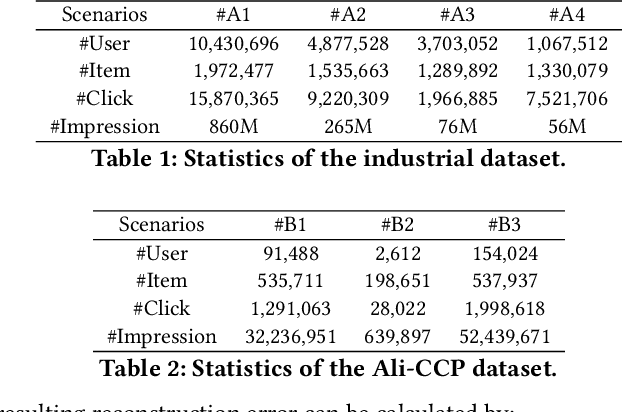
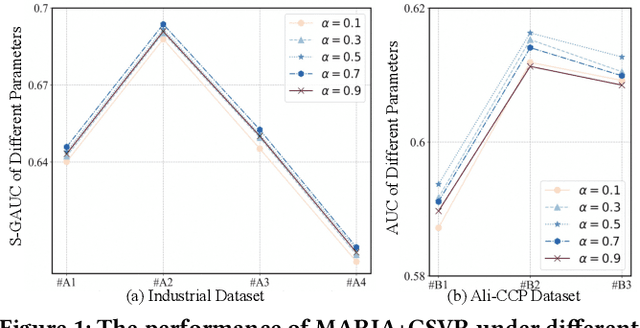
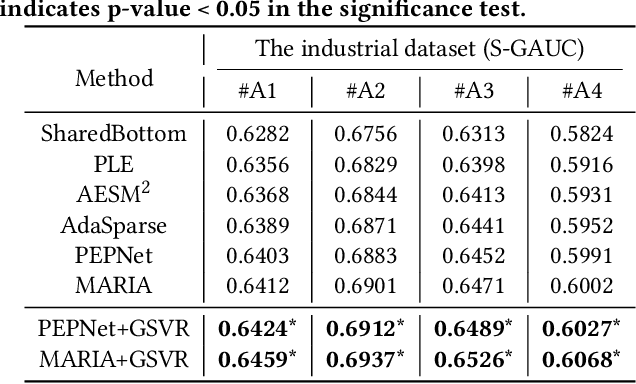
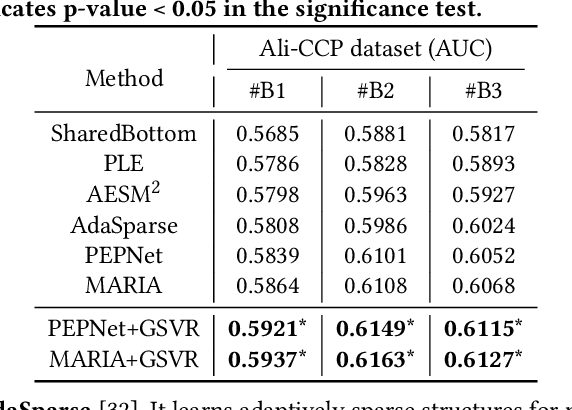
With the emergence of e-commerce, the recommendations provided by commercial platforms must adapt to diverse scenarios to accommodate users' varying shopping preferences. Current methods typically use a unified framework to offer personalized recommendations for different scenarios. However, they often employ shared bottom representations, which partially hinders the model's capacity to capture scenario uniqueness. Ideally, users and items should exhibit specific characteristics in different scenarios, prompting the need to learn scenario-specific representations to differentiate scenarios. Yet, variations in user and item interactions across scenarios lead to data sparsity issues, impeding the acquisition of scenario-specific representations. To learn robust scenario-specific representations, we introduce a Global-Distribution Aware Scenario-Specific Variational Representation Learning Framework (GSVR) that can be directly applied to existing multi-scenario methods. Specifically, considering the uncertainty stemming from limited samples, our approach employs a probabilistic model to generate scenario-specific distributions for each user and item in each scenario, estimated through variational inference (VI). Additionally, we introduce the global knowledge-aware multinomial distributions as prior knowledge to regulate the learning of the posterior user and item distributions, ensuring similarities among distributions for users with akin interests and items with similar side information. This mitigates the risk of users or items with fewer records being overwhelmed in sparse scenarios. Extensive experimental results affirm the efficacy of GSVR in assisting existing multi-scenario recommendation methods in learning more robust representations.
DGenCTR: Towards a Universal Generative Paradigm for Click-Through Rate Prediction via Discrete Diffusion
Aug 20, 2025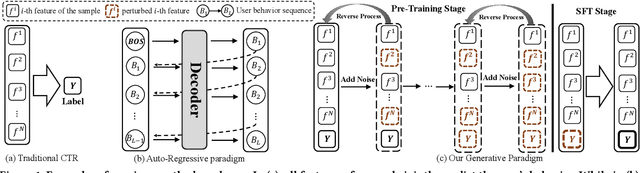
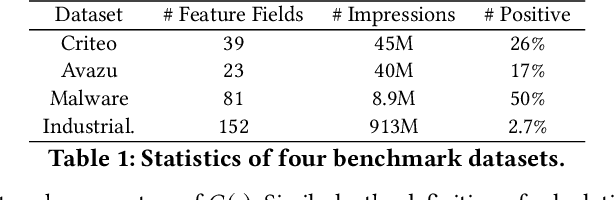
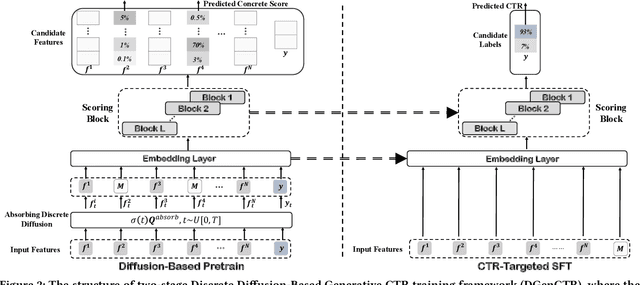
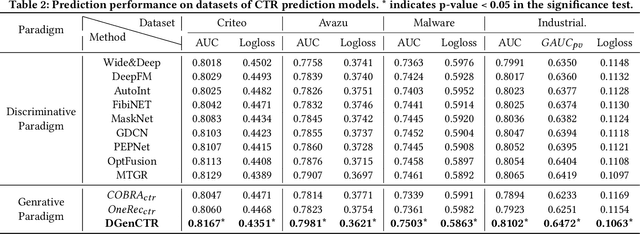
Recent advances in generative models have inspired the field of recommender systems to explore generative approaches, but most existing research focuses on sequence generation, a paradigm ill-suited for click-through rate (CTR) prediction. CTR models critically depend on a large number of cross-features between the target item and the user to estimate the probability of clicking on the item, and discarding these cross-features will significantly impair model performance. Therefore, to harness the ability of generative models to understand data distributions and thereby alleviate the constraints of traditional discriminative models in label-scarce space, diverging from the item-generation paradigm of sequence generation methods, we propose a novel sample-level generation paradigm specifically designed for the CTR task: a two-stage Discrete Diffusion-Based Generative CTR training framework (DGenCTR). This two-stage framework comprises a diffusion-based generative pre-training stage and a CTR-targeted supervised fine-tuning stage for CTR. Finally, extensive offline experiments and online A/B testing conclusively validate the effectiveness of our framework.
Distribution-Guided Auto-Encoder for User Multimodal Interest Cross Fusion
Aug 20, 2025Traditional recommendation methods rely on correlating the embedding vectors of item IDs to capture implicit collaborative filtering signals to model the user's interest in the target item. Consequently, traditional ID-based methods often encounter data sparsity problems stemming from the sparse nature of ID features. To alleviate the problem of item ID sparsity, recommendation models incorporate multimodal item information to enhance recommendation accuracy. However, existing multimodal recommendation methods typically employ early fusion approaches, which focus primarily on combining text and image features, while neglecting the contextual influence of user behavior sequences. This oversight prevents dynamic adaptation of multimodal interest representations based on behavioral patterns, consequently restricting the model's capacity to effectively capture user multimodal interests. Therefore, this paper proposes the Distribution-Guided Multimodal-Interest Auto-Encoder (DMAE), which achieves the cross fusion of user multimodal interest at the behavioral level.Ultimately, extensive experiments demonstrate the superiority of DMAE.