 Add to Chrome
 Add to Firefox
 Add to Edge
SAFENLIDB: A Privacy-Preserving Safety Alignment Framework for LLM-based Natural Language Database Interfaces
Nov 11, 2025
The rapid advancement of Large Language Models (LLMs) has driven significant progress in Natural Language Interface to Database (NLIDB). However, the widespread adoption of LLMs has raised critical privacy and security concerns. During interactions, LLMs may unintentionally expose confidential database contents or be manipulated by attackers to exfiltrate data through seemingly benign queries. While current efforts typically rely on rule-based heuristics or LLM agents to mitigate this leakage risk, these methods still struggle with complex inference-based attacks, suffer from high false positive rates, and often compromise the reliability of SQL queries. To address these challenges, we propose \textsc{SafeNlidb}, a novel privacy-security alignment framework for LLM-based NLIDB. The framework features an automated pipeline that generates hybrid chain-of-thought interaction data from scratch, seamlessly combining implicit security reasoning with SQL generation. Additionally, we introduce reasoning warm-up and alternating preference optimization to overcome the multi-preference oscillations of Direct Preference Optimization (DPO), enabling LLMs to produce security-aware SQL through fine-grained reasoning without the need for human-annotated preference data. Extensive experiments demonstrate that our method outperforms both larger-scale LLMs and ideal-setting baselines, achieving significant security improvements while preserving high utility. WARNING: This work may contain content that is offensive and harmful!

Towards reliable head and neck cancers locoregional recurrence prediction using delta-radiomics and learning with rejection option
Aug 30, 2022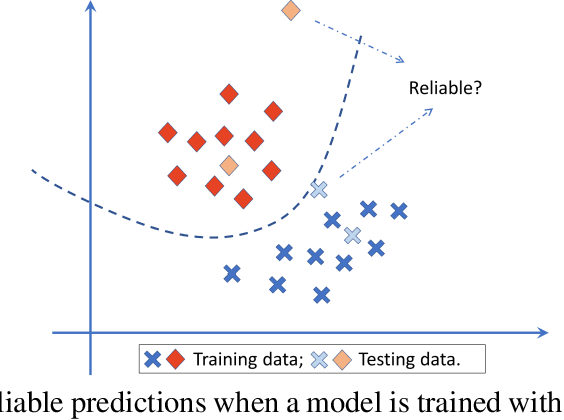
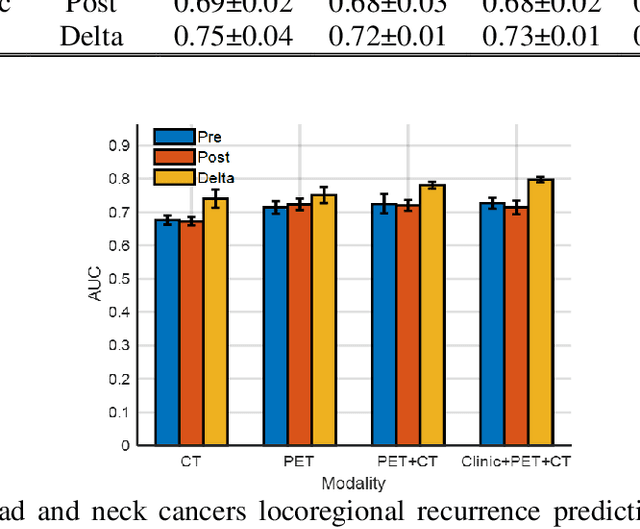
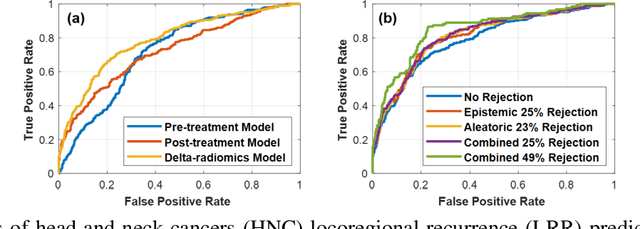
A reliable locoregional recurrence (LRR) prediction model is important for the personalized management of head and neck cancers (HNC) patients. This work aims to develop a delta-radiomics feature-based multi-classifier, multi-objective, and multi-modality (Delta-mCOM) model for post-treatment HNC LRR prediction and adopting a learning with rejection option (LRO) strategy to boost the prediction reliability by rejecting samples with high prediction uncertainties. In this retrospective study, we collected PET/CT image and clinical data from 224 HNC patients. We calculated the differences between radiomics features extracted from PET/CT images acquired before and after radiotherapy as the input features. Using clinical parameters, PET and CT radiomics features, we built and optimized three separate single-modality models. We used multiple classifiers for model construction and employed sensitivity and specificity simultaneously as the training objectives. For testing samples, we fused the output probabilities from all these single-modality models to obtain the final output probabilities of the Delta-mCOM model. In the LRO strategy, we estimated the epistemic and aleatoric uncertainties when predicting with Delta-mCOM model and identified patients associated with prediction of higher reliability. Predictions with higher epistemic uncertainty or higher aleatoric uncertainty than given thresholds were deemed unreliable, and they were rejected before providing a final prediction. Different thresholds corresponding to different low-reliability prediction rejection ratios were applied. The inclusion of the delta-radiomics feature improved the accuracy of HNC LRR prediction, and the proposed Delta-mCOM model can give more reliable predictions by rejecting predictions for samples of high uncertainty using the LRO strategy.